
A deep pantry fails in a boring way: not because the food went bad, but because nobody could reach it, rotate it, or trust the shelf under it. Get shelves right and rotation becomes a habit you barely notice. Get them wrong — overloaded, too deep, in the wrong room — and food quietly expires in the back while new cans pile up in front.
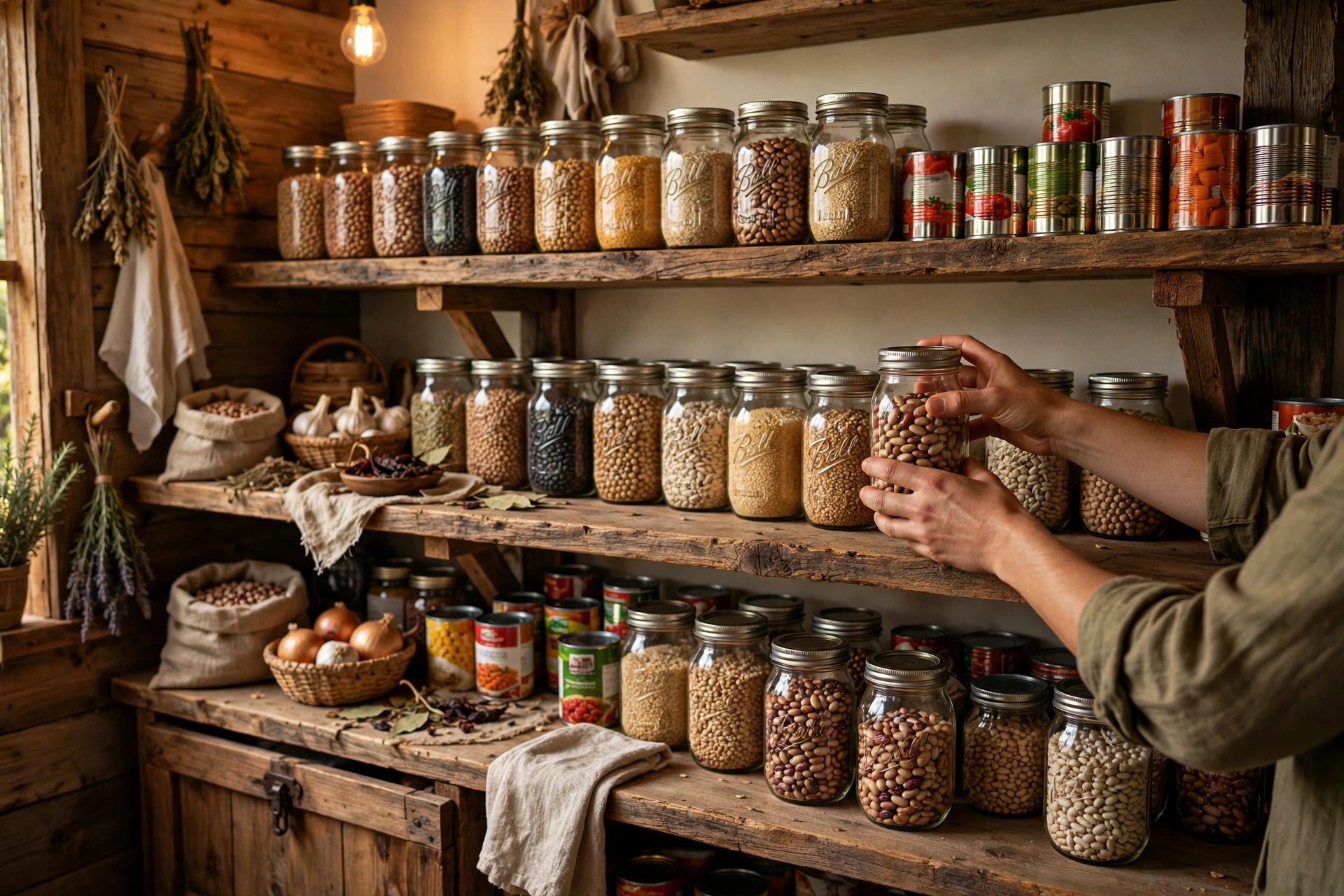
Wire shelves vs solid shelves
Wire shelving — the chrome or epoxy-coated steel kind — is cheap, adjustable, and lets air move around your food, which matters in a basement. Its weakness is small items: spice jars and pouch meals tip and fall through the gaps; a liner or shallow bins fixes that. Solid shelves — wood, metal, or heavy-duty plastic — hold everything flat and wipe clean after a leak, but cheap particleboard sags under canned goods and swells if it gets wet. Our usual answer: wire for most of the room, one solid run for small jars. Buy shelves rated for real weight, and anchor tall units to the wall.
What the shelf has to hold: canned goods are heavy
Plan by weight, not by how tidy things look empty. A case of canned vegetables runs roughly 20 to 25 pounds. A gallon of water weighs about 8.3 pounds, so six jugs in a row are 50 pounds in one place. A full 5-gallon bucket of rice weighs around 35 pounds. Ratings are printed per shelf, spread evenly — a unit rated at 350 pounds per shelf handles pantry loads easily, while light closet shelving rated at 50 will bow under two cases of cans. Two rules: the heaviest things go on the bottom shelf or the floor inside the frame, never up high; and choosing between two units, the higher per-shelf rating wins.
How deep should shelves be?
A standard can is about 4 inches across; a 12-inch shelf holds two rows of cans with room to work, a 16-inch shelf holds three, and deeper shelves swallow buckets two deep. Deeper is not better: past about 18 inches you get a back row you must unload the front to reach — food you’ll find after its date, not before. Match depth to the job: 12 to 16 inches for cans and jars you rotate weekly, 18 where buckets live.
Rotation racks and first-in, first-out
Rotation has a plain name in every warehouse: first in, first out. The oldest food gets eaten first; new food goes behind it, never in front. Gravity-fed can racks — slanted shelves where you drop new cans in the top and they roll to the front — do this automatically, and for a household that eats a lot of the same canned goods they earn their space. They’re a poor fit for odd sizes, jars, and one-time buys. Most deep pantries end up mixed: racks for high-turnover cans, plain shelves for the rest, one rule on both — load from the back or the top, take from the front.
Where the shelves should live
Food keeps best somewhere cool, dark, and dry, and steady beats perfect: a basement corner that holds one temperature all year does less damage than a garage that swings with the seasons. Keep food off bare concrete where you can — concrete wicks moisture and cold into whatever touches it, and buckets sitting straight on a slab grow mold underneath. Shelves solve most of this by lifting everything onto the frame; for floor-level buckets, a pallet underneath is enough. Keep shelves away from water heaters, laundry chemicals, and any wall with a history of leaks. If water has ever come in, food starts one shelf up.
Laying the room out for rotation
Group by food, not by shopping trip: all the canned tomatoes in one run, all the soups in another, so one glance tells you what you’re low on. Labels face out. Write each can’s use-by month and year on top in thick marker; the dates printed on rims are small and always facing the wall when you need them. Leave one short section by the door — the use-first shelf — and move anything within a few months of its date there; plan meals off it first. And leave a walkway you can use carrying a case of cans: a room you can’t move in is a room you won’t rotate.
Common mistakes
- Loading by looks. Heavy buckets on a top shelf because they fit — the most dangerous arrangement in the room.
- Buying shelves before measuring the food. Kit pails and 5-gallon buckets set the height and depth they need; measure them first.
- One deep shelf against the back wall. The back third becomes a time capsule. Only buckets go there, two deep at most.
- Storing by purchase date. Rotation runs on use-by dates — two identical cans bought the same day can carry dates a year apart.
- No room left to rotate. A shelf packed to the stops can’t take new stock behind the old. Leave a hand’s width of slack on high-turnover runs.
- Forgetting the water. The heaviest thing in the room goes low, on the strongest shelf or the floor — never above the food.
Where to go next
Work out how much food and water your household needs with the Food & Water Planner, then stock the shelves from the pantry hub and the harvest hub. Buying a first kit? The starter kit reviews compare three kits side by side.