
A useful pantry is not a museum. Start with food your household already eats, then add specialized products where they make sense. This page is the slow way to build a pantry — a little at a time, on a normal grocery budget, with nothing wasted. It works whether you’re covering a three-day power outage or building up to a month or more.
Cover a few ordinary days
Start with three days. Not three days of special survival food — three days of the meals your household already eats. Look at a normal week of dinners and breakfasts and ask which of them can sit on a shelf: pasta and jarred sauce, rice and beans, canned chili, tuna, peanut butter, oatmeal, soup. If your family eats it on a regular Tuesday, it belongs in the pantry.
The habit that builds a pantry without hurting is buy one extra. One extra can of chili, one extra bag of rice, one extra jar of peanut butter on each grocery trip. It costs a few dollars at a time, it never feels like a big purchase, and in a couple of months you’ve quietly built two weeks of food.
Once three days feels easy, stretch the same list to two weeks, then a month. Same foods, just more of them. Ordinary food has three advantages no kit can match: you already know how to cook it, your family will actually eat it, and you can buy it on sale at the store you already shop at.
Plan water at the same time
Food is only half the plan. Almost every shelf-stable meal needs water — rice and beans soak it up, freeze-dried meals need it before they’re food at all, and even a can of soup goes down better with something to drink beside it.
The rule of thumb is one gallon per person per day, for drinking and cooking together. A family of four covering two weeks needs about 56 gallons — more than most people guess, which is why water deserves its own corner of the plan from day one. Our Food & Water Planner works out the exact numbers for your household.
You don’t have to store every drop. A good filter turns other sources into drinking water and stretches what you store — our water filter comparison covers the countertop and portable options and what each one actually removes. And remember the third leg: cooking fuel. Dry food you can’t cook is only half stored, so keep a way to boil water that doesn’t depend on your stove working.
Try before buying deep
The most expensive pantry mistake is a case of food nobody will eat. It happens all the time with big buckets and bulk buys: the price per serving looks great, the food shows up, and it turns out the kids hate it, it’s too salty for someone’s diet, or it’s mostly filler.
So the rule is simple: never buy deep on anything you haven’t tasted. Buy one pouch or one can first. Serve it at a normal dinner — not as a novelty — and see what the family honestly thinks. Check the ingredient list while you’re at it, especially for allergies, sodium, and anything a family member can’t have.
One more thing to check before buying in bulk: calories, not servings. A “serving” on a bucket label can be as low as 200 calories, which means three or four servings per person per day. Our page on how we rate shows the math we use to score kits — it’s the same math worth doing before any big purchase, and the starter kit reviews show it applied to real products.
Date, store and rotate
A pantry only works if the food is still good when you need it. Three habits keep it that way.
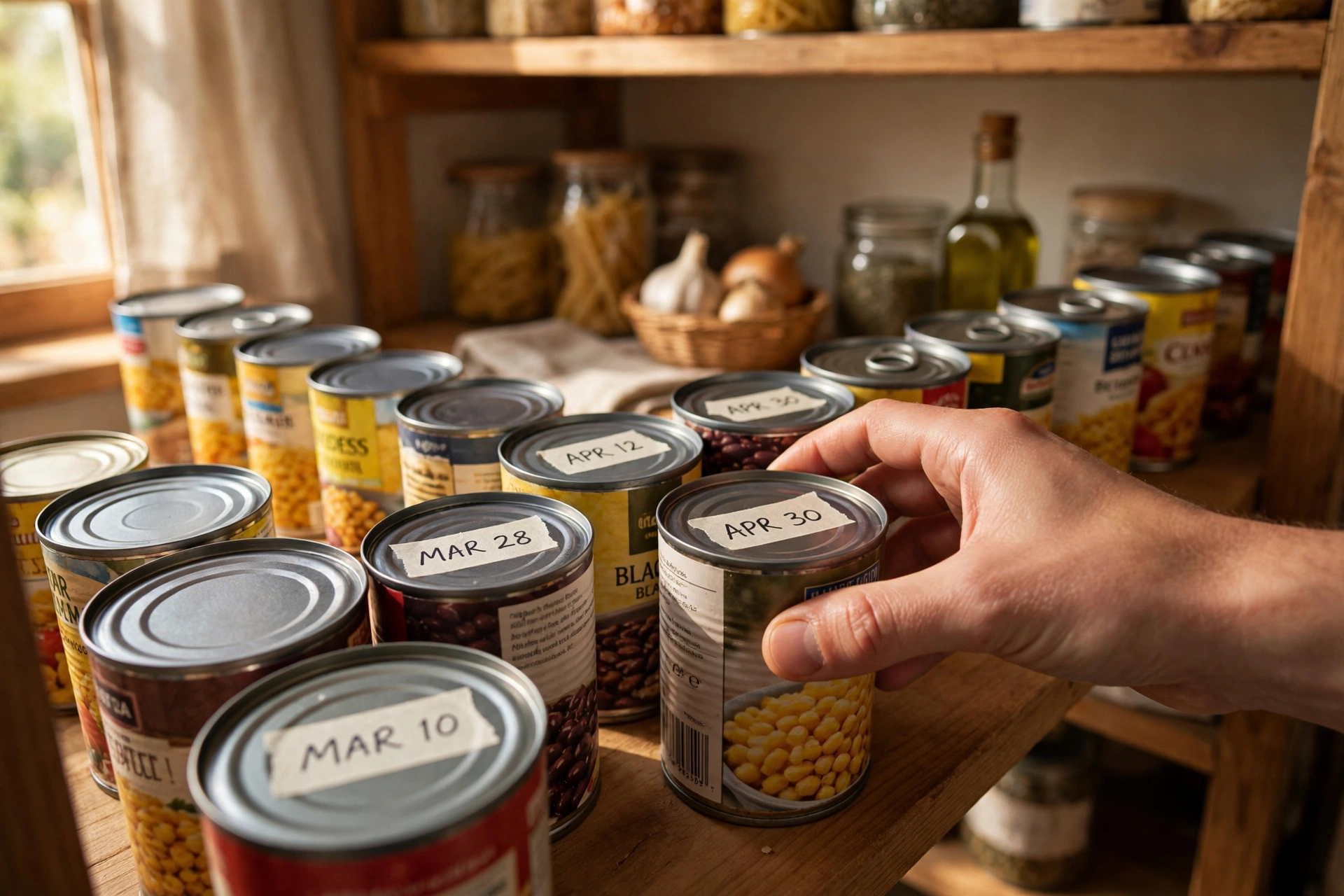
Date everything. When something goes on the shelf, write the month and year on it with a marker — big, on the front, where you’ll see it. Manufacturer dates are printed small and differ from brand to brand; your marker date is the one you’ll actually use.
Store it right. Cool, dark, and dry beats any fancy container. A closet shelf or a basement corner away from heat and damp will do. Keep food off concrete floors, and watch for rust, dents on the seam, or bulging cans — those go in the trash, no debate.
Rotate. New cans go behind the old ones, so the oldest food is always at the front. Then eat from the pantry on purpose: one pantry meal a week means stock is always moving, nothing quietly expires at the back, and your family stays used to eating this food. Rotation isn’t a chore you schedule — it’s just cooking with what’s in front.
And a word on dates: for most shelf-stable food, a “best by” date is about quality, not safety. Food past that date is usually fine, though flavor fades with time. Trust your eyes and nose, and when something looks or smells wrong, throw it out — no meal is worth a sick family.
The slow rhythm
That’s the whole system: one extra item each grocery trip, one pantry meal each week, dates checked as you put things away. Do that for a season and you’ll have a pantry that covers real life — an ice storm, a lost paycheck, a week when getting to the store is hard — without ever making one big, risky purchase.
Ready to put numbers on it? The Food & Water Planner turns your household size into exact amounts. And when you’re ready to choose what goes on the shelf, Build the Right Shelf walks through the first decisions.