
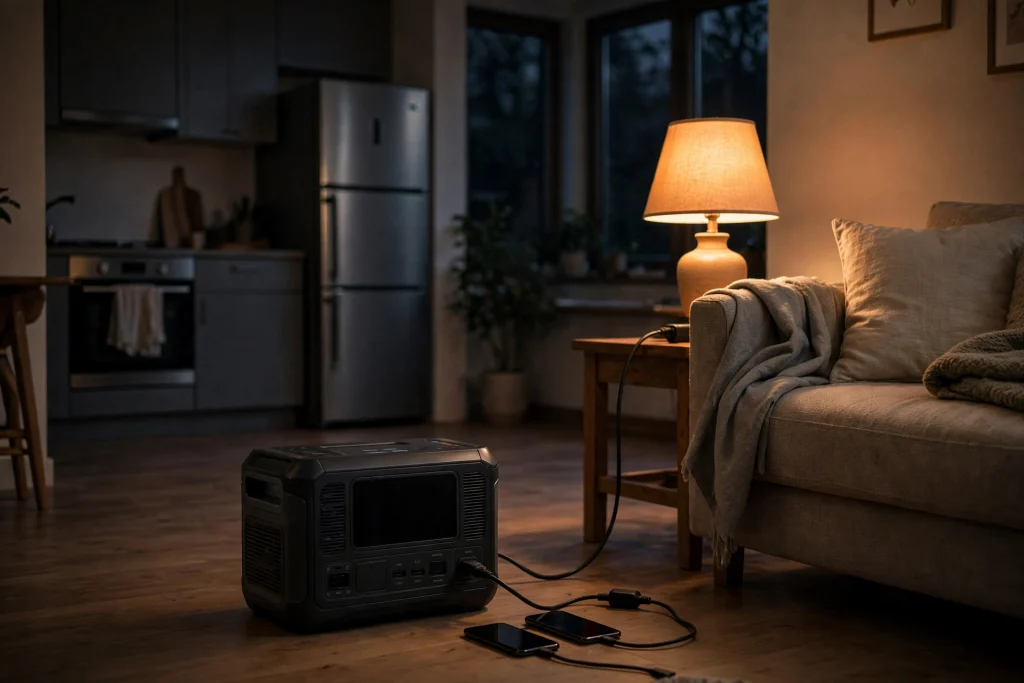
Wondering what size power station you need for an outage? Tick the appliances you want to keep running, set how many hours a day each one actually runs, and this calculator adds up the two numbers that decide it: the watts your station must deliver at once, and the watt-hours of battery it takes to last a full day. No sign-up, nothing leaves your browser.
The Two Numbers That Matter
Running watts are what an appliance draws while it works. Starting watts are the brief surge a motor needs to kick on — a fridge or pump can pull two to three times its running watts for a second or two, and a station that cannot cover the surge shuts down even if the steady load looks fine. Watt-hours (Wh) are the size of the battery’s tank: watts multiplied by hours. This calculator handles all three for you.
Pick Your Appliances
Fridge and freezer hours default to 10–12, not 24 — their compressors cycle on and off, and the hours here mean hours actually drawing power.
Kitchen & Food
| Appliance | Running | Starting | Hours / day |
|---|---|---|---|
| 150 W | 1,200 W | ||
| 200 W | 1,400 W | ||
| 1,000 W | 1,200 W | ||
| 1,000 W | 1,000 W | ||
| 1,500 W | 1,500 W | ||
| 850 W | 850 W |
Medical & Safety
| Appliance | Running | Starting | Hours / day |
|---|---|---|---|
| 40 W | 40 W | ||
| 80 W | 80 W | ||
| 350 W | 500 W | ||
| 800 W | 1,300 W | ||
| 15 W | 15 W |
Climate & Comfort
| Appliance | Running | Starting | Hours / day |
|---|---|---|---|
| 900 W | 2,200 W | ||
| 1,500 W | 1,500 W | ||
| 800 W | 2,350 W | ||
| 100 W | 100 W | ||
| 280 W | 700 W |
Electronics & Connectivity
| Appliance | Running | Starting | Hours / day |
|---|---|---|---|
| 20 W | 20 W | ||
| 65 W | 65 W | ||
| 200 W | 400 W | ||
| 100 W | 100 W | ||
| 10 W | 10 W | ||
| 50 W | 50 W |
Water & Heavy Loads
| Appliance | Running | Starting | Hours / day |
|---|---|---|---|
| 1,000 W | 2,100 W | ||
| 1,200 W | 2,250 W | ||
| 550 W | 1,100 W | ||
| 4,000 W | 4,000 W | ||
| 5,400 W | 5,400 W |
Your Size
Running watts, everything on at once: 0 W
Peak watts, biggest motor starting: 0 W
Look for an inverter rated at least: —
Energy used per day: 0 Wh
Battery size for one full day: —
That puts you in: tick at least one appliance above
How Long a Charged Station Lasts at Your Usage
- 1,000 Wh station: —
- 2,000 Wh station: —
- 3,600 Wh station: —
Planning note: the full-day battery figure assumes no recharging at all. With solar panels topping the station up during the day, most households buy roughly half of it and stretch runtime by running the fridge in cycles.
A Worked Example
Take a typical outage list for a family: the fridge (150 W, 10 hours a day), a chest freezer (200 W, 12 hours), the Wi-Fi router (20 W, all day), LED lighting (50 W, 6 hours), and a CPAP (40 W, 8 hours). Run it through the calculator above and you get 460 running watts — but the freezer’s starting surge pushes the peak to 1,660 W, so the inverter recommendation lands at 2,000 W. The day’s energy comes to 5,000 Wh, which makes a full no-recharge day a battery of about 5,900 Wh. That sounds enormous until you apply the planning note: with solar panels recharging by day, the common real-world buy for this exact list is a 2 kWh-class station — about 8 hours per charge at this pattern, refilled while the sun is up. Notice what decided the purchase: not the 460 watts, but the freezer’s surge and the overnight hours.
How to Read Your Result
- The inverter size comes first. If the station cannot start your biggest motor, nothing else on your list matters — it trips off and stays off. When you land between two sizes and a fridge, freezer, or pump is on the list, take the bigger inverter.
- Battery size is about hours, not power. Most disappointment lives here: a station can be strong enough to run the fridge and still be empty by 3 a.m. Match the watt-hours to how long your plan has to hold, not just to what it has to start.
- Landing between classes is normal. Go one size bigger when a medical device is on the list. A smaller size is fine when you have panels to recharge by day and can cycle the fridge instead of running it flat out.
Mistakes That Leave People in the Dark
- Sizing by watts alone. Watts say what can run at once; watt-hours say for how long. Buying on the first number only is how a fridge ends up warm by morning.
- Forgetting the starting surge. A freezer that runs at 200 W can demand 1,400 W for a second when its compressor kicks on. If the surge is not covered, the station shuts down even though the steady load looked fine.
- Trusting the number on the box. The rated capacity is the battery inside, not what reaches your plugs — about 85 percent is a fair planning figure, and it is what this calculator uses.
- Planning to run a space heater. A standard heater draws 1,500 W and drains a 1 kWh station in well under an hour. Heat in an outage is a fuel problem, or a blankets-and-layers problem — not a battery problem.
- Running the fridge flat out. A fridge only needs its compressor part of the day. Cycling it — a few hours on, a few off, door kept closed — can nearly halve what it takes from the battery.
Questions People Ask
What size power station runs a fridge overnight?
For most full-size fridges, plan on roughly 1,000–1,500 usable watt-hours for a night of cycling — a 1 kWh-class station is the floor, and 2 kWh is comfortable. Tick the fridge above with your own hours to get your number.
Can a power station run a space heater?
It can — briefly. At 1,500 W, even a large 3.6 kWh station is empty in about two hours. If heat matters in your outage plan, look at fuel heat or a much bigger battery bank.
What size do I need for a CPAP?
Without the heated humidifier a CPAP draws about 40 W — one night is roughly 320 Wh, so a 500 Wh station covers it with room to spare. With the humidifier on (about 80 W), double that. Many people turn the humidifier off during outages and double their runtime.
Will a power station run my whole house?
No — that is standby-generator territory. Portable stations are for the loads that matter most: food cold, lights on, phones and medical devices running, water moving. This calculator is built around exactly that list.
How long will my station take to recharge from solar?
Roughly, the battery’s watt-hours divided by the panels’ real output — about 70–80 percent of their rating in good sun. A 2,000 Wh station behind 400 W of panels needs most of a good day. Recharge speed is one of the specs we weigh hardest in the power hub.
How These Numbers Work
The watt figures are typical published values from manufacturer and industry appliance charts. Your appliance’s own label is the final word — check the label on the appliance itself if a load really matters, especially pumps and air conditioners, which vary the most.
The inverter recommendation adds the biggest single starting surge to your running total, then rounds up with about 20 percent of spare capacity, because a station run flat-out shuts down at the worst moment and ages fast. The battery estimate assumes about 85 percent of a station’s rated capacity is usable after conversion losses — makers rate the battery inside, not what reaches your plugs. Runtime estimates spread your daily energy evenly; real life is lumpier, so treat them as planning numbers, not promises.
Medical loads: if anything on your list keeps someone healthy — oxygen, a CPAP, refrigerated medicine — buy one size class bigger than whatever this page suggests and keep a second way to power it. Do not plan medical equipment to the edge of a battery.
What To Do Next
- Preserve the Power — our power hub: the stations and generators we score, backup planning, and fuel storage
- Best Solar Generators for Home Backup — our three picks in the 2,000Wh class compared on specs, price, and owner feedback
- Food & Water Planner — the other half of the outage plan: how much food and water your household needs
- How We Rate — how every score on this site is decided
- All Our Free Tools — every calculator in one place