
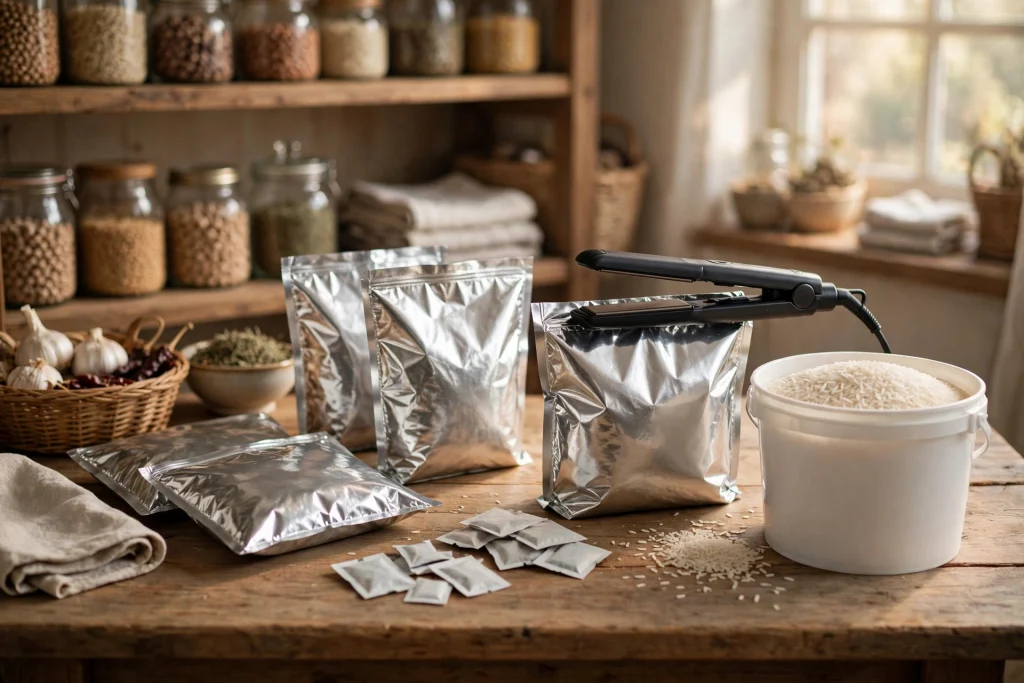
How many oxygen absorbers do you need for a one-gallon mylar bag — or a five-gallon bucket liner? It depends on the bag and on what is going in it: dense foods like rice and beans leave little trapped air, while airy foods like pasta leave a lot. Pick your container and your food below and this calculator gives you the absorber size and count, per bag and for the whole batch. No sign-up, nothing leaves your browser.
Run Your Numbers
| Container | |
|---|---|
| Food type | |
| How many bags? |
Your Absorbers
Absorber capacity needed per bag: about 300 cc
What to drop in each bag: 1 x 300 cc absorber
Equivalent in 300 cc absorbers: 1 x 300 cc
For your whole batch: 1 bag — 1 absorber total
Absorbers usually come in packs of ten. Once a pack is open they start working immediately — have your bags filled and ready, work steadily, and reseal any leftovers airtight (a vacuum-sealed jar works) within about half an hour.
How the Sizing Works
An absorber’s rating is how much oxygen it can soak up, in cubic centimeters. Air is about 21 percent oxygen, so the job is to cover the oxygen trapped in the bag after the food goes in. Food displaces most of the air — a gallon bag of rice holds far less air than a gallon bag of pasta shapes — which is why honest sizing charts give different numbers by food type, not just by bag size. The figures here follow the published sizing charts (about 300 cc for a gallon of dense food, 2,000 cc for a five-gallon liner) with an allowance added for medium and airy foods.
Two comforts in the math: a little too much absorber hurts nothing but the budget, and absorbers are cheap. Too little fails silently — the food looks packed while oxygen keeps working on it. When you land between two sizes, round up. And know what absorbers do not do: they remove oxygen, not moisture. Food going into mylar has to be dry — about 10 percent moisture or less — or no absorber will save it.
Worked Examples
A gallon bag of pasta. Pasta is airy — the shapes trap air — so the gallon’s 300 cc base becomes about 450 cc, and the practical pick is one 500 cc absorber. Packing ten bags for the pantry shelf: ten 500 cc absorbers, usually sold as a single pack of ten.
Five-gallon bucket liners of rice. Rice is dense, so each liner takes the chart figure of 2,000 cc — one 2,000 cc absorber, or about seven 300 cc absorbers if that is what you have on hand. A case of six liners is six 2,000 cc absorbers and a done shelf.
Mistakes That Ruin Stored Food
- Packing food that is not dry. Oxygen absorbers are for dry foods only — grains, beans, pasta, dehydrated goods at roughly 10 percent moisture or less. Moist food sealed away from oxygen is a botulism risk, not a pantry. If it feels damp, it does not go in a bag.
- Opening the pack, then dawdling. Absorbers start absorbing the moment they meet air and spend themselves in open air within about half an hour. Fill every bag first, then open the pack, drop, and seal in one steady run.
- Expecting the bag to pull drum-tight. Absorbers remove the oxygen fifth of the air; the nitrogen stays. A bag that stays a little soft is normal and fine — brick-hard only happens with vacuum sealing, which is a different tool.
- Wasting absorbers on salt and sugar. They do not need oxygen absorbers (and keep poorly with them). Store them dry and sealed, as they are.
- Reusing absorbers. They are single-use. A spent one feels hard and crunchy; a fresh one feels like soft powder. Pinch before you trust.
Questions People Ask
How many oxygen absorbers for a 1-gallon mylar bag?
One 300 cc absorber for dense foods like rice and beans. For pasta and other airy foods, step up to a 500 cc. When in doubt, the 500 cc costs pennies more and covers both.
Can I use two smaller absorbers instead of one big one?
Yes — capacity adds up. Two 300 cc absorbers do the work of one 600 cc. Mixing sizes to reach the number is completely fine.
How long do absorbers keep?
Unopened, in their sealed packaging, a year or more is typical — check the maker’s date. Once the pack is open, the clock runs in minutes, not days: use them or reseal them airtight right away.
My bag did not shrink down. Did it fail?
Probably not. Absorbers take out about a fifth of the air (the oxygen), so a modest draw-in over a day or two is success. A bag that stays fully puffed after 48 hours points to a leaky seal — check the seam, and re-do that bag with a fresh absorber.
Do I need absorbers if I vacuum seal?
A true vacuum removes most of the air, oxygen included, so absorbers add little in a vacuum-sealed bag. Most mylar packing is heat-sealed, not vacuumed — and there, the absorber is the whole game.
Plan the Rest of the Shelf
- All Our Free Tools — every calculator in one place
- Preserve the Pantry — how much to store, rotation, and the shelf systems behind these bags
- Food & Water Planner — how many meals and gallons your household needs before you start packing them
- How We Rate — how every score on this site is decided