
Our Food & Water Planner covers days. This calculator covers seasons — the deep pantry math for a household that wants months of food stored in bulk staples, not shopping bags. Bulk staples are the cheapest calories in the preparedness world by a wide margin, but nobody can picture what “three months of food” weighs. So here it is in pounds, by the foods that actually store.
Run your storage
—
—
| Food | Share of calories | You need |
|---|
Plus salt — about 10 pounds per adult per year, no calories, no substitute — and the spices that make month three taste different from month one. Water is a separate plan: the Food & Water Planner runs those gallons.
The shares are not arbitrary. Grains carry the plan because they are cheap, filling, and keep for decades packed right — wheat berries, rice, oats, and pasta all land near 1,600 calories a pound. Beans bring the protein grains lack. Fats look tiny on the list and matter out of proportion: at about 4,000 calories a pound, a few gallons of oil quietly carry weeks of energy, and a grain-and-beans diet without fat is one nobody sticks to. Sugar and honey are morale as much as fuel. Powdered milk covers the children and the cooking. If you adjust one thing for your own table, adjust the grains — that row is the pantry.
Worked example: the starting numbers — 2 adults and 1 child, 3 months to cover, 2,000 calories per adult a day — come to about 274 pounds of food: roughly 7 five-gallon buckets for the grains and beans, and about 474,864 calories stored in total.
Questions people ask
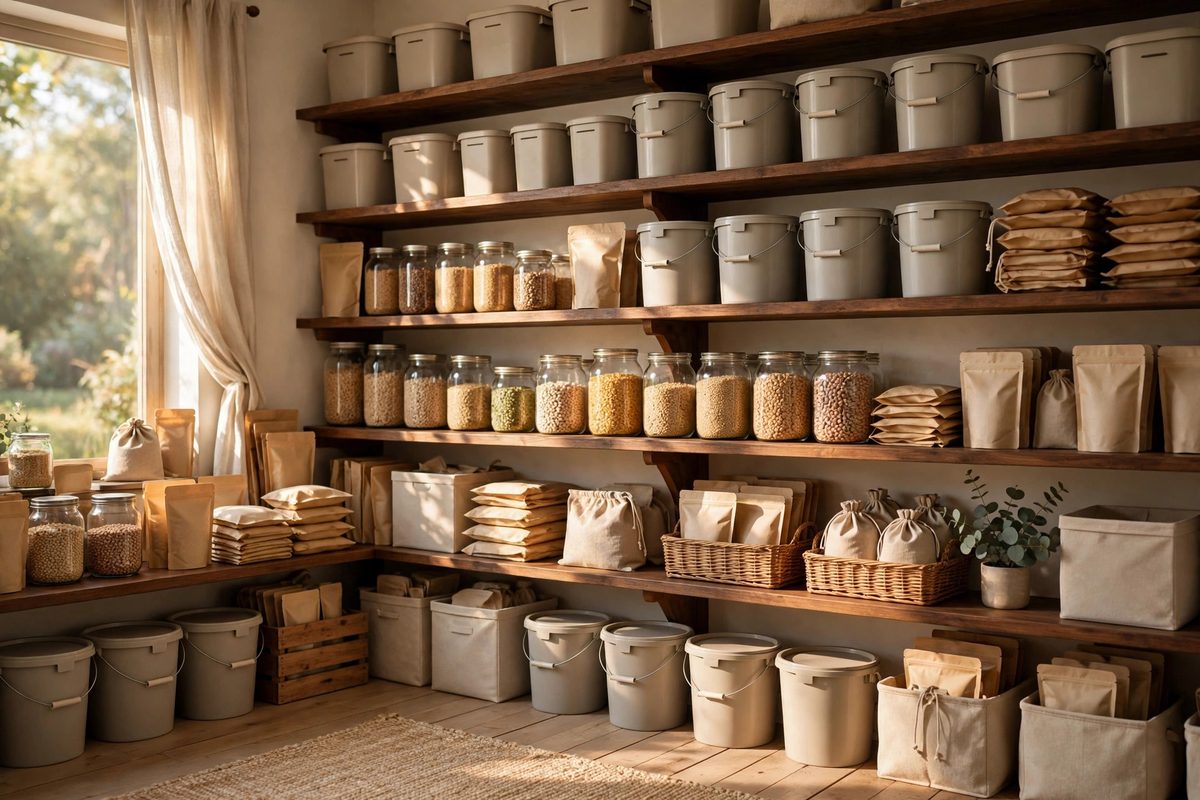
How much food is a three-month supply, really? For two adults and a child at average appetites, about 275 pounds of dry staples — the output above — plus water and salt. That sounds like a lot until it is stacked: it fits in roughly seven 5-gallon buckets for the grains and beans, plus shelf space for the rest. A closet, not a warehouse.
Why not just buy ready-made kits? Convenience, at a price. Our kit reviews put ready-made servings around $5.91 each for roughly a meal’s calories; bulk grains deliver the same calories for a small fraction of that — often a tenth. The sensible household usually does both: kits for the first weeks and grab-and-go, staples for the long middle. The kit reviews score the shortcut honestly.
How long do bulk staples keep? Wheat berries, white rice, and dried beans packed in mylar with oxygen absorbers are 20-to-30-year foods. Oils are the short pole — a year or two, rotated. Brown rice, whole-wheat flour, and anything with natural oils in it belongs in the eat-first rotation, not the deep store. Our Food Shelf-Life Lookup puts 30 staples in one searchable table, with the packing method each one wants.
The shortcut, if you want one
Bulk staples win on price per calorie. Ready-made kits win on the evenings you do not want to think. Most deep pantries end up with both — our three reviewed kits:
Mountain House Essential Bucket
The benchmark we price against: 22 servings a bucket and a 30-year shelf life, at the highest cost per serving of the three.
ReadyWise 72-Hour Kit
The budget grab-and-go: three days for one person, no cooking beyond boiling water.
Augason Farms Variety Pail
The middle path: the most servings per dollar of the three kits we reviewed.
As an Amazon Associate, Truly Preserved earns from qualifying purchases. It never changes a score or a number on this page.