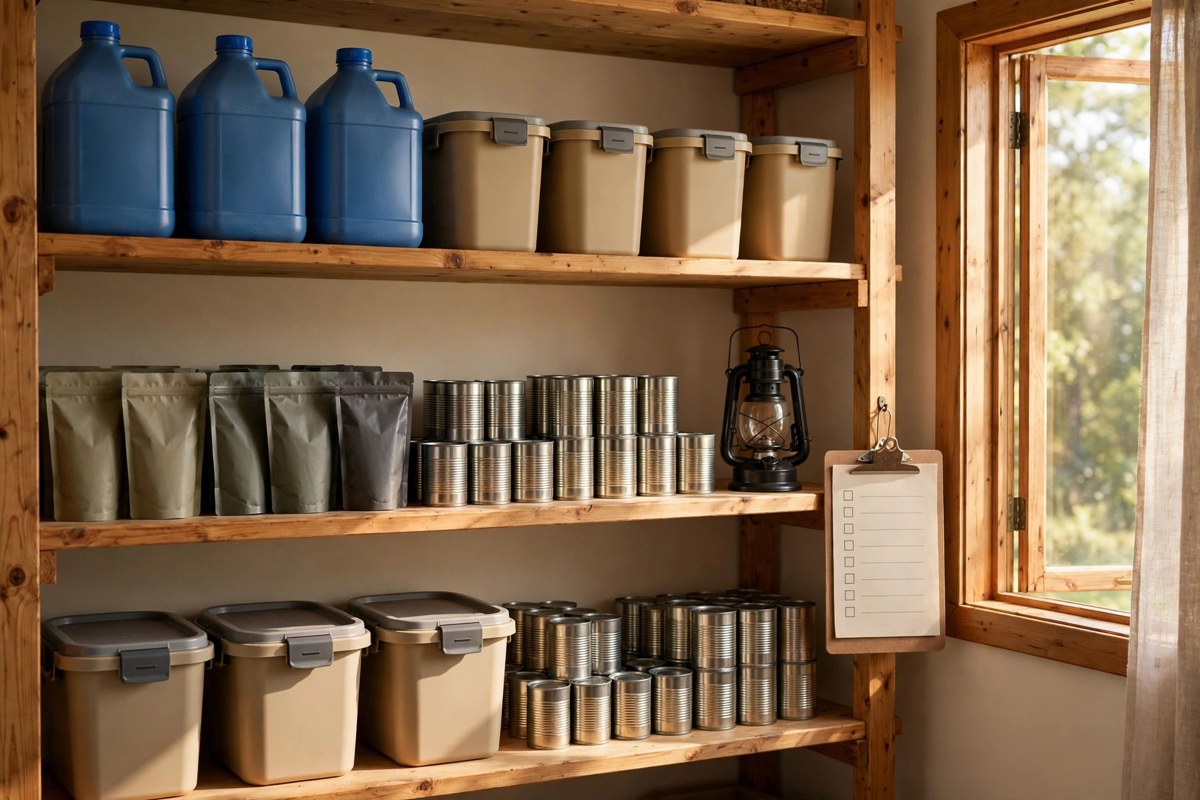
Most emergency advice starts with a shopping list. This one starts with a shelf. The checklist below walks the house the way a bad week actually unfolds — water first, then the food you can eat standing at the counter, then the power that keeps the cold food cold — and lets you tick off what is already handled. Set your household size and the quantities adjust: gallons, meals, and servings are counted for your house, not a generic one. When every box is ticked, print the list and tape it inside the pantry door, where the twice-a-year recheck takes five minutes. The amounts follow the planning guidance at Ready.gov — the same baseline behind our Food & Water Planner — and where this list aims past the official minimum, it says so. No sign-up, and nothing you tick leaves your browser.
Work the list, shelf by shelf
Start with your household size — every quantity on the list is counted for that many people, for three days. Tick each item as you confirm it is in the house, in date, and where you think it is.
0 of 45 sorted
Water 0 of 6
Everything else on this list can wait a day. Water cannot — it is also half the food plan, because stored food that needs water is not food until the water shows up. Container and storage details live in our Preserve the Water hub.
Food from the deep pantry 0 of 7
The deep pantry rule runs this whole section: store what you already eat, and eat what you store. Exotic food nobody touches is not a plan.
Power — keep the cold food cold 0 of 6
Outage power on this site has one first job: the fridge and freezer hold their cold, and the freeze-dried and frozen stores you already paid for stay worth eating. The rest of the hub is our Preserve the Power page.
Warm or cool 0 of 4
The weather does not care that the power is out, and the house has to answer it without the furnace or the air conditioner.
Knowing what is going on 0 of 4
When the networks go down, information is a supply like any other — and it runs out just as fast.
Medicines and health 0 of 4
General planning only — anything specific to your household belongs to your own doctor or pharmacist.
Toilets and cleanup 0 of 5
If the water stops, the flushing stops with it — and plain hygiene is what keeps a bad week from turning into a sick one.
Papers, cash, and keys 0 of 4
The boring section. It is also the one people are most grateful for afterward.
If you have to leave 0 of 5
Staying home is the plan. This section is the backup to the plan, packed before it is ever needed.
How to work this list
Do it in passes. The first pass is a Saturday morning with a marker: tick what is already true — most houses are further along than they think. The second pass is the short shopping list left over, bought a little at a time, which is how everything on this site gets built: slowly, and rotated often. Then run the list again twice a year — the weekends the clocks change are the usual anchor — because batteries die, dates pass, pets change food, and children grow out of the sizes you packed.
When every box is ticked, the honest next step is not more gear. It is a bigger number: stretch the plan from three days to fourteen with the Food & Water Planner, and let the numbers there argue with this list until the two agree.
Turn the ticks into numbers
Food & Water Planner — your household and your days, turned into meals and gallons
The quantities on this page follow the planning guidance published by Ready.gov and FEMA — a gallon of water per person per day and a several-day supply of food — read in full at ready.gov/kit. Where this list and that guidance differ, it is because a deep pantry aims past the minimum, and the list says so where it does.
The water layer, from our comparison
Three pieces from our water filter comparison that cover the make-it-safe item above, at three sizes:
As an Amazon Associate, Truly Preserved earns from qualifying purchases. It never changes a score or a number on this page.