
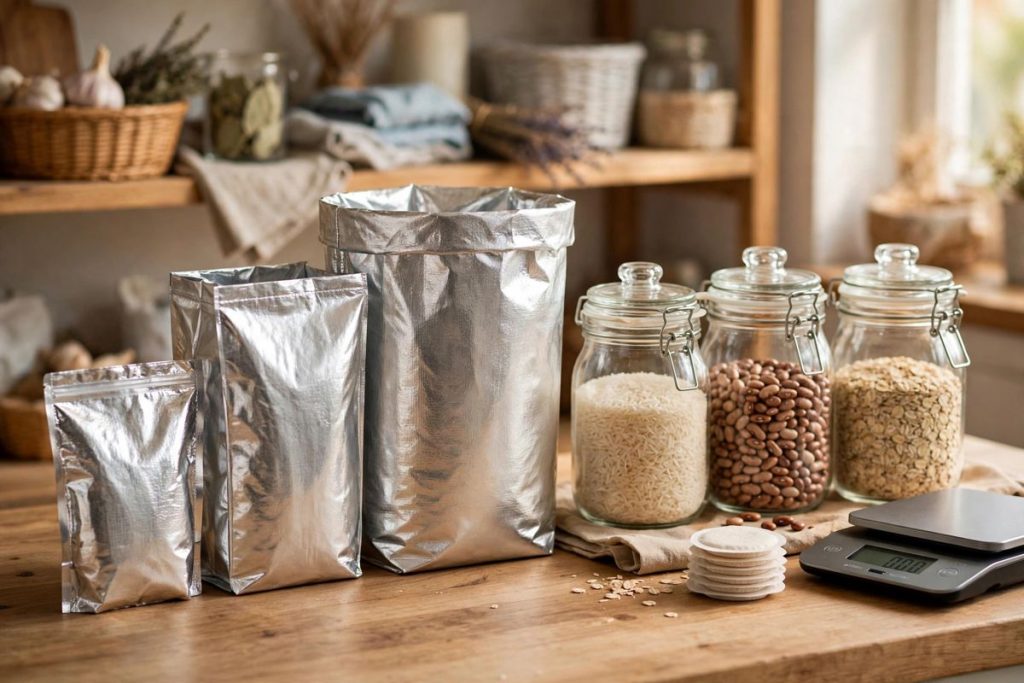
How do you know what size mylar bag to buy — and how many — before the food is sitting on your counter? This selector runs that math for you. Pick the dry food you are packing, enter how much of it you have on hand (by weight or by volume), and it tells you the bag size to use, how many bags the batch takes, and the oxygen absorber to drop in each bag. The absorber numbers are the same numbers our Oxygen Absorber Calculator gives for the same bag and food, because both tools run off the one sizing chart — the two can never disagree. No sign-up, and nothing you type leaves your browser.
Run Your Numbers
—
—
—
—
Worked Example — Check the Selector Against This
Worked example, labelled so you can reproduce it: set the food to white rice, long grain, the amount to 25, the unit to pounds (lb), and the bag preference to let the selector choose. The selector should answer: 4 × 1-gallon mylar bags, with one 300 cubic centimetre (cc) oxygen absorber in each bag — 4 absorbers total for the batch. The math behind it: rice runs about 6.98 pounds per gallon of bag space, so 25 pounds takes up about 3.58 gallons, which rounds up to four gallon bags; a gallon bag of dense food like rice takes a 300 cc absorber on the shared sizing chart. Try a second one while you are here: 10 pounds of rolled oats should also give 4 × 1-gallon bags, but with one 500 cc absorber in each bag — oats are a medium food that traps more air, so the chart steps the absorber up. If your screen says anything else, tell us through the contact page — the example is the test, not a decoration.
How the Sizing Works
Bags are sold by volume — quart, 1-gallon, 2-gallon, and the 5-gallon bucket liner — but food is bought by weight, so the whole job is converting one to the other honestly. Each food in the list carries a published weight for one cup, and a gallon of bag space holds 16 cups. White rice, long grain, weighs 198 grams a cup on King Arthur Baking’s published ingredient weight chart, which puts it at about 6.98 pounds per gallon of bag space; dry beans (185 grams a cup), lentils (192 grams), and small dry pasta shapes (105 grams) come from published United States Department of Agriculture (USDA) cup weights collected at Grams to Cups Converter. Those figures land where the bag makers land: Wallaby’s sizing guide puts a 1-gallon bag at 5 to 6 pounds of rice, and ShieldPro publishes about 6 to 8 pounds of dry goods for its 1-gallon bag — our per-food numbers sit inside that range for dense foods and below it for airy ones, which is the right direction: pasta shapes and rolled oats take up far more bag than their weight suggests.
Three honest limits. First, the count rounds up, so the last bag of a batch usually runs part-full — that is normal, and the absorber is still sized for the full bag, exactly as the Oxygen Absorber Calculator sizes it, because the air in a part-full bag still has to be covered. Second, freeze-dried meals and ingredients are in the list by volume only: one maker’s freeze-dried meal can weigh twice another’s at the same volume, and no published cup weight covers the class, so the selector asks you to enter cups, quarts, gallons, or litres for them rather than invent a weight. Third, granulated sugar is in the list for bag sizing, but its absorber line reads none — sugar does not need an oxygen absorber and keeps poorly with one, so store it dry and sealed as it is.
On bag choice, the selector follows the rule our mylar bags guide is built on: gallon bags for the working stock you will actually open, because cracking one gallon bag leaves the rest of the bucket sealed, and 5-gallon liners for the deep stock you do not plan to touch. Left on its own setting it works up the sizes — quart bags for a small batch, gallon bags up to five, 2-gallon bags up to five, then bucket liners — and the preference box lets you overrule it when you already know how you pack.
Mistakes This Selector Heads Off
- Buying bags by the food’s weight alone. Ten pounds of rice and ten pounds of rolled oats are nowhere near the same pile — the oats take roughly twice the bag space. Weight only turns into bags through the food’s own cup weight.
- Packing the whole batch in one 5-gallon liner. The day you open it, the whole batch starts aging. Liners are for the deep stock; the food you eat from belongs in gallon bags inside the same bucket.
- Sizing the absorber to the food instead of the bag. Absorbers cover the air in the container, so a part-full gallon bag still wants the gallon bag’s absorber. When you land between sizes, round up — extra capacity hurts nothing but the budget.
- Dropping an absorber in sugar. Sugar and salt do not need one. Seal them dry, as they are.
Questions People Ask
How many pounds of rice fit in a 1-gallon mylar bag?
About 7 pounds figured from the published cup weight (198 grams a cup), and bag makers publish 5 to 8 pounds for the same bag depending on the grain — call it a 6 to 7 pound working figure and expect the bag to seal comfortably there.
How many 1-gallon mylar bags do I need for 25 pounds of rice?
Four. Twenty-five pounds of rice takes up about 3.58 gallons of bag space, so three bags run over-full and the fourth carries the rest. That is the worked example above — run it and check us.
Is it better to use 1-gallon bags or a 5-gallon bucket liner?
Both, for different jobs: liners for the deep stock you will not open for years, gallon bags for anything you will eat from, because opening a liner starts the clock on everything in it. Our mylar bags guide compares the bags themselves, thickness included.
What oxygen absorber goes in each bag?
The same one our Oxygen Absorber Calculator gives for that bag size and food type — 300 cc for a gallon of dense food like rice or beans, 500 cc for a gallon of airy food like pasta, 2,000 cc for a 5-gallon liner of dense food. The selector prints it per bag and for the whole batch.
Can I pack freeze-dried food with this selector?
Yes — by volume. Freeze-dried meals vary too much in weight for a published weight-per-gallon figure, so enter the cups, quarts, or gallons you have and the selector sizes the bags and the (airy-food) absorbers from the volume.
Run the Rest of the Numbers
- Oxygen Absorber Calculator — the absorber sizing chart this selector shares, for custom bag sizes and batch counts
- Best Mylar Bags for Long-Term Food Storage — which bags to buy once you know the size: thickness, the per-side mil trap, and the sealer that fits them
- Freeze-Dried Conversion Calculator — fresh weight to dried weight for the food going into the bags
- Long-Term Food Storage Calculator — how many pounds of staples your household needs in the first place, by food and by bucket
- All Our Free Tools — every calculator in one place
The Gear Behind the Math
Wallaby 1-Gallon Mylar Bags 30-Pack with Oxygen Absorbers
The gallon bag this selector lands on most often — the top pick in our mylar bags guide, with the absorbers included.
Sukerle 5-Gallon Mylar Bags 15-Pack with Oxygen Absorbers
The bucket liners for the deep stock — the 5-gallon side of the same guide, for batches the selector routes to liners.
METRONIC 8-Inch Impulse Sealer
The seal is what keeps a sized bag sized — the sealer from our mylar bags guide.
As an Amazon Associate, Truly Preserved earns from qualifying purchases. It never changes a score or a number on this page.
Truly Preserved is reader-supported. When you buy through links on this page, we may earn a commission at no extra cost to you. As an Amazon Associate, Truly Preserved earns from qualifying purchases. Read our full affiliate disclosure.