
Affiliate Disclosure: Truly Preserved is reader-supported. When you buy through links on this page, we may earn a commission at no extra cost to you. As an Amazon Associate, Truly Preserved earns from qualifying purchases. Learn more.
How we researched this comparison. We scored 3 products head to head for this page. The work behind the scores: manufacturer specifications and certification records where they apply, prices checked when this review was written, and patterns across verified owner feedback — a praise or complaint point only counts here when it shows up again and again, not once. The products were chosen to cover the main designs and price points a buyer in this category actually cross-shops. We are a research desk: we do not buy or hands-on test the products, and commissions never change a score. How we research and score →
A battery box runs a fridge for a day. A fuel generator runs it for as long as you have fuel — and that is why the best portable generators for fridge and freezer backup still earn their place next to the power stations we usually cover. This comparison is built from published specs, current prices, and aggregated owner feedback from retailer listings and owner forums. We don’t own these generators; we did the homework so you can see the full picture before spending. The three picks below are all inverter generators — the quiet kind that makes clean power safe for phones, laptops, and modern fridge electronics. They split on the choice that actually decides an outage: the Champion runs on gasoline or propane and makes enough watts for a fridge and a freezer together, while the Honda and the WEN are smaller gasoline-only machines built around one fridge and the basics. Not sure what your loads add up to? Run them through our Generator Fuel & Runtime Calculator before you buy — five minutes there beats buying the wrong size.
The Short Version
Champion 4250W Dual Fuel Inverter
See it on AmazonWe may earn a commission at no extra cost to you.
Honda EU2200i
See it on AmazonWe may earn a commission at no extra cost to you.
WEN 56203i
See it on AmazonWe may earn a commission at no extra cost to you.
How we chose: We compared the manufacturers’ published specs side by side, checked current prices on October 18, 2026, and read owner feedback across roughly 6,000 Amazon ratings on these three listings as counted by Keepa (3,233 on the Honda, 2,773 on the WEN, and a thin 27 on the Champion’s current listing), plus retailer reviews and owner forums, counting the praises and complaints that kept coming up. Scores weigh how much it can run, what it costs per watt, noise, fuel choices, warranty, and what owners say after real outages. Read our full methodology.
Head-to-Head Specs
| Champion 4250W Dual Fuel Inverter Read the review ↓ |
Honda EU2200i Read the review ↓ |
WEN 56203i Read the review ↓ |
|
|---|---|---|---|
| Price | $695 | $1,199 | No live Amazon offer found on Oct 18 — see its section below |
| Running watts | 3,500 (gas) / 3,150 (propane) | 1,800 | 1,700 |
| Starting watts | 4,250 | 2,200 | 2,000 |
| Cost per running watt | ~20 cents | ~67 cents | — |
| Fuel | Gasoline or propane | Gasoline only | Gasoline only |
| Run time at 1/4 load | 22 hrs on 4 gal gas; 21 hrs on a 20-lb propane tank | 8.1 hrs on 0.95 gal | 10.8 hrs on 1 gal |
| Noise | 64 dBA at 23 feet | 48 dBA at 1/4 load, 57 dBA at full load | 51 dBA at 1/4 load |
| Weight | 79 lb (open frame, no wheels) | 47.4 lb | 39 lb |
| Start | Recoil | Recoil | Recoil |
| Outlets | 120V 30A RV (TT-30R), 120V duplex, 2 USB, 12V DC adapter | 120V duplex | 120V duplex, 12V DC, 2 USB |
| CO shutoff | CO Shield on current production — check the box | Yes — CO-MINDER | No automatic CO shutoff listed |
| Warranty | 3 years | 3 years residential | 2 years |
Prices checked October 18, 2026 on Amazon. Generator prices swing with sales and storm news — always confirm before buying. All three are 120V only: none of them runs a 240V well pump or central air.
Champion 4250W Dual Fuel Inverter: The One That Runs the Fridge and the Freezer
Our score: 8/10 — the only pick here with watts to spare for a fridge and a separate freezer at the same time, and the only one that can burn propane that has sat in the shed for five years. At $695 it also costs a little over half what the Honda does while making nearly twice the power. This is Champion’s model 200977 — an open-frame inverter, not the enclosed “4500” box Champion also sells; the honest notes below explain why the model number matters.
The Champion makes 3,500 running watts on gasoline and 3,150 on propane, with 4,250 starting watts for the moment a compressor kicks on. That headroom is the whole story. A fridge (roughly 150–400 running watts, 800–1,200 to start) plus a chest freezer (about 80–150 running watts by owners’ own meter readings, 500–1,200 to start) plus lights, the router, and phone chargers still leaves room — where the two smaller machines below are doing math every time something cycles on. It puts out clean inverter power under 3% THD, has a 30-amp RV outlet the other two lack, and starts with a pull cord — there is no electric start on this model. On a quarter load it runs up to 22 hours on its 4-gallon gas tank, or up to 21 hours on a standard 20-pound propane tank — the grill tank you already own. The $695 price is today’s Buy Box price as tracked by Keepa; Amazon’s own offer was out of stock when we checked, so that price is a marketplace seller’s, and it will move.
Pros:
- Runs a fridge and a freezer together, with headroom — 3,500 running watts
- Dual fuel: propane stores for years without going stale, gasoline makes full power
- A 30-amp RV outlet, USB ports, and CARB compliant — sold in California, unlike the Honda
- About 20 cents per running watt at $695 — the best power-per-dollar here by a wide margin
- 3-year warranty with free lifetime tech support
Cons:
- 79 pounds with no wheels — a two-person lift into a truck bed
- Loudest here at 64 dBA — quiet for an open frame, not quiet like the Honda
- Recoil start only — no push-button start at this price
- Champion’s model naming is a maze — see the warning in the honest notes below
- Parallel kit and cover cost extra
Be straight about the feedback pool here: the current Amazon listing for model 200977 carries only 27 ratings (4.2 stars, counted by Keepa) — too few to hang a verdict on. The wider owner record for Champion’s dual-fuel inverters is much bigger, and it praises the fuel switch, the long runtime, and support that answers the phone; the complaints that repeat across the line are hard starting for some owners (including a run of propane no-start reports on the enclosed sibling model) and parallel-kit connectors that use separate fiddly plugs instead of one cable. We scored the Champion on its specs, its price per watt, and that broader record — and we are telling you the listing’s own rating count is thin rather than borrowing a bigger number from a different model.
Buy it if: you have a fridge and a freezer to protect, or a deep pantry’s worth of frozen food riding on the outage. Skip it if: one person has to carry the generator up stairs or into a vehicle alone — buy the Honda or the WEN and rotate what stays plugged in.
Check the current price on Amazon →
Honda EU2200i: The Quiet One Owners Keep for a Decade
Our score: 8/10 — the best-made small generator here, and the quietest under a real load. What you give up is watts and fuel choice: 1,800 running watts, gasoline only, at $1,199 — about 67 cents per running watt, the highest here by far. (That $1,199 is today’s Buy Box price as tracked by Keepa; Amazon’s own stock of this model comes and goes.)
The EU2200i is the machine the other two get measured against. Honda rates it at 48 dBA at quarter load — normal conversation is about 60 — rising to 57 dBA at full load. It runs 8.1 hours at quarter load on a 0.95-gallon tank, weighs 47.4 pounds, and carries Honda’s CO-MINDER carbon-monoxide shutoff, a fuel shutoff that drains the carburetor for storage, Bluetooth monitoring through Honda’s app, and the ability to pair with a second EU2200i later if your needs grow. Honda itself lists a refrigerator or freezer among its jobs. The 3-year residential warranty matches the Champion’s, and the dealer network behind it is the deepest in this business — when a Honda breaks in ten years, somebody near you can fix it.
Pros:
- Quietest here — 48 dBA at light load, 57 dBA working hard
- Honda build and dealer network; owners report decades of service
- CO-MINDER shutoff, fuel shutoff for clean storage, app monitoring
- Can pair with a second unit later for double the power
- Holds its resale value better than any other small generator
Cons:
- $1,199 for 1,800 running watts — about 67 cents a watt, more than triple the Champion’s rate
- Gasoline only — no propane option at any price from Honda
- Small tank: 3.2 hours at full load, so a hard-working day means refills
- Honda’s own spec page says this model is not for sale in California
Across ~3,233 Amazon ratings (4.7 stars — the highest rating here, counted by Keepa), owners praise the same three things: it starts on the first pull, it is quiet enough to talk over, and it just keeps working year after year. The complaints that repeat are about the deal, not the machine: the price, the lack of a propane option, a small set of reports about costly inverter-module repairs out of warranty, and the base model having no 30-amp RV outlet (that is the Companion version, sold separately).
Buy it if: it will run one fridge and the basics, noise matters (close neighbors, thin walls, a sleeping baby), and you keep gear for a long time. Skip it if: you need a fridge and a freezer running together, or the budget is the point.
Check the current price on Amazon →
WEN 56203i: The Budget Pick That Covers One Fridge
Our score: 7/10 — the cheapest way here to keep one fridge cold, and at 39 pounds the easiest to grab. What you give up is headroom, warranty length, and any CO shutoff. One wrinkle on price: the Amazon listing our link points to showed no live offer when we checked on October 18, 2026, so we are printing no price for the WEN rather than guessing one. The link stays in place — check it for today’s price and the current listing.
The 56203i makes 1,700 running watts from a 79cc engine — a touch under the Honda — and stretches a 1-gallon tank to 10.8 hours at quarter load, the longest run per gallon here. At 51 dBA at quarter load it sits between the Honda and the Champion for noise, and it is the only pick with USB ports built in. Two details punch above its price: a fuel shutoff that runs the carburetor dry before storage (the single best defense against the gummed-carb no-start that kills stored generators), and parallel ports, so a second WEN can double your power later. It is also CARB compliant, which the Honda above is not.
Pros:
- Lightest here at 39 pounds, and the longest run per gallon at light loads
- Fuel shutoff for storage — the feature that keeps cheap generators alive
- Quiet for its class at 51 dBA; USB ports and 12V outlet built in
- Parallel capable; CARB compliant
Cons:
- No automatic CO shutoff listed — placement discipline is on you (see the safety note below)
- 2-year warranty, the shortest here, and no watt meter on the panel
- Plastic pull-starter parts feel cheap next to the Honda
- Needs an altitude kit above 2,000 feet, per owner reports
Across ~2,773 Amazon ratings (4.6 stars, counted by Keepa), owner feedback splits cleanly by how people treated it. Owners who filled it, ran it, and loaded it the week it arrived praise the price, the quiet, and first-pull starts. The recurring one-star theme — and it is specific enough to act on — is buyers who shelved it without ever running it, found it dead months later past the return window, and fought the warranty process from there. The lesson costs nothing: whatever generator you buy, run it under load the day it lands.
Buy it if: the job is one fridge, lights, phones, and a fan, and the budget is a few hundred dollars. Skip it if: a freezer full of meat is also on the list, or you want a CO shutoff — step up to the Champion.
Check the current price on Amazon →
Head-to-Head by What Matters
Can these run a refrigerator and a freezer at the same time?
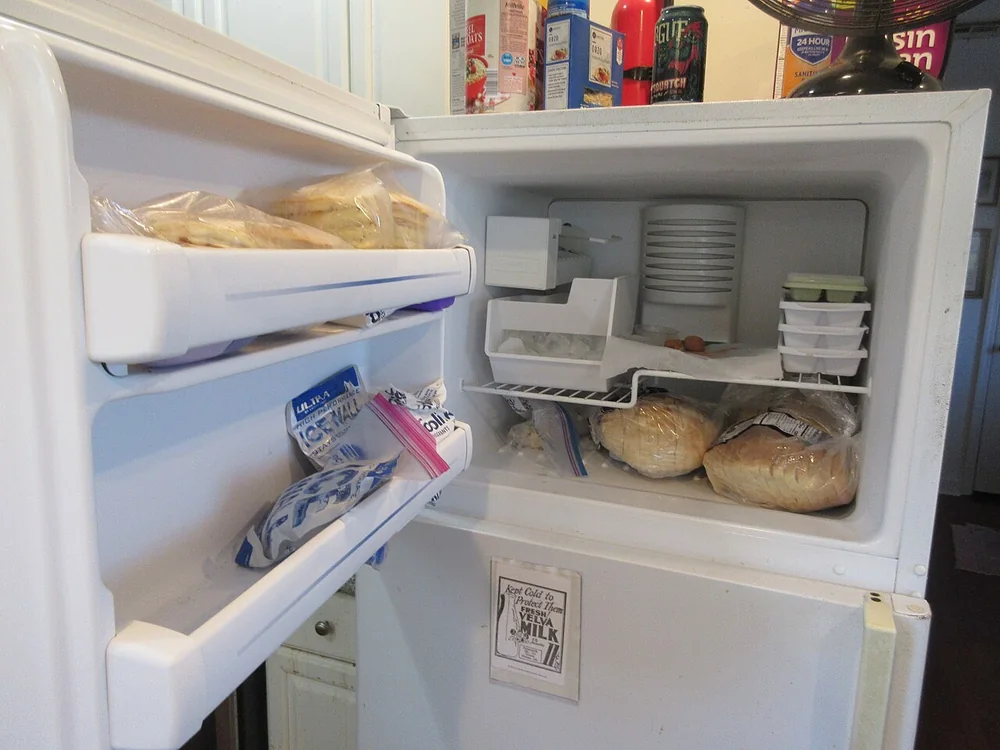
The Champion can, comfortably — it is the only one we’d say that about. Start with the math every sizing guide agrees on: a modern fridge runs at roughly 150–400 watts and needs 800–1,200 watts for the second its compressor starts; a chest freezer runs at about 80–150 watts and needs roughly 500–1,200 to start. Together that is at most about 550 running watts, but the two compressors can ask for their starting watts in the same moment. The Champion’s 4,250 starting watts and 3,500 running watts absorb that without blinking. The Honda (2,200 starting) and the WEN (2,000 starting) will each run one fridge plus lights and chargers all day; run a fridge and a freezer on them only by rotating — plug in one, let it pull down to temperature, swap — or by staggering starts and keeping everything else off. Our Power Station Size Calculator works through the same math for battery boxes.
How long will each one run on a tank of fuel?
The Champion runs longest between stops: up to 22 hours on gasoline at quarter load, and up to 21 hours on a 20-pound propane tank at the same load. The WEN is next at 10.8 hours on its 1 gallon — the best hours-per-gallon here, because its engine is the smallest. The Honda goes 8.1 hours at quarter load on 0.95 gallons, and only 3.2 hours at full load; it is built for light, steady work, not for carrying a house. Turn those into a day of outage: at quarter load around the clock, figure roughly 2.2 gallons a day for the WEN, 2.8 for the Honda, and 4.4 gallons of gasoline — or a bit over one 20-pound propane tank — for the Champion. Our Generator Fuel & Runtime Calculator runs these numbers for your own load list.
Hours on one tank at quarter load
From the figures above — the Champion runs longest between stops; the WEN is the most frugal per gallon.
Which one is quiet enough to run at night near the house?
The Honda is the quietest, at 48 dBA at quarter load and 57 dBA at full load. The WEN is close at light loads at 51 dBA — but that is its only published number, and small engines get louder as the load climbs. The Champion at 64 dBA is the loudest here — a bit louder than normal speech at 23 feet. That is the open frame showing: Champion built this one lighter and cheaper instead of enclosing it, and 64 dBA is still well under a conventional jobsite generator (usually 70 dBA and up). Remember the trade that matters more than decibels: quiet placement tempts people to move a generator closer to the house, and carbon monoxide does not care how quiet it is. Twenty feet away, exhaust pointed away from the house, no exceptions — see the safety note below.
Published noise figures, in decibels
Each maker’s own published number, on its own basis — the Honda’s is at quarter load, the WEN’s at light load.
Gasoline or propane — which fuel should you plan on?
Propane is the better storage fuel and gasoline is the stronger running fuel, and the Champion is the only pick here that lets you have both. Gasoline starts degrading in as little as three to six months untreated; stabilizer stretches that (we keep STA-BIL on the shelf for exactly this), but it stays a rotation chore, and a gummed carburetor is the number-one reason a stored generator will not start. Propane in a sealed tank does not go stale — owners and manufacturers put its shelf life at indefinite — and it burns cleaner, so the carburetor stays clean through years of sitting. The cost is power: the Champion makes 3,150 running watts on propane against 3,500 on gasoline, a 10% give-back. Our call: store propane as the fuel that is always ready, keep a can of treated gasoline for the days you need every watt. With the Honda or the WEN, gasoline is the only choice, which makes their fuel shutoffs — run the carb dry before storage — the most important feature on the panel.
How heavy is each one to move around?
The WEN wins at 39 pounds — one person, one hand on the handle, up the porch steps. The Honda at 47.4 pounds is a firm two-hand carry but still one-person work. The Champion is a different animal at 79 pounds with no wheels: it carries by its frame handles across a driveway fine, but lifting it into a truck bed or up stairs is a two-person job, full stop. Be honest about who moves this thing at 2 a.m. in the rain. That person is the real spec.
What does each one cost to own over time?
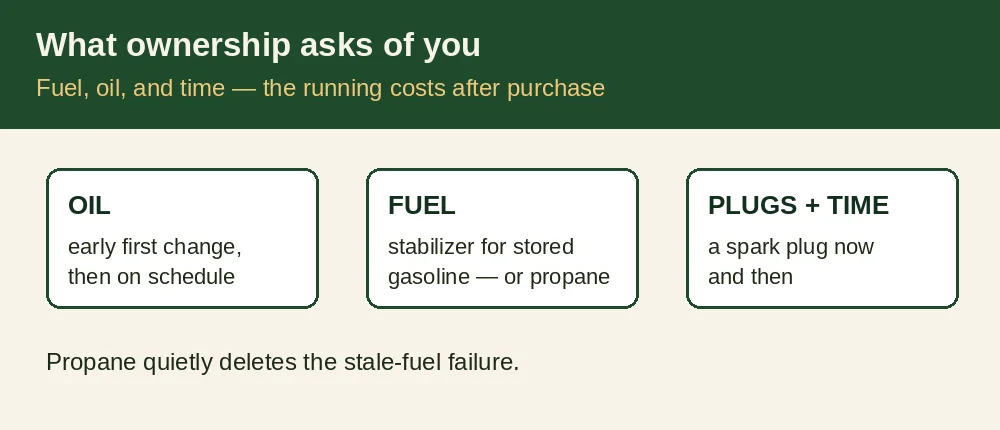
The Champion is the cheapest power here: $695 for 3,500 running watts is about 20 cents a watt, against about 67 cents a watt for the Honda ($1,199 for 1,800 watts). The WEN’s price could not be verified today (see its section), so we will not run per-watt math on a number we did not see; in its class it normally sells for a few hundred dollars, well under the Honda. The running costs after that are fuel, oil, and time. Budget an oil change early (small engines shed metal in their first hours — WEN owners who skip the early changes show up in the complaint pool) and then on the maker’s schedule, a spark plug now and then, and stabilizer for any gasoline that will sit. The Champion’s propane option quietly deletes the biggest ownership cost of a stored generator: the outage-day discovery that your fuel, or your carburetor, gave up months ago. None of the three has a subscription, an app fee, or a wear-out battery — when a generator dies it is usually fuel neglect, not age, and fuel neglect is free to prevent. If you’d rather skip fuel entirely, the battery boxes in our solar generator comparison are the other honest answer — and the Bluetti vs Jackery head-to-head covers the two we’d pick first.
Honest Notes Before You Buy
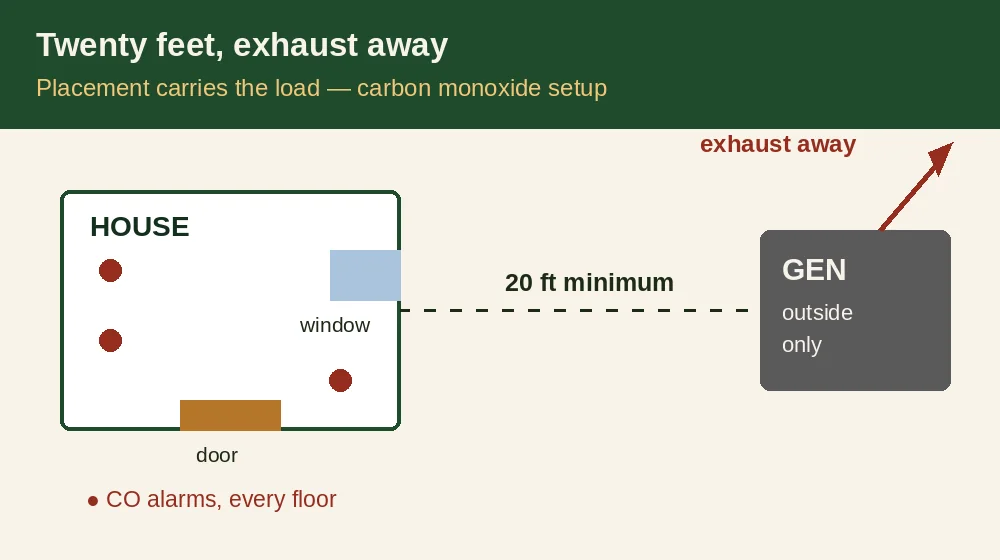
Carbon monoxide kills, quietly, every storm season. All three of these are outdoor-only machines: at least 20 feet from any door, window, or vent, exhaust pointed away, never in a garage — not even with the door open. The Honda shuts itself off if CO builds up (CO-MINDER), and current Champion production does the same with its CO Shield — confirm that badge is on the box, since this model has been in production for years. The WEN lists no automatic CO shutoff, so placement discipline carries the whole load there. Put battery CO alarms on every floor of the house regardless of which one you buy.
Champion’s model names are a maze, and it nearly caught us. Champion sells a 4250, an enclosed 4500, and an open-frame 4500, all dual-fuel inverters with similar running watts and very different prices, noise, and starting systems — and retailer pages mix the names up freely. This post’s pick is model 200977: 4,250 starting watts, open frame, recoil start, $695 on the day we checked. Our first research pass priced the wrong sibling; the recheck against Keepa’s listing for the exact item our link points to caught it. If you shop it elsewhere, match the model number 200977 before you pay.
The Honda is not sold in California. Honda’s own spec page for the EU2200i says “Not for sale in California.” California readers: both the WEN and this Champion (model 200977) are CARB compliant, so either is buyable there.
None of these runs the whole house. All three are 120V machines. Central air, an electric range, a dryer, and most well pumps (240V) are out. What they run — fridge, freezer, lights, router, phones, a fan, a CPAP — is the list that matters in the first three days of an outage. Bigger backup is a bigger machine and a transfer switch installed by an electrician; never backfeed a house through a dryer outlet.
Test it the week it arrives. The single most common one-star story across all three brands is the same: bought it, shelved it, needed it, dead. Run your generator under a real load for half an hour the week it lands, while the return window is wide open. Then run it a few times a year. A generator is a promise you have to keep exercising.
Prices move. The $695 Champion and $1,199 Honda were the live Buy Box prices tracked by Keepa on October 18, 2026. Generator prices jump when a storm is in the forecast and drop in the quiet months — buying in the off-season is the easiest money in this whole comparison.
Questions People Ask
Can a 2,000-watt generator run a refrigerator and freezer at the same time?
Sometimes, and it is tighter than the headline watts suggest. A fridge and a freezer together run at roughly 230–550 watts, which a 2,000-watt machine handles easily — the problem is the second both compressors start together and ask for 1,300–2,400 watts at once. Modern, smaller appliances usually stay under the line; an older fridge plus a big chest freezer can trip it. If both must run together guaranteed, buy the 3,500-running-watt class (the Champion here) and stop doing math during outages.
How many watts does a refrigerator need to start?
Most modern fridges need about 800–1,200 starting watts for the second or two the compressor kicks on, against 150–400 watts to keep running. Older and larger models can ask for more — the label inside the door lists amps; multiply amps by 120 for a rough watt figure, then double it for the start. Every generator in this post clears a single modern fridge’s start with room to spare.
Is a dual-fuel generator worth it for a generator that mostly sits?
For a machine that sits, dual fuel is the feature that matters most — because sitting is what kills gasoline. Propane does not go stale in the tank, does not gum a carburetor, and the tank on your grill is already a fuel store. You give up about 10% of the watts on propane (3,150 vs 3,500 on the Champion). If you will run the generator monthly — job sites, camping — gasoline-only is fine and cheaper. If it waits for outages, pay for the second fuel.
How long will a 20-pound propane tank run a generator?
On the Champion at quarter load, Champion rates up to 21 hours from a standard 20-pound tank — roughly a full day of fridge-and-basics duty per tank, since the fridge cycles rather than drawing constantly. Heavier loads shorten that fast; at half load, plan on closer to half the hours. Two staged tanks cover a long weekend of essentials for most homes.
Can I run a portable generator in the garage if I open the door?
No. Carbon monoxide builds up in enclosed and partly enclosed spaces faster than it clears, and it drifts into the house from an attached garage with the door wide open. Outdoors only, at least 20 feet from doors, windows, and vents, exhaust pointed away. This rule has no quiet-generator exception — the Honda’s 48 dBA makes it tempting to tuck it closer, and that temptation is exactly the trap.
Generator or power station — which should a fridge-and-freezer household buy first?
Depends on your outages. A 2kWh power station (the boxes in our solar generator comparison) runs a fridge silently indoors for about a day with zero upkeep, and recharges from the wall or sun. A fuel generator runs it for as many days as you have fuel, costs less per watt, and asks for oil, fuel rotation, and outdoor space in return. Short, rare outages: the battery box. Multi-day outages or a freezer full of meat you cannot replace: the generator — and plenty of households end up with both, the box for the first day and the generator behind it. More outage planning lives on our guide to keeping the power on.
Sources & freshness: manufacturer spec pages (Honda Power Equipment, Champion Power Equipment, WEN), Amazon listings and owner reviews via Keepa and camelcamelcamel, GeneratorBible spec records, and independent sizing guides consulted October 2026. Prices last checked: October 18, 2026. Last updated: October 30, 2026.
Talk it over with other readers. The Truly Preserved Community on Facebook is where readers compare notes on food storage, water, and backup power — and where your questions help decide what we research next. Join the group →
Three more worth a look
Not in the comparison above — three more inverter generators readers cross-shop in this class. We have not reviewed or scored these; they complete the field.
Westinghouse iGen4500
The remote-start favorite: 4,500 starting watts with a key-fob start, one of the best-selling inverters in this class for RV and home backup alike.
Generac GP3300i
The big-name alternative: 3,300 watts from the brand most people already know from whole-house standby units.
Honda EU3200i
The EU2200i’s bigger brother: 3,200 watts of the same Honda quiet, for loads a step beyond a fridge and freezer — at Honda money.
As an Amazon Associate, Truly Preserved earns from qualifying purchases. Mentioned products are not reviewed or scored by us.