
Affiliate Disclosure: Truly Preserved is reader-supported. When you buy through links on this page, we may earn a commission at no extra cost to you. As an Amazon Associate, Truly Preserved earns from qualifying purchases. Learn more.
How we researched this comparison. We scored 3 products head to head for this page. The work behind the scores: manufacturer specifications and certification records where they apply, prices checked when this review was written, and patterns across verified owner feedback — a praise or complaint point only counts here when it shows up again and again, not once. The products were chosen to cover the main designs and price points a buyer in this category actually cross-shops. We are a research desk: we do not buy or hands-on test the products, and commissions never change a score. How we research and score →
How long will a power station run a refrigerator? The short answer: a typical full-size fridge runs about 28 hours on a 2,000Wh power station, about 14 hours on a 1,000Wh station, and only about 7 hours on a 500Wh station. An efficient newer fridge does better — around 35 hours on that same 2,000Wh box — and an older fridge does much worse, closer to 14 hours. This page is built from published specs, current prices, the EnergyGuide math below, and aggregated owner feedback from retailer listings and owner forums. We don’t own these power stations; we did the homework so you can plan an outage with real numbers instead of the inflated runtimes on the box. If you would rather run your own appliances through the math, start with our Power Station Size Calculator.
Hours for a typical full-size fridge, by station size
From the short answer above, built on the EnergyGuide math used throughout this page.
The Short Version
EcoFlow DELTA 2 Max
See it on AmazonWe may earn a commission at no extra cost to you.
Bluetti Elite 200 V2
See it at BluettiOur full breakdownWe may earn a commission at no extra cost to you.
Jackery Explorer 2000 v2
See it on AmazonWe may earn a commission at no extra cost to you.
How we chose: We compared the manufacturers’ published specs side by side, checked current street prices, built every runtime figure on this page from EnergyGuide yearly energy use (the method is shown in full below), and read owner feedback across roughly 3,200 ratings and reviews for these three models, counting the praises and complaints that kept coming up. Scores weigh how well each box works in an outage, what it costs to own, build and warranty, and what owners say after months of use. Read our full methodology.
The Runtime Table: Hours by Fridge Size and Station Size
Every number in this table comes from the same math, so you can redo it for your own fridge in a minute. Find the yellow EnergyGuide label on your fridge (or look the model up) and take its estimated yearly kWh. Divide by 365 and you have its daily use; divide that by 24 and you have its average draw in watts — much lower than the running watts on the nameplate, because the compressor cycles on and off. Then: runtime in hours = station watt-hours × 0.85 ÷ average watts. The 0.85 is the share of the battery that actually reaches your fridge after inverter losses and the reserve the battery keeps for itself — the same efficiency figure EcoFlow uses in its own runtime examples.
| Your fridge (EnergyGuide yearly use) | Average draw | 500Wh station | 1,000Wh station | 2,000Wh class station | 3,600Wh class station |
|---|---|---|---|---|---|
| Mini fridge (250 kWh/year) | ~29W | ~15 hours | ~30 hours | ~61 hours | ~107 hours |
| Efficient full-size fridge (430 kWh/year) | ~49W | ~9 hours | ~17 hours | ~35 hours | ~62 hours |
| Typical full-size fridge (550 kWh/year) | ~63W | ~7 hours | ~14 hours | ~28 hours | ~49 hours |
| Large French-door fridge (700 kWh/year) | ~80W | ~5 hours | ~11 hours | ~22 hours | ~38 hours |
| Older fridge (1,100 kWh/year) | ~126W | ~3.5 hours | ~7 hours | ~14 hours | ~24 hours |
Hours on a 2,000Wh-class station, by fridge type
The 2,000Wh column of the table above — the class all three stations below sit in.
Read the table as a ceiling, not a promise. It assumes a fridge that starts cold, in a normal-temperature kitchen, with the door mostly shut. A hot garage, kids opening the door every hour, or a fridge still cooling down after being off will all pull the real number down — the sections below cover what eats runtime and how to stretch it. One maker is stricter than our 0.85: Bluetti’s own published formula multiplies capacity by 90% depth of discharge and then by 85% efficiency, which lands near 77% usable and would trim roughly two to three hours off the 2,000Wh figures above. Plan on the lower number and be pleased if you beat it.
The three stations we recommend for this job all sit in the 2,000Wh row, which is why their fridge runtimes land within an hour of each other. They are compared in full in our solar generator comparison for home backup; the specs that matter for fridge duty are below.
Head-to-Head Specs
| EcoFlow DELTA 2 Max Read the review ↓ |
Bluetti Elite 200 V2 Read the review ↓ |
Jackery Explorer 2000 v2 Read the review ↓ |
|
|---|---|---|---|
| Best for | Fridge plus room to grow | Lowest cost per watt-hour | Carrying it to the fridge |
| Price | $1,049 | $899 | $899 |
| Capacity | 2,048Wh | 2,073.6Wh | 2,042Wh |
| Runtime, typical fridge (550 kWh/year) | ~28 hours | ~28 hours | ~28 hours |
| Cost per watt-hour | ~51 cents | ~43 cents | ~44 cents |
| Output (continuous) | 2,400W (4,800W surge) | 2,600W (3,900W Power Lifting) | 2,200W (4,400W surge) |
| Battery | LiFePO4, 3,000 cycles to 80% | LiFePO4, 6,000+ cycles to 80% | LiFePO4, 4,000 cycles to 70% |
| Solar input (max) | 1,000W | 1,000W | 400W |
| AC outlets | 6 | 4 | 3 |
| Weight | 50 lb | 53.4 lb | 39.5 lb |
| Grows later? | Yes, to 6,144Wh | No | No |
| Warranty | 5 years | 5 years | 5 years (3 + 2 with registration) |
Prices and specs from manufacturer and retailer listings, October 2026. Prices for these boxes swing a lot with sales — always confirm before buying. Solar panels are sold separately for all three.
EcoFlow DELTA 2 Max: The One That Can Grow Past One Day
Our score: 9/10 — for fridge duty specifically, the DELTA 2 Max wins on the one thing the other two cannot do: when 28 hours is not enough, you can plug in another battery instead of buying another station.
The DELTA 2 Max holds 2,048Wh and puts out 2,400W across six AC outlets, so the fridge, a freezer, the router, and lights can all run at once without a power strip. On a typical fridge alone, the table math gives it about 28 hours; add one of EcoFlow’s extra batteries and the same math gives roughly 56 hours, and with two, about 84 hours — three and a half days of cold food. It also refills fastest from the sun alongside the Bluetti, taking up to 1,000W of solar through two separate inputs. Best solar panel pairing: 400W to 1,000W of panels — two 200W panels is the practical minimum for putting back a fridge’s daily use, and the dual inputs let you split panels across two roof angles.
Pros:
- Only pick here that grows — up to 6,144Wh with extra batteries
- Six AC outlets, the most of the three
- Fast refill: about 80 minutes from a wall, up to 1,000W of solar
- 5-year warranty included
Cons:
- Fans get loud under heavy load and while fast-charging
- Extra batteries cost real money — the growth path is not cheap
- 50 lb is a firm two-hand carry
Across ~1,357 Amazon ratings (4.7 stars) plus owner forums, owners praise the fast charging, the app, and that it runs a fridge and freezer without drama. The complaints that keep coming up are fan noise when it works hard, the price of the extra batteries, and a smaller set of reports about trouble after a firmware update — if yours works, think twice before updating it the night before a storm.
Buy it if: your outages sometimes run past a day, or a freezer rides along with the fridge. Skip it if: it will live in a bedroom and fan noise during a recharge would keep you up.
The DELTA 2 Max is $1,049 at EcoFlow’s own store today, and Amazon runs its own sales on it. Check the current price on Amazon →
Bluetti Elite 200 V2: The Cheapest Watt-Hours, and the Longest-Lived Battery
Our score: 8/10 — the Elite 200 V2 runs a typical fridge the same ~28 hours as the EcoFlow, for less money per watt-hour, and its battery is rated to outlast both rivals. What you give up is growth: the 2,073.6Wh it ships with is all it will ever hold.
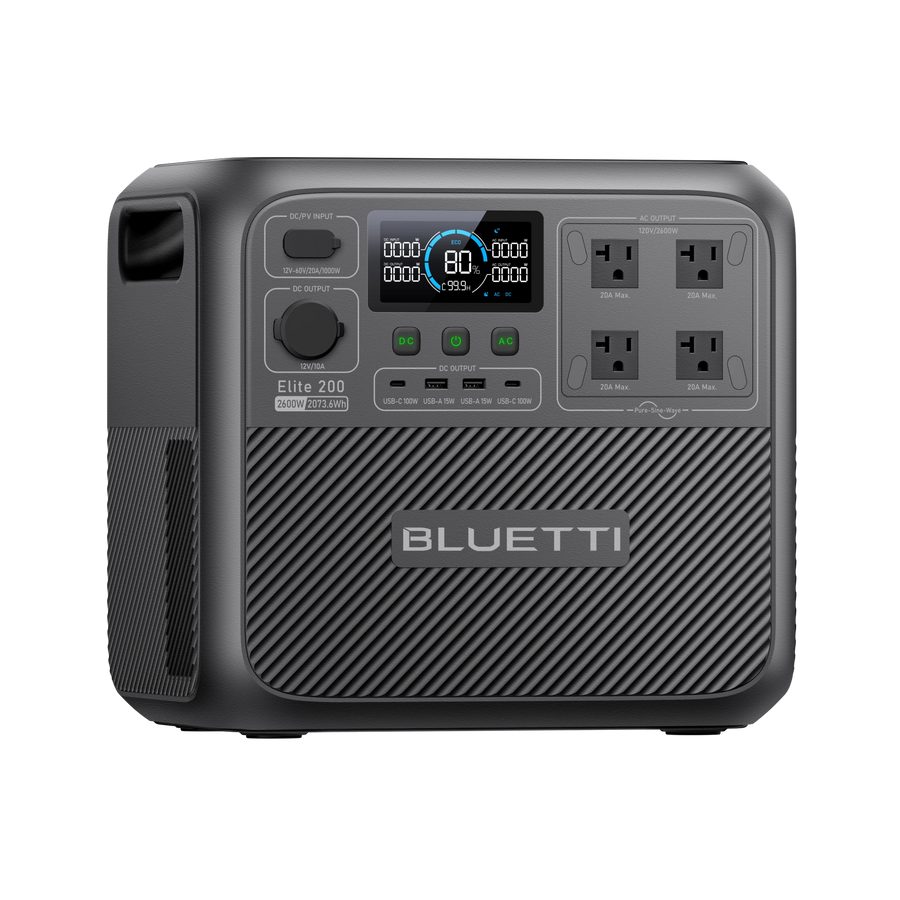
Photo: Bluetti.
The Elite 200 V2 holds 2,073.6Wh — a touch more than the other two — and puts out 2,600W, the strongest inverter here, through four AC outlets. That output shrugs off a fridge’s startup spike and still has room for a microwave at lunch. Its battery rating is the headline: 6,000 or more full charges to 80% capacity, roughly double the EcoFlow’s cycle rating, which matters if the box will cycle often instead of sitting in a closet. Bluetti also rates it at 16 dB under low load — a fridge’s gentle draw is exactly the load where that quiet shows. Best solar panel pairing: 400W to 1,000W of panels on its single 1,000W input; two 200W panels cover a fridge’s daily use in good sun, and it can take far more when you want a fast refill. We compared it head-to-head with the Jackery in Bluetti Elite 200 V2 vs Jackery Explorer 2000 v2.
Pros:
- Lowest cost per watt-hour of the three (~43 cents)
- Battery rated 6,000+ cycles to 80% — the longest-lived here
- Strongest output (2,600W) and very quiet under a fridge’s light load
- 5-year warranty included
Cons:
- Cannot add extra batteries later
- Heaviest here at 53.4 lb
- The app feels basic next to the hardware
Across ~947 ratings on its main Amazon listing, owners praise how much power fits in a small box, the fast charging, and that it runs a fridge and freezer without drama. The complaints that repeat: the weight, an app that feels unfinished, and owners who bought expecting to add a battery later and learned there isn’t one.
Buy it if: one day of fridge backup is your target and you want the lowest price per watt-hour and the longest battery life. Skip it if: you can see yourself needing two or three days — buy the expandable box instead.
The Elite 200 V2 is $899 at Bluetti’s own store today, which is where our link takes you. Check the current price at Bluetti →
Jackery Explorer 2000 v2: The Lightest Way to Get the Same 28 Hours
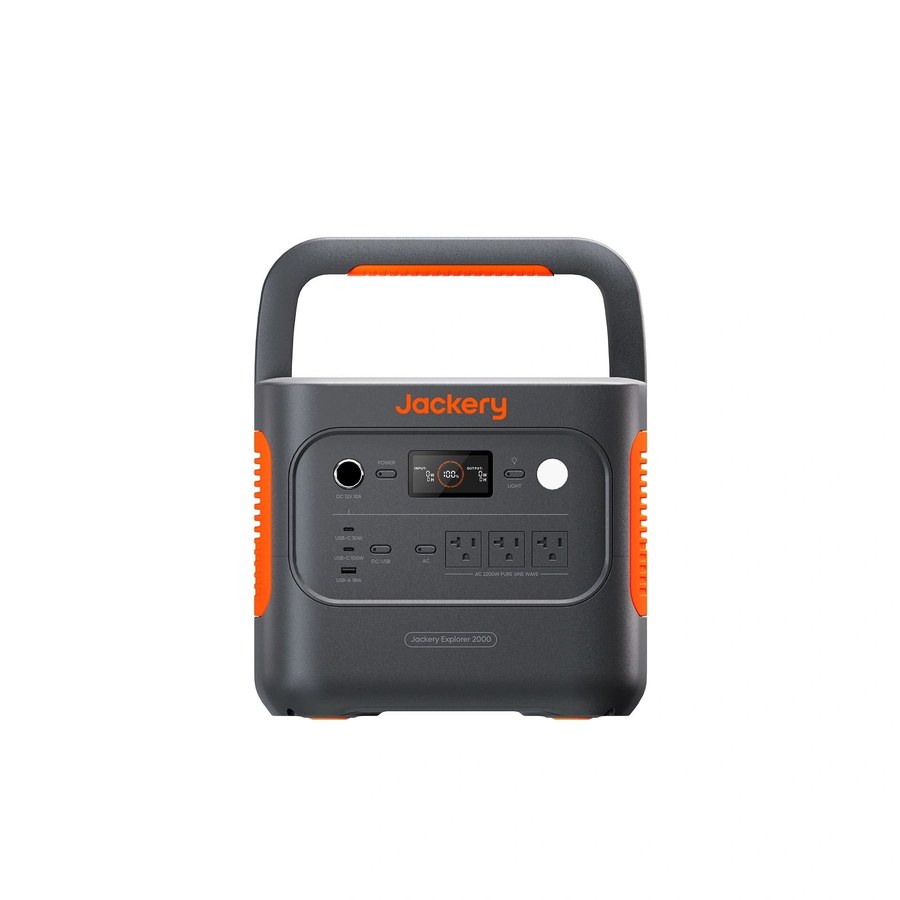
Photo: Jackery.
Our score: 8/10 — the Explorer 2000 v2 runs a typical fridge the same ~28 hours as the other two, but at 39.5 lb it is the only one most people can carry across the house one-handed when the lights go out.
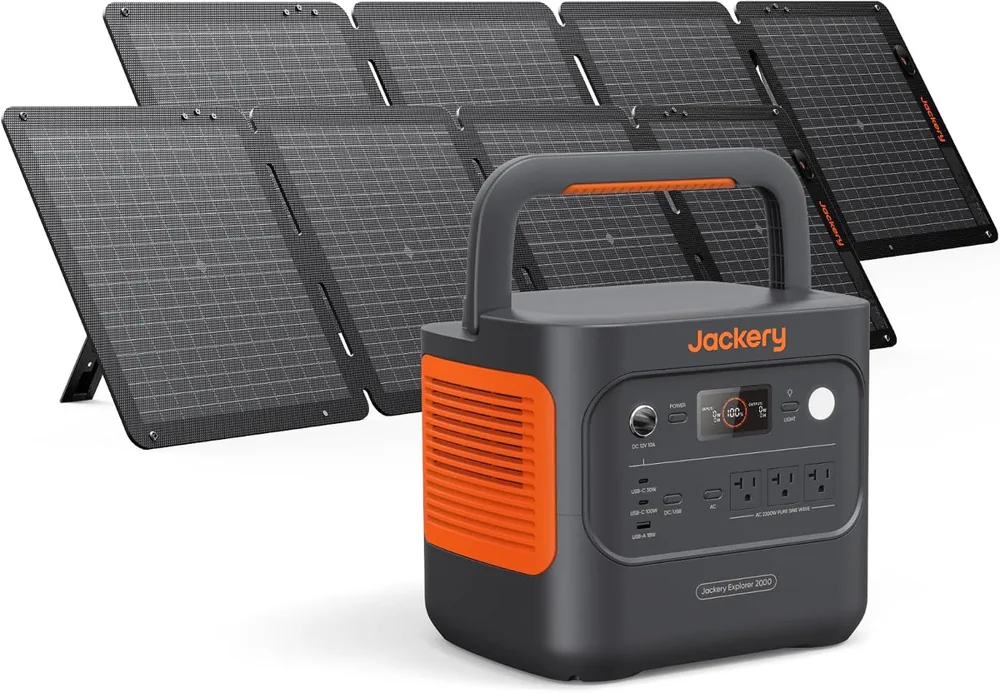
The Explorer 2000 v2 holds 2,042Wh and puts out 2,200W (4,400W surge) through three AC outlets — plenty for any fridge’s startup spike, with the fewest outlets of the three if the whole kitchen tries to move in. Its party trick is weight: about 14 lb lighter than the Bluetti, in a smaller box, with a silent charging mode under 30 dB for overnight refills. The honest weakness is solar: its input tops out at 400W, less than half what the other two accept, so a sunny day puts back less and a flat battery takes around 7.5 hours of good sun on two 200W panels to refill. Best solar panel pairing: two 200W panels — that maxes out its 400W input; buying bigger panels for this box is money wasted.
Pros:
- Lightest 2kWh box here by a wide margin (39.5 lb)
- Quiet, with a silent charging mode under 30 dB
- Fast wall charging — full in about 1.7 hours in emergency mode
- 5-year warranty (3 years, +2 with registration)
Cons:
- Solar input capped at 400W — slow refills from the sun
- Cannot add extra batteries later
- Only three AC outlets
Across ~892 Amazon ratings (4.4 stars), owners love the size, the quiet, and the fast wall charging — it is the one people describe as easy to grab when the lights flicker. The complaints that repeat: solar charging feels slow next to rivals, and the panels and carry case are sold separately, so the full setup costs more than the box price.
Buy it if: the station will move — between rooms, floors, or a car — and wall charging is your main refill. Skip it if: solar is your main refill plan; the 400W cap will frustrate you by day two.
The Explorer 2000 v2 is $899 at Jackery’s own store today, and Amazon runs its own sales on it. Check the current price on Amazon →
Can a power station start a fridge, or only keep it running?
All three stations above can start any home fridge — that is the first thing to check, because starting is the hard part. A fridge’s compressor draws a short spike when it kicks on: roughly 600 to 1,200 watts for a full-size fridge, against running watts of only 100 to 250. A station has to clear that spike every time the compressor cycles, all night. The Jackery’s 4,400W surge is the lowest rating here and still clears it several times over. Where small stations fail is exactly here: many 500Wh-class boxes surge at 1,000W or less, right at the edge of a big fridge’s spike, so the fridge starts ten times and fails on the eleventh. If you already own a small station, test it on your fridge on a quiet weekend — an hour of cycling tells you more than any spec sheet.
How long will a 2,000Wh station run my fridge in a real kitchen?
For a typical full-size fridge, plan on about a day — the table says ~28 hours, and real kitchens usually land a little under the table. The EcoFlow DELTA 2 Max, Bluetti Elite 200 V2, and Jackery Explorer 2000 v2 all hold almost identical capacity (2,042 to 2,073.6Wh), so the brand matters far less than your fridge: the same box runs an efficient fridge for ~35 hours and an older one for ~14. Heat is the biggest real-world tax. A fridge in a 90-degree kitchen works harder than the EnergyGuide test kitchen, and every degree of room temperature shows up as compressor time. If your outage is a summer storm outage, budget the table number minus a quarter and you will rarely be disappointed.
Can one station run a fridge and a freezer together?
Yes — a 2,000Wh station runs a typical fridge and a separate freezer together for about 16 hours. The math: a fridge at 550 kWh/year averages ~63W, and a freezer at 400 kWh/year averages ~46W, so together they average ~109W, and 2,048Wh × 0.85 ÷ 109W lands at roughly 16 hours. Two cautions. First, both compressors can spike at the same moment, so use a station with real surge headroom — all three picks qualify. Second, the freezer is the more forgiving load: a full freezer holds a safe temperature for about 48 hours closed (24 if half full, per USDA guidance), while the fridge side gives you only about 4 hours unpowered. In a long outage, spend your battery on the fridge and let the freezer coast.
What cuts runtime short in a real outage?
Four things eat the table’s hours, in this order. Door openings — every open door dumps cold air the compressor then has to replace; in an outage, get everything for a meal in one trip. Room heat — a fridge in a hot kitchen or garage cycles far more than its label assumes. The extras inside the fridge — ice makers and automatic defrost heaters draw real power in bursts; if your fridge lets you switch the ice maker off, do it before the storm, not during. Everything else you plug in — the router, lights, and phone chargers people add without thinking typically pull 30 to 60 watts together, which quietly turns a fridge-only 28 hours into closer to 20. None of this makes the table wrong; it makes the table a ceiling. Our Solar Recharge-Time Calculator shows the other half of the picture — how fast panels can put those hours back.
How do I stretch the fridge further on the same battery?
The biggest stretch costs nothing: run the fridge in shifts instead of nonstop. USDA food-safety guidance says a closed fridge keeps food safe for about 4 hours without power, and perishables held above 40°F for more than 2 hours should be thrown out — so the rhythm that works is power on until the box is properly cold again, then off for a few hours while it coasts, doors shut, with a cheap appliance thermometer telling you the truth instead of a guess. Households that cycle this way routinely stretch a day of battery into two days of safe food. Two more habits help: cool the fridge a few degrees colder than usual while the grid is still up (cold food is stored runtime), and freeze water bottles to fill empty space — a full fridge holds its cold far better than an empty one. And if the outage runs long, this is where a fuel generator still earns its keep: our portable generator picks for fridge and freezer backup cover the boxes that run as long as your stored fuel does.
What does a day of cold food cost?
There is no fuel and almost no upkeep with any of these three — the honest math is the price per watt-hour and what a day of fridge coverage costs. Per watt-hour: about 43 cents for the Bluetti Elite 200 V2, ~44 cents for the Jackery Explorer 2000 v2, and ~51 cents for the EcoFlow DELTA 2 Max. Divided by the ~28 hours each runs a typical fridge, you are paying roughly $770 to $910 per day of cold food per charge — a lot, until you price a freezer full of meat or a fridge of insulin. Solar changes the math after purchase: a typical fridge uses about 1.5 kWh a day, and 400W of panels in good sun puts back roughly that much, so a station plus panels can hold a fridge indefinitely through sunny days for the cost of the panels alone. The costs that sneak up are those panels (none are included with any pick here), EcoFlow’s extra batteries if you take the growth path, and — years out — the battery itself: all three are rated for 3,000 charges or more to 80%, and when the battery fades, the whole box is the replacement.
Honest notes before you trust the table
Marketing runtimes are not measured on your fridge. When a listing says a station runs “a refrigerator for 30+ hours,” the fine print is usually a small camping fridge drawing 40 watts, not a full-size kitchen fridge averaging 63 watts or more. Any runtime claim that does not name the fridge’s wattage is advertising, not information — the EnergyGuide method on this page exists so you never have to take one on faith.
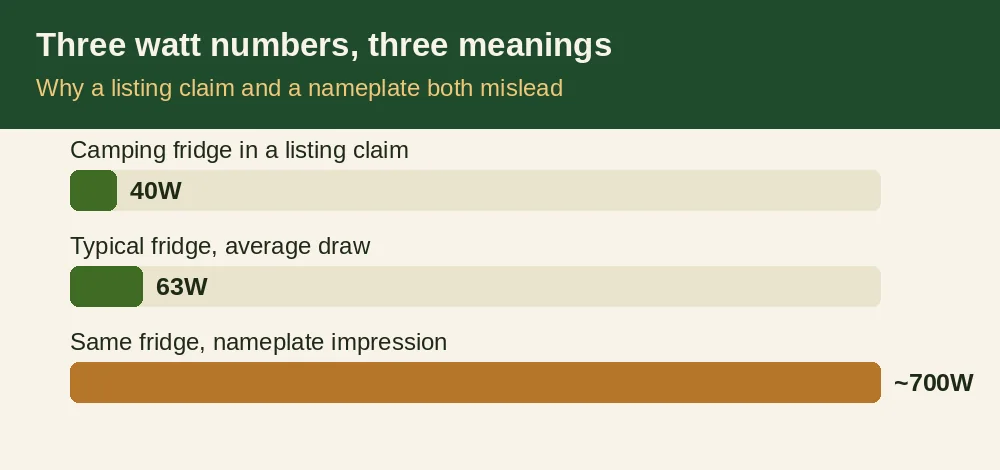
The nameplate watts will scare you for no reason. A fridge labeled 6 or 7 amps looks like a 700-watt load. It is not, on average — that label describes the compressor running flat out, which it does only part of the day. Sizing a station from nameplate amps alone is how people buy twice the battery they need.
Test before the outage, not during it. Plug your fridge into the station on a normal evening and let it cycle for a few hours. You will learn your real runtime, whether the startup spike ever trips the box, and how loud the fans are in your kitchen — all while the grid is still there to rescue the experiment.
These boxes are a day, not a week. A 2,000Wh station holds roughly the energy in eight ounces of gasoline. For a multi-day outage with no sun, the honest options are an expandable station, panels, a generator, or some rotation of all three — our guide to keeping the power on lays out how the pieces fit together.
Common Questions
How long will a 1,000Wh power station run a refrigerator?
About 14 hours for a typical full-size fridge (550 kWh/year on its EnergyGuide label), about 17 hours for an efficient one, and only about 7 hours for an older fridge. That covers most single-night outages, with little left over for anything else.
How long will a 2,000Wh power station run a refrigerator?
About 28 hours for a typical full-size fridge, about 35 hours for an efficient newer model, and about 14 hours for an older fridge — roughly a day of cold food per charge. All three stations recommended on this page sit in this class, which is why it is the size we point most households to.
Can a 500W power station run a fridge?
Starting is the problem, not running. A full-size fridge’s compressor spikes at roughly 600 to 1,200 watts when it kicks on, and many small stations surge at or below that — the fridge may start most of the time and fail sometimes, which is the worst outcome at 2 a.m. Even when it works, 500Wh is only about 7 hours on a typical fridge. Test yours at home before counting on it.
What size power station do I need to run a fridge for 24 hours?
For a typical fridge, a 2,000Wh station — it delivers about 28 hours, which leaves a small margin over the day. An efficient fridge can make 24 hours on roughly 1,500Wh. An older fridge needs the 3,600Wh class (about 24 hours) or an expandable 2,000Wh station with an extra battery.
Does the fridge have to stay plugged into the station the whole time?
No. Food-safety guidance gives a closed fridge about 4 safe hours without power, so many people run the station in shifts — cool the box down, unplug for a few hours, repeat — and stretch one charge across two days. Use an appliance thermometer and keep the fridge at 40°F or below; food held above that for more than 2 hours should be thrown out.
Will running a fridge hurt the power station?
No — a fridge is a normal load for any station rated for it, and all three picks here are rated well past a fridge’s running and startup draw. Repeated overload shutdowns are the warning sign: if a station keeps tripping when the compressor starts, the station is too small, and the fix is a bigger surge rating, not a different fridge.
Sources & freshness: manufacturer spec pages (EcoFlow, Bluetti, Jackery), EnergyGuide and ENERGY STAR fridge energy figures, FoodSafety.gov and USDA power-outage food-safety guidance, price tracking on Keepa and camelcamelcamel, and Amazon owner reviews consulted October 2026. Prices last checked: October 20, 2026. Last updated: October 30, 2026.
Talk it over with other readers. The Truly Preserved Community on Facebook is where readers compare notes on food storage, water, and backup power — and where your questions help decide what we research next. Join the group →
Three more worth a look
Not scored above — three more stations readers ask about for longer fridge coverage. We have not reviewed these; they complete the field.
EcoFlow DELTA Pro
The 3,600Wh row in the table above: about 49 hours on a typical fridge, and the step up for houses backing up more than a fridge and lights.
Anker SOLIX F2000
Another 2,048Wh entry, sold on wheels with a pull handle, with a big existing owner base — same ~28-hour fridge class as our picks.
Goal Zero Yeti 2000X
The old guard: Goal Zero built this category for the off-grid crowd. Stock comes and goes on Amazon — worth a check when you shop.
As an Amazon Associate, Truly Preserved earns from qualifying purchases. Mentioned products are not reviewed or scored by us.
Related reading: the freezer version of this math — how long a power station will run a freezer, worked out by freezer type and station size, with the USDA closed-lid hours stacked after the battery.