
Every food-storage shelf runs on one question: how long does this actually keep? Not the date stamped on the bag — the realistic number, for food packed right and kept in a cool, dark, dry place. This lookup puts 30 common staples in one searchable table: the honest storage life, the packing method each food wants, and the catch that surprises people. It is the companion to our Long-Term Food Storage Calculator — that page counts the pounds; this one counts the years. The figures follow university extension and food-storage guidance, at the conservative end of the published ranges. This table is also the reference behind the dates-checked item on our Household Emergency Checklist, which works the whole first 72 hours as one tick-off list.
Look up a food
Showing all 30 foods.
| Food | Realistic storage life | Best way to store it | Worth knowing |
|---|---|---|---|
| White rice | Up to 25–30 years | Mylar bag with oxygen absorbers, in a bucket | The backbone staple. Packed right and kept cool, it is close to a forever food. |
| Brown rice | About 6 months | Original bag in a cool pantry; the freezer stretches it | The oils in the bran go rancid. This is a working-pantry food, not a deep-store one. |
| Rolled oats | Up to 20–25 years | Mylar bag with oxygen absorbers | Steel-cut oats run close behind; instant oats keep more like 5–10 years. |
| Wheat berries | Up to 25–30 years | Mylar bag or bucket with oxygen absorbers | Grind them fresh. Whole berries outlast flour by decades. |
| White flour | Up to 10 years in mylar; 1–2 in the bag | Mylar bag with oxygen absorbers | Whole-wheat flour is a months food — the germ oil spoils it. |
| Dry pasta | Up to 10–15 years | Mylar bag, or the box sealed inside a bucket | Plain semolina only. Egg noodles keep 1–2 years. |
| Quinoa | Up to 10–15 years | Mylar bag with oxygen absorbers | Rinse it before cooking to wash off the bitter natural coating. |
| Cornmeal (degerminated) | Up to 10–15 years | Mylar bag with oxygen absorbers | Whole-grain cornmeal keeps about a year — check which kind you bought. |
| Pearled barley | Up to 15–20 years | Mylar bag with oxygen absorbers | Hulled barley keeps for less time than pearled. |
| Popcorn kernels | Up to 10–15 years | Sealed jar or mylar bag | Kernels need to stay dry but not dried out, or they stop popping. |
| Potato flakes | Up to 10–15 years | Mylar bag with oxygen absorbers | Plain flakes only; seasoned mixes keep for less time. |
| Dried beans (pinto, black, kidney) | Up to 25–30 years | Mylar bag with oxygen absorbers | Very old beans stay safe but take longer to soften; a long soak and patience fix most of it. |
| Lentils | Up to 20–25 years | Mylar bag with oxygen absorbers | No soaking needed — the fastest-cooking legume in the store. |
| Split peas | Up to 20–25 years | Mylar bag with oxygen absorbers | Same story as lentils: soups and sides that cook without a soak. |
| Powdered milk (nonfat) | Up to 15–20 years | Sealed #10 can, or mylar with oxygen absorbers | Whole-milk powder keeps only a year or two — the fat in it spoils. |
| Freeze-dried meals | Up to 25–30 years | Original sealed cans or pouches, left sealed | Pouches run shorter than #10 cans. Ready-packed versions like Mountain House #10 cans are the set-and-forget end of this row. |
| Peanut butter powder | Up to 10–15 years | Mylar bag with oxygen absorbers | Jarred peanut butter is a 1–2 year food; the powder is the storage form. |
| TVP (textured vegetable protein) | Up to 10–15 years | Mylar bag with oxygen absorbers | Takes on the flavor of whatever it cooks in — a protein extender, not a main event. |
| Canned meat (tuna, chicken) | 3–5 years at best quality | Original cans, cool and dark | Sound cans stay safe past the date; texture and flavor fade. Dent-free and rust-free is the rule. |
| Canned vegetables | 3–5 years at best quality | Original cans, cool and dark | Acid foods — tomatoes above all — sit at the short end, closer to 18 months to 2 years at best quality. |
| Dried fruit (raisins, apricots) | 1–2 years | Sealed bag or jar; the freezer stretches it | The sugar keeps it safe a long while; chewiness goes first. |
| Honey | Keeps indefinitely | Sealed jar at room temperature | It crystallizes, it does not spoil. A warm water bath brings it back to liquid. |
| Sugar (granulated) | Keeps indefinitely | Dry sealed bucket — no oxygen absorber | An absorber turns sugar into a brick. Dry is the only thing sugar asks for. |
| Salt | Keeps indefinitely | Dry sealed container | It can cake and table salt can yellow over the years; it still does its job. |
| Cocoa powder (unsweetened) | Up to 10 years | Mylar bag or a sealed jar | Mixes with milk powder stirred in keep for less time than plain cocoa. |
| Instant coffee | Up to 20 years | Original sealed jar, or mylar | Roasted beans are about a 1-year food for flavor. Instant is the storage coffee. |
| Baking soda | About 2–3 years of full fizz | Sealed and dry | Test a pinch in vinegar. Tired soda has lost its lift but still cleans fine. |
| White vinegar | Keeps indefinitely | Original bottle | The acid is its own preservative. A cloudy mother forming is harmless. |
| Dry yeast | 1–2 years; longer in the freezer | Original packets, freezer is best | Proof it in warm water before baking day. Dead yeast is the saddest surprise in storage cooking. |
| Bouillon (cubes or powder) | Up to 5 years at best quality | Sealed jar, kept dry | It cakes and dulls long before it could ever become unsafe. |
One Shelf, Read Honestly: A Worked Example
Picture a shelf stocked in 2021 and opened today. The bucket of white rice, packed in mylar with absorbers and kept in a cool closet: it was a 25-year food then and it has used up five of those years — fine in 2026, fine in 2040. The bag of white flour next to it, never repacked: it was done by 2023, and the storage life it had left is exactly why the table gives flour two numbers instead of one. The jarred peanut butter from 2023 was a 1–2 year food and is past its best; its replacement on a serious shelf is the powder, at 10–15 years. Same shopping trip, three different clocks. That is the whole skill this page is for: knowing which clock each food is on before the year you need it.
How to Use This Lookup
- Read every number as “packed right, kept cool.” These years assume under about 70 degrees, dark, and dry, with oxygen kept out where the table says so. A hot garage can cut them in half. Heat is the biggest thief on the shelf — bigger than time.
- Match the method to the food, not the other way round. Most dry staples want mylar and absorbers — our Oxygen Absorber Calculator sizes them by the bag. Sugar and salt are the standing exceptions: they want dry, not sealed-against-oxygen.
- Put the short clocks in the working pantry. Brown rice, flour in the bag, jarred peanut butter, dried fruit — these are eat-and-rotate foods. The deep store is for the 10-year-and-up rows.
- When a can is in doubt, the can decides. Bulging, leaking, rusted through, or spurting on opening means out, whatever the table says. The years in this table are for sound cans and sealed packages only.
Questions People Ask
Is food past its date unsafe?
Usually not — the dates on shelf-stable food are about quality, not safety, and the years in this table already sit past most printed dates. What fades is flavor, texture, and vitamins. The exceptions are the ones in step 4 above: a damaged can is out on sight, and anything that smells rancid — the fats in brown rice, whole-wheat flour, whole-milk powder — is done whether the calendar agrees or not.
Why does packing change the years so much?
Oxygen, moisture, light, and heat are the four things that age stored food, and packing is how you fight the first three. A mylar bag with the right absorbers takes oxygen nearly to zero, which is why the same white flour is a 1–2 year food in its paper bag and an up-to-10-year food sealed properly.
What is the single best food to store first?
White rice, and it is not close: cheapest calories on the shelf, up to 25–30 years packed right, and it cooks the same on day one as year twenty. Beans ride with it for the protein rice lacks. The pair of them is the foundation almost every deep pantry is built on.
Does freezing extend these numbers?
For the short-clock foods, yes — brown rice, flour, and yeast all stretch in a freezer, and freezing dry goods for a few days is also the standard way to kill any pantry pests before long storage. For the mylar-packed staples the freezer adds little; cool and dark is already doing the work.
How do I know my storage spot is cool enough?
If the room is comfortable to stand in year-round, it is close. Interior closets on the ground floor beat garages, attics, and sheds everywhere the seasons swing. Every 10 degrees cooler roughly stretches the life of most stored foods — a basement shelf is worth real years over a garage shelf.
The long-keepers, ready-packed
Most rows in the table are pack-it-yourself staples. These three from our Preserve the Pantry hub arrive already packed for the long end of their rows:
Mountain House #10 Can
The freeze-dried row at its longest: sealed cans rated in decades, in the flavors our reviews score highest.
Augason Farms Variety Pail
The bulk-calorie pail from our kit reviews — the most servings per dollar of the ready-made options we scored.
Nutrient Survival Powdered Milk
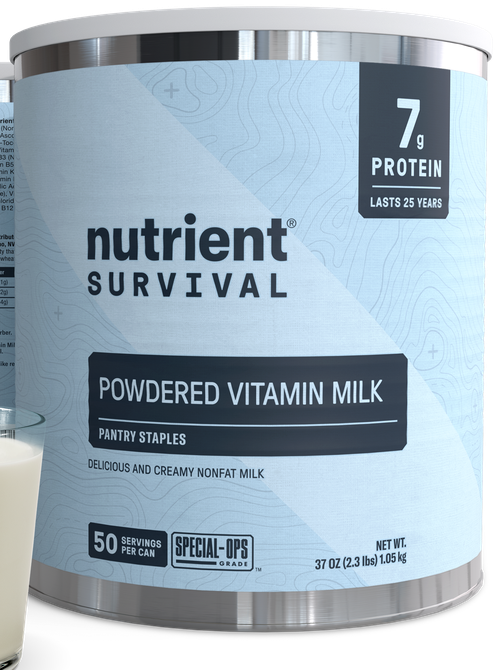
The powdered-milk row done for you: packed for long storage instead of the grocery shelf’s short clock.
As an Amazon Associate, Truly Preserved earns from qualifying purchases. It never changes a score or a number on this page.