
Truly Preserved is reader-supported. If you buy through a link on this page we may earn a commission at no extra cost to you. Nobody pays for placement or scores.
THE SHORT ANSWER
Carrots are a low-acid vegetable, so sliced or diced carrots are canned in a pressure canner — never a water bath. Pints process 25 minutes and quarts 30 minutes, at 11 pounds on a dial-gauge canner (0–2,000 feet) or 10 pounds on a weighted-gauge canner (0–1,000 feet), with 1 inch of headspace. An average of 17½ pounds of carrots without tops fills a 7-quart canner load. Every figure on this page comes from the USDA’s tested procedure, credited at the bottom.
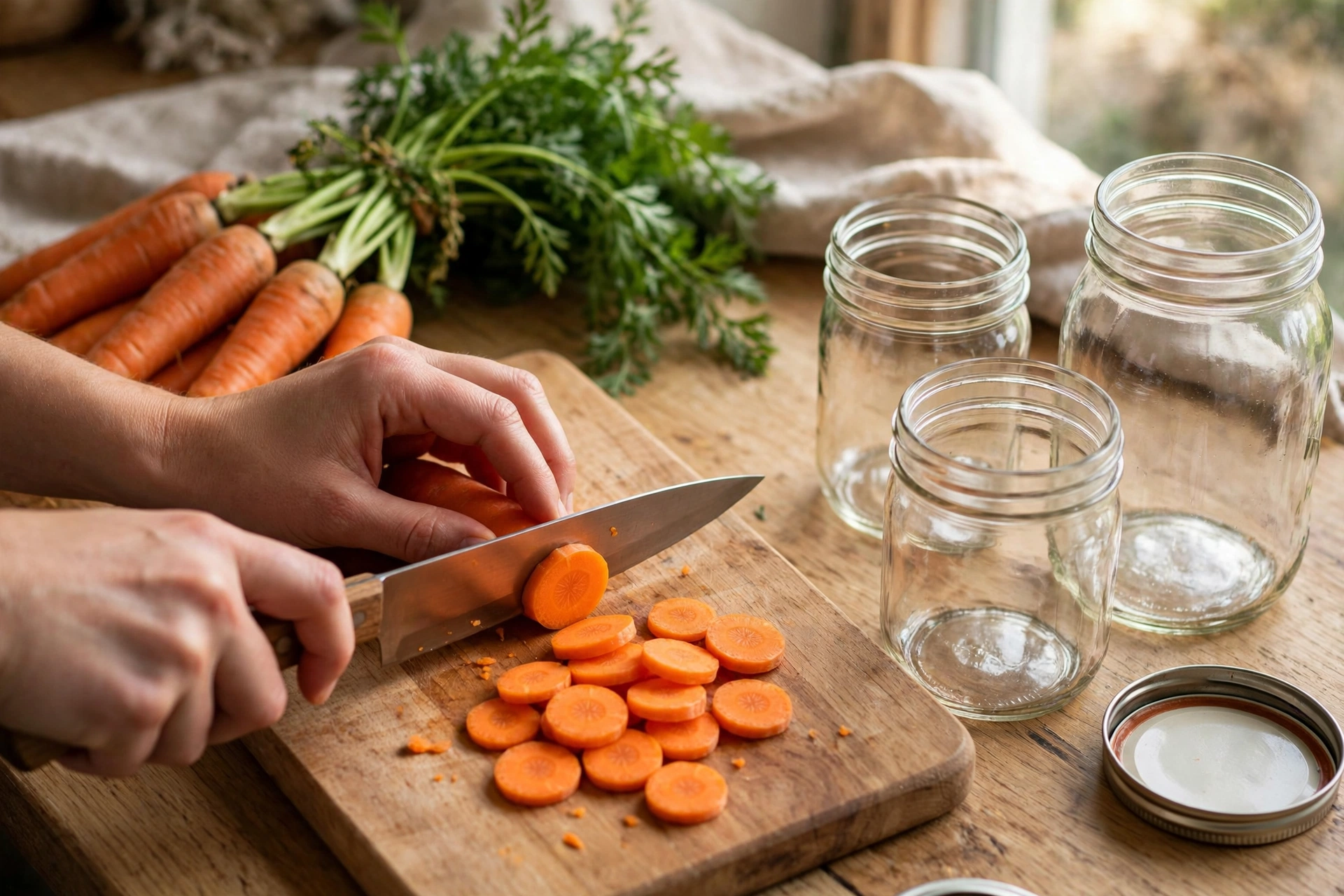
Canned carrots are the quiet workhorse jar — sweet, ready-cooked rounds that drop into soups, stews, and pot roasts all winter without a peeling session attached. A good carrot patch produces far more than a family eats fresh, and carrots can up sweeter than they went in.
This guide follows the USDA’s tested procedure for sliced or diced carrots exactly, hot pack and raw pack. The canner discipline is the same one our flagship how to can green beans teaches on a 20-minute vegetable; carrots run a little longer. If the canner itself is still a decision, best pressure canner for beginners covers the sizes worth buying. This guide is part of our preservation guides.
What You Need
An average of 17½ pounds (without tops) is needed per canner load of 7 quarts, and an average of 11 pounds per load of 9 pints. A bushel (without tops) weighs 50 pounds and yields 17 to 25 quarts — an average of 2½ pounds per quart. For quality, the USDA says to select small carrots, preferably 1 to 1¼ inches in diameter; larger carrots are often too fibrous. You also need a pressure canner, pint or quart jars with new lids, and canning salt if you want it: 1 teaspoon per quart, for flavor only.

Presto 16-Quart Pressure Canner
The beginner pressure canner sized for carrot loads — 25 minutes for pints, 30 for quarts — with the dial and weighted options this page's tables cover.
$151.63 from Amazon
Ball Half-Pint Mason Jars, 12-Pack
Half-pint jars suit carrots for small households — a single meal's worth per jar, and the right size for a first trial batch.
Check Availability
Ball Regular Mouth Canning Lids, 96 Count
Flat lids are single-use, and a bushel of carrots is 17 to 25 quarts of jars. The 96-count box keeps a fresh lid on every one.
$36.99 from AmazonBefore You Start
The decisions that matter are made at the sink, not the stove. Choose small carrots — 1 to 1¼ inches in diameter is the USDA’s preference, because larger carrots are often too fibrous — and wash, peel, and rewash them before cutting; the peel-and-rewash order is in the procedure, not a nicety. And settle the canner question now: carrots are low-acid, the USDA gives no boiling-water process for them, and the pressure in the tables rises with altitude while the time stays the same.
How to Can Carrots, Step by Step
- Prepare the carrots. Wash, peel, and rewash the carrots. Slice or dice them.
- Hot pack. Cover the carrots with boiling water, bring to a boil, and simmer for 5 minutes. Fill jars, leaving 1 inch of headspace.
- Or raw pack. Fill jars tightly with raw carrots, leaving 1-inch headspace.
- Add liquid and salt. Add 1 teaspoon of salt per quart to the jar, if desired. Add hot cooking liquid or water, leaving 1-inch headspace on either pack.
- Close the jars. Wipe each rim clean, center a new lid, and screw the band down fingertip-tight.
- Process. Process in the pressure canner for the time and pressure for your jar size, canner type, and altitude in the tables below.
- Rest and check. Let the canner cool and depressurize on its own, lift the jars out, and check every seal before the jars go on the shelf.
The Numbers: Times, Pressures, and Amounts
| Jar size | Process time | Dial gauge, 0–2,000 ft | Dial gauge, 2,001–4,000 ft | Dial gauge, 4,001–6,000 ft | Dial gauge, 6,001–8,000 ft |
|---|---|---|---|---|---|
| Pints | 25 minutes | 11 lb | 12 lb | 13 lb | 14 lb |
| Quarts | 30 minutes | 11 lb | 12 lb | 13 lb | 14 lb |
| Jar size | Process time | Weighted gauge, 0–1,000 ft | Weighted gauge, above 1,000 ft |
|---|---|---|---|
| Pints | 25 minutes | 10 lb | 15 lb |
| Quarts | 30 minutes | 10 lb | 15 lb |
Headspace is 1 inch for both packs and both jar sizes. Processing times are the same for hot pack and raw pack.
Carrots also freeze well — blanched slices hold their color and sweetness in the freezer without a canner at all. These are the two tools that side of the job runs on.

Nesco VS-12 Vacuum Sealer
For the share of the carrot crop that gets frozen instead of canned — vacuum-sealed bags keep blanched carrot slices from drying out in the freezer.
$108.18 from Amazon
Ziploc Freezer Quart Bags
Quart freezer bags are the freezer half of the method — blanched slices go in flat and pour out by the handful for soups all winter.
$26.48 from AmazonCommon Mistakes
Canning the big, woody carrots. The USDA steers you to small carrots, 1 to 1¼ inches across, for a reason: larger carrots are often too fibrous, and canning does not soften fiber into tenderness.
Reaching for the water bath canner. Carrots are low-acid and there is no tested boiling-water process for them. Pressure canner, full stop.
Skipping the rewash after peeling. The procedure is wash, peel, and rewash. The second wash is what takes the peelings’ dirt off the cut surfaces before they are sliced.
Guessing at altitude. A dial-gauge canner run at 11 pounds by a cook at 5,000 feet is under-processed food. Find your altitude band in the table before the canner heats.
Rushing the cool-down. Forcing a pressure canner open pulls liquid out of the jars and can fail seals. Let it come down on its own.
Storage and Shelf Life
Store sealed jars in a cool, dark, dry place with the bands removed, and label each jar with the date. Home-canned carrots hold their best quality for about a year; rotate the shelf so the oldest jars get eaten first. A jar with a failed seal goes in the refrigerator and gets eaten within a few days, or gets reprocessed with a fresh lid within 24 hours.
Viewers also searched for these items.

All American 21.5-Quart Pressure Canner
The cast-aluminum, metal-to-metal-seal canner built to be handed down — a fit for a vegetable that gets canned every single year.
$449.95 from Amazon
Morton Canning and Pickling Salt, 4 lb
The salt in this recipe is optional and for flavor — 1 teaspoon per quart — and this is the pure canning salt the recipe means.
$2.68 from Amazon
Etekcity Digital Kitchen Scale
Carrots are planned by weight without tops — 17½ pounds for 7 quarts — and a kitchen scale turns a garden pile into a known load.
$9.99 from AmazonFrequently Asked Questions
Can I can carrots in a water bath canner?
No. Carrots are a low-acid vegetable and the USDA procedure is pressure canner only — 25 minutes for pints and 30 minutes for quarts at the pressures in the tables.
Do I have to add salt?
No. The 1 teaspoon per quart is for flavor only, and the procedure works without it.
Hot pack or raw pack — which is better?
Both use the same times and pressures. The hot pack simmers the carrots 5 minutes before jarring; the raw pack fills the jars tightly with raw carrots instead. Pick the rhythm that fits your kitchen.
How many carrots do I need?
An average of 17½ pounds without tops for 7 quarts, or 11 pounds for 9 pints. A bushel without tops is 50 pounds and yields 17 to 25 quarts.
Procedure, times, and amounts: USDA Complete Guide to Home Canning, Guide 4, “Carrots — Sliced or Diced”, via the National Center for Home Food Preservation.
Prices shown on this page were last checked November 26, 2026 — prices change; check before you buy.
Talk it over with other readers
The Truly Preserved Community on Facebook is where readers compare notes on food storage, water, and backup power — and where your questions help decide what we research next.