
Truly Preserved is reader-supported. If you buy through a link on this page we may earn a commission at no extra cost to you. Nobody pays for placement or scores.
THE SHORT ANSWER
Chicken is canned in a pressure canner only — there is no other tested method. Boneless pints process 75 minutes and quarts 90 minutes; bone-in pints 65 minutes and quarts 75 minutes, at 11 pounds on a dial-gauge canner (0–2,000 feet) or 10 pounds on a weighted-gauge canner (0–1,000 feet). Headspace is 1¼ inches — more than vegetables get — and the hot pack, with the meat cooked about two-thirds done and covered with hot broth, is the pack the USDA prefers. Every figure on this page comes from the USDA’s tested procedure, credited at the bottom.
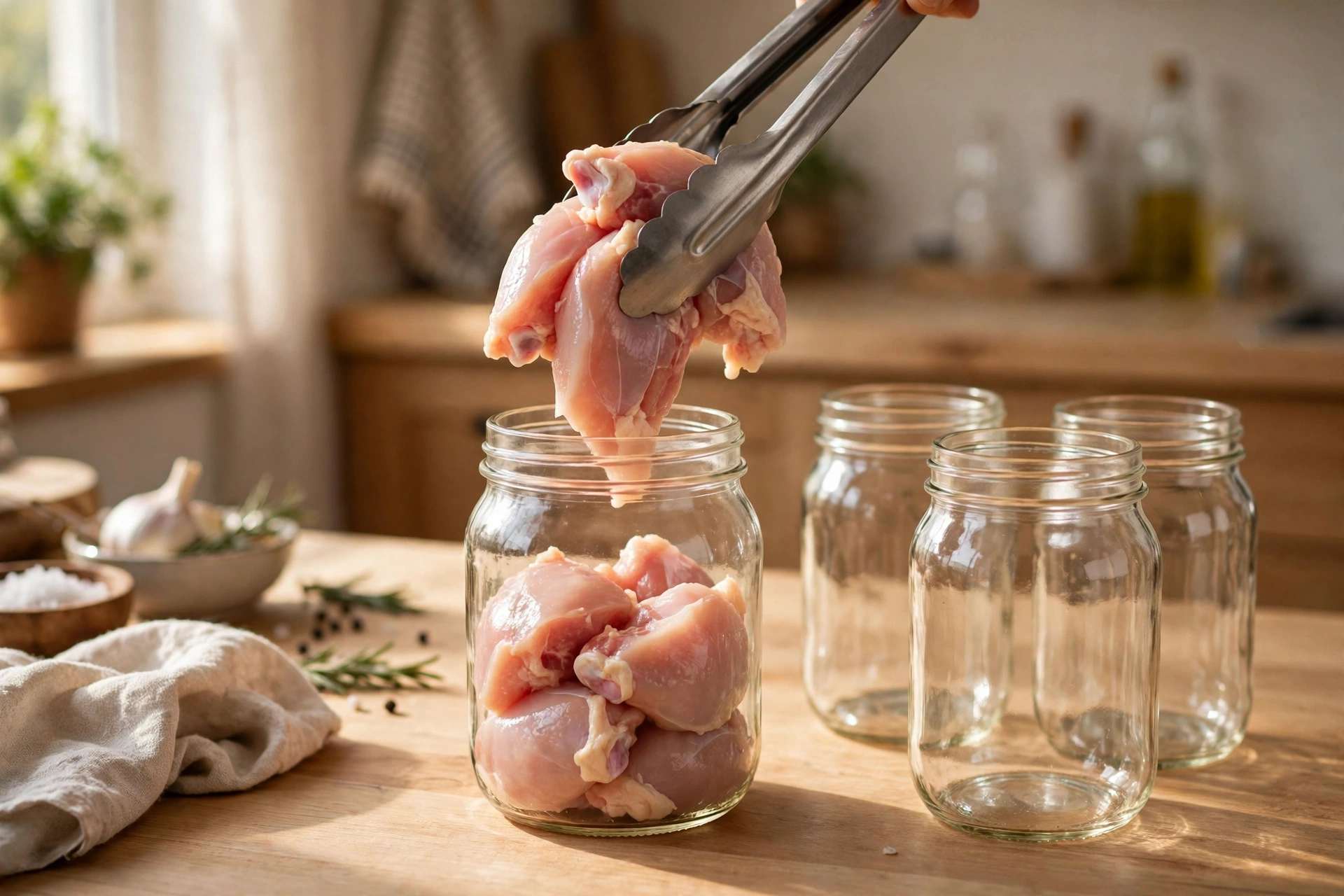
A jar of canned chicken is the fastest dinner in the pantry: cooked, tender, in its own broth, ready for soup, casserole, or chicken salad without a thaw or a trip to the store. It is also meat — low-acid, dense, and unforgiving of shortcuts — which is why this procedure is followed to the letter or not at all.
This guide follows the USDA’s tested “Chicken or rabbit” procedure exactly, for chicken, in both hot pack and raw pack and both bone-in and boneless forms. The same procedure covers rabbit, and the source notes it is written for chicken, duck, goose, turkey, and game birds as well. If the canner is still a purchase ahead of you, best pressure canner for beginners covers the choice, and this guide is part of our preservation guides.
What You Need
Start with freshly killed and dressed, healthy birds — the USDA notes that large chickens are more flavorful than fryers. Dressed chicken should be chilled for 6 to 12 hours before canning. (For rabbit under the same procedure: dressed rabbits are soaked 1 hour in water containing 1 tablespoon of salt per quart, then rinsed.) You also need a pressure canner — there is no substitute — pint or quart jars with new lids, broth for the hot pack, and canning salt if you want it: 1 teaspoon per quart, for flavor only. Excess fat is removed before the meat is cut into jar-size pieces.

Presto 16-Quart Pressure Canner
The beginner pressure canner for meat's long processes — up to 90 minutes for boneless quarts — with the dial and weighted options this page's tables cover.
$151.63 from Amazon
Ball Half-Pint Mason Jars, 12-Pack
Half-pint jars hold a single meal's worth of chicken for small households — one jar stretches to a soup or a chicken salad.
Check Availability
Ball Regular Mouth Canning Lids, 96 Count
Flat lids are single-use, and meat day is not the day to run short. The 96-count box keeps a fresh lid on every jar, every batch.
$36.99 from AmazonBefore You Start
Settle three things first. The canner: chicken is a low-acid meat and pressure canning is the only tested method — no water bath, no oven, no electric pressure cooker process exists in the source. The chill: dressed chicken is chilled 6 to 12 hours before canning, so this is a two-day rhythm for birds you dress yourself — dress and chill one day, can the next. And the pack decision: the USDA says the hot pack is preferred for best liquid cover and quality during storage, because natural poultry fat and juices are usually not enough to cover the meat in raw packs.
How to Can Chicken, Step by Step
- Chill and trim. Use freshly killed and dressed, healthy chickens, chilled for 6 to 12 hours before canning. Remove excess fat. Cut the chicken into pieces sized to fit your jars, with the bones in or removed — your choice, and it changes the processing time.
- Hot pack (preferred). Boil, steam, or bake the meat until about two-thirds done. Fill jars with the pieces and hot broth, leaving 1¼-inch headspace.
- Or raw pack. Fill jars loosely with raw meat pieces, leaving 1¼-inch headspace. Do not add liquid.
- Add salt if you want it. 1 teaspoon of canning salt per quart jar, if desired, on either pack. It flavors the meat; it does not preserve it.
- Close the jars. Wipe each rim clean — fat on a rim is a failed seal waiting — center a new lid, and screw the band down fingertip-tight.
- Process. Process in the pressure canner for the time and pressure for your pack, bones, jar size, and altitude in the tables below. Boneless meat processes longer than bone-in; do not mix the rows up.
- Rest and check. Let the canner cool and depressurize on its own, lift the jars out, and check every seal before the jars go on the shelf.
The Numbers: Times, Pressures, and Amounts
Dial-gauge pressure canner:
| Style of pack | Jar size | Process time | Dial gauge, 0–2,000 ft | Dial gauge, 2,001–4,000 ft | Dial gauge, 4,001–6,000 ft | Dial gauge, 6,001–8,000 ft |
|---|---|---|---|---|---|---|
| Without bones — hot and raw | Pints | 75 min | 11 lb | 12 lb | 13 lb | 14 lb |
| Without bones — hot and raw | Quarts | 90 min | 11 lb | 12 lb | 13 lb | 14 lb |
| With bones — hot and raw | Pints | 65 min | 11 lb | 12 lb | 13 lb | 14 lb |
| With bones — hot and raw | Quarts | 75 min | 11 lb | 12 lb | 13 lb | 14 lb |
Weighted-gauge pressure canner:
| Style of pack | Jar size | Process time | Weighted gauge, 0–1,000 ft | Weighted gauge, above 1,000 ft |
|---|---|---|---|---|
| Without bones — hot and raw | Pints | 75 min | 10 lb | 15 lb |
| Without bones — hot and raw | Quarts | 90 min | 10 lb | 15 lb |
| With bones — hot and raw | Pints | 65 min | 10 lb | 15 lb |
| With bones — hot and raw | Quarts | 75 min | 10 lb | 15 lb |
Headspace is 1¼ inches for both packs, with bones or without.
Plenty of chicken is better frozen than canned — raw pieces and whole birds freeze without a 90-minute process attached. These are the two tools that side of the job runs on.

FoodSaver Elite Vacuum Sealer
For the share of the flock that gets frozen instead of canned — vacuum-sealed chicken pieces keep far longer in the freezer without drying out.
$218.56 from Amazon
Ziploc Freezer Quart Bags
Quart freezer bags are the simple half of the freezing method — portioned pieces go in flat, stack tight, and thaw one meal at a time.
$26.48 from AmazonCommon Mistakes
Reaching for any canner but a pressure canner. There is no tested boiling-water, oven, or electric-cooker process for chicken. The USDA procedure is pressure canner only.
Using the bone-in time for boneless meat. Boneless jars are denser and process longer — 75 minutes for pints and 90 for quarts, against 65 and 75 with bones. The rows are not interchangeable.
Adding liquid to a raw pack. The raw pack is explicit: fill loosely, leave 1¼-inch headspace, and do not add liquid. The hot pack is the one that gets broth.
Skipping the chill. Dressed chicken is chilled 6 to 12 hours before canning. Birds canned warm off the dressing table skip a step the procedure builds in.
Packing the fat in. The procedure says to remove excess fat before cutting the pieces. Fat left on works against the seal and the storage quality.
Storage and Shelf Life
Store sealed jars in a cool, dark, dry place with the bands removed, and label each jar with the date and whether it is bone-in or boneless — the distinction mattered at canning time and matters again in meal planning. Home-canned chicken holds its best quality for about a year; rotate the shelf so the oldest jars get eaten first. A jar with a failed seal goes in the refrigerator and gets eaten within a few days, or gets reprocessed with a fresh lid within 24 hours.
Viewers also searched for these items.

All American 21.5-Quart Pressure Canner
The cast-aluminum, metal-to-metal-seal canner built for decades of the longest processes in the guide — and meat is exactly that.
$449.95 from Amazon
Morton Canning and Pickling Salt, 4 lb
The salt in this procedure is optional and for flavor — 1 teaspoon per quart — and this is the pure canning salt the procedure means.
$2.68 from Amazon
ThermoPro Instant-Read Thermometer
An instant-read thermometer earns its place on meat day checking the hot pack's progress before the jars are filled and sealed.
$8.99 from AmazonFrequently Asked Questions
Can I can chicken in a water bath or an electric pressure cooker?
No. The USDA procedure for chicken is a pressure canner process, and no other method is given. Meat is low-acid and dense; the pressure canner is the whole safety story.
Why does boneless chicken process longer than bone-in?
The tables say so, and the page follows them exactly: without bones, pints take 75 minutes and quarts 90; with bones, pints take 65 and quarts 75. Use the row that matches the jar you filled.
Hot pack or raw pack — which does the USDA prefer?
Hot pack. The source states it is preferred for best liquid cover and quality during storage, and that natural poultry fat and juices are usually not enough to cover the meat in raw packs.
Does this procedure work for rabbit or turkey?
The source procedure is titled “Chicken or rabbit” and its text covers chicken, duck, goose, turkey, game birds, and rabbit. Rabbit gets one extra step: soak the dressed rabbit 1 hour in water containing 1 tablespoon of salt per quart, then rinse.
Procedure, times, and amounts: USDA Complete Guide to Home Canning, Guide 5, “Chicken or Rabbit”, via the National Center for Home Food Preservation.
Prices shown on this page were last checked November 26, 2026 — prices change; check before you buy.
Talk it over with other readers
The Truly Preserved Community on Facebook is where readers compare notes on food storage, water, and backup power — and where your questions help decide what we research next.