
Truly Preserved is reader-supported. If you buy through a link on this page we may earn a commission at no extra cost to you. Nobody pays for placement or scores.
THE SHORT ANSWER
Wash firm, ripe strawberries, leave them whole or cut them in half, and — because strawberries are a soft-skinned berry — dip them for 10 minutes in an ascorbic acid or other antimicrobial solution instead of cracking their skins in boiling water. Dry at 140°F until the berries are hard and rattle when the tray is shaken. Colorado State University Extension gives 24 to 36 hours for berries — times are ranges, and the rattle test decides. Every figure on this page comes from the credited extension source at the bottom.
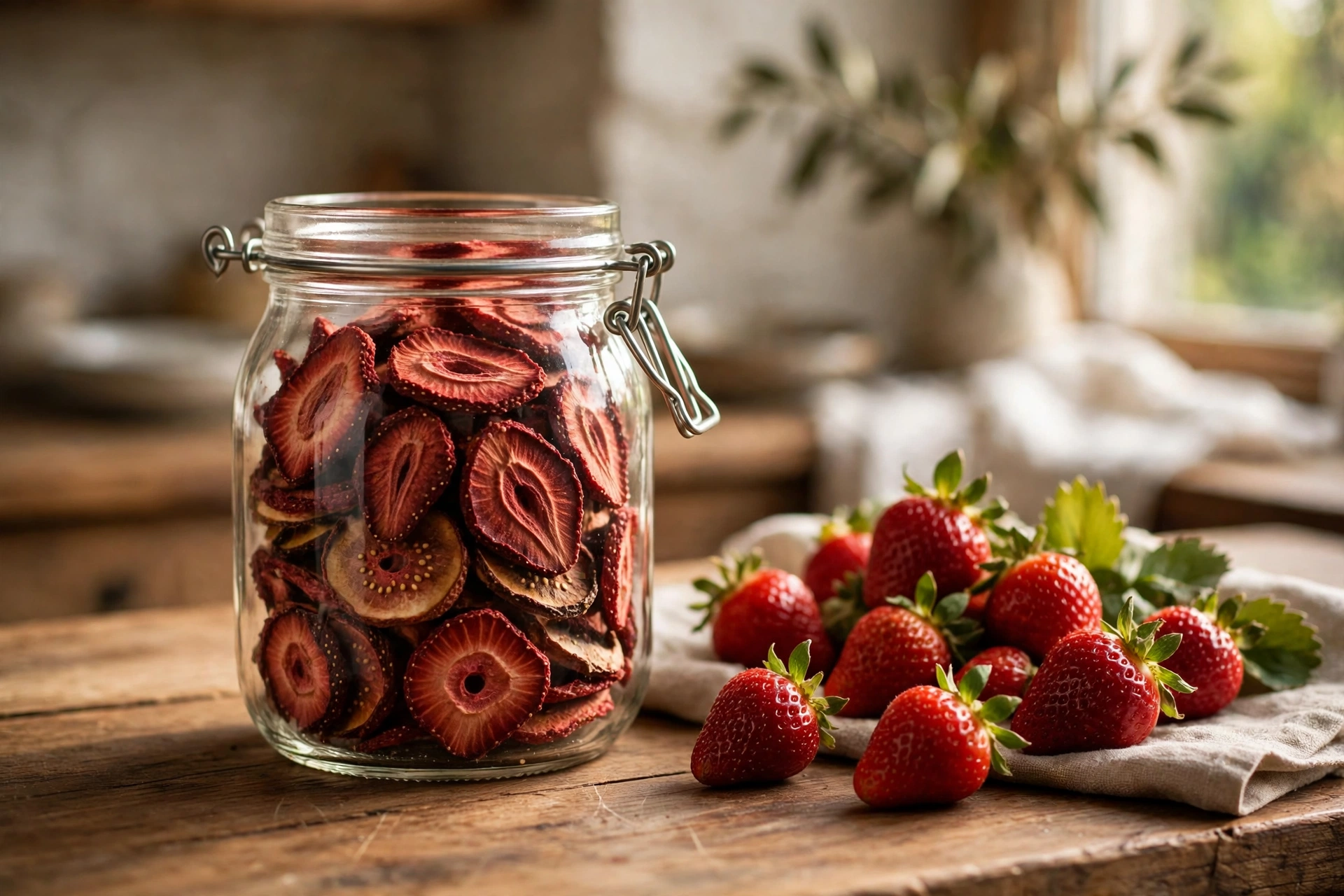
Dried strawberries are the jar that disappears first. Fresh berries have a shelf life measured in days and a flavor that fades almost as fast; dried, they turn into concentrated, chewy-sweet pieces that keep for months and go into oatmeal, trail mix, baking and straight snacking. They are also the slowest common fruit in the dehydrator — berries are in the longest time bracket in Colorado State’s fruit table — so this is a batch you start when the machine can run undisturbed.
This guide follows Colorado State University Extension’s berry procedure exactly, including the soft-skin exception that changes the pretreatment for strawberries. This guide is part of our preservation guides; the same dip-and-dry pattern runs through how to dehydrate apples and the banana guide in this series. For the machine itself, the best dehydrators for food storage covers the models built for long runs like this one.
What You Need
Select firm, ripe fruit and wash it well. Sort and discard any fruit that shows decay, bruises or mold — with berries, one moldy piece in the flat is the piece that matters. The source’s berry row gives you the choice of leaving berries whole or cutting them in half, and the tray rule: place them on drying trays not more than two berries deep. For the pretreatment you need an ascorbic acid or other antimicrobial solution, mixed as the table below gives it, and a dehydrator that holds 140°F.
Plan the timing before the flat comes home. A berry run is the longest common job in a home dehydrator, so the practical move is to start it when the machine can run through a full day and night without being needed for anything else — a weekend batch, started in the morning, tested the following day. Halving the berries is the one real choice in the preparation, and it is worth making deliberately: whole berries keep the classic look and the longest drying time, while halves expose the cut surface to the moving air and sit more naturally in the not-more-than-two-deep loading the procedure calls for. Either way, sort ruthlessly at the sink. Drying concentrates flavor, and it concentrates the flavor of a tired, mold-flecked berry just as faithfully.

Excalibur 9-Tray Dehydrator
A 24 to 36 hour berry run needs a dehydrator built for long, steady work at 140°F — nine trays also means fewer batches per flat.
Check Availability
ThermoPro Instant-Read Thermometer
On a run this long, a thermometer check confirms the machine is still holding 140°F on hour twenty, not just hour one.
$8.99 from Amazon
Etekcity Digital Kitchen Scale
Weighing flats before drying helps a strawberry grower track what a harvest actually yields in dried berries.
$9.99 from AmazonBefore You Start
Strawberries break the usual berry rule, and the source says so in its own table. Berries with firm skins get dipped in boiling water for 30 seconds to crack their skins; berries with soft skins — strawberries are the source’s own example — get the 10-minute ascorbic acid dip instead. Do not boil your strawberries. Also plan the test correctly: dryness is judged on cooled fruit, and the berry test is mechanical, not visual — the berries should be hard and rattle when shaken on the trays.
Handle the berries gently at every step before the trays. Strawberries bruise under their own weight in a deep colander, and a bruised spot is a spot that dries dark and soft while the rest of the berry dries hard. Wash them in a shallow layer, drain them without piling, and get them into the dip promptly. The guide’s general fruit advice applies with force here: drying does not improve fruit, so the flat you would not serve at the table is not the flat to spend a day and a half of dehydrator time on.
How to Dehydrate Strawberries, Step by Step
- Select and wash. Choose firm, ripe strawberries and wash them well. Remove any that are decayed, bruised or moldy.
- Whole or halved. Leave the berries whole or cut them in half — both are in the source’s procedure.
- Dip for 10 minutes. Because strawberries have soft skins, dip them in ascorbic acid or another antimicrobial solution for 10 minutes. Do not use the boiling-water skin-cracking step; that is for firm-skinned berries.
- Drain well. Remove the berries from the solution and drain them well.
- Load the trays. Place the berries on drying trays not more than two berries deep.
- Dry at 140°F. Dry at 140°F for the source’s berry range of 24 to 36 hours — the longest bracket in the fruit table, so start the batch when it can run.
- Test for the rattle. Cool a few berries and shake the tray. The batch is done when the berries are hard and rattle when shaken on the trays.
The Numbers: Temperature, Time and the Rattle Test
Strawberries are covered by the berries row of the Colorado State fruit table, soft-skin dip and all. The figures below are that row, plus the dip mixes from the same guide.
| Food | Preparation | Drying temperature | Drying time | Done when |
|---|---|---|---|---|
| Berries (strawberries) | Wash; leave whole or cut in half; for soft skins (strawberries), dip 10 minutes in ascorbic acid or other antimicrobial solution | 140°F | 24 to 36 hours | Hard, and berries rattle when shaken on trays |
| Firm-skinned berries (for contrast) | Dip in boiling water 30 seconds to crack skins | 140°F | 24 to 36 hours | Hard, and berries rattle when shaken on trays |
| Ascorbic acid dip (pretreatment) | 2 1/2 tablespoons (34 grams) pure ascorbic acid crystals in 1 quart (1000 milliliters) cold water; soak 10 minutes | — | 10-minute soak | — |
Times are ranges and the dryness test decides. Berries sit at the long end of home drying, and a berry that looks dry on the surface can still be soft inside — cool the test berries and listen for the rattle.
Not every strawberry has to be dried. The overflow freezes well for smoothies and sauce, vacuum-sealed or bagged, and soft or slightly overripe berries are exactly what fruit leather is for — these are the tools that side of the job runs on.

FoodSaver Elite Vacuum Sealer
Strawberries destined for smoothies freeze best vacuum-sealed, so they pour out loose instead of in one icy block.
$218.56 from Amazon
Ziploc Freezer Quart Bags
Quart freezer bags handle smaller frozen portions of the berries that do not go into the dehydrator.
$26.48 from AmazonCommon Mistakes
Boiling the strawberries to crack their skins. That step belongs to firm-skinned berries. The source names strawberries as the soft-skin case and gives them the 10-minute dip instead.
Loading the trays deep. Not more than two berries deep is the tray rule in the procedure. A deep layer traps moist air and stretches an already long drying time.
Pulling them at the short end because they look done. The range is 24 to 36 hours and the test is hard berries that rattle. Surface color is not the test, and neither is the clock.
Testing warm berries. Warm fruit seems softer and moister than it is — and in the other direction, a warm berry can feel set while its center is still soft. Cool the test pieces to room temperature.
Skipping conditioning. Berries finish unevenly by size. Conditioning for four to 10 days, described under Storage, evens the residual moisture before sealing.
Storage and Shelf Life
Condition the cooled berries first: loosely in large plastic or glass containers about two-thirds full, lightly covered, in a warm, dry, well-ventilated place for four to 10 days, stirring or shaking daily; if beads of moisture form inside, return the berries to the trays for further drying and repeat the conditioning. Then pack in small amounts in dry, scalded glass jars or moisture- and vapor-proof containers, label with the name, date and pretreatment, seal tightly against moisture and insects, and store in a cool, dry, dark place or in the refrigerator or freezer. Properly stored, dried fruits keep well for six to 12 months; discard anything with off odors or signs of mold.
Dried strawberries go where fresh ones cannot: into oatmeal and granola without turning them soggy, into trail mix that rides in a hot car, into baking where fresh berries would bleed their juice through a batter, and straight out of the jar as a snack that tastes like the first week of June. Because the flavor is concentrated, a small amount seasons a whole dish. Keep the jar sealed between uses — berries this dry pull moisture back from the air readily — and work through the oldest batch first, inside the storage window above.
Viewers also searched for these items.

Cosori Food Dehydrator, 6 Stainless Trays
Six stainless trays give halved strawberries the not-more-than-two-deep loading the procedure calls for.
$135.99 from Amazon
Nesco Snackmaster Pro Dehydrator
A stacking dehydrator is the compact option for a first flat of berries before committing to bigger runs.
$64.39 from AmazonFrequently Asked Questions
Why do strawberries take so much longer than bananas?
They are in a different row of the source table. Berries carry a 24 to 36 hour range, against 6 to 10 hours for banana slices — whole and halved fruit simply holds more water than a 1/8-inch slice.
Should strawberries be whole or halved?
Either. The procedure says leave whole or cut in half. Halved berries expose more surface; the temperature, dip and rattle test stay the same.
Do strawberries need the boiling-water dip other berries get?
No. That dip cracks firm skins. The source gives soft-skinned berries — strawberries are its example — a 10-minute dip in ascorbic acid or another antimicrobial solution instead.
How do I know they are really done?
By the source’s test: the berries are hard and rattle when shaken on the trays, judged after cooling a few to room temperature.
Procedure, pretreatment, temperature, times and dryness test: Colorado State University Extension, “Drying Fruits” (berries row), via Colorado State University Extension.
Prices shown on this page were last checked November 26, 2026 — prices change; check before you buy.
Talk it over with other readers
The Truly Preserved Community on Facebook is where readers compare notes on food storage, water, and backup power — and where your questions help decide what we research next.