
Truly Preserved is reader-supported. If you buy through a link on this page we may earn a commission at no extra cost to you. Nobody pays for placement or scores.
THE SHORT ANSWER
Scrub the mushrooms, discard tough, woody stalks, slice tender stalks 1/4 inch thick, and dip everything for 10 minutes in a solution of 1 teaspoon of citric acid per quart of water. There is no blanching. Dry at 140°F until the mushrooms are dry and leathery — Colorado State University Extension gives 8 to 12 hours. Times are ranges, and the dry-and-leathery test decides. Every figure on this page comes from the credited extension source at the bottom.
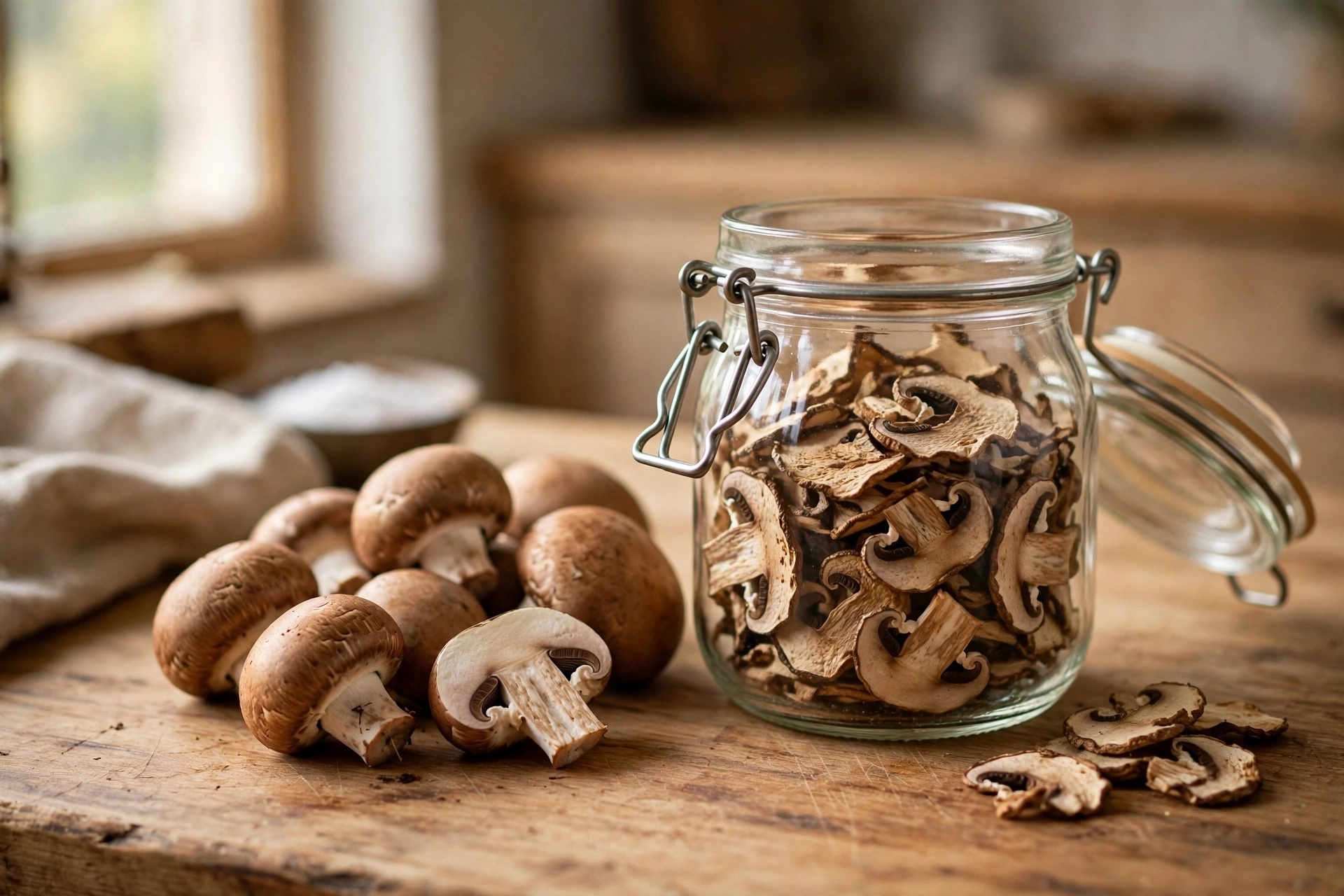
Mushrooms dry better than almost any other vegetable — they shrink to a fraction of their fresh size, keep their deep savory flavor, and come back in hot liquid ready for soups, stews, sauces and eggs. A tray of fresh mushrooms that would slump in the refrigerator inside a week becomes a jar that waits months for the right meal. Colorado State includes mushrooms in its drying vegetables table with one preparation step most vegetables do not get: a citric acid dip in place of blanching.
This guide follows Colorado State University Extension’s mushroom procedure exactly, warning included. This guide is part of our preservation guides, and the method sits next to how to dehydrate apples in the same series. If you are choosing equipment, best dehydrator for beginners covers the starter models and the best dehydrators for food storage the larger ones.
What You Need
Scrub the mushrooms clean. Discard tough, woody stalks — they do not dry into anything worth eating. Slice tender stalks 1/4 inch thick. Peel large mushrooms and slice them; leave small mushrooms whole. For the dip, citric acid and water: 1 teaspoon of citric acid per quart of water. For yield expectations, know that mushrooms are mostly water and shrink hard — load the trays generously, in single or thin layers 1/2 inch deep or less. You also need a dehydrator that holds 140°F.
Buy or pick with the tray in mind. Mushrooms shrink dramatically as they dry, so a batch that looks modest fresh becomes a small jar — most cooks find they need to dry far more than they first planned to make the run worthwhile, and loading generously within the thin-layer rule is the right instinct. Mixed sizes need sorting before slicing: the large mushrooms get peeled and sliced, the small ones go in whole, and separating them onto different trays lets each tray come out when its own pieces pass the test instead of holding finished slices hostage to the slowest whole mushroom. Keep the woody stalks out from the start; no amount of drying turns them tender, and they are easier to discard at the cutting board than to pick out of a finished jar.

Cosori Food Dehydrator, 6 Stainless Trays
Six trays in a single layer hold a full market haul of mushroom slices at the steady 140°F this procedure specifies.
$135.99 from Amazon
ThermoPro Instant-Read Thermometer
A thermometer verifies the trays are holding 140°F through the 8 to 12 hour mushroom run.
$8.99 from Amazon
Etekcity Digital Kitchen Scale
Weighing mushrooms before and after drying shows just how much water a batch carried — and when it has truly left.
$9.99 from AmazonBefore You Start
The warning in the source table comes first, in its own words: the toxins of poisonous varieties of mushrooms are not destroyed by drying or by cooking, and only an expert can differentiate between poisonous and edible varieties. Drying is not a safety step for a mushroom you are unsure about — dry only mushrooms you bought or know with certainty. Second: mushrooms are not blanched in this method. The table lists no blanching time for them; the citric acid dip does the pretreatment work instead.
Expect the kitchen to smell like mushrooms, pleasantly, for the whole run — and expect the pieces to look unimpressive halfway through. Mushrooms shrivel as they lose water, well before they are dry, and a tray that looks finished at the halfway point is usually just a tray that has shrunk. The test does not care how a piece looks; cooled and handled, it either reads dry and leathery or it does not. Judge by hand, at the end of the range, and give thick slices and whole small mushrooms the extra time their size demands.
How to Dehydrate Mushrooms, Step by Step
- Scrub and sort. Scrub the mushrooms. Discard tough, woody stalks.
- Slice by size. Slice tender stalks 1/4 inch thick. Peel large mushrooms and slice them. Leave small mushrooms whole.
- Dip in citric acid. Dip the prepared mushrooms for 10 minutes in a solution of 1 teaspoon of citric acid per quart of water, then drain them.
- Load the trays. Arrange the pieces in single or thin layers, 1/2 inch deep or less, so warm air reaches every surface.
- Dry at 140°F. Dry at 140°F for the source’s range of 8 to 12 hours, rotating trays if your machine dries unevenly from bottom to top.
- Test dry and leathery. Cool a few pieces and test them. The batch is done when the mushrooms are dry and leathery — the test named in the source table.
- Cool and pack. Cool the mushrooms completely, condition them as described under Storage if you are storing a large batch, and pack them sealed.
The Numbers: Temperature, Time and the Leathery Test
Mushrooms are the no-blanch row of the vegetable table — the dip replaces the blanch, and the finish is leathery rather than brittle.
| Food | Preparation | Drying temperature | Drying time | Done when |
|---|---|---|---|---|
| Mushrooms | Scrub; slice tender stalks 1/4 inch thick; peel and slice large mushrooms, leave small ones whole; dip 10 minutes in 1 teaspoon citric acid per quart of water; no blanching | 140°F | 8 to 12 hours | Dry and leathery |
Times are ranges and the dryness test decides. Whole small mushrooms and thick slices sit at the long end of the range; thin slices finish earlier. Test cooled pieces, not warm ones.
Not every mushroom has to be dried. The overflow freezes well after cooking down, vacuum-sealed or bagged for soups and sauces, and dried mushrooms also grind into a seasoning powder — these are the tools the storage and freezing side runs on.

FoodSaver Elite Vacuum Sealer
Cooked-down mushrooms for the freezer keep their flavor vacuum-sealed in meal-sized portions.
$218.56 from Amazon
Ziploc Freezer Quart Bags
Quart freezer bags portion frozen mushrooms and the dried overflow that goes to the freezer for longest keeping.
$26.48 from AmazonCommon Mistakes
Drying a mushroom you cannot name. The source warning is absolute: drying and cooking do not destroy the toxins of poisonous varieties, and only an expert can tell poisonous from edible. Uncertain mushrooms do not go on the tray.
Blanching them like other vegetables. Mushrooms are a no-blanch row in this table. Blanching waterlogs them; the 10-minute citric acid dip is the pretreatment the procedure specifies.
Keeping the woody stalks. Tough, woody stalks are discarded in the preparation step. Dried, they stay tough, and they drag down a jar of otherwise good slices.
Packing by the clock. Eight to 12 hours is a window. Pieces are done when they are dry and leathery, tested cooled — a soft, cool center means the tray goes back in.
Storing them warm. Pack cooled food only. Warm mushrooms sealed in a jar sweat, and that moisture is an invitation to mold.
Storage and Shelf Life
Cool the mushrooms completely before packing. For conditioning, Colorado State places cooled dried vegetables loosely in large plastic or glass containers about two-thirds full, lightly covered, in a warm, dry, well-ventilated place for four to 10 days, stirring or shaking daily — while noting that because vegetables dry to a nearly waterless state, conditioning them is not always necessary. Pack in small amounts in dry, scalded glass jars or moisture- and vapor-proof containers, seal the lids against insects and moisture reabsorption, label with the name and date, and store in a cool, dry, dark place. Properly stored, dried vegetables keep well for six to 12 months; discard anything with off smells or signs of mold. To use them, Colorado State counts tomatoes and leafy or tender vegetables as cover-with-hot-water vegetables, and dried mushrooms go the same route in practice — into hot liquid, simmered to tenderness; root, stem and seed vegetables in the same guide soak 30 to 90 minutes in cold water or 20 to 60 minutes in boiling water before simmering.
Dried mushrooms are an ingredient, not a snack, and they behave like one: into soups, stews, casseroles, sauces and stuffings, where the cooking liquid restores them and their flavor spreads through the whole pot — Colorado State notes dried vegetables are best used exactly this way. Save the soaking or simmering liquid rather than draining it away; it carries the mushroom flavor with it, and the same guide advises using the soaking water in cooking to keep what the vegetables offer. A jar of dried mushrooms beside the stove shortens the distance between an ordinary weeknight sauce and a good one.
Viewers also searched for these items.

Sukerle 5-Gallon Mylar Bags with Absorbers
Five-gallon mylar bags with absorbers store a forager-season quantity of dried mushrooms in one sealed unit.
$42.99 from Amazon
Nesco Snackmaster Pro Dehydrator
A compact stacking dehydrator runs a first small batch of mushrooms without taking over the counter.
$64.39 from Amazon
IRIS USA Airtight Container, 30 lb, with Wheels
An airtight container keeps the mushroom jars together, sealed against pantry humidity.
$23.99 from AmazonFrequently Asked Questions
Do mushrooms need blanching before drying?
No. The Colorado State table lists no blanching time for mushrooms; the pretreatment is a 10-minute dip in a solution of 1 teaspoon of citric acid per quart of water.
Can I dry wild mushrooms?
Only mushrooms identified with certainty. The source warns that the toxins of poisonous varieties are not destroyed by drying or by cooking, and that only an expert can differentiate between poisonous and edible varieties.
Why citric acid?
Colorado State recommends pretreating vegetables in a citric acid solution to enhance quality and safety, and its mushroom row specifies the dip by strength and time.
How do dried mushrooms rehydrate?
Add them to hot liquid and simmer to tenderness — dried vegetables generally reconstitute at about 1 cup dried to 2 cups, per Colorado State.
Procedure, temperature, times, dryness test and mushroom warning: Colorado State University Extension, “Drying Vegetables,” via Colorado State University Extension.
Prices shown on this page were last checked November 26, 2026 — prices change; check before you buy.
Talk it over with other readers
The Truly Preserved Community on Facebook is where readers compare notes on food storage, water, and backup power — and where your questions help decide what we research next.