
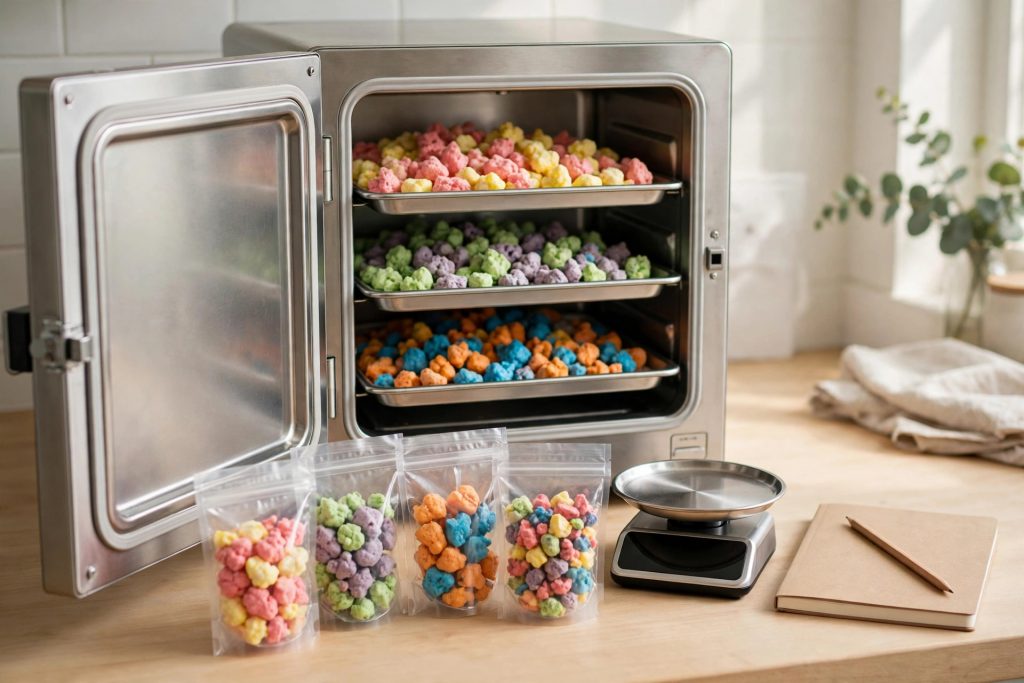
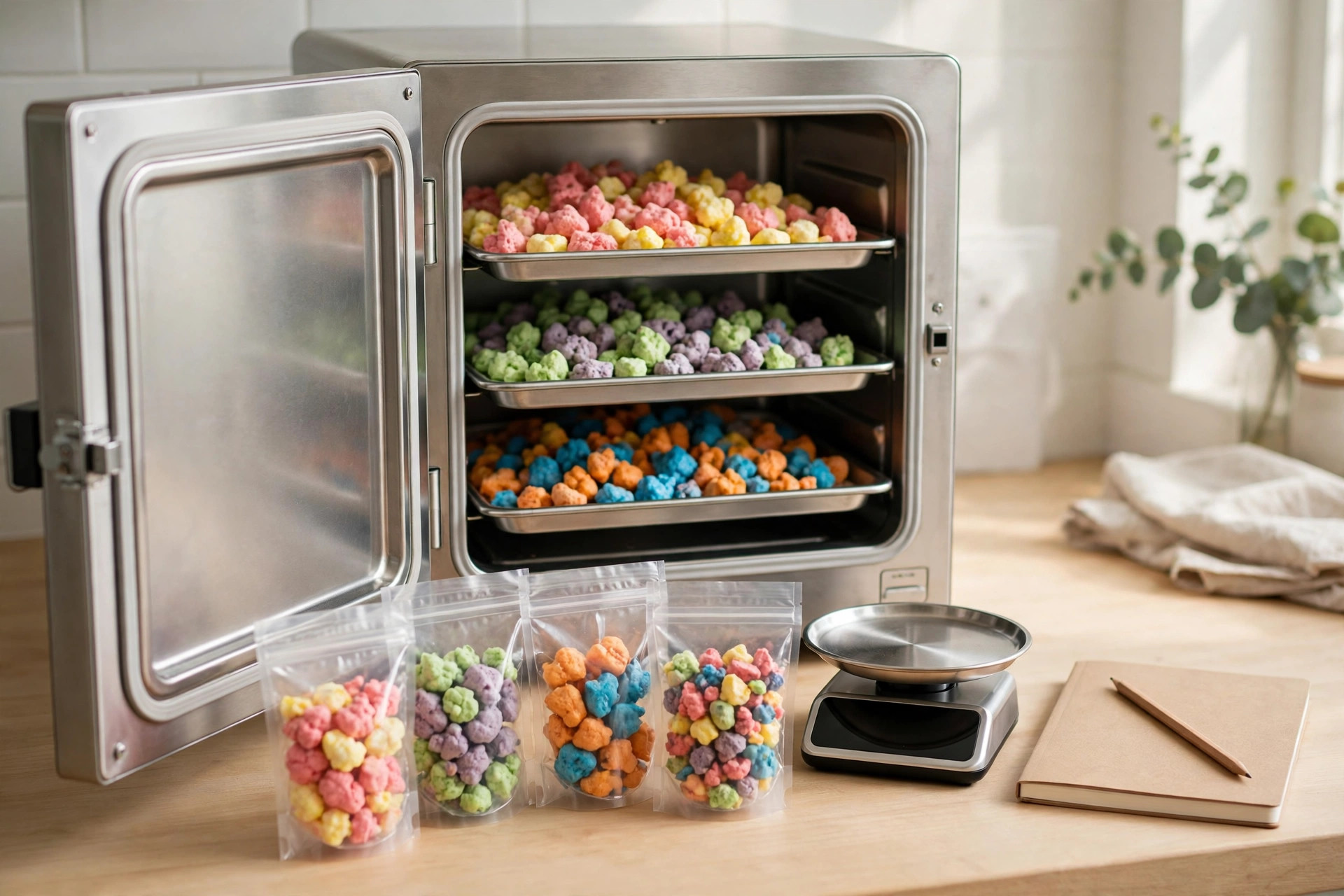
What is the profit margin on freeze-dried candy? There is no single number — there is your number, and it depends on four things: what the bulk candy cost, how many retail bags one batch fills, what each bag and its packaging cost you, and what the marketplace takes off the top. The sample everyone quotes — an $11 bulk bag of candy turned into 49 small bags sold at $5 each — takes in $245, and on the candy cost alone that looks like a 95 percent margin. Count the packaging, the power to run the batch, and a selling fee, and the same batch lands at about $1.31 of cost in each $5 bag — a $3.69 margin per bag, about 74 percent, and $181 of profit on the batch, before your time. Run your own candy, your own bags, and your own fees below. No sign-up, and nothing you type leaves your browser.
Run Your Numbers
—
—
—
Two of the starting numbers deserve a word. The $11 into 49 bags at $5 is the worked sample from a candy-business guide that sellers pass around — we use it because it is the example readers actually ask us about, not because every candy does it: a batch that fills fewer, bigger bags will show it the moment you change the bag count. And the fee starts at 10 percent only as a placeholder. Every marketplace, card reader, and market booth takes a different cut — put in the one you will actually pay, because the fee is the line sellers most often leave out.
The Worked Example: How $245 Shrinks, Honestly
Here is that sample batch with every cost counted, one line at a time. The candy is $11 for the batch. The batch fills 49 retail bags, sold at $5 each: 49 × $5 = $245 in sales. Packaging — a pouch, a label, and a seal — is figured at $0.50 a bag, so 49 × $0.50 = $24.50. Running the machine for the batch is figured at $4, in line with the $3–$6 a batch our Freeze-Dryer Payback Calculator uses for electricity and pump oil. The selling fee is figured at 10 percent of sales: 10 percent of $245 = $24.50.
Add it up: $11.00 candy + $24.50 packaging + $4.00 running + $24.50 in fees = $64.00 of total cost. Profit on the batch is $245 − $64 = $181. Spread over 49 bags, that is $64 ÷ 49 = $1.31 of cost per bag, a margin of $5.00 − $1.31 = $3.69 per bag, and $181 ÷ $245 = 73.9 percent.
| Counting | Cost per bag | Margin per bag | Margin |
|---|---|---|---|
| Candy only | $0.22 | $4.78 | 95.5% |
| + Packaging | $0.72 | $4.28 | 85.5% |
| + Running the batch | $0.81 | $4.19 | 83.9% |
| + Selling fees | $1.31 | $3.69 | 73.9% |
Read the table top to bottom and you can see where the headline number goes. The 95 percent figure is not a lie, exactly — it is just the first line of the math, quoted as if it were the last. Packaging costs this batch more than the candy itself did, and the fee costs exactly as much as the packaging. None of that makes the batch a bad one: $181 on an $11 bag of candy is a strong return. It just means the honest margin is roughly three-quarters, not nineteen-twentieths — and if your bags are bigger, your candy costs more, or your market takes a bigger cut, your number will be lower. That is what the calculator is for.
What This Math Leaves Out
Three real costs sit outside the calculator, and a fair seller should hear them from us. First, your time: weighing, bagging, sealing, and labeling 49 bags takes a while, and the $181 is what is left to pay for it — divide the batch profit by the hours the batch actually took you and you will know what the work paid. Second, the machine: a freeze dryer is a $1,895-and-up purchase before it dries its first piece of candy, and its payback is a separate question — our payback calculator runs that math, and our freeze dryer size comparison prices the machines against each other. Third, the costs of being a business at all: licenses or permits where your state requires them, taxes, bags that tear, batches that do not sell, and the candy that gets eaten by quality control. The calculator gives you the margin on a batch that sells out. Selling out is the part it cannot do for you.
Questions People Ask
What is the profit margin on freeze-dried candy?
It depends on your candy cost, your bag count, your packaging, and your selling fees — there is no standard number. In the worked sample on this page, an $11 bulk bag that fills 49 retail bags sold at $5 each takes in $245 and, with packaging, running costs, and a 10 percent fee counted, keeps $181 of it: a $3.69 margin per bag, or about 74 percent. Run your own inputs in the calculator above; that is the only version of the answer that is yours.
Why do sellers quote margins of 90 percent or more?
Because they are dividing the sale price by the candy cost and stopping there. Candy-only math on the sample batch gives 95.5 percent. Packaging, power, and fees are real costs with real invoices attached, and counting them brings the same batch to about 74 percent — still good, just honest.
Do I need a license to sell freeze-dried candy from home?
There is no single national answer — food sales from a home kitchen are ruled state by state, and states treat freeze-dried candy differently: some cover it under a cottage-food law, some want a license or a permitted kitchen, and farmers-market and online sales can carry different rules again. Check your own state’s cottage-food rules and your local health department before your first sale, not after. This is one of the questions in the candy-business cluster on our What People Are Asking About Freeze-Dried Food hub, where the licensing question gets its own full answer.
How much does a freeze-dried candy business cost to start?
The machine is the big piece: in our size comparison, home freeze dryers ran from $1,895 for the Small to $4,995 for the X-Large, checked on the maker’s store on October 26, 2026. After that come the smaller, repeating costs this page is built on — trays if you want spares, bulk candy, and the pouches, labels, and seals that run about $0.50 a bag in our sample. Start with one machine and one candy that sells; the margin math above tells you how fast the machine pays for itself at your pace.
Which candies freeze dry best for a business?
The chewy, fruity ones are the reliable sellers and the reliable driers: candies like Skittles, gummies, and saltwater taffy puff up and turn crunchy because they are mostly sugar and water with little fat. Chocolate and anything fatty are the problem children — the fat does not dry, so the texture and shelf life suffer — the same fat rule that puts peanut butter and butter on the cannot-dry list in what foods can’t you freeze dry. Start with the candies that dry cleanly; they are also the ones that bag and keep best.
Should I pay myself out of the margin?
Yes — decide that on purpose. The margin this calculator shows is what is left before your time. If a batch clears $181 and took three hours of hands-on work across the run, the batch paid about $60 an hour before machine wear and taxes. If it took all day, the same margin is a much thinner wage. Sellers who never do that division are the ones who feel busy and stay broke.
Run the Rest of the Numbers
- Freeze-Dryer Payback Calculator — how long the machine itself takes to pay for itself at your pace
- Harvest Right Freeze Dryer Sizes Compared — what the machines cost, by size, before you price a business on one
- What People Are Asking About Freeze-Dried Food — the rest of the candy-business and freeze-drying questions, answered
- All Our Free Tools — every calculator in one place
The Gear Behind the Math
Harvest Right Medium
The machine size most small candy sellers start on, from our size comparison — big enough for real batches, small enough for a kitchen corner.
Blue Alpine Medium Select
Our direct partner: use the code and Blue Alpine matches our commission as your discount.
METRONIC 8-Inch Impulse Sealer
The seal is the package: this is the sealer from our mylar bags guide, and it closes the retail pouches the margin above is figured on.
As an Amazon Associate, Truly Preserved earns from qualifying purchases. It never changes a score or a number on this page.