
Affiliate Disclosure: Truly Preserved is reader-supported. When you buy through links on this page, we may earn a commission at no extra cost to you. As an Amazon Associate, Truly Preserved earns from qualifying purchases. Read our full affiliate disclosure.
Last updated: October 31, 2026
THE SHORT ANSWER
A freeze dryer that runs with a normal screen, working heaters, and a working pump — but sits silent and lets the ice melt — has most likely lost its refrigeration side: the condenser and its fan are not running, whatever the screen says. Harvest Right’s Troubleshooting Guide calls this “Freeze Dryer Not Cooling” and tests it by ear and by frost, not by the display: listen for the refrigeration condenser, feel for air blowing from the fan, and run its one-hour freeze test. No sound, no moving air, and no frost pattern points to a condenser failure or a refrigeration relay failure — and the sealed refrigeration system past that point is a service call, not a kitchen project.
This page started with a candy-mode run that went wrong overnight. The owner woke to heating elements working, the external vacuum pump working, a screen showing everything normal, no error messages anywhere — and a machine that was completely silent, with all the excess water melted. Restarting it that afternoon, the motor starts, but no fans run. It is an unnerving failure precisely because the machine insists nothing is wrong. What follows is built from Harvest Right’s Troubleshooting Guide (Software Version 5.0), the maker’s official support pages, and owner reports — we work a research desk, not a repair bench, and this page stops where owner-level checks stop.
The sound map: what a healthy cycle sounds like
Your ears are the first diagnostic tool here, because a freeze dryer is really three machines sharing one cabinet, and each one makes its own noise:
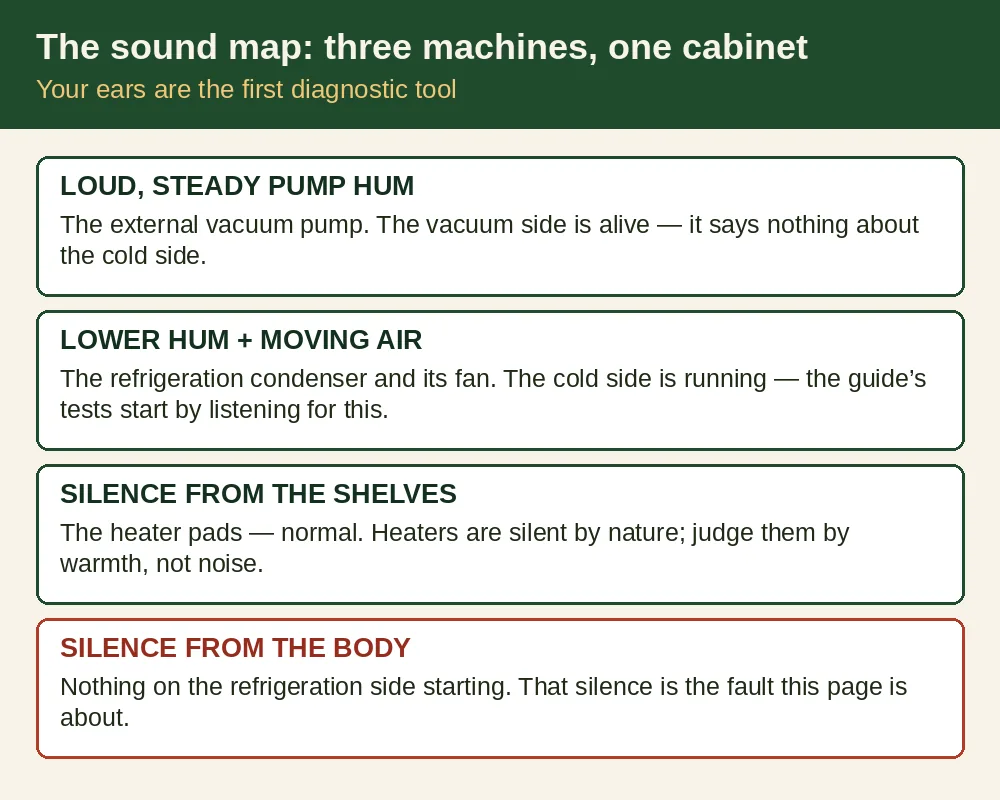
| Sound | What makes it | What it tells you |
|---|---|---|
| A loud, steady pump hum | The external vacuum pump | The vacuum side is alive — it says nothing about the cold side |
| A lower hum plus moving air | The refrigeration condenser and its fan | The cold side is running; the guide’s tests start by listening for exactly this |
| No sound at all from the shelves | The heater pads | Normal — heaters are silent by nature; judge them by warmth, not noise |
| Silence from the machine body | Nothing on the refrigeration side starting | The fault this page is about |
The pump tricks people. It is a separate unit, plugged into the back of the freeze dryer, and it can hum away happily while the refrigeration side never starts — so “the pump works” and “the machine is silent” are both true at once. The sound that matters is the one the guide tells you to listen for: when the freeze dryer enters Freeze mode, you should hear the refrigeration condenser running, and at the vents you should be able to feel air blowing from the fan. In the reported case, the owner heard the pump and the heaters did their work — it was the condenser’s hum and the fan’s air that never showed up. By morning, a chamber full of ice had quietly melted back to water, because nothing was holding the cold.
Why the screen can read normal while the cold side is dead
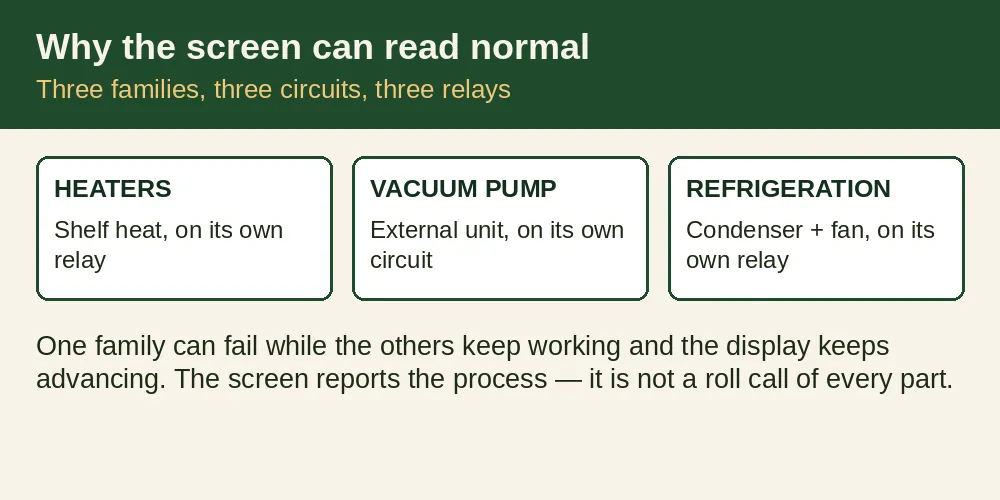
The screen reports the process — which stage the cycle is in, what the timers and sensors say. It is not a roll call of every part. The heaters, the pump, and the refrigeration each run on their own circuits and their own relays on the machine’s relay board, which is why one family can fail while the others keep working and the display keeps advancing. Harvest Right’s own guide treats the screen as insufficient evidence: its test for this fault never asks what the display says. It has you power the machine off and back on and listen for the condenser, then run the chamber empty and look for an actual frost pattern on the inside wall. Cold you can see and air you can feel outrank a normal-looking screen.
One honest caution: the guide is written for Software Version 5.0, and fault wording — and whether a fault announces itself at all — varies between software versions and machine generations. A silent machine with no error message is a documented pattern in owner reports even where the same fault on another version would put “Freeze Dryer Not Cooling” on the screen.
How a dead fan or condenser melts a whole batch
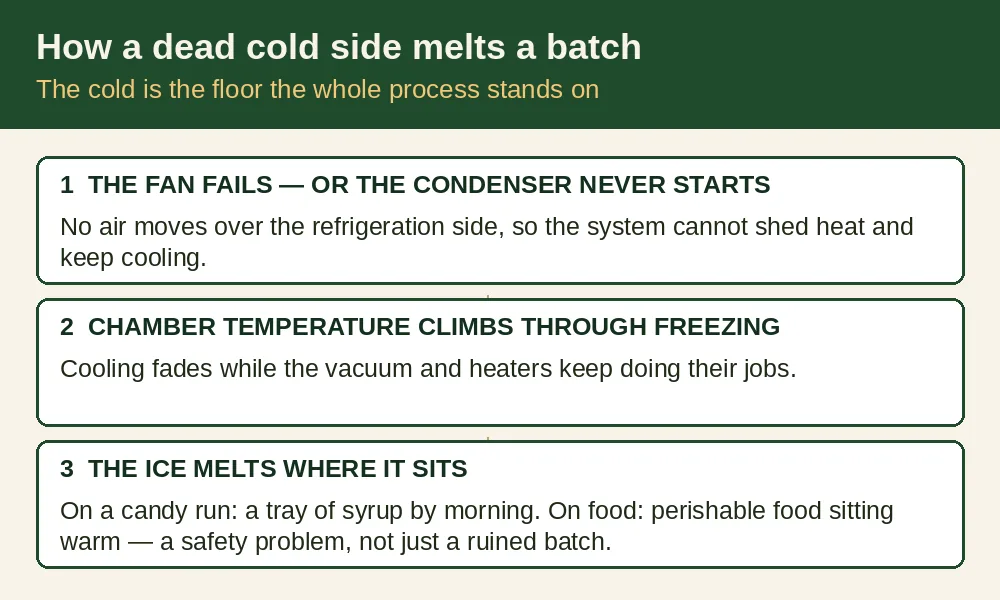
Freeze drying holds food frozen while the vacuum does its slow work; the cold is not a stage, it is the floor the whole process stands on. The fan’s job is to move air over the refrigeration side so the system can shed heat and keep cooling. Owners reporting this fault describe the sequence plainly, and the physics agrees with them: the fan fails or the condenser never starts, cooling fades, chamber temperature climbs back through freezing, and the ice that should have left as vapor simply melts where it sits. On a candy run that means a tray of syrup by morning. On a food batch it means perishable food sitting warm — which is a food-safety problem, not just a ruined batch. The guide’s related fault, “Not Getting Cold Enough,” names the deeper version of the same story: a refrigerant problem, possibly a leak, which no owner-level check will fix.
The owner-level checks, in order
- Save what can be saved first. Get the trays into a freezer before you touch a single setting. If perishable food has sat above 40°F for more than two hours, the USDA rule we use on every outage page says discard it — and never taste food to decide. Candy is a quality loss, not a safety scare; thawed meat is the other way round.
- Do the documented power reset, and listen while you do it. The guide’s first move for a not-cooling fault is to power the freeze dryer off and back on and listen for the refrigeration condenser to start. For a machine stuck in candy mode, Harvest Right’s support page gives the same shape: off, wait about five minutes, back on, and check the software version while you are there — version 23 or higher for current candy-mode behavior.
- Feel for the fan’s air. The guide’s question is literal: can you feel air blowing from the fan? Ears and hands, at the vents, while the machine is in Freeze mode. Air moving means the fan side lives; no air with a running screen moves the condenser and its relay to the top of the list.
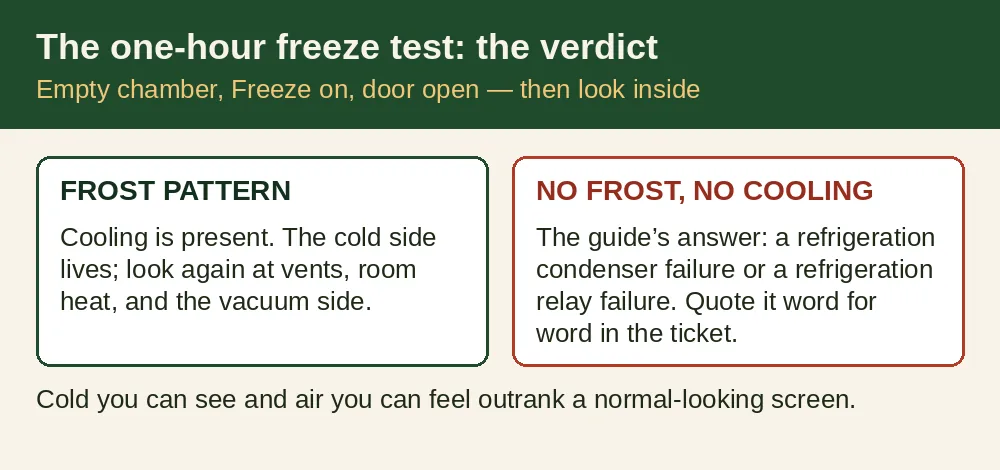
- Run the guide’s freeze test — empty. Press End Process, take the food out, open the test screen with the circled leaf at the top left of the start screen, switch Freeze on, and let it run an hour with the door open. Then look inside: the guide’s verdict is the frost pattern. No cooling and no frost pattern after an hour points to a refrigeration condenser failure or a refrigeration relay failure. Both are findings worth quoting word for word in a support ticket.
- Clear the air’s path, and check the room. Owners and the maker’s setup guidance agree on the basics: vents blocked by a wall, a box, or a mat starve the fan of air, and a hot room makes a struggling refrigeration side give up sooner. Pull the machine out, clear the vents, and retest in a cool room before you conclude anything has died.
- Rule out the vacuum side while you are there. A same-day thread in the same owner community chased a vacuum-and-no-heat fault to the door gasket, and the guide’s vacuum checklist is cheap insurance: drain valve fully closed, door gasket clean and undamaged, door latched so you can see the thin seal ring around the gasket, vacuum hose fittings tight, pump oil at the middle of the sight glass. Your pump running does not prove the chamber is sealing.
Where the line is: listening, feeling for air, clearing vents, and running the maker’s own tests are owner work. Past that line, the guide itself hands off: a failed refrigeration relay means a replacement relay board from Harvest Right, fitted on their instructions if you are comfortable working inside an unplugged machine — and a refrigerant leak or a dead compressor is the sealed system. The guide’s answer for that is a refrigerator repair technician working to Harvest Right’s refrigeration appendix (it lists the refrigerant charge by machine size for exactly that handoff), or sending the unit to Harvest Right. Do not open the sealed system yourself, and do not keep running batches on a machine that cannot hold cold — every run is another tray thawing in a box.
Out of warranty? Check which warranty you actually mean
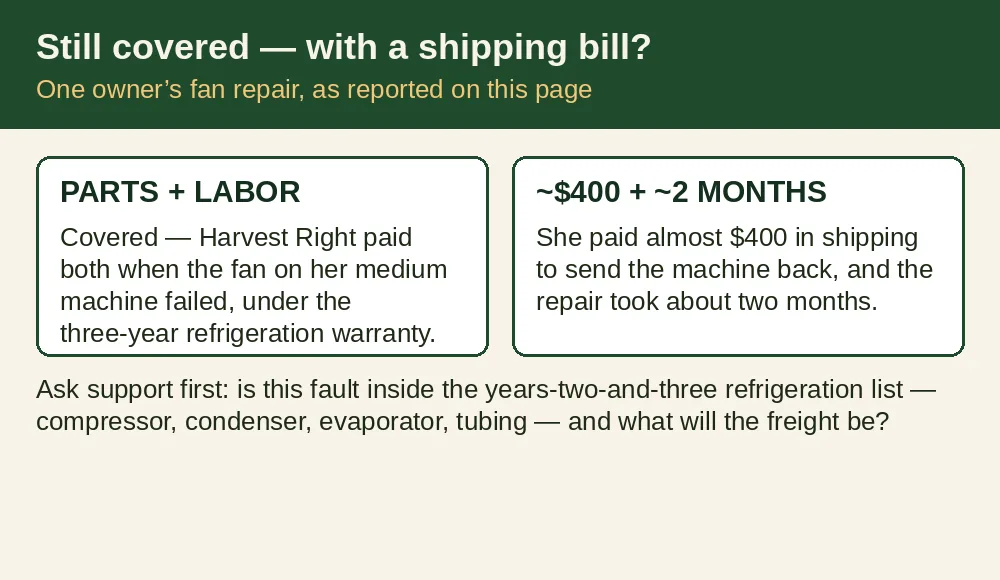
Harvest Right’s published warranty is a full one year on the whole machine and pump, then years two and three on the sealed refrigeration system — compressor, condenser, evaporator, and tubing — with the owner paying diagnostic charges and transportation in those later years. A machine can be “out of warranty” at the kitchen table and still hold refrigeration coverage on paper. One owner’s report puts a real number on the catch: when the fan on her medium machine failed completely, Harvest Right covered parts and labor under the three-year refrigeration warranty, but she paid almost $400 in shipping to send the machine back, and the repair took about two months. Ask support two questions before anything moves: is this fault inside the years-two-and-three refrigeration list, and what will the freight be? The answers decide whether this is a covered repair with a shipping bill or a local technician job.
Questions people also ask
Why is there no error message if the machine failed?
Because the screen tracks the process, not every part, and because fault detection varies by software version. The guide’s not-cooling test exists precisely for this gap: it diagnoses by condenser sound, fan air, and frost pattern instead of waiting for the display to confess.
The motor starts but no fans run. What does that point to?
To the refrigeration side’s start chain: the fan itself, or the refrigeration relay that switches that side on. Run the guide’s freeze test; if an hour produces no frost pattern, its answer is condenser failure or refrigeration relay failure, and both go through Harvest Right or a refrigeration technician.
Can I keep using it if the pump and heaters still work?
No. Without the cold side, the machine is a vacuum box at room temperature: ice melts instead of drying, and perishable food sits warm for hours. Park it until the refrigeration side is sorted.
Is the melted candy batch safe to rerun?
Candy that melted is a texture and quality loss, not usually a safety one — but rerunning it in a machine that still cannot freeze will just melt it again. Fix the cold side first; then judge the candy by how it looks and smells, and perishable food by the 40°F / two-hour rule instead.
Before the next batch
When the machine is back, the maintenance habits in our Harvest Right sizes comparison — pump oil every 20 to 30 batches, sensible circuits, room to breathe around the vents — are most of what keeps the cold side boring. If the repair-versus-replace math is on your table, our home freeze dryer comparison prices the alternatives honestly. And the sister fault to this one — a machine that fails mid-batch with a heater message and burns the load — has its own page: why did my freeze dryer fail mid-batch?
Related questions
- Why did my freeze dryer fail mid-batch?
- How long does opened freeze-dried food last?
- What foods can’t you freeze dry?
This question sits in What People Are Asking About Freeze-Dried Food — the full list of freeze-dried questions from real forums, each with a short answer.
Talk it over with other readers
The Truly Preserved Community on Facebook is where readers compare notes on food storage, water, and backup power — and where your questions help decide what we research next.