
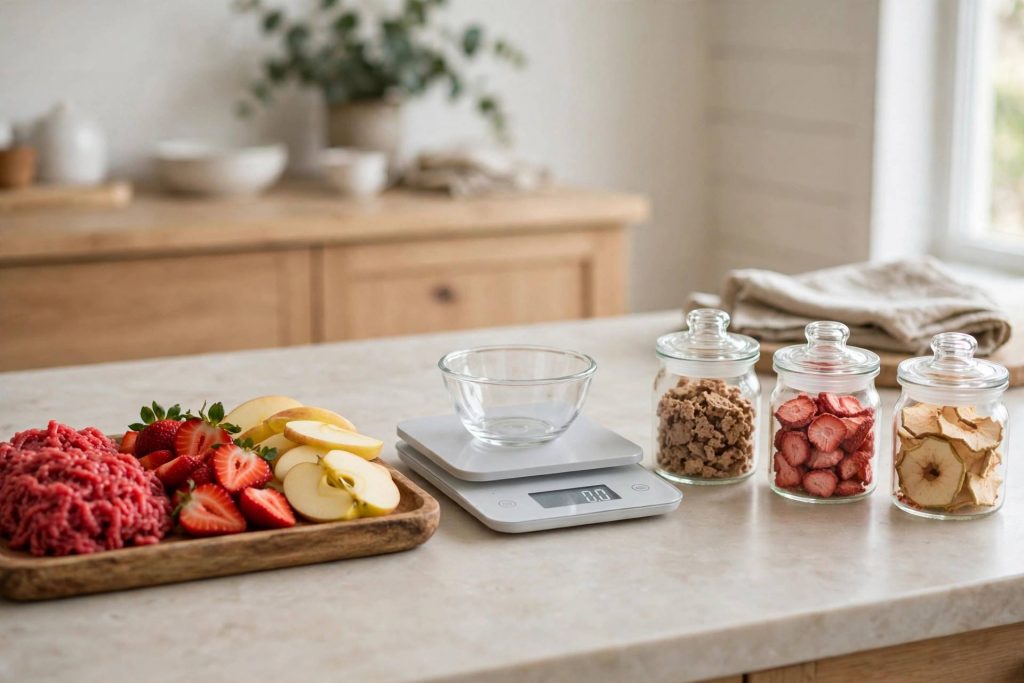
How much does fresh food weigh after it is freeze-dried — and how much water brings it back? This calculator runs the subtraction for you. Freeze drying removes the water and almost nothing else, so a food’s dried weight is its fresh weight minus its water, and the water to add back is that same water, by weight. Pick the food, enter the amount in pounds, ounces, grams, or kilograms, and the calculator returns the freeze-dried weight and the rehydration water in grams, millilitres, and cups. It works in reverse, too: enter the dried amount you have and it tells you the fresh amount it came from. The figures come from the USDA’s published water content for each food, dried to about 2% remaining moisture — the same dataset as our fresh to freeze-dried conversion chart, where every row is shown in full. No sign-up, and nothing you type leaves your browser.
Run Your Numbers
—
—
—
One worked example, because it is the question this tool was built from: 3 pounds of fresh 90% lean ground beef comes out at about 0.95 pounds dried — the “3 pounds of hamburger makes 1 pound freeze-dried” figure members of a large freeze-drying group quote is the lean-grind answer. Run the same 3 pounds as a 70% lean grind and the answer is about 1.38 pounds, because fat does not dry out: water leaves, fat stays, and a fatty food dries heavier and stores shorter. If your food is not in the list, the weigh-before-and-after method on the conversion chart page covers it — weigh the tray going in and coming out, and the difference is the water to add back.
How the Calculator Works
Each food in the list carries its published water content — ground beef by grind, chicken breast, eggs, milk, cheddar, fruits, vegetables, and the cooked grains people dry most. The calculator takes the water out on paper: dried weight equals fresh weight times the food’s solid share, adjusted for the roughly 2% moisture a finished batch keeps. Rehydration water is the water that came out, returned gram for gram; since a gram of water is a millilitre, the gram and millilitre figures match, and cups are figured at 237 grams to the cup. Expect the real batch to land close to these numbers rather than on them — a riper banana or a fattier grind shifts its own water — so treat the calculator as the planning number and your scale as the final word for any specific tray.
Questions People Ask
Is there a conversion chart that shows fresh to freeze-dried amounts?
Yes — the full chart is on our conversion chart page: 18 foods, each from 1 pound fresh, with the dried weight and the water to add back. This calculator is that chart in working form, in any unit and either direction.
How much water do I add to rehydrate freeze-dried food?
The water that came out, by weight. If a tray went in at 500 grams and came out at 130 grams, it took out 370 grams of water, and 370 grams — 370 ml, about 1.6 cups — is what goes back in, ideally in stages: most of it at once, a rest of 10–15 minutes, then a spoonful at a time to texture. For a food from the list, the calculator above gives the figure without the tray weights.
How do I rehydrate a whole meal, like chili or lasagna?
By the batch’s total weight, not by ingredient. Weigh the meal before the cycle and after it; the difference is the water for the whole batch, and each portion gets its share of that water. A 2,000-gram batch of chili that dries to 420 grams took out 1,580 grams of water, so a quarter of the batch wants about 395 grams — roughly 1⅔ cups — back.
Why does fatty food dry heavier than the calculator’s lean examples?
Because freeze drying removes water only. Fat stays in the food, so a fatty grind, which starts with less water in it, keeps more of its fresh weight — and that stored fat is why fatty freeze-dried foods keep for months rather than decades. The list carries ground beef at three grinds so you can see the spread on the same food.
Can I convert by volume instead — cups of fresh to cups of dried?
Only loosely, and the chart page explains why: dried food holds its shape, so volume stays roughly the same while weight falls, but how a food packs into a cup varies too much for published figures. The one worked volume example we can stand behind is shredded cheddar: 5 pounds fresh is about 5 quarts, and the dried shreds take about the same 5 quarts at about 3.2 pounds. For anything else, weigh it once and write your own number on the jar lid.
Run the Rest of the Numbers
- Fresh to Freeze-Dried Conversion Chart — the full chart this calculator is built from, with the weigh-before-and-after method
- Oxygen Absorber Calculator — size the absorber for the bags and jars the dried food goes into
- Food Shelf-Life Lookup — how long the dried food keeps once it is packed
- What People Are Asking About Freeze-Dried Food — the rest of the freeze-drying questions, answered
- All Our Free Tools — every calculator in one place
The Gear Behind the Math
Harvest Right Medium
The machine size most home dryers in our size comparison land on — the trays these conversions are figured for.
Blue Alpine Medium Select
Our direct partner: use the code and Blue Alpine matches our commission as your discount.
METRONIC 8-Inch Impulse Sealer
Once the dried weight is on the bag, the seal is what keeps it that way — the sealer from our mylar bags guide.
As an Amazon Associate, Truly Preserved earns from qualifying purchases. It never changes a score or a number on this page.
Truly Preserved is reader-supported. When you buy through links on this page, we may earn a commission at no extra cost to you. As an Amazon Associate, Truly Preserved earns from qualifying purchases. Read our full affiliate disclosure.