
Affiliate Disclosure: Truly Preserved is reader-supported. When you buy through links on this page, we may earn a commission at no extra cost to you. As an Amazon Associate, Truly Preserved earns from qualifying purchases. Learn more.
How we researched this comparison. We scored 2 products head to head for this page. The work behind the scores: manufacturer specifications and certification records where they apply, prices checked when this review was written, and patterns across verified owner feedback — a praise or complaint point only counts here when it shows up again and again, not once. The products were chosen to cover the main designs and price points a buyer in this category actually cross-shops. We are a research desk: we do not buy or hands-on test the products, and commissions never change a score. How we research and score →
The cheapest way to feed a family through a long outage is not a meal kit. It is the best bulk staples for long-term storage on a budget — plain white rice, dry beans, wheat berries, rolled oats, sugar, and salt, bought by the pound and packed right. This guide is built from published specs, prices verified on October 24, 2026, university extension and Church of Jesus Christ (LDS) storage research, and aggregated owner feedback. We don’t own these pails; we did the homework — the serving counts, the shelf-life claims, and the cost per 1,000 calories, checked line by line. The Preserve the Pantry hub holds the kit reviews this guide builds on.

The Short Version
Augason Farms Long Grain White Rice, 24 lb Pail
See it on AmazonWe may earn a commission at no extra cost to you.
Palouse Brand Hard Red Spring Wheat Berries, 25 lb Bucket
See it on AmazonWe may earn a commission at no extra cost to you.
How we chose: Every staple below is judged on three numbers — realistic shelf life from extension and LDS storage tables, calories per pound from USDA figures, and cost per 1,000 calories at a price verified this run. Scores weigh cost per calorie first, then how honestly the shelf-life claim holds up, then what else you have to buy to actually eat the food. Read our full methodology.
Head-to-Head: What a Pound of Calories Costs
| Product | Price | Total calories | Cost per 1,000 cal |
|---|---|---|---|
| Augason Farms White Rice Pail, 24 lb Read the review ↓ |
$66.83 | 39,270 | $1.70 |
| Palouse Hard Red Wheat Berries, 25 lb Read the review ↓ |
$70.95 | ~38,000 | $1.87 |
Two honest notes on that table. First, the wheat calorie total is our math — about 1,525 calories per pound of hard wheat berries, times 25 pounds — because Palouse sells the berry, not a calorie count. Second, both pails lose to loose food on price alone: a 50-pound bag of long-grain rice from a warehouse store, or a case of six #10 cans from the LDS Store (pinto beans listed at $53 a case when we checked the store on October 24), carries the same calories for far less per 1,000. What the pails sell is the packing already done — sealed, dated, and ready to stack. Whether that is worth roughly double is the real question of this guide, and the answer depends on whether you will actually pack loose food yourself. Our serving-cost dataset shows what happens when you skip this layer entirely and buy meal kits instead: the same calories cost three to five times more.
Augason Farms Long Grain White Rice Pail — Our Score: 8/10
The Augason rice pail is the one pre-packed staple we’d buy first, because white rice is the one food every storage table agrees on: the LDS chart and University of Georgia Extension both put properly packed white rice at 25 to 30-plus years, and Augason’s own claim — up to 30 years unopened, best at 55–70°F — sits inside that range instead of above it.
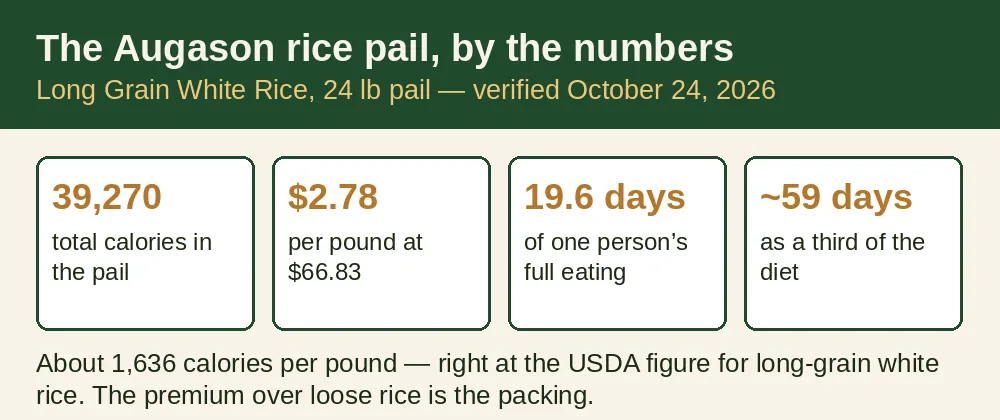
What you get is 24 pounds of long-grain white rice in a 4-gallon watertight pail, certified gluten-free, with an oxygen absorber inside that Augason tells you to remove and discard after opening. At $66.83 from a third-party seller on October 24 — Amazon-direct was out of stock that day, and Keepa showed no current price — that is $2.78 a pound — several times the per-pound price of a warehouse bag, and the whole premium is the pail, the packing, and the date printed on it.
Pros
- Shelf-life claim matches the extension tables: 30 years for packed white rice is real, not marketing stretch.
- Calorie claim checks out: 39,270 total calories over 24 pounds is about 1,636 per pound, right at the USDA figure for long-grain white rice.
- Nothing else to buy. No mill, no cooker, no repacking weekend.
Cons
- Augason cannot keep its own serving count straight: one official description says 231 servings, the Amazon store listing says 242, for the same pail and the same calories. Ignore servings; divide calories by 2,000 and the pail is 19.6 days of one person’s full eating, or about 59 days of rice-as-a-third-of-the-diet.
- Owner feedback on Augason pails generally — across the brand’s large review base — repeats two complaints: lids that pop in shipping, and seals owners don’t fully trust as airtight. Check the lid the day it arrives.
- $2.78 a pound for a food that costs well under a dollar a pound loose.
Buy it if you want the first 25 pounds of rice done today, packed by someone else, and you will spend your own packing time on beans and oats instead. Skip it if you already own mylar bags and buckets — you can pack the same rice for a third of the price — our mylar bags and oxygen absorbers guide is exactly how.
Check the current price on Amazon →
Palouse Brand Hard Red Spring Wheat Berries — Our Score: 7/10
Palouse sells the one staple most guides wave at and never price: whole wheat berries, current-year harvest only, triple-cleaned, in a 25-pound bucket whose gasket lid reseals after opening. The company publishes the field and harvest date behind a QR code on the bucket. For a food people store for decades, “which year did this grow?” is a fair question, and Palouse is the only seller in this guide that answers it.
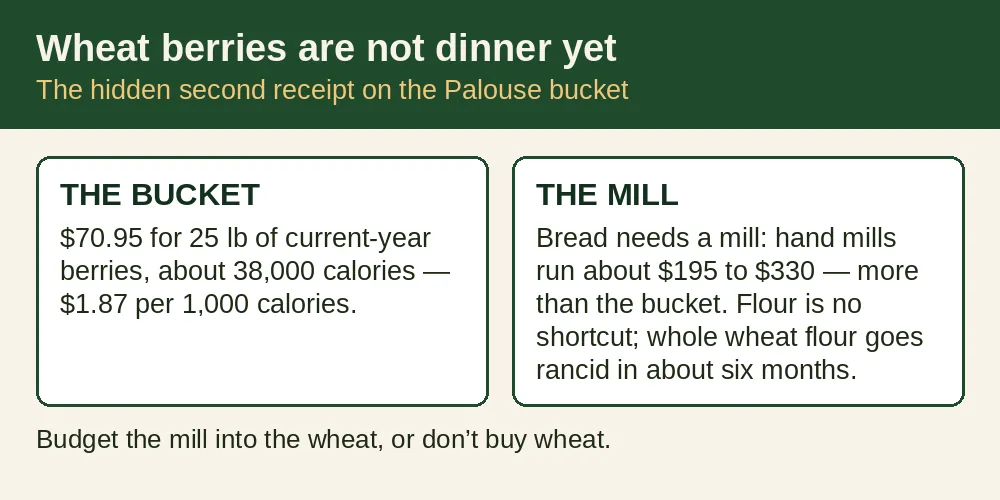
The verified price on October 24 was $70.95 — and note whose price that is: a third-party seller’s. Neither tracker showed an Amazon-direct offer that day, so the number can move with whoever holds the listing. At roughly 38,000 calories in the bucket, that is $1.87 per 1,000 calories — a fair price for berries, and a pointless one if you cannot grind them. More on that below; it is the reason this scores 7 and not higher.
Pros
- Current-year harvest, triple-cleaned, glyphosate-residue-free and Non-GMO Project Verified — claims stated by the maker and checkable on the bucket.
- Berries are the longest-lived form of wheat there is: LDS and Utah State both put sealed whole wheat at 25 to 30-plus years, because the oils that go rancid sit protected inside the kernel.
- Works unmilled in a pinch — Palouse’s own directions include rinsing, soaking 8 hours, and boiling 1 to 1.5 hours for whole-berry dishes.
Cons
- Bread requires a mill. Hand mills in current roundups run about $195 to $330, and a powered mill needs power in the outage you are storing for. Budget the mill into the wheat, or don’t buy wheat.
- Third-party-only listing on the day we checked — price and seller can change without the product changing.
- Hard red wheat makes hearty, dense bread. Bakers who want soft sandwich loaves usually prefer hard white wheat; Palouse sells that too, at $70.95 from a third-party seller on the day we checked.
Buy it if you own a mill, or have priced one into this purchase, and you want wheat that was harvested this year rather than scooped from a bin of unknown age. Skip it if the mill is a someday purchase — flour is not the shortcut either, since whole wheat flour goes rancid in about six months.
Check the current price on Amazon →
How long will each staple actually last — in its bag, and packed properly?
White rice lasts longest, and the gap between the bag it came in and a proper pack is measured in decades. The table below pulls from the LDS long-term storage chart, University of Georgia Extension (C1310), Utah State Extension, and Clemson HGIC. “Packed properly” means mylar with an oxygen absorber inside a bucket, or a commercial #10 can, stored at 75°F or cooler.
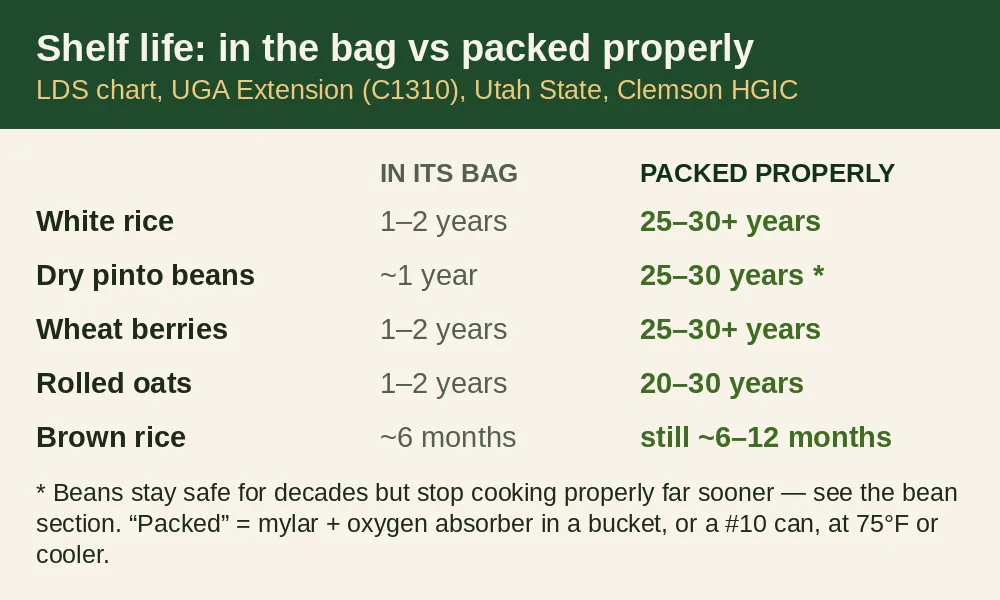
| Staple | In its original bag | Packed properly | Calories per lb |
|---|---|---|---|
| White rice | 1–2 years | 25–30+ years | ~1,650 |
| Brown rice | ~6 months | Still ~6–12 months | ~1,620 |
| Dry pinto beans | ~1 year | 25–30 years* | ~1,550 |
| Wheat berries | Rotate in 1–2 years | 25–30+ years | ~1,525 |
| Rolled oats | 1–2 years | 20–30 years | ~1,750 |
| Sugar | Indefinite if dry | Indefinite if dry | ~1,750 |
| Salt | Indefinite | Indefinite | 0 |
*The bean asterisk is the most important footnote in this guide, and it gets its own section below: beans stay safe for decades but stop cooking properly far sooner. Brown rice is the other trap — its bran oil goes rancid in about six months no matter how well you pack it, which is why the LDS list puts brown rice under products not recommended for long-term storage. Store white rice. Eat brown rice fresh. Our Food Shelf-Life Lookup covers 30 staples the same way.
Which staple gives you the most calories for a dollar?
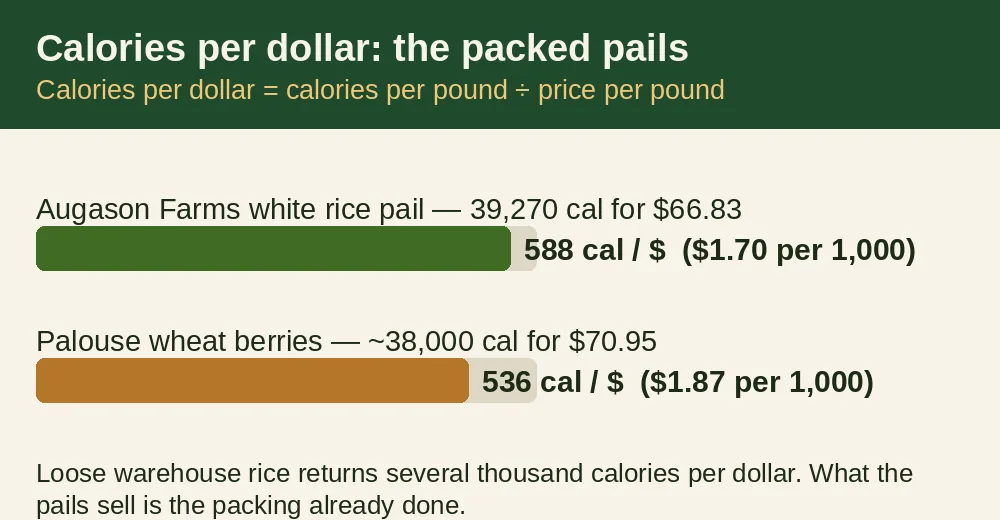
Rolled oats and rice tie at the top of the calorie table, and loose food beats packed food every time. The formula is simple enough to run in any store aisle: calories per dollar equals calories per pound divided by price per pound. White rice at 1,650 calories per pound, bought loose at warehouse prices, returns several thousand calories per dollar. The Augason pail, at $66.83 for 39,270 calories, returns about 588 calories per dollar — $1.70 per 1,000 calories. The Palouse bucket returns about 536 per dollar, $1.87 per 1,000. Those are honest numbers for packed food. A freeze-dried meal kit returns a few hundred calories per dollar at best, which is why this shelf gets built from staples first and kits second.
How much does a family of four need for 30 days?
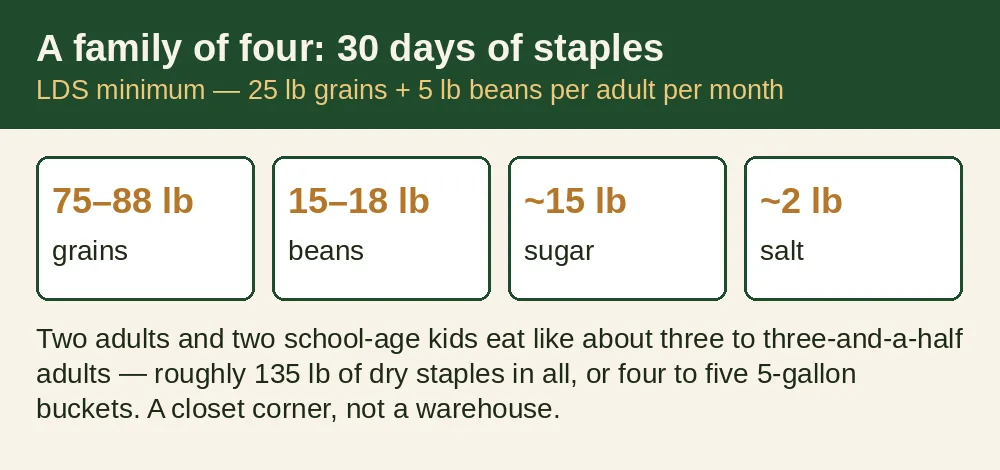
A family of four needs roughly 135 pounds of dry staples for 30 days if staples carried every calorie — and they shouldn’t. The LDS minimum plan works out to 25 pounds of grains plus 5 pounds of beans per adult per month, with sugar, salt, oil, and milk on top. Two adults and two school-age kids eat like about three to three-and-a-half adults, so a month looks like 75 to 88 pounds of grains and 15 to 18 pounds of beans, plus about 15 pounds of sugar and a couple of pounds of salt. That is four to five 5-gallon buckets — a closet corner, not a warehouse. Run your own household through our Long-Term Food Storage Calculator before you buy; most families overbuy rice and underbuy everything else.
Do sugar and salt need oxygen absorbers?
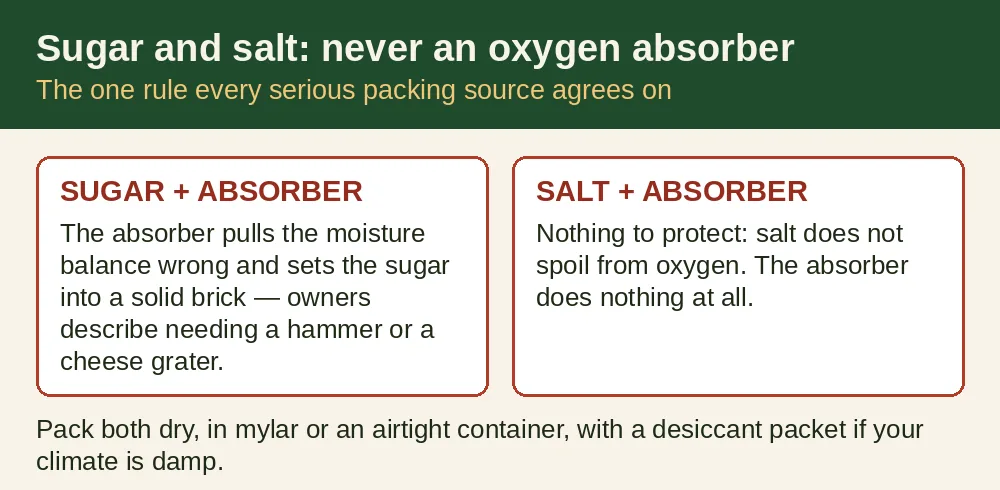
No — sugar and salt must never get an oxygen absorber. This is the one rule every serious packing source agrees on, from PackFreshUSA to the LDS dry-pack instructions, which put an absorber in every product except sugar. An absorber pulls the moisture balance in a sugar pack wrong and sets it into a solid brick owners describe as needing a hammer or a cheese grater to undo. Salt simply has nothing to protect: neither food spoils from oxygen. Moisture is their only enemy, so pack them dry, in mylar or a plain airtight container with a desiccant packet if your climate is damp — and leave the absorbers for the rice, beans, wheat, and oats. Our Oxygen Absorber Calculator sizes absorbers for the foods that do need them.
Why won’t old beans soften, even after hours of cooking?
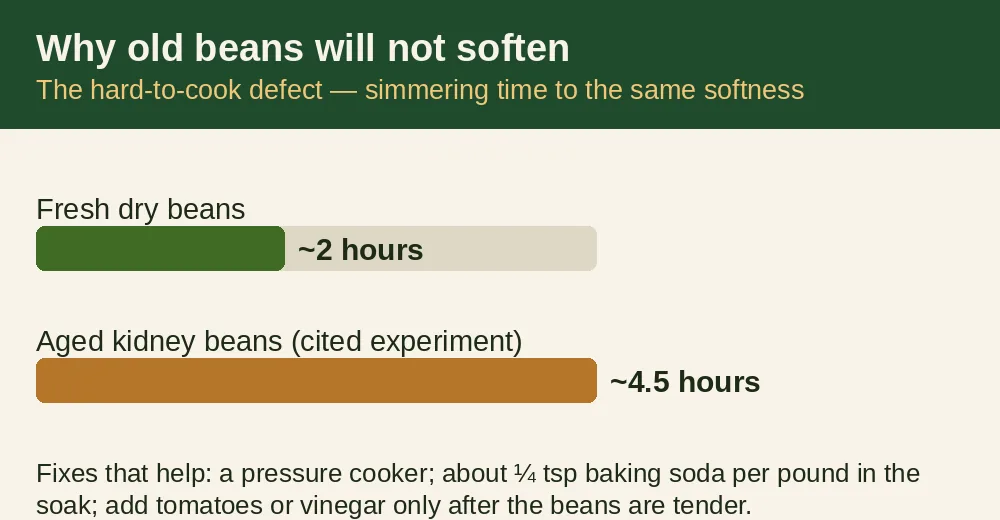
Old beans won’t soften because of the hard-to-cook defect: as dry beans age — faster in warm, humid storage — minerals cross-link the pectin in the bean and the seed coat toughens, until simmering for four hours or more still leaves them firm. In one cited experiment, aged kidney beans needed about four and a half hours to reach the softness fresh beans hit in two, and beans past roughly two years may never get creamy at all. The safety charts say 25 to 30 years; the cooking-quality window the USDA and the bean industry work with is one to two years. Both numbers are true, and only one of them matters at dinner. The fixes that actually help: a pressure cooker, a pinch of baking soda — about a quarter teaspoon per pound — in the soak, and adding tomatoes or vinegar only after the beans are tender, since acid sets them firm again. Plan on it plainly: buy bean pails and loose beans to rotate through your cooking, not to forget for 30 years.
What else do you have to buy to actually eat this food?
Wheat needs a mill, beans reward a pressure cooker, and everything on this shelf needs water and a way to boil it. That is the hidden second receipt. A hand grain mill runs about $195 to $330 in current listings — more than the bucket of wheat it grinds — and Georgia Extension’s own disaster-kit list includes a hand-cranked mill alongside the food, because officials treat the mill as part of the wheat purchase. Beans cook in any pot, but old beans in a plain pot can eat an afternoon of fuel; a pressure cooker cuts that hard. And a staples-only shelf is not a complete diet: BYU’s storage research flags vitamins A, C, B12, and E and calcium as the gaps in a grain-and-bean base, which is why oil, powdered milk, and fruit and vegetable layers belong in the plan next.
Honest Caveats
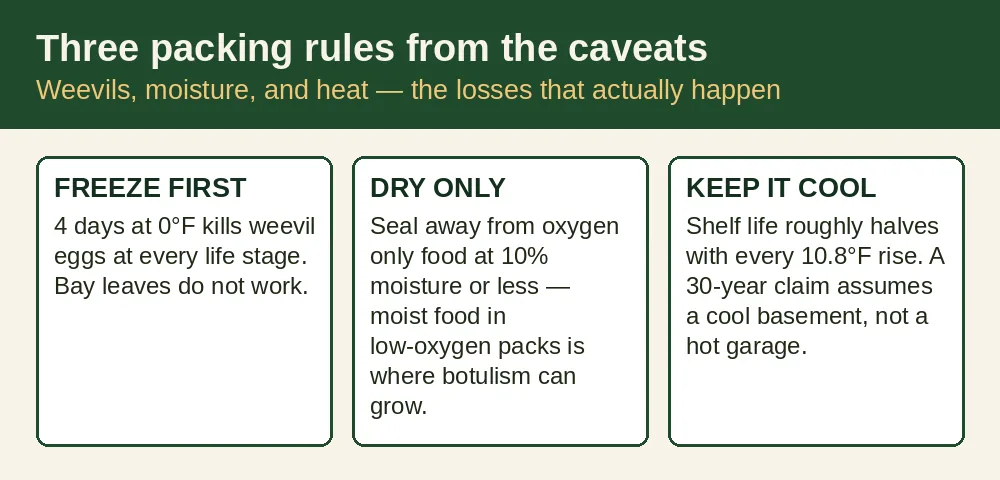
Three warnings before you spend. First, weevils: eggs ride home inside store packaging, and the most repeated owner loss story in this niche is a full bucket of rice, stored a year or two in a plain lidded bucket with no mylar and no absorber, opened to find it alive. An absorber, or four days at 0°F before packing, kills insects at every life stage. Bay leaves do not work. Second, moisture: only food at 10% moisture or less may be sealed away from oxygen — Utah State Extension warns that moist food in low-oxygen packaging is exactly where botulism can grow. Everything in this guide is safely dry; home-dried fruit that still bends is not. Third, heat: shelf life roughly halves with every 10.8°F rise, per USDA figures cited by Utah State. A 30-year claim assumes a cool basement. The same pail in a hot garage is a different, shorter food.
Frequently Asked Questions
How long does white rice last in mylar with an oxygen absorber — and how is brown rice different?
White rice packed in mylar with an absorber, in a bucket, at 75°F or cooler, keeps 25 to 30-plus years per LDS and University of Georgia Extension tables. Brown rice is a different food for storage: the oil in its bran goes rancid in about six months at room temperature no matter how it is packed, so it belongs in the everyday pantry, not the long-term shelf.
How much rice should I store per person per month?
About 10 pounds per person per month covers rice as roughly a third of one adult’s eating — about 16,500 calories. The full LDS minimum is broader: 25 pounds of all grains plus 5 pounds of beans per adult per month, with sugar, salt, and oil counted separately.
Do sugar and salt need oxygen absorbers?
No. Never. An absorber turns sugar into a solid brick and does nothing for salt, because neither spoils from oxygen. Pack both dry with a desiccant if humidity is your problem, and save absorbers for rice, beans, wheat, and oats.
What size oxygen absorber do I need for a 5-gallon bucket?
The working rule is 300 to 500cc of absorber per gallon of container — so 2,000 to 2,500cc total for a 5-gallon bag, and dense foods like rice sit at the low end while airy foods like pasta sit at the high end. Our Oxygen Absorber Calculator runs the exact numbers for your bag size and food.
Why won’t my stored beans soften, even after hours of cooking?
Age. The hard-to-cook defect cross-links the bean’s pectin and toughens the seed coat over time, faster in warm storage. A pressure cooker and a pinch of baking soda in the soak are the reliable fixes. Beans are safe far longer than they are pleasant — rotate them within a year or two for cooking quality.
How do I tell if stored rice has gone bad, and what about weevils?
Musty or sour smell, clumping, or webbing means toss it. Weevil eggs arrive inside store packaging; an oxygen absorber in the sealed pack, or freezing the rice for about four days at 0°F before packing, kills insects at every stage. Dead insects in sealed rice are harmless; live webbing in an open bag means sift and use it soon, or throw it out.
Sources & freshness: LDS Provident Living long-term storage chart and LDS Store listings; University of Georgia Extension C1310; Utah State University Extension food storage guides; Clemson HGIC pantry factsheet; USDA calorie figures; manufacturer specs for Augason Farms and Palouse Brand; prices verified October 24, 2026 via Keepa and camelcamelcamel. Prices last checked: October 24, 2026. Last updated: October 30, 2026.
Talk it over with other readers. The Truly Preserved Community on Facebook is where readers compare notes on food storage, water, and backup power — and where your questions help decide what we research next. Join the group →