
Truly Preserved is reader-supported. If you buy through a link on this page we may earn a commission at no extra cost to you. Nobody pays for placement or scores.
THE SHORT ANSWER
Home-cured bacon, Oregon State University Extension’s recipe: for a 5-pound pork belly, rub on 5 tablespoons of salt and 1 teaspoon of Curing Salt #1 (Prague Powder #1 — 6.25 percent sodium nitrite), seal the belly in a bag, and refrigerate it at 40°F for 5 to 7 days, turning the bag daily. It is ready when it feels firm. Then hot-smoke it at 225° to 250°F — about 3 hours — to an internal temperature of 160°F, chill it, and slice. Use Curing Salt #1 exactly as measured: Oregon State recommends it for bacon and advises against Curing Salt #2 for bacon, and USDA FSIS caps nitrite in dry-cured bacon at 200 parts per million.
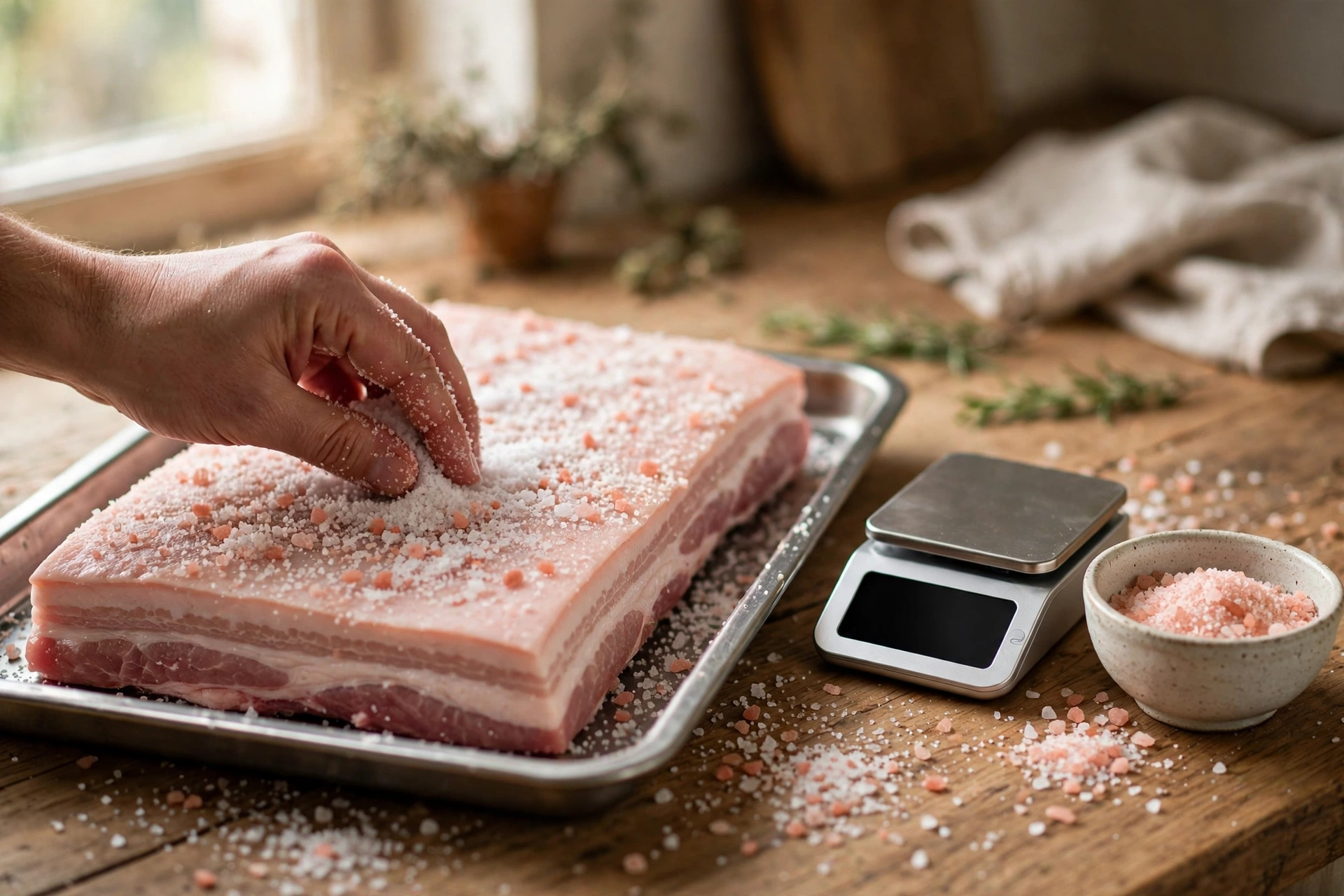
Bacon is the cure that teaches respect for the scale. Everything else in home curing is forgiving; nitrite is not. Too little and the cure under-protects the meat, too much and the curing salt itself becomes the hazard — Oregon State warns plainly that nitrite has a relatively high toxicity and must be used in the amounts set by researched recipes. So this guide does one thing differently from most bacon write-ups on the internet: it uses one extension recipe, Oregon State University’s, with its amounts exactly as published, and it does not blend numbers from anywhere else.
One naming trap before anything else, because Oregon State flags it too: pink curing salt is not Himalayan pink salt. They share a color and nothing else. The recipes below mean Prague Powder #1, a manufactured blend of 6.25 percent sodium nitrite and 93.75 percent salt.
What You Need
A fresh pork belly — the recipe is written for 5 pounds — plus salt, Curing Salt #1, and sugar if you want it: Oregon State notes white or brown sugar works well in dry cures. A kitchen scale is not optional equipment in curing; the belly gets weighed, because the recipe is built on the meat’s weight. A large zip-top bag, a tray to catch leaks, refrigerator space at 40°F, and a smoker or oven setup that can hold 225° to 250°F finish the list.

Hoosier Hill Farm Prague Powder #1, 2.5 lb
Prague Powder #1 — 6.25 percent sodium nitrite — is the curing salt Oregon State's bacon recipe specifies, in a tub that outlasts many bellies.
$18.99 from Amazon
Etekcity Digital Kitchen Scale
Curing starts with weighing the belly — the recipe is built on the meat's weight, and this scale reads it to the gram.
$9.99 from Amazon
TempPro Instant-Read Meat Thermometer
The finish line is an internal 160°F, and this is how you know the bacon crossed it.
$8.99 from AmazonBefore You Start
Three rules govern this whole project. First, one recipe: Oregon State’s amounts, Oregon State’s times. The fastest way to make curing dangerous is to average two recipes from two websites. Second, the right curing salt: Prague Powder #1, 6.25 percent sodium nitrite. Oregon State does not recommend Prague Powder #2 for bacon — it produces more nitrosamines when the bacon is fried. Third, the ceiling behind the recipe: USDA’s food safety service caps ingoing sodium nitrite at 200 parts per million for dry-cured bacon (120 ppm for pumped and immersion-cured bacon). A researched recipe keeps a home cure inside those lines; improvisation is how a cure leaves them.
How to Cure Bacon at Home, Step by Step
- Weigh the belly. The recipe is written for 5 pounds of pork belly. If your belly weighs something else, use a tested recipe written for that weight rather than scaling this one by feel.
- Mix the cure. For 5 pounds: 5 tablespoons of salt and 1 teaspoon of Curing Salt #1. Add white or brown sugar to taste if you are using it — Oregon State lists sugars as the dry cure’s sweetener, and the salt and curing salt amounts are the parts that do not move.
- Rub it on. Coat the belly thoroughly on all sides with the cure mixture.
- Bag and refrigerate. Seal the belly in a zip-top bag, set it on a tray, and refrigerate at 40°F.
- Cure 5 to 7 days, turning daily. Flip the bag once a day so the cure and the liquid it draws stay in contact with every surface. The belly is ready when it feels firm to the touch.
- Rinse and dry. Take the belly out of the cure and rinse off the surface cure before it goes to the heat.
- Hot-smoke to temperature. Smoke at 225° to 250°F — about 3 hours — until the bacon reaches an internal temperature of 160°F. Oregon State’s rule is the temperature, not the clock: cook the bacon to 160°F.
- Chill, then slice. Cold bacon slices cleanly. Refrigerate the finished bacon and use sliced bacon within 7 days, or freeze it for longer storage.
The Numbers
| Checkpoint | The figure | Source |
|---|---|---|
| Belly weight for this recipe | 5 pounds | Oregon State Extension PNW 784 |
| Salt | 5 tablespoons | Oregon State Extension PNW 784 |
| Curing Salt #1 (6.25% sodium nitrite) | 1 teaspoon | Oregon State Extension PNW 784 |
| Cure temperature | 40°F refrigerator | Oregon State Extension PNW 784 |
| Cure time | 5 to 7 days, turn the bag daily; ready when firm | Oregon State Extension PNW 784 |
| Hot-smoke | 225° to 250°F, about 3 hours, to 160°F internal | Oregon State Extension PNW 784 |
| Nitrite ceiling — dry-cured bacon | 200 ppm ingoing sodium nitrite maximum | USDA FSIS (9 CFR 424.22) |
| Nitrite ceiling — pumped/immersion bacon | 120 ppm ingoing maximum | USDA FSIS (9 CFR 424.22) |
| Finished bacon, refrigerated | Use sliced bacon within 7 days; freeze for longer | Oregon State Extension PNW 784 |
Cured bacon freezes best in meal-size vacuum packs. The two sealers worth having for that job:

FoodSaver Elite Vacuum Sealer
Sliced bacon freezes best vacuum-sealed in meal-size portions — this is the sealer built for constant use.
$218.56 from Amazon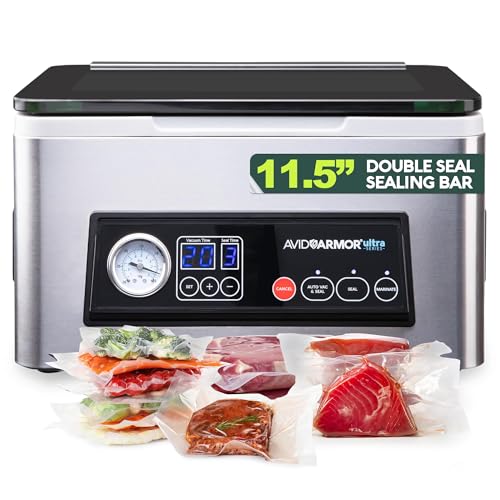
Avid Armor USV20 Chamber Vacuum Sealer
The chamber option for packing bacon flat — bags cost less and the seal holds through months in the freezer.
$349.00 from AmazonCommon Mistakes
Substituting Himalayan pink salt. It is a table salt with a color. It contains no measured nitrite and cures nothing. Oregon State calls this confusion out by name.
Reaching for Curing Salt #2. The #2 blend is made for long, dry-aged products, and Oregon State advises against it for bacon specifically because it makes more nitrosamines when bacon is fried.
Scaling the cure by eye. A heaped teaspoon of curing salt is a different dose than a level one. The recipe’s amounts are the safety system; measure them the way they are written.
Curing warm. The recipe’s refrigerator is 40°F. A belly curing in a 45°F fridge is outside the recipe, whatever the calendar says.
Storage and Shelf Life
Finished bacon goes back in the refrigerator, and sliced bacon should be used within 7 days. For longer storage, freeze it — portioned and sealed, it waits there without the clock the refrigerator imposes. When in doubt about a batch at any stage — off smell, slimy surface, a cure that never firmed — the extension answer is the same as it is everywhere in this program: throw it out.
Viewers also searched for these items.

Nesco VS-12 Vacuum Sealer
The everyday sealer for portioning sliced bacon before it goes to the freezer.
$108.18 from Amazon
Metronic 8-Inch Impulse Sealer
Heat-seals the cure bags and storage pouches — the bench tool the curing shelf runs on.
$39.99 from Amazon
Ziploc Freezer Quart Bags
Meal-size freezer bags for the sliced bacon that gets eaten first.
$26.48 from AmazonFrequently Asked Questions
What is the difference between Curing Salt #1 and #2?
Curing Salt #1 (Prague Powder #1) is 6.25 percent sodium nitrite with salt, made for cured meats that will be cooked — bacon included. Curing Salt #2 adds nitrate for long dry-aging, and Oregon State advises against it for bacon because it produces more nitrosamines when the bacon is fried.
How much curing salt goes on a 5-pound belly?
Oregon State’s recipe: 1 teaspoon of Curing Salt #1, with 5 tablespoons of salt, for 5 pounds of pork belly.
How do I know the cure is finished?
Time and feel together: 5 to 7 days at 40°F, turned daily, and the belly feels firm when it is ready.
Does the bacon have to be smoked?
It has to be cooked to temperature — Oregon State’s figure is 160°F internal. Hot-smoking at 225° to 250°F is the method that gets it there with the flavor bacon is for; the temperature is the requirement, the smoke is the tradition.
Recipe and method: Oregon State University Extension, “Making Cured Bacon at Home,” PNW 784 (2025). Nitrite limits: USDA Food Safety and Inspection Service, 9 CFR 424.22.
Prices shown on this page were last checked November 26, 2026 — prices change; check before you buy.
Talk it over with other readers
The Truly Preserved Community on Facebook is where readers compare notes on food storage, water, and backup power — and where your questions help decide what we research next.