
Truly Preserved is reader-supported. If you buy through a link on this page we may earn a commission at no extra cost to you. Nobody pays for placement or scores.
THE SHORT ANSWER
Safe jerky, the USDA food safety service’s method: heat the meat to 160°F — and poultry to 165°F — before the dehydrating process, because that wet-heat step is what destroys the bacteria drying alone cannot. After heating, hold a constant dehydrator temperature of 130 to 140°F through the drying. On the cure question, the research the fact sheet reports is specific: jerky made with a curing mix containing salt and sodium nitrite showed more bacterial destruction than jerky made without it, and cured meat that was also heated before drying did best of all — but the heat step is the requirement, and the fact sheet’s safest ground-beef method is precooking to 160°F before drying. Home-dried jerky keeps 1 to 2 months. Every figure comes from the FSIS fact sheet credited at the bottom.
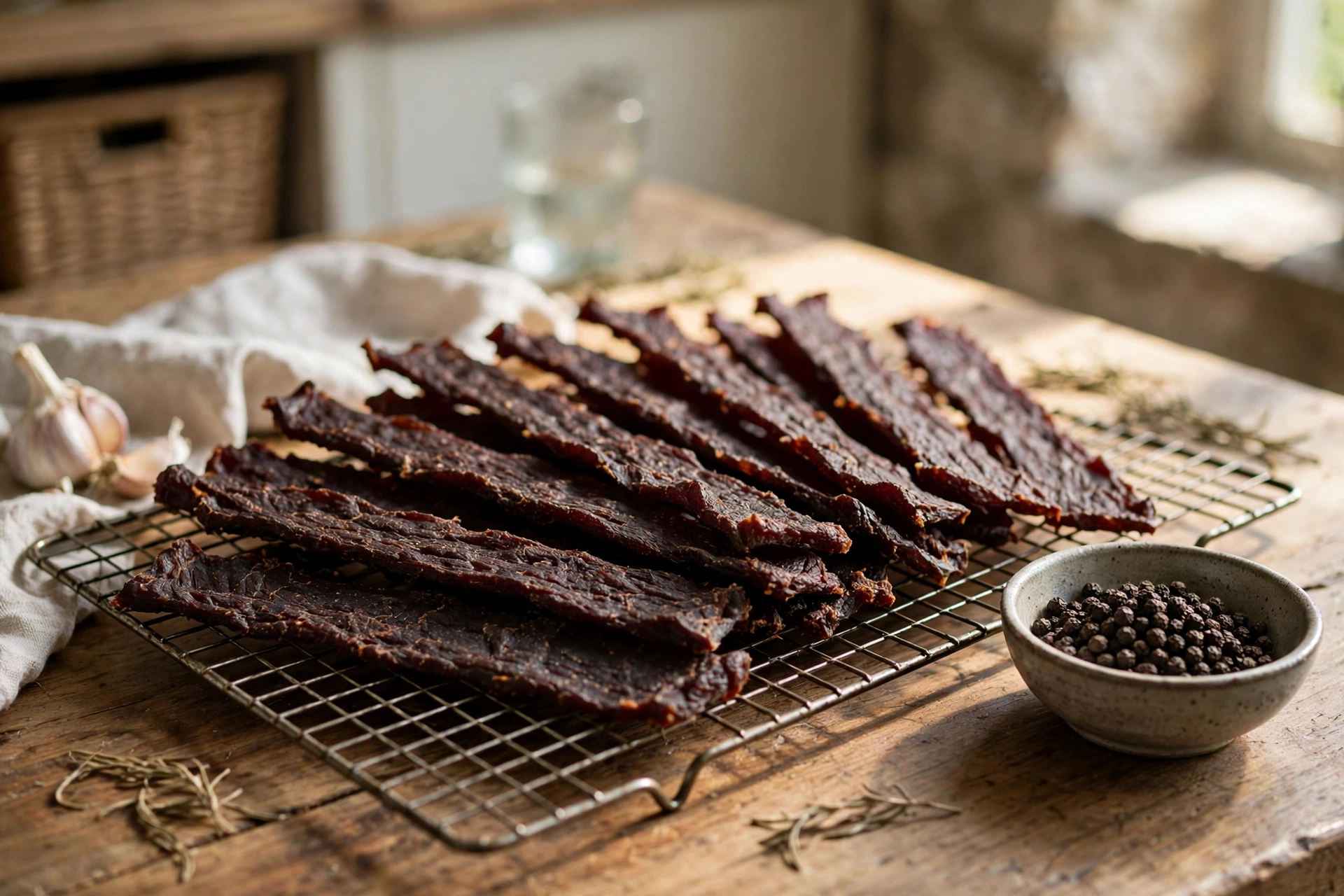
Jerky feels like the simplest preserved meat there is — slice, season, dry — and it is the one the food safety service writes its most worried fact sheet about. The reason is a physics problem: in a dehydrator running at 130 to 140°F, the evaporating moisture keeps the meat itself cool while it dries, so the meat may never reach a temperature that kills Salmonella and E. coli O157:H7 — and once meat has dried, the bacteria on it become much more heat resistant. Illnesses from homemade jerky are what moved the USDA Meat and Poultry Hotline to its current recommendation, and this guide follows that fact sheet exactly.
This guide is part of our preservation guides. It answers the two questions jerky makers actually argue about — do I need a cure, and do I really need the heat step — with the fact sheet’s own evidence, and it links the cure half of the question to how to use curing salt safely. If you are choosing the dehydrator itself, the temperatures below are the specification to shop against: the machine must hold 130 to 140°F steadily after the meat has been heated.
What You Need
Lean meat or poultry, sliced for jerky; a marinade or cure mixture if you are using one; a way to heat the meat to temperature before drying — the fact sheet’s methods are steaming or roasting to temperature, measured with a food thermometer; and a food dehydrator that will maintain a constant 130 to 140°F through the drying process. The thermometer is not optional: both finish figures in this guide are thermometer readings.

Cosori Food Dehydrator, 6 Stainless Trays
The drying step must hold a constant 130 to 140°F — a dehydrator with a real thermostat is the machine this method assumes.
$135.99 from Amazon
ThermoPro Instant-Read Thermometer
The whole method turns on two thermometer readings — 160°F for meat, 165°F for poultry, before drying — and this is how they are verified.
$8.99 from Amazon
Hoosier Hill Farm Prague Powder No. 1
Prague Powder #1, the curing salt in the mixes the FSIS research tested — used in jerky only at the amount a tested recipe or its package directs.
$18.99 from AmazonBefore You Start
Understand the order of operations, because it is the whole guide: heat first, then dry. Heating after drying is a weaker step — the fact sheet explains that after drying, bacteria become much more heat resistant. Understand also what a dehydrator cannot do: most dehydrator instructions do not include the heating step, and a dehydrator may not reach temperatures high enough to heat meat to 160°F or 165°F, which is why the heating happens before the meat goes in. Finally, the research warning the fact sheet carries: in the studies it reports, pathogenic E. coli on venison survived drying times of up to 10 hours and temperatures of up to 145°F. Drying alone, even long drying, is not the kill step.
How to Cure Jerky Safely, Step by Step
- Slice and season the meat. Slice the meat for jerky and apply your marinade or curing mix. If you use a curing mix containing salt and sodium nitrite, use it in the amount its recipe or package directs — the fact sheet’s research used a commercial beef jerky spice mixture with a curing mix, and found it killed more bacteria than no cure.
- Heat the meat before drying. Steam or roast the meat to 160°F — poultry to 165°F — as measured with a food thermometer, before dehydrating it. This step assures that any bacteria present will be destroyed by wet heat.
- Move it straight to the dehydrator. Do not let the heated meat sit; the drying step follows the heating step.
- Dry at a constant 130 to 140°F. Maintain that dehydrator temperature through the whole drying process: fast enough to dry the food before it spoils, and enough water removed that microorganisms are unable to grow.
- Check the texture. The jerky is dried when a cooled piece cracks but does not break when bent — and it got there only after the heat step, never instead of it.
- Store it like the fact sheet says. Home-dried jerky should be consumed within 1 to 2 months.
The Numbers: The Heat Step and the Drying Range
| Checkpoint | The figure (USDA FSIS) |
|---|---|
| Heat meat before dehydrating | 160°F |
| Heat poultry before dehydrating | 165°F |
| Dehydrator temperature during drying | 130 to 140°F, constant |
| Survival found in research | E. coli survived drying up to 10 hours and temperatures up to 145°F (venison study) |
| Home-dried jerky storage | 1 to 2 months |
| Commercially packaged jerky storage | Up to 12 months in a cool, dry place |
Dried jerky keeps best sealed in small packs, and the dehydrator shelf beside it — fruit, vegetables, and the rest of the drying program — runs on the same machines. Two tools for the storage step:

Nesco Snackmaster Pro Dehydrator
The round stackable dehydrator alternative for the same 130-to-140°F drying work, expandable as batches grow.
$64.39 from Amazon
Excalibur 9-Tray Dehydrator
The 9-tray benchmark for big jerky batches, with the tray volume a whole season's meat needs.
Check AvailabilityCommon Mistakes
Drying first and heating later. The fact sheet’s warning is mechanical: after drying, bacteria become much more heat resistant. The 160°F step belongs before the dehydrator, while wet heat can still do its work.
Trusting the dehydrator to reach 160°F. A dehydrator may not reach temperatures high enough to heat meat to 160°F or 165°F, and its instructions usually omit the step. Heat the meat separately, with a thermometer.
Believing a cure replaces the heat. The research gives the cure real credit — more bacterial destruction with a curing mix than without — and still concludes that safety is minimized when the meat is precooked to 160°F before drying. Cure plus heat is the finding; cure instead of heat is not.
Letting the dehydrator drift cool. After heating, the 130 to 140°F drying range must be constant. A machine that sags below it dries slowly enough for spoilage to win the race.
Storing home jerky like store jerky. Commercially packaged jerky keeps up to 12 months; home-dried jerky is a 1-to-2-month food. The shelf lives are not interchangeable.
Storage and Shelf Life
Store home-dried jerky in a cool, dry place and consume it within 1 to 2 months, per the fact sheet. Sealed, portioned packs keep the batch’s texture even and keep a opened bag from becoming the whole batch’s problem. Any jerky that was dried without the heat step should be treated as the fact sheet treats the method itself: not the safe version of this food.
Viewers also searched for these items.

Nesco VS-12 Vacuum Sealer
Jerky's 1-to-2-month home shelf life goes better in sealed portions — vacuum packs keep the texture the drying built.
$108.18 from Amazon
Ziploc Freezer Quart Bags
Quart freezer bags for the jerky portions headed to the freezer, frozen flat and stacked.
$26.48 from Amazon
IRIS USA Airtight Container, 30 lb, with Wheels
Airtight storage for the dried batch's working supply, sealed against the humidity that softens jerky.
$23.99 from AmazonFrequently Asked Questions
Do I need curing salt in jerky?
The fact sheet reports research in which a curing mix containing salt and sodium nitrite killed more bacteria than no cure, and cured meat heated before drying did best of all. It does not present the cure as a substitute for the heat step — for ground beef jerky, its conclusion is that safety concerns are minimized if the meat is precooked to 160°F prior to drying.
Why 160°F before drying, if the dehydrator runs at 130 to 140°F?
Because the dehydrator’s dry heat may never bring the meat itself to a bacteria-killing temperature before it dries — and dried bacteria are more heat resistant. The pre-heating step destroys bacteria with wet heat while that still works.
What about poultry jerky?
The poultry figure is higher: heat poultry to 165°F before the dehydrating process, then dry at the same constant 130 to 140°F.
How long does homemade jerky keep?
One to 2 months, per the fact sheet — against up to 12 months for commercially packaged jerky stored in a cool, dry place.
Method, temperatures, research findings, and storage: USDA Food Safety and Inspection Service, “Jerky and Food Safety” (fact sheet), via via the USDA Food Safety and Inspection Service.
Prices shown on this page were last checked November 26, 2026 — prices change; check before you buy.
Talk it over with other readers
The Truly Preserved Community on Facebook is where readers compare notes on food storage, water, and backup power — and where your questions help decide what we research next.