
Truly Preserved is reader-supported. If you buy through a link on this page we may earn a commission at no extra cost to you. Nobody pays for placement or scores.
THE SHORT ANSWER
Wash and trim zucchini, cut it into 1/4-inch slices, blanch them — 2 1/2 to 3 minutes in steam or 1 1/2 minutes in water — and dry at 140°F for 10 to 12 hours, until the chips are brittle or crisp. Those are Clemson University HGIC’s figures for summer squash, and its general rule for vegetables is the test: dried until brittle or crisp, at about 10 percent moisture. Times are ranges, and the crisp test decides. Every figure on this page comes from the credited sources at the bottom.
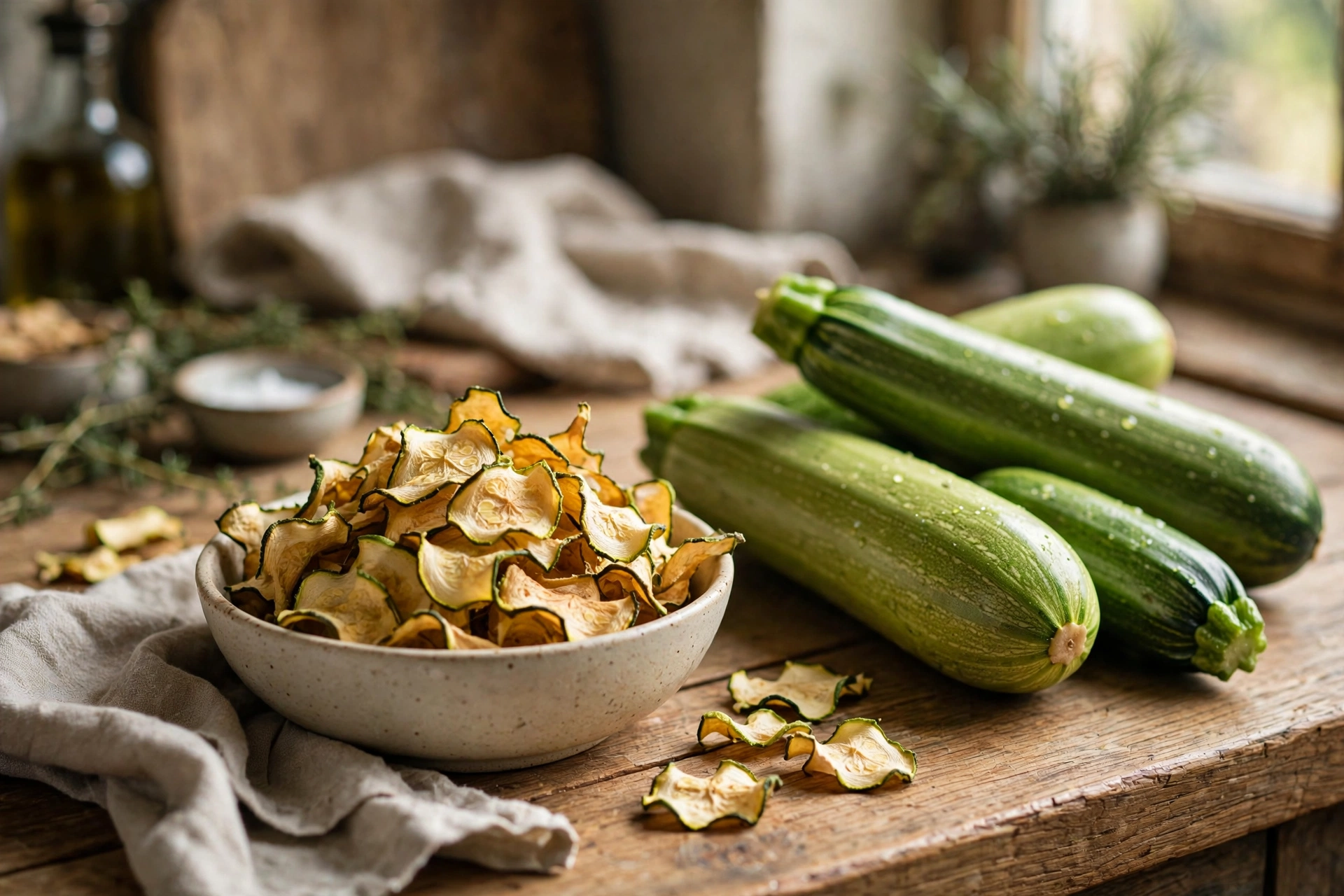
Zucchini is the garden joke — plants that produce faster than neighbors will accept them — and chips are the answer that actually gets eaten. Sliced thin, blanched and dried crisp, zucchini becomes a light, dippable snack that Clemson lists first among its vegetable chip suggestions, ahead of tomato, squash, parsnip, turnip, cucumber, beet and carrot chips. A mountain of summer zucchini becomes a jar of chips that takes up one shelf corner.
This guide follows Clemson University’s HGIC summer squash procedure — zucchini is a summer squash, and the source’s chip section names it directly — with Colorado State University Extension for the 140°F temperature. This guide is part of our preservation guides; the same blanch-and-dry pattern runs through the other vegetable guides in this series, and how to dehydrate apples covers the fruit side. For machines, best dehydrator for beginners is the starting roundup.
What You Need
Wash and trim the zucchini and cut it into 1/4-inch slices — uniform slices, because Clemson is explicit that pieces kept uniform in size dry at the same rate, and a chip batch lives or dies on even crispness. Prepare only as many vegetables as can be dried at one time; holding washed, cut vegetables, even in the refrigerator, costs quality and nutrients. For scale, Colorado State’s yield table lists squash at 10 pounds fresh drying to 3/4 pound, or 5 pints. You need a pot and basket for blanching, and a dehydrator that holds 140°F.
Choose the zucchini for the chip, not just for the garden. Firm, fresh zucchini in prime condition is what Clemson requires of every vegetable it dries — wilted produce has already begun to deteriorate, and a soft, seedy, overgrown zucchini makes a soft chip no matter how carefully it is blanched. Smaller, firm fruit slice into rounds that hold together through blanching and drying; the giant club that hid under the leaves is better grated for baking or frozen. Sort at the sink as you wash, discarding bruised or damaged pieces, because one poor slice in a tray of chips is the slice that stays damp, and damp is what the whole crisp test exists to catch.

Nesco Snackmaster Pro Dehydrator
A stacking dehydrator fits chip batches well — thin zucchini rounds in single layers across trays at a steady 140°F.
$64.39 from Amazon
ThermoPro Instant-Read Thermometer
A thermometer check confirms 140°F at the trays, the temperature the 10 to 12 hour chip range assumes.
$8.99 from Amazon
Etekcity Digital Kitchen Scale
Weighing the zucchini glut before slicing shows what 10 pounds fresh becomes — about 3/4 pound of chips.
$9.99 from AmazonBefore You Start
Zucchini is blanched, unlike onions or mushrooms. Clemson calls blanching a necessary step for most vegetables: it destroys the enzymes that cause loss of color and flavor during drying and storage, sets the color, and shortens drying and rehydration time by relaxing the tissue walls. The times differ by method — steam takes longer than water — and both are in the table below. After blanching, dip the slices briefly in cold water only long enough to stop the cooking, drain them onto the tray, and get the tray into the dehydrator immediately; the heat left in the slices starts the drying faster.
Set the blanching station up before the first slice is cut: pot at a rolling boil, basket ready, cold water waiting, trays beside the stove. Blanching is timed in minutes and the slices move quickly from pot to cold water to tray, and a cook who is hunting for a colander while the timer runs over-blanches the batch by default. Work in small batches — Clemson’s rule for water blanching is that if the water takes longer than a minute to come back to a boil, too many vegetables went in — and let each small batch be a good one.
How to Dehydrate Zucchini Chips, Step by Step
- Slice 1/4 inch thick. Wash and trim the zucchini, then cut it into 1/4-inch slices, as uniform as you can make them.
- Blanch the slices. Steam blanch for 2 1/2 to 3 minutes, or water blanch for 1 1/2 minutes. In water, if the pot takes longer than one minute to return to a boil, too many slices went in — reduce the next batch.
- Cool briefly and drain. Dip the blanched slices briefly in cold water, only long enough to stop the cooking — do not cool them to room temperature. Drain them directly onto the drying tray and wipe the excess water from underneath.
- Load in a single layer. Arrange the slices in a single layer on the trays and place them in the dehydrator right away.
- Dry at 140°F. Dry for 10 to 12 hours in the dehydrator, per the Clemson table. Watch the chips closely at the end — they dry much more quickly then and can scorch.
- Test for crisp. Cool a few chips and test them. The batch is done when the chips are brittle or crisp — a chip that bends is a chip that goes back in.
- Cool and pack at once. Cool the chips completely and pack them immediately into sealed containers, as the storage section describes.
The Numbers: Temperature, Time and the Crisp Test
Zucchini dries under the summer squash row of the Clemson table. Blanching method changes the blanch time; it does not change the temperature or the test.
| Food | Preparation | Drying temperature | Drying time | Done when |
|---|---|---|---|---|
| Zucchini (summer squash) | Wash, trim, cut into 1/4-inch slices; steam blanch 2 1/2 to 3 minutes or water blanch 1 1/2 minutes | 140°F | 10 to 12 hours in a dehydrator | Brittle or crisp (about 10 percent moisture) |
Times are ranges and the dryness test decides. Clemson also notes that drying times in a conventional oven could be up to twice as long, depending on air circulation — one more reason the crisp test, not the clock, ends the batch.
Not every zucchini has to become chips. The overflow freezes well for soups and baking, vacuum-sealed or bagged, and grated zucchini dries for winter baking too — these are the tools the freezing side of the harvest runs on.

FoodSaver Elite Vacuum Sealer
Zucchini grated for winter baking freezes flat and clean vacuum-sealed, with no freezer-burned edges.
$218.56 from Amazon
Ziploc Freezer Quart Bags
Quart freezer bags portion frozen zucchini for soups in the amounts recipes actually call for.
$26.48 from AmazonCommon Mistakes
Skipping the blanch. For zucchini, blanching is part of the procedure, not a preference. Unblanched slices keep active enzymes that cost color and flavor through drying and storage.
Mixed slice thickness. A 1/4-inch slice is the unit the times are built on. Thick rounds stay leathery in the middle while thin ones scorch at the edges of the same tray.
Cooling the blanched slices to room temperature. Clemson says to cool them only long enough to stop the cooking, then drain and load at once. Fully cooled, drained-later slices sit wet and lose quality.
Walking away at the end. Vegetables dry much more quickly at the end of the run and can scorch. The last hour of a chip batch is the hour to watch.
Packing warm chips. Packaging warm food causes sweating inside the container, and that moisture can grow mold. Cool completely, then pack immediately.
Storage and Shelf Life
Cool the chips completely, then pack them into clean, dry, insect-proof containers as tightly as possible without crushing — glass jars with tightly fitted lids are Clemson’s recommended containers, and they make any collected moisture easy to see. Store in a cool, dry, dark area. Clemson gives dried foods four months to one year depending on storage temperature, with vegetables keeping generally six months at 60°F or three months at 80°F. Check the jars during storage: chips that have reabsorbed moisture but are not spoiled get used immediately or redried and repackaged; moldy food is discarded. Because vegetables dry to about 10 percent moisture, they do not need conditioning like fruits.
Serve the chips the day they cool for the loudest crunch, with a favorite dip — Clemson suggests chips exactly this way, as a nutritious low-calorie snack. What does not get eaten the first day goes into the sealed jars above and comes back out for lunches and road food; a chip that has softened in storage can be redried briefly rather than thrown away, as long as it shows no sign of mold or spoilage. Pieces that never quite crisped also have a second life crushed into soups, where crispness was never the point.
Viewers also searched for these items.

Cosori Food Dehydrator, 6 Stainless Trays
Six stainless trays give a big zucchini day the single-layer room chips need to crisp evenly.
$135.99 from Amazon
IRIS USA Airtight Container, 30 lb, with Wheels
An airtight container keeps chip jars sealed together against pantry humidity.
$23.99 from AmazonFrequently Asked Questions
Is zucchini really in the source table?
Yes, by its family and by name. Clemson’s table lists summer squash — wash, trim, cut into 1/4-inch slices — and its vegetable chips section names zucchini first among the vegetables to try.
Steam or water blanching — which is better?
Both are in the procedure: steam for 2 1/2 to 3 minutes, water for 1 1/2 minutes. Clemson notes water blanching is faster but usually costs more nutrients than steam.
Why aren’t my chips crisp?
Either they need more time — test cooled chips, since warm ones feel softer — or the slices were uneven. Chips are done at brittle or crisp, about 10 percent moisture; bendy chips go back in.
How long do zucchini chips keep?
Stored cool, dry and dark in sealed containers, dried vegetables generally keep six months at 60°F or three months at 80°F, per Clemson.
Procedure, blanching and drying times, dryness standard and chip guidance: Clemson University HGIC, “Drying Vegetables,” via Clemson University Home & Garden Information Center; temperature and yield: Colorado State University Extension, “Drying Vegetables.”
Prices shown on this page were last checked November 26, 2026 — prices change; check before you buy.
Talk it over with other readers
The Truly Preserved Community on Facebook is where readers compare notes on food storage, water, and backup power — and where your questions help decide what we research next.