
Affiliate Disclosure: Truly Preserved is reader-supported. When you buy through links on this page, we may earn a commission at no extra cost to you. As an Amazon Associate, Truly Preserved earns from qualifying purchases. Read our full affiliate disclosure.
Last updated: October 31, 2026
THE SHORT ANSWER
Yes — freeze-dried cheese makes mac and cheese and potatoes au gratin, and it works best cooked straight into the dish dry, where the sauce or casserole liquid rehydrates it as it heats. Shreds melt into sauces and casseroles; powder disappears into cheese sauces and soups. Slices and chunks are the snacking form. The one honest limit: a top layer of freeze-dried cheese will not brown and bubble the way fresh grated cheese does, so put most of it inside the dish, not on top.
Susan Pitt asked it plainly in The Freeze Drying Community’s Open Questions: “For those of you who FD cheese how do you use it after? Can it be used to make mac and cheese or tators augratin?” It is the right question to ask before a tray of cheddar goes in, not after — because freeze-dried cheese does not come back as a block you slice. It comes back as an ingredient, and it is a genuinely good one, as long as you cook with it the way it wants to be cooked.
Start with the form you dried it in
How you cut the cheese before the cycle decides what it is good for after. This is the part owners learn on the second batch, not the first — and it is why which cheeses dry well in the first place matters: the hard, lower-fat cheeses that dry best are also the ones that cook best afterward.
| Form | Best for | Watch out for |
|---|---|---|
| Shreds | Casseroles, au gratin, pizza, eggs | Clumps if dumped in dry |
| Powder (blended dry) | Mac and cheese sauce, soups, popcorn | Goes stale fastest once opened |
| Slices or chunks | Snacking, cheese boards, travel | Slowest to rehydrate evenly |
Grating before drying is the move most owners settle on. Shreds expose the most surface, so they dry the most completely and melt back the most evenly. Powder is just shreds run through a blender after drying — make it in small amounts, because the extra surface that makes it melt so well also makes it pick up moisture and stale flavors faster in storage.
Cooking with it dry — the main way
For most cooked dishes, skip rehydrating as a separate step. Stir the dry shreds or powder directly into hot, wet food and let the dish’s own liquid do the work:
- Mac and cheese: Stir powder or fine shreds into the hot drained pasta with the milk and butter, a spoonful at a time, over low heat. The pasta’s surface moisture and the milk rehydrate the cheese as it melts. Owners consistently report the flavor lands right — sharp cheddar tastes like sharp cheddar — while the sauce texture runs a little less silky than fresh-grated, because freeze-dried cheese has no moisture of its own to give back to the sauce. A splash of extra milk fixes most of that.
- Soups and sauces: Whisk powder in at the end, off a hard boil. Boiling a cheese sauce hard makes any cheese grainy; freeze-dried is no different, just less forgiving.
- Eggs, casseroles, and bakes: Shreds scattered through the dish rehydrate from the surrounding ingredients as it bakes. No extra step.
The pattern in owner reports is consistent: cooked into a dish, freeze-dried cheese is hard to pick out from fresh. Served as itself — a slice on a cracker — the texture gives it away. Plan your batches for the first job and treat the second as a bonus.
Rehydrating first, when a dish needs it
Some uses do want the cheese soft before it goes in — a quesadilla filling, a sandwich, anything where dry shreds would stay dry because the dish around them has little free liquid. The method owners use is a sprinkle, not a soak:
- Spread the shreds in a shallow dish in a thin layer.
- Mist or sprinkle with cool water — roughly a teaspoon of water per cup of shreds to start.
- Cover and rest 10 to 20 minutes, then check. Add a few drops more only if shreds still feel brittle.
Too much water is the common mistake: drowned shreds turn pasty and will not melt cleanly afterward. You are aiming for pliable, not wet. Chunks and slices take longer and rehydrate unevenly — the outside softens while the center stays crisp — which is another reason shreds are the cooking form.
Potatoes au gratin, head-on
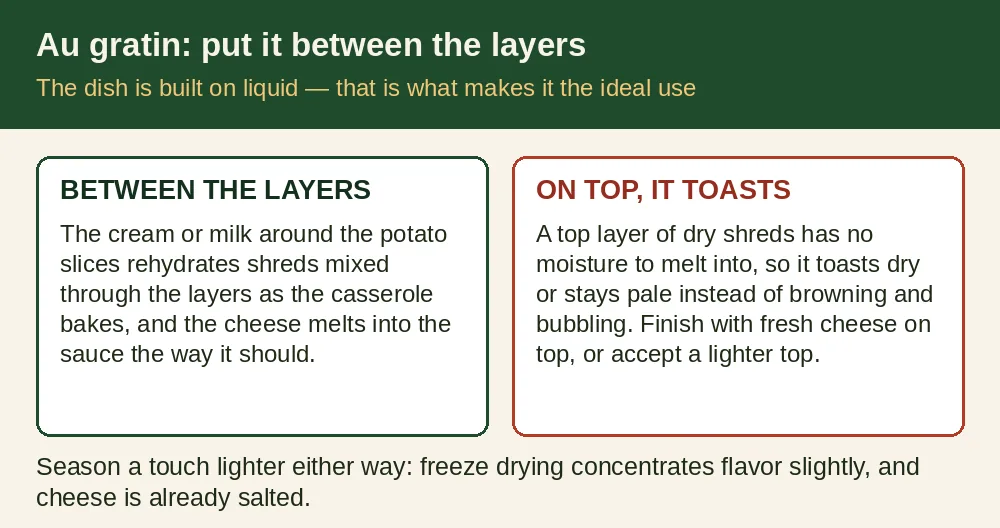
Au gratin is nearly the ideal use, because the dish is built on liquid. The cream or milk surrounding the potato slices rehydrates shreds mixed through the layers as the casserole bakes, and the cheese melts into the sauce the way it should. Two honest limits:
- The top layer behaves differently. Fresh grated cheese on top melts, bubbles, and browns. A top layer of freeze-dried shreds has no moisture to melt into, so it tends to toast dry or stay pale and crisp rather than forming that browned crust. Owners who want the classic top either finish with a handful of fresh cheese or accept a lighter top and put the freeze-dried cheese where it counts — between the layers.
- Season a touch lighter. Freeze drying concentrates flavor slightly, and cheese is already salted. Taste the sauce before adding the full salt you would use with fresh.
Snacking, and how long it keeps
Slices and chunks eaten dry are a real use, not a fallback — crisp, intensely cheesy, and shelf-stable in a way fresh cheese never is. They are a staple in hiking and lunchbox threads for exactly that reason.
On storage, keep expectations honest. Cheese carries fat, and fat is what shortens the life of any freeze-dried food. Our page on how long opened freeze-dried food lasts lays out the framing: a sealed mylar bag with an oxygen absorber is the long shelf, and an opened bag of a fatty food like cheese is a use-it-within-about-a-month supply. That makes freeze-dried cheese a rotate-through-it food, not a 25-year food. Store it by the guidance in our mylar bags guide, and if it ever smells like old oil, that batch is done — rancid fat does not get better.
Portioning is simple: shreds go into a dish by roughly the same volume you would use fresh, and powder a spoonful at a time until the sauce tastes right.
Questions people also ask
Can you eat freeze-dried cheese dry?
Yes. Freeze-dried cheese slices and chunks are eaten dry as a crisp snack, and shreds go straight onto popcorn or salads. The texture is crunchy rather than chewy, and the flavor is concentrated — a little goes further than fresh.
Does freeze-dried cheese melt?
Freeze-dried cheese melts when it has moisture and gentle heat — inside a sauce, casserole, or hot pasta dish. Dry shreds scattered on top of a bake mostly toast instead of melting, because there is no liquid for them to melt into.
How long does freeze-dried cheese last?
Sealed in mylar with an oxygen absorber, cool and dark, plan on a year or more — shorter than lean freeze-dried foods, because cheese fat can go rancid over time. Once opened, treat it as a use-within-about-a-month ingredient and reseal it airtight between uses.
What is freeze-dried cheese powder good for?
Freeze-dried cheese powder is best in mac and cheese sauce, cheese soups, scrambled eggs, and as a seasoning on popcorn or roasted vegetables. It blends in without lumps when whisked into warm liquid a spoonful at a time.
Related questions
- What foods can’t you freeze dry?
- Can you freeze dry coffee creamer?
- How do I freeze dry yogurt — and why did my yogurt bites fail?
- How long does opened freeze-dried food last?
This question sits in What People Are Asking About Freeze-Dried Food — the full list of freeze-dried questions from real forums, each with a short answer.
Talk it over with other readers
The Truly Preserved Community on Facebook is where readers compare notes on food storage, water, and backup power — and where your questions help decide what we research next.