
Truly Preserved is reader-supported. If you buy through a link on this page we may earn a commission at no extra cost to you. Nobody pays for placement or scores.
THE SHORT ANSWER
The gentlest entree math we found is Good To-Go’s Mushroom Risotto (7/10) — about 2,049mg of sodium across a 2,000-calorie day — with Peak Refuel’s Basecamp Bucket (7/10) next at roughly 2,350mg. The big 30-year buckets run two to three times that; buy those for the shelf life, not the sodium.
Emergency entrees are salt delivery systems with a meal attached. That is not an insult — salt makes shelf-stable food taste like food — but a reader shopping for low sodium emergency food cannot use the per-serving number on the front of the pouch, because servings in this category run 190 to 410 calories and nobody eats one. This comparison stretches every label to the same 2,000-calorie day, which is the only honest way to compare them. It is built from published specs, the makers’ own nutrition panels, current prices, and aggregated owner feedback. We don’t own these products; we did the homework. This page reports label data only — what any sodium figure means for an individual reader’s health is between that reader and their own care team. The page for this shelf is Preserve the Pantry.
Score out of 10
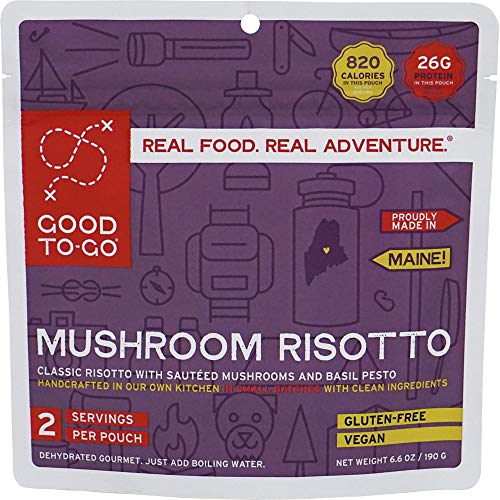
Good To-Go Mushroom Risotto
420mg of sodium in a full 410-calorie serving — about 2,049mg across a 2,000-calorie day, the gentlest entree math we found.
Check Availability
Score out of 10
Peak Refuel Basecamp Bucket 3.0
Its Beef Stroganoff label reads 470mg per 400-calorie serving — about 2,350mg per 2,000-calorie day, a third of the big-bucket rate.
Check Availability
Score out of 10
Mountain House Essential Meal Assortment Bucket
The 30-year bucket, at roughly 6,100mg of sodium per 2,000-calorie day on our derived label total. Buy it for the decades, not the sodium.
$129.99 from Amazon
Score out of 10
ReadyWise 120 Serving Emergency Food Supply
Entree labels run 450–750mg per small serving; stretched to a day, that is roughly 4,500–6,800mg. Included so the number is on the record.
Check AvailabilityHow we chose: we read the full nutrition panel for every entree named below from the maker’s own page or a retailer listing of the maker’s label, then divided sodium by calories to get the rate that survives serving-size games. Scores weigh that rate first, then shelf life and cost per day from our earlier verified datasets. Read our full methodology.
Head-to-Head Specs
| Good To-Go Mushroom Risotto | Peak Refuel Basecamp 3.0 | Mountain House Essential Bucket | ReadyWise 120 Serving Bucket | |
|---|---|---|---|---|
| Price | $10.99 | $169.99 | $129.99 | $329.99 |
| Best for | Lowest-sodium meals | A bucket that eats daily | 30-year storage | Bulk servings |
| Sodium per serving | 420 mg | 470 mg | 490 mg* | 450–750 mg |
| Sodium per 2,000-cal day | ~2,049 mg | ~2,350 mg | ~6,100 mg | ~4,500–6,800 mg |
| Shelf life (maker) | Minimum 2 years | 10 years | 30 years | Up to 25 years |
*Mountain House’s per-serving figure is its Adobo Rice & Chicken label as listed by REI (490mg per 280-calorie serving); its per-day figure is our derived rate for the whole Essential Bucket from the maker’s pouch labels — about 3,050mg per 1,000 calories, counted in our Mountain House vs Peak Refuel comparison — doubled to a 2,000-calorie day.
Sodium per serving, label figures
Each maker’s own panel for the entree named in the table: Good To-Go’s risotto, Peak’s stroganoff, Mountain House’s Adobo rice, ReadyWise’s stroganoff at the top of its range.
Per serving, the four labels look like neighbours. Per day they are not: serving sizes run from 220 to 410 calories, and a day of eating multiplies the small servings nine times over.
Good To-Go Mushroom Risotto — Our score: 7/10
The risotto wins this page on arithmetic, not marketing. Its label — arborio rice, cremini mushrooms, nutritional yeast, walnuts — reads 410 calories per serving with 420 milligrams of sodium, so a full 2,000-calorie day of it lands near 2,049 milligrams, the lowest entree figure we could build from a published panel this run. It is dehydrated rather than freeze-dried, handmade in Maine, gluten-free and vegan on the maker’s label, and rated 4.7 out of 5 across 168 reviews on the maker’s store, where it was $10.99 a pouch in November 2026. Owners praise the ingredient list and complain about the 20-minute soak. The honest trade is shelf life: the maker states a minimum of two years to the expiration date. This is rotation food — buy a few, eat them on trips, replace them — not a decade bucket.
- Pros: lowest sodium per 2,000-calorie day of any entree here; a serving is a real meal at 410 calories, so the label needs no multiplying tricks; short, pronounceable ingredient list.
- Cons: two-year floor on shelf life; 20-minute rehydration; contains walnuts and sulfites; per-calorie cost is trail-meal money, not bucket money.
Buy it if sodium is the first filter and the shelf gets rotated anyway. Skip it if the purchase has to sit untouched for ten years.
Peak Refuel Basecamp Bucket 3.0 — Our score: 7/10
Peak’s bucket is the sodium surprise of the bucket aisle. Its Beef Stroganoff panel reads 470 milligrams of sodium in a 400-calorie serving with 20 grams of protein — about 2,350 milligrams per 2,000-calorie day, roughly a third of the Mountain House bucket’s derived rate, a gap our earlier head-to-head counted from the same labels. The bucket publishes its totals where rivals make you derive them: 10,180 calories and 480 grams of protein across 24 servings, at $169.99 on the maker’s store this November (out of stock there at the check; REI lists it at $165.95), which works out to $16.70 per 1,000 calories from our October verification. Owners rate it 4.5 stars across roughly 192 ratings — a thin record, and the post says so every time we cite it. The costs are a 10-year shelf claim by the maker’s current FAQ (older pouches still carry a 5-year best-by — believe the pouch in your hand) and a menu built partly on wheat, which matters to the readers of our gluten-free page, not this one.
- Pros: the gentlest sodium rate in a true bucket; published calorie and protein totals; servings that are actual meals at about 424 calories.
- Cons: 10-year shelf claim against 25–30 for rivals; thin owner record at roughly 192 ratings; several entrees are wheat-based.
Buy it if a bucket has to be eaten day after day and the sodium rate is the deciding number. Skip it if the plan is measured in decades first and diet second.
Vegetable & Fruit Seeds
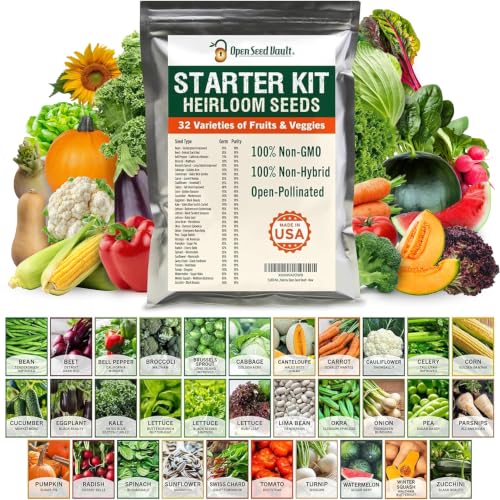
4.6 stars across roughly 14,600 Amazon ratings — the deepest owner record here — but the calorie crops are thin: 15 to 25 seeds of beans, peas, and pumpkin.
$28.99 from Amazon
Mountain House Essential Meal Assortment Bucket — Our score: 8/10
Mountain House keeps the highest score on this page and the worst sodium number, and both facts belong in the open. The bucket is the storage benchmark — 30-Year Taste Guarantee, gluten-free assortment, 4.7 stars across roughly 1,233 ratings — and its labels are salty in the way owners keep reporting: about 3,050 milligrams per 1,000 calories derived pouch by pouch from the maker’s own labels, which is about 6,100 milligrams across a 2,000-calorie day. Individual pouches look ordinary (the Adobo Rice & Chicken lists 490 milligrams per 280-calorie serving at REI); it is the day that adds up, because the servings are small and the salt per calorie is high. At $129.99 on the maker’s store — sold out there on November 11, 2026, with the Amazon link staying up under our publish-anyway rule — you are paying for three decades of not thinking about the bucket. A reader counting sodium should think about it anyway, and pair the bucket with the low-sodium layer below.
- Pros: longest guarantee in the category; certified gluten-free meals; the deepest owner record here.
- Cons: roughly 6,100mg of sodium per 2,000-calorie day on derived label math; highest cost per calorie of the buckets; small servings.
Buy it if shelf life outranks sodium and the rest of the shelf carries the low-salt layer. Skip it if this bucket alone would be the diet for a stretch of days.
ReadyWise 120 Serving Emergency Food Supply — Our score: 7/10
ReadyWise’s labels make the serving-size trap visible. Its Cheesy Lasagna panel reads 450 milligrams per 200-calorie serving; the Creamy Pasta & Vegetables reads 480 per 190; the Savory Stroganoff reads 750 per 220. Per serving, all three sit in the same neighbourhood as the winners above. Per 2,000-calorie day they land between roughly 4,500 and 6,800 milligrams, because a day of this bucket is nine or ten servings, not two or three meals. The bucket itself is unchanged from our bucket comparison: 120 servings, 24,540 calories, $329.99 at the maker’s store (verified again November 11, 2026), $26.90 per 2,000-calorie day, 4.5 stars across roughly 10,553 ratings. It is the most expensive day of eating on this page and the saltiest range. Those two facts together are the review.
- Pros: panels are published and countable; fruit and vegetable buckets in the same range carry near-zero sodium and pair well (see below); constant retail availability.
- Cons: the highest sodium-per-day range here; the highest cost per 2,000-calorie day here; small servings hide both numbers.
Buy it if it is one layer of a mixed shelf whose other layers carry no salt. Skip it if it would be eaten alone for days — its own labels argue against that plan.

Nesco VS-12
A full-featured countertop sealer for bagging batches before they go into storage.
$108.18 from Amazon

FoodSaver Elite Liquid Plus
It senses bags and moisture for you — at the highest price per inch of seal bar here.
$218.56 from AmazonCan you build a lower-sodium day around a salty bucket?
Yes — the produce and staple layer is where the sodium actually comes down, because plain freeze-dried produce carries almost none. Nutrient Survival’s fruit and vegetable bucket publishes its panel on the maker’s page: five of its six foods read 0 milligrams of sodium per serving, and the mixed vegetables read 35 milligrams, with 0 grams of added sugar across the bucket — 55 servings for $99.99 at the maker’s store, sold out there when we checked on November 11, 2026. Its powdered milk reads 115 milligrams per 70-calorie cup. None of that is a meal by itself, and we are not scoring it as one. It is dilution you can count: every produce-and-staple meal swapped into a bucket day pulls the day’s total down by the entree it replaced, and the arithmetic is printed on both panels. Our Food Shelf-Life Lookup covers the plain staples — rice, oats, beans, lentils — that do the same job from the bulk shelf at a fraction of the cost, and our serving-cost dataset prices the swap.
Honest caveats
Three, plainly. First, per-2,000-calorie-day figures are arithmetic built from the makers’ panels — a way to compare labels on equal footing — not a serving suggestion and not health guidance; this page takes no position on what any reader’s sodium limit should be. Second, one figure here is derived, and we have labelled it every time: Mountain House publishes no bucket calorie or sodium total, so its per-day rate comes from adding its own pouch labels, the method we documented in post 499. Third, panels change. The pouch in your hand outranks this page, and a reformulated label is a new product for counting purposes. For the diabetic-side label reading that pairs with this page, our emergency food for diabetics guide works the carbohydrate side of the same panels.
Viewers also searched for these items.


COSORI Dehydrator
A fruit roll sheet in the box, temperature set to the degree, and a 48-hour timer that ends the batch before it over-dries.
$135.99 from Amazon
Millennium Energy Bars (SOS Food Lab)
Nine real flavors and the only bar here people call genuinely good. Single 400-calorie bars made for go-bags and school kits.
$19.99 from AmazonFAQ
What counts as low sodium in emergency food?
On a label, the FDA’s “low sodium” claim means 140 milligrams or less per serving — a bar almost no entree clears. The workable comparison is the rate: sodium per 2,000-calorie day, built from the panel. On that measure the entrees here run from about 2,049 milligrams (Good To-Go) to a 4,500–6,800 range (ReadyWise).
Why does freeze-dried food have so much sodium?
Salt is doing three jobs at once in a pouch: flavour in food eaten without a kitchen, appetite appeal under stress, and a recipe built for people who may be sweating through physical work. The labels show the result — most bucket entrees land between 450 and 750 milligrams per serving before serving size is accounted for.
Which emergency food bucket has the least sodium?
Of the buckets with published panels we could stretch to a day, Peak Refuel’s Basecamp 3.0 runs gentlest at about 2,350 milligrams per 2,000-calorie day on its stroganoff label, against roughly 6,100 for Mountain House’s Essential Bucket on derived label math.
Does rinsing or extra water lower the sodium?
The sodium is dissolved in the meal itself once the pouch is made; the panels we read describe the food as prepared by the maker’s directions. We found no maker guidance promising a reduction from added water, so we print none.
Are there zero-sodium emergency foods?
Plain produce comes close: five of the six foods in Nutrient Survival’s produce bucket read 0 milligrams per serving on the maker’s panel, and plain staples like rice and oats carry none worth counting. They are ingredients, though — a day still has to be built, which is why the Emergency Food Cost Index counts complete days, not single foods.
Sources & freshness: Good To-Go’s Mushroom Risotto page and panel, Peak Refuel’s Beef Stroganoff panel and Basecamp totals (posts 438/499 datasets), REI’s Mountain House listings, ReadyWise panels as listed by Costco and Woot, Nutrient Survival’s produce bucket and milk panels, all consulted November 11, 2026. Prices last checked: November 11, 2026.
Talk it over with other readers. The Truly Preserved Community on Facebook is where readers compare notes on food storage, water, and backup power — and where your questions help decide what we research next. Join the group →
Prices shown on this page were last checked November 26, 2026 — prices change; check before you buy.