
Affiliate Disclosure: Truly Preserved is reader-supported. When you buy through links on this page, we may earn a commission at no extra cost to you. As an Amazon Associate, Truly Preserved earns from qualifying purchases. Read our full affiliate disclosure.
Last updated: November 1, 2026
THE SHORT ANSWER
Send the food that is fully dry, low in fat, and packed in single portions: cooked lean-meat meals, pasta and rice dishes, fruit, pie bites, and candy. Freeze drying removes most of the water, and water is most of the weight — a meal that weighed a pound in the pot can ship at 4 to 6 ounces. Skip fatty food, chocolate-heavy treats in hot lanes, and anything that did not dry all the way through, and plan on your box being eaten over weeks to a few months, not stored for years.
This is the question behind a lot of freeze dryer purchases. In The Freeze Drying Community — the big Facebook group for home freeze drying — one member joined saying her son is in the military and she “finally bought a freeze dryer to send him home made meals,” and another member’s fall post showed pumpkin pie bites packed as a care package for a son and his teammates on base. The instinct is exactly right: home cooking is the one thing a care package cannot normally carry, and a freeze dryer changes that. What decides whether the box lands well is not the recipe. It is what the food was made of, how dry it got, and how it was packed.
The weight math: you are not mailing the water
Most cooked food is mostly water. The USDA’s Food Safety and Inspection Service puts raw whole chicken at 66% water, 85%-lean ground beef at 64%, and beef eye of round at 73%. Fruit runs higher still — strawberries are about 91% water in USDA food data. A freeze dryer removes nearly all of that water and leaves the solids: the protein, the starch, the flavor. So the dried weight is roughly what is left when the water leaves.
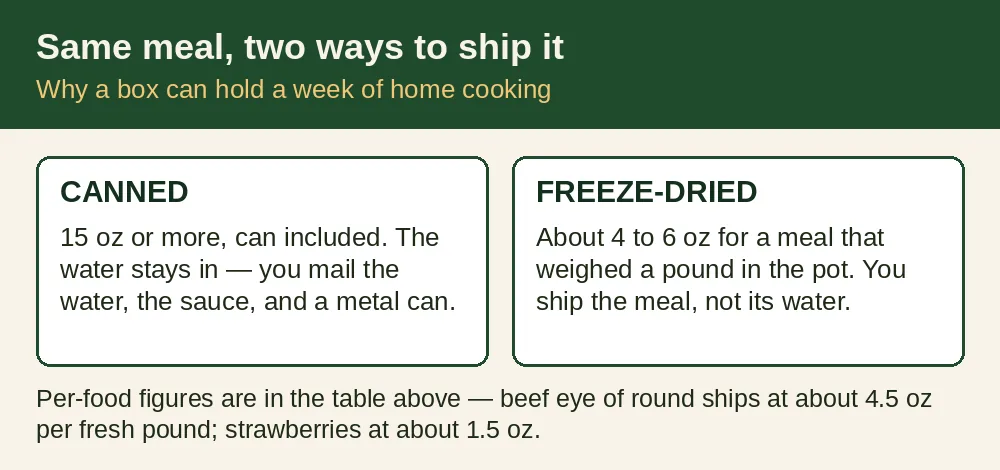
| Food, 1 pound before drying | Water in it | About what it ships at |
|---|---|---|
| Beef eye of round, raw | 73% (USDA) | ~4.5 oz dried |
| Whole chicken, raw | 66% (USDA) | ~5.5 oz dried |
| Ground beef, 85% lean, raw | 64% (USDA) | ~6 oz dried |
| Strawberries, fresh | ~91% | ~1.5 oz dried |
| Same meal, canned instead | Water stays in | 15 oz or more, can included |
These are typical figures, not lab results for your batch — your own scale tells the real story, and weighing a tray before and after drying is how experienced owners check both the weight and the water they will need to add back. The comparison that matters for a care package is the last row. The canned version of a home meal ships its water, its sauce, and a metal can. The freeze-dried version ships the meal. That is why a box can hold a week of home cooking for a whole team and still be a box one person can carry to the post office.
What travels best
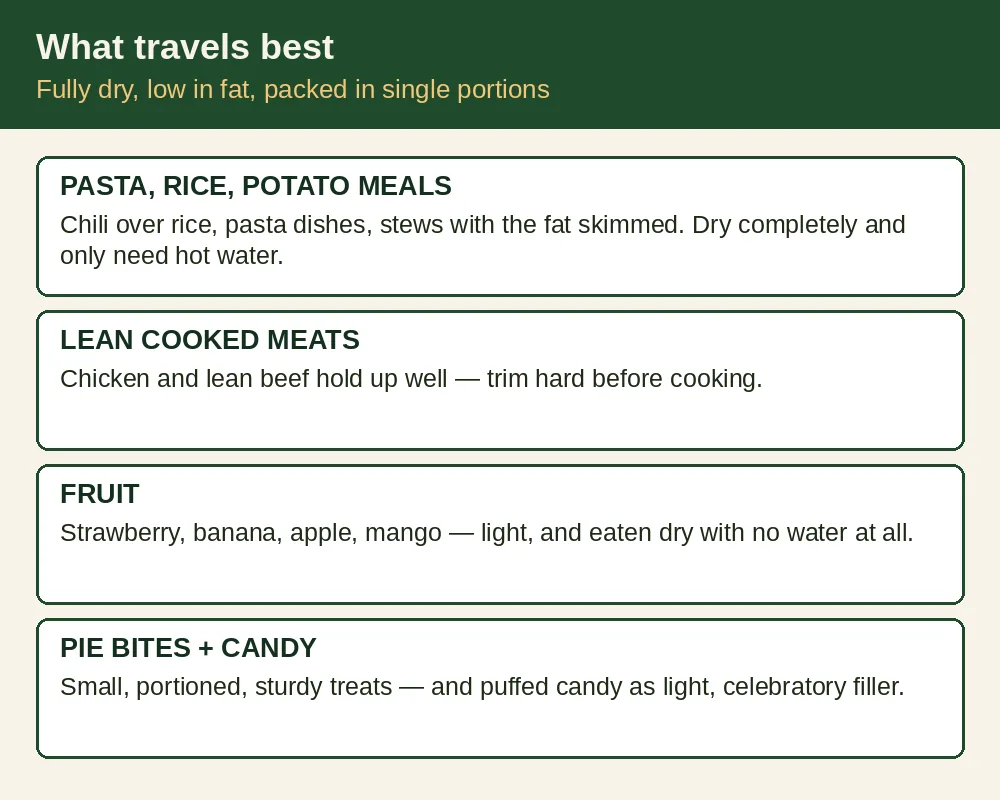
- Cooked meals built on pasta, rice, or potatoes: chili over rice, pasta dishes, stews with the fat skimmed. They dry completely, portion neatly, and only need hot water at the other end.
- Lean cooked meats in a sauce or a meal: chicken and lean beef hold up well. Trim hard before cooking — the fat rule below is the one that decides shelf life.
- Fruit: strawberries, banana, apple, and mango dry light, eat well dry as a snack, and never need water at all — a real plus where hot water is a project.
- Pie bites and baked treats: the pumpkin pie bites in that group post are a good model — small, portioned, low enough in fat, and sturdy when they are packed with cushioning around them.
- Candy: the puffed candy from a candy-mode run is light, portionable filler that makes a box feel like a celebration. More on home candy batches on our home treats page.
What to leave out of the box
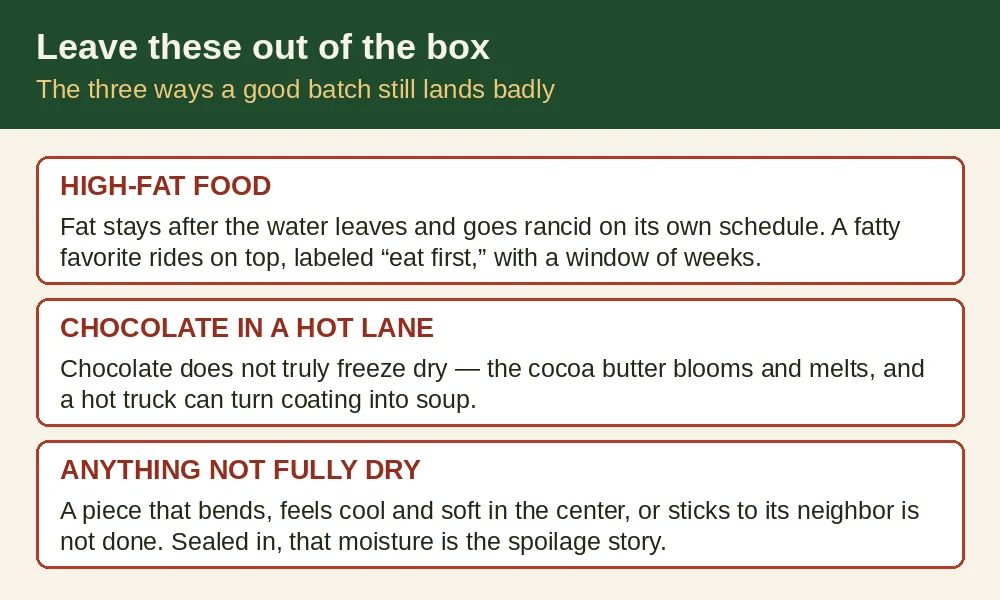
- High-fat food. Iowa State University Extension’s AnswerLine is blunt about it: foods high in fat do not freeze dry well and should be avoided for storage, because the fat stays in the food after the water leaves and goes rancid on its own schedule. Sausage-heavy dishes, fatty beef, cheese-loaded meals, and peanut-butter-based treats are eat-this-week food, not mail-it-across-an-ocean food. If a fatty favorite has to go in, put it on top, label it “eat first,” and accept a window of weeks.
- Chocolate in a hot lane. Chocolate does not truly freeze dry — the cocoa butter blooms and melts, as our what-can’t-you-freeze-dry page covers — and a box headed to a hot climate can sit in heat that turns chocolate coating into soup long before it arrives. In winter, to a cool destination, chocolate-covered items are a judgment call. In summer, skip them.
- Anything that did not dry to completion. Extension guidance is that freeze-dried food must be completely dried — crisp — and packaged right away so it does not take moisture back from the air. A piece that bends, feels cool and soft in the center, or sticks to its neighbor is not done. Sealed into a bag, that leftover moisture is the whole spoilage story. Give thick pieces extra dry time and check the center of the thickest one before you bag anything.
- Fragile, crisp items with no protection. Thin chips, meringue-type pieces, and delicate pie bites can arrive as flavored powder after a week of being thrown, stacked, and dropped. That is a packing problem, not a drying problem — portion them small, cushion them, and keep them away from the corners of the box.
Packing for heat and rough handling
Pack each portion in its own mylar pouch with an oxygen absorber, sized to one meal or one snack sitting. Single portions do three jobs: the rest of the box stays sealed while one meal is opened, a torn pouch costs one portion instead of a week’s food, and your recipient can share without a knife-and-scale project. Size the absorber to the bag with our Oxygen Absorber Calculator rather than guessing.
One distinction worth getting right, because the two products sit next to each other in every supply shop: an oxygen absorber and a desiccant do different jobs. The absorber pulls oxygen out of the sealed pouch, which protects flavor and slows the fat that is in the food from turning. A desiccant absorbs moisture — and your food should already be dry when it goes in the bag. Iowa State’s guidance puts it plainly: an oxygen absorber, not a desiccant, is what belongs in the container with freeze-dried food. Write the contents and the date you dried it on every pouch. In a shared barracks fridge or a team shelf, the labeled, oldest, fattiest pouches get eaten first — and that rotation is worth more than any single packing trick.
The supplies from our mylar comparison are the ones that fit this job: the Wallaby 1-Gallon Mylar Bags for meal-size portions, the Sukerle 5-Gallon Mylar Bags when a whole batch is moving at once, and the METRONIC 8-Inch Impulse Sealer to close them. Thickness, sizes, and absorber counts for each are in the full comparison: Best Mylar Bags for Long-Term Food Storage. Fill the empty space in the shipping box so pouches cannot shift and rub, tape the seams, and put a second copy of the address inside the box.
How long will it actually keep in transit?
Plan on a shorter clock than the storage pages promise, and your box will never disappoint anyone. The 25-year figures attached to freeze-dried food assume a cool, dark shelf — extension guidance for stored freeze-dried food is a cool, dark place, and heat is the enemy every storage source names first. A care package does not get a cool, dark shelf. It gets a hot warehouse, a sun-baked truck, and maybe weeks of sitting before mail call. None of that makes properly dried food unsafe in a few weeks; it does eat the quality margin fast, and it eats the fatty items first.
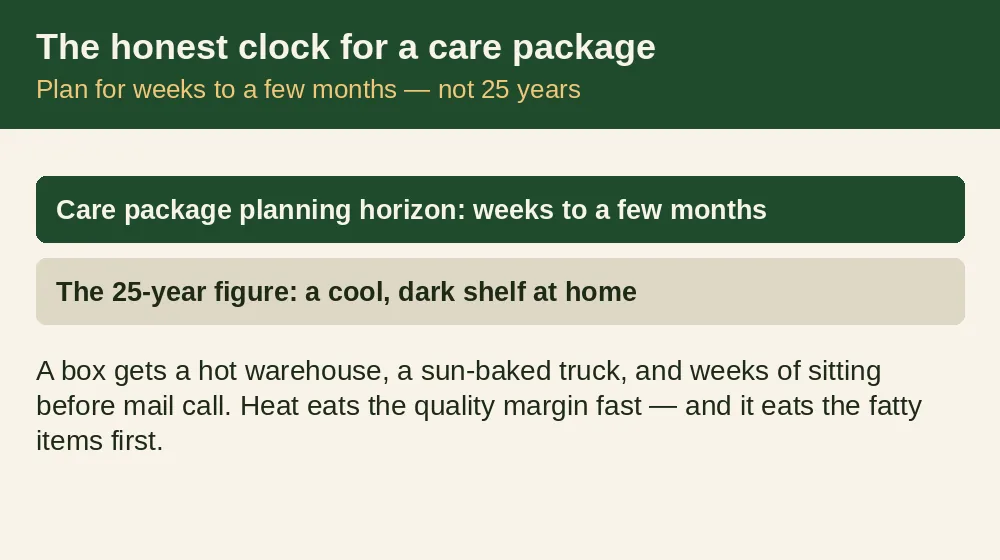
So the honest planning horizon for a care package is: ship food meant to be eaten over the next few weeks to a few months. Lean meals, fruit, and candy in good mylar with an absorber have plenty of margin inside that window. Fatty favorites ride at the top of the box with an “eat first” note. If you want to know how a food keeps on a shelf at home, our Food Shelf-Life Lookup has the storage numbers — just do not apply the 25-year end of them to a box crossing an ocean in August.
The military mail part, from USPS
These are the rules as USPS publishes them on its Military & Diplomatic Mail page, checked October 29, 2026:
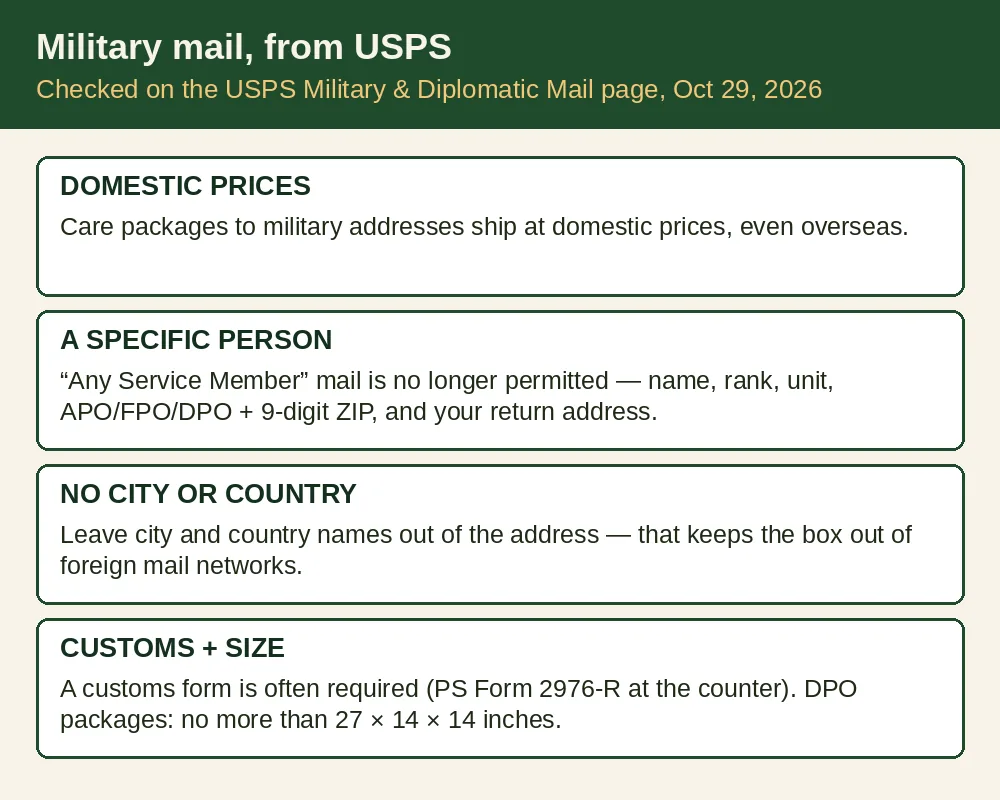
- Care packages to military addresses ship at domestic prices, even when the recipient is overseas.
- Address the box to a specific person. Mail addressed to “Any Service Member” is no longer permitted. Use the recipient’s name, rank, and unit, with the APO, FPO, or DPO address and its 9-digit ZIP Code, and always include your return address.
- Do not put a city or country name in the address. USPS says that keeps the box out of foreign mail networks. The address follows the pattern your recipient gives you — name, unit or PSC and box number, then APO/FPO/DPO with its two-letter code (AA, AE, or AP) and ZIP.
- Expect a customs form. USPS says you often need one for APO/FPO/DPO packages; Click-N-Ship tells you which form your destination requires, and if you did not complete it online, you fill out PS Form 2976-R at the Post Office counter. Describe the contents in detail — USPS now requires more-detailed package descriptions — so “2 pouches freeze-dried beef stew, 1 pouch dried strawberries” beats “food.”
- Restrictions depend on the destination ZIP. Click-N-Ship flags some prohibitions for the 5-digit military ZIP you are shipping to, but USPS is clear that the sender is responsible for following both U.S. rules and the destination country’s. One standing example from the same USPS page: hand sanitizer and flammable sanitizing wipes may not be shipped overseas. Check your recipient’s specific ZIP before you seal the box, not after.
- DPO packages have a size limit: no more than 27 inches long, 14 inches wide, and 14 inches high.
Freeze-dried food is a good citizen under these rules: it is shelf-stable, light, and easy to describe honestly on a customs form. It does not solve the perishable problem by being almost-perishable, though — if a destination’s rules bar a food category, dried does not change the category. When the ZIP’s rules and your box disagree, the rules win.
A word about basic training
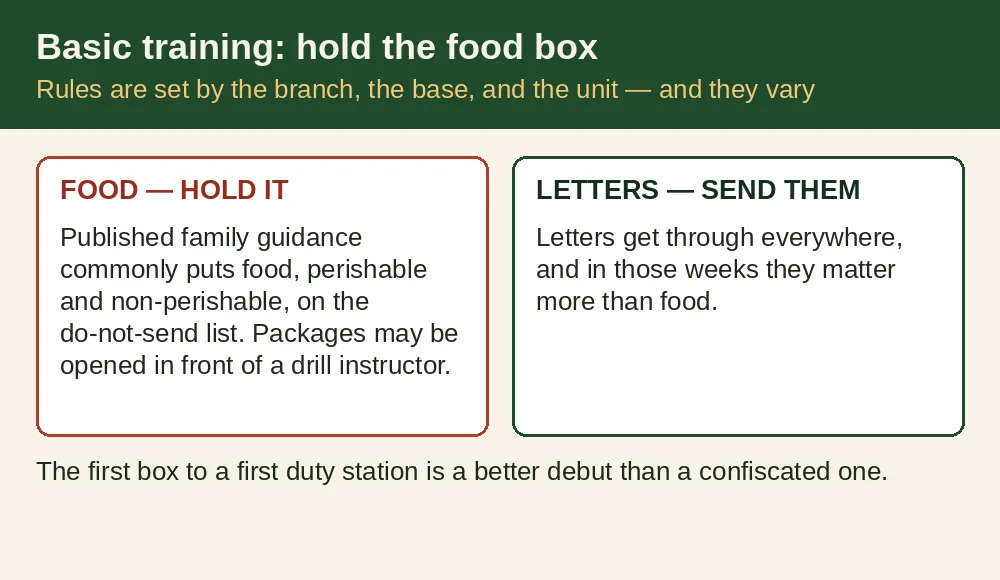
If your recipient is in basic training rather than at a duty station, hold the food box. Rules for what recruits may receive are set by the branch, the base, and the training unit, and they vary — but published boot-camp guidance for families commonly puts food, both perishable and non-perishable, on the do-not-send list, and packages may be opened in front of a drill instructor, with anything not allowed taken away on the spot. Letters, on the other hand, get through everywhere and matter more than food in those weeks. Check the mailing guidance your recruit’s unit sends families before sending anything edible; the freeze dryer will still be there at graduation, and the first box to a first duty station is a better debut than a confiscated one. One family in that same community thread was planning around a son leaving for basic training on December 28 — for a timeline like that, the care-package season really starts after training, not during it.
If you are still choosing the machine all of this gets made in, our home freeze dryer comparison covers the sizes honestly — a medium machine’s 10-to-15-pound fresh batches are what turn into a box like this in one run.
Questions people also ask
Does my recipient need hot water to eat freeze-dried meals?
Hot water is best, but it is not required. Freeze-dried meals rehydrate in cold water in 20 to 60 minutes, and fruit and candy need no water at all — which is why a good box mixes full meals with food that can be eaten straight from the pouch.
How much should I send at once?
Send what gets eaten in a few weeks, more often, rather than a warehouse in one box. A medium freeze dryer’s batch — 10 to 15 pounds of fresh food — dries down to roughly 3 to 5 pounds of finished food, which is a sensible single box: enough meals and treats to share, not so much that the last pouches sit in the heat for months.
Can I mail a care package to a stateside base the same way?
A stateside base address is ordinary domestic mail — no customs form, no APO/FPO/DPO format. The packing advice on this page still applies, because the box still rides trucks and sits in mail rooms, but the USPS military-mail rules above only govern APO, FPO, and DPO addresses.
Related questions
- What foods can’t you freeze dry?
- What freeze-dried treats can I make at home for family and gifts?
- Can you rehydrate freeze-dried meals with cold water?
This question sits in What People Are Asking About Freeze-Dried Food — the full list of freeze-dried questions from real forums, each with a short answer.
Talk it over with other readers
The Truly Preserved Community on Facebook is where readers compare notes on food storage, water, and backup power — and where your questions help decide what we research next.