
Truly Preserved is reader-supported. If you buy through a link on this page we may earn a commission at no extra cost to you. Nobody pays for placement or scores.
THE SHORT ANSWER
Skip the freeze dryer if any one of these is true for your house: you cannot hand a batch 24 to 36 hours, you have nowhere outside your living space to run a vacuum pump at about 52 dB, you will not keep up with pump-oil changes every 20 to 30 batches, or you will run the machine so rarely that your cost lands near $2.20 per fresh pound instead of $0.92. For most of those households, a dehydrator at $80 to $300 — or a shelf of commercial freeze-dried food — is the honest buy.
This page argues the negative case on purpose, and it argues it out of our own published numbers: the Harvest Right size comparison, where the batch times, noise figures, weights, and circuit asks come from; our cost-per-pound dataset, which priced a Harvest Right Medium batch by batch; our pump-oil answer, which sets out the upkeep schedule; and our freeze dryer versus dehydrator answer, which prices the cheaper machine. We sell nothing on this page. If the tests below clear you, the comparison and calculator links at the bottom will help you buy well. If they do not, walking away is the win.
Can you give every batch a day and a half?
A freeze dryer batch takes 24 to 36 hours for most foods — that is the figure our dehydrator comparison prints, and our size comparison puts a full cycle of freezing, vacuum, and drying at 20 to 40 hours depending on the food’s water content, with wet foods at the long end.
That cycle time is the first walk-away test, because nothing about it compresses. A dehydrator finishes in 6 to 14 hours and can be checked, tasted, and emptied the same day. A freeze dryer ties up its trays for a day and a half per load, so a garden harvest that ripens in one week goes through the machine in a queue — and on a small machine holding 6 to 10 pounds a batch, a real tomato harvest takes several runs back to back. If your food arrives in gluts and your patience does not, the machine will spend harvest season behind, and you will spend it annoyed at a purchase that cost more than a good used car repair.
Can your house take the noise?
A Harvest Right home freeze dryer runs at about 52 dB — conversation-and-dishwasher territory, per the spec table in our home freeze dryer comparison — and the sound is not steady: the vacuum pump is the loud part, and it cycles through the whole run.
Owners in our size comparison research give the same advice so consistently that we print it as a rule: plan on a utility room, garage, or basement, not a kitchen corner, and expect heat output in a closed room on top of the noise. A one-bedroom apartment, an open-plan house where the kitchen is the living room, or a bedroom wall shared with the only spare counter — those are walk-away floor plans for this machine, whatever the food math says. The dehydrator, a fan and a heating element, asks none of this.

COSORI Premium Dehydrator
A dehydrator covers most of what this page’s readers actually want to preserve, at a tenth of a freeze dryer’s price.
$135.99 from Amazon
Score out of 10
Mountain House Essential Bucket
And if the goal is just stored food, the bucket skips the machine entirely — freeze-dried meals, already done.
$129.99 from AmazonWill you actually change the oil?
Pump-oil upkeep is the chore that decides whether a freeze dryer stays a pleasure or becomes furniture: on Harvest Right’s Premier pump, the oil is drained, filtered, and changed every 20 to 30 batches; on the older Standard pump, every 4 to 5 batches.
The oil itself is not a free choice either. Harvest Right approves exactly three oils for its pumps — its own, Robinair Premium, and JB Black Gold — and names a popular dairy-brand oil as one to keep out of the Premier pump entirely, as our oil answer lays out. The escape hatch is real but priced: the oil-free pump upgrade runs $1,495 ordered by phone, per our size comparison. So the honest test is a question about you, not the machine: are you the person who changes furnace filters on schedule? If upkeep chores slide in your house, they will slide here too, on a pump that does not forgive it.
What does low volume do to the cost per pound?
Low volume is what turns a freeze dryer from a bargain into the most expensive way to own one: at 100 lifetime batches, our cost dataset puts a Harvest Right Medium at $2.20 per fresh pound all-in; at 500 batches, the same machine lands at $0.92.
| Lifetime batches (Medium) | Machine cost per batch | Cost per fresh pound |
|---|---|---|
| 100 batches | $19.95 | $2.20 |
| 250 batches | $7.98 | $1.24 |
| 500 batches | $3.99 | $0.92 |
| 1,000 batches | $2.00 | $0.76 |
The table is our published cost-per-pound math: the $1,995 Medium spread over the batches, plus about $7.56 a batch in electricity, oil, and mylar, on a 12.5-pound fresh load. A busy garden household can pass 500 batches in five years. A buy-it-just-in-case machine may never reach 100 — and at 100, you are paying $2.20 for every pound you put by, before the food itself. Count the dried food that comes out instead of the fresh food that went in and the figures climb again, because most of the weight you paid to process was water. If your honest forecast is a few batches a year, the math has already answered this page’s question.
Do you have the space and the circuit?
A freeze dryer asks for a permanent home and, on most sizes, a circuit of its own: the maker’s current FAQ asks for a dedicated 15-amp circuit, and the machines run from about 61 pounds for the Small to about 107 pounds for the Large before the pump.
The Small’s footprint is closer to a big microwave than a dishwasher, and it still wants that dedicated circuit on a standard 110-volt outlet. The Medium draws an average of 9 to 11 amps while it runs. The X-Large settles the question for most houses on its own: 257 pounds and a dedicated 20-amp circuit. Renters who cannot touch the wiring, kitchens with no spare counter that can be given up for good, and anyone who pictured moving the machine to make room for Thanksgiving should read those numbers twice. The machine does not visit your kitchen. It moves in.


Nesco VS-12
A 130-watt double pump, a double-seal setting, and an 11.8-inch bar — for sealing the batch you just saved.
$108.18 from Amazon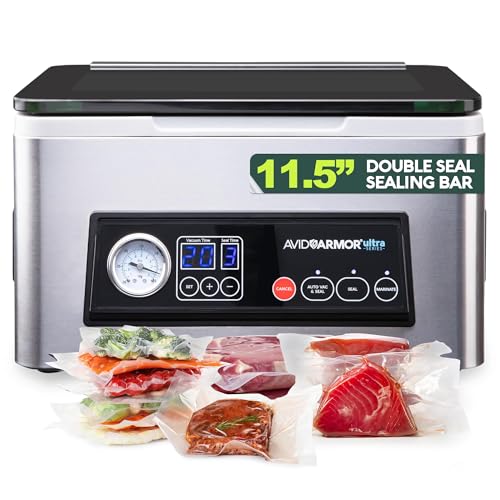
Avid Armor USV20
The chamber machine: soups, marinades and smooth cheap pouches — if it fits in an 11 x 10 pouch.
$349.00 from AmazonWho is better served by a dehydrator?
A dehydrator is the better buy if the food is for this year: it costs $80 to $300, puts food by for 1 to 5 years, and finishes a batch in 6 to 14 hours.
Garden surplus and snacks are its home ground — fruit leather, dried apples, jerky, and herbs, at pennies of electricity a batch — and dried fruit often tastes better in year one, because dehydrating concentrates flavor. Freeze-dried food’s party trick is year ten, not month two. Our freeze dryer versus dehydrator answer runs the full head-to-head, including the one thing a dehydrator cannot do: safely put by a cooked casserole or a tray of scrambled eggs for the long shelf. If your plan is eating what you grow, buy the appliance. The freeze dryer is a storage system, and storage systems only pay when the storage itself is the point.
Who is better served buying commercial freeze-dried food?
Buying commercial freeze-dried food is the better answer if you want the 25-year shelf without the machine: in our published comparisons, freeze-dried meals run about $17 to $20 per 1,000 calories — Peak Refuel’s bucket at $16.70 per 1,000 calories, Mountain House at $19.92 — with no pump, no oil, and no day-and-a-half batches.
That is a steep per-calorie price, and it is still cheaper than a machine you run 60 times. Our cost-per-serving dataset prices the kits per serving, per meal, and per full day of eating, and our Mountain House versus Peak Refuel comparison counts the calories the bucket lids skip. A household that wants a shelf of real meals for a bad month — and no new appliance, no upkeep, and no production schedule — is not settling when it buys the buckets. It is choosing the version of freeze-dried food that fits its life.
Viewers also searched for these items.

Sour Patch Kids (5 lb)
The bulk bag is the economical way to feed a freeze dryer — one bag fills several tray loads, and the pieces are the standard size every candy-mode timing is written for.
$20.99 from Amazon
Robinair 13203 Vacuum Pump Oil
A pump that runs quiet and pulls nothing is very often an oil problem — this is the replacement our maintenance guide names.
$16.79 from Amazon
JB Black Gold Pump Oil
The second oil owners keep for the same change — either beats the waterlogged oil already in the pump.
$54.50 from AmazonFrequently asked questions
Is a freeze dryer worth it for a small garden?
Usually not on the math alone. A small garden’s surplus arrives in a few gluts a year, which keeps lifetime batches low — and low volume is exactly what pushes the cost toward $2.20 per fresh pound in our dataset. A dehydrator handles the same surplus for $80 to $300, unless the goal is meals stored for a decade or more.
How loud is a home freeze dryer in a kitchen?
About 52 dB for Harvest Right home models, per our comparison’s spec table — conversation-and-dishwasher territory, with the vacuum pump cycling louder and quieter across a run that lasts a day or more. Owners consistently advise a utility room, garage, or basement over a kitchen corner.
Can I skip the oil changes if I buy the oil-free pump?
Yes — the oil-free pump has no oil to change, and it is the one genuine way out of the upkeep schedule. Our size comparison prices that upgrade at $1,495 ordered by phone, which belongs in the purchase math from the start, not as a surprise in year two.
What is the cheapest honest way to get freeze-dried food?
For most households, buying it. Commercial freeze-dried meals run about $17 to $20 per 1,000 calories in our published comparisons, which beats owning a machine at low volume. Home freeze drying only wins the cost argument at several hundred batches — the payback calculator linked below runs your own volume through the same math.
Sources & freshness: All figures are from Truly Preserved’s own published research: the Harvest Right size comparison (batch times, noise, weights, circuits, oil-free upgrade price), the freeze-drying cost-per-pound dataset (lifetime-batch cost table), the pump-oil answer (approved oils and change intervals), the freeze dryer versus dehydrator answer (machine prices, shelf lives, batch times), and the Mountain House versus Peak Refuel comparison with the cost-per-serving dataset (commercial cost per 1,000 calories).
More answers like this one: This answer belongs to What People Are Asking About Freeze-Dried Food and the Preserve the Harvest page. If the tests above cleared you instead, start with Home Freeze Dryers Compared and the Harvest Right size comparison, then run your own volume through the Freeze-Dryer Payback Calculator before you spend anything.
Talk it over with other readers. The Truly Preserved Community on Facebook is where readers compare notes on food storage, water, and backup power — and where your questions help decide what we research next. Join the group →
Prices shown on this page were last checked November 26, 2026 — prices change; check before you buy.