
Truly Preserved is reader-supported. If you buy through a link on this page we may earn a commission at no extra cost to you. Nobody pays for placement or scores.
Ask ten sellers how long does freeze dried food last and you get one number — theirs, at its longest, in its best storage spot. The honest answer is a set of numbers: one per brand, one for the food you dry at home, and a much shorter one that starts the day you open the package. This page puts the makers’ own stated figures side by side, names whose claim each number is, and then hands you the tool we built to look up the foods that are not in a branded pouch at all. We don’t own a test lab; we did the homework, and every figure below is attributed to whoever published it. The page for this shelf is Preserve the Pantry.
THE SHORT ANSWER
Factory-sealed freeze-dried food carries maker-stated lives of 10 to 30 years: Mountain House states 30 years under a taste guarantee, ReadyWise, Augason Farms, and Nutrient Survival state up to 25 years, and Peak Refuel’s current FAQ states 10 years. Food you freeze-dry at home is a different product — Utah State University Extension puts it at 10 to 15 years in airtight packaging with oxygen absorbers and advises planning on 5 to 10. Once a package is opened, the numbers collapse to days and weeks: Mountain House says to use the contents of an opened can within about a week for best results. Every one of those figures assumes a cool, dry, dark shelf — heat spends them faster.
How we built this page: we took each brand’s shelf-life figure from that maker’s own pages or FAQ, the home-drying figures from university extension guidance, and the staple-by-staple figures from our own lookup table, which follows extension ranges at the conservative end. Where a maker’s listings disagree with its own FAQ, we print both and tell you which one to believe. Read our full methodology.
How long does each brand say its food lasts?
Each brand’s stated life is that brand’s own claim for its own sealed packaging, and the claims are not measured the same way — one is a taste guarantee, the rest are shelf-life statements with storage conditions attached. Read the table as five separate promises, not one ranking.
| Brand | Stated life, sealed | What the claim rests on | Storage condition |
|---|---|---|---|
| Mountain House | 30 years | Taste Guarantee | Below 75°F, dry |
| ReadyWise | Up to 25 years | Maker statement | Cool, dry, dark |
| Augason Farms | Up to 25 years | Maker statement | 55–70°F, dry |
| Nutrient Survival | Up to 25 years | Maker statement | Cool, dry |
| Peak Refuel | 10 years | Maker FAQ | Cool, dry |
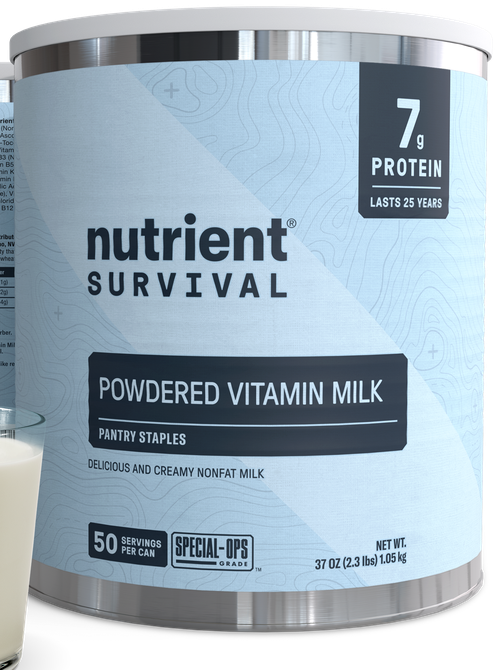
Photo: Nutrient Survival.
Mountain House raised its figure to 30 years in 2016 and defines it strictly: the food should still taste good at year 30, and if a meal bought from the maker or an authorized seller disappoints inside the window, the guarantee backs a replacement. Augason Farms prints the most precise storage window of the group — best at 55 to 70°F with low humidity — and splits its own figures by format on some products, with at least one beef can rated to 15 years sealed and a year once opened. Peak Refuel is the outlier at the short end, and honest about it: a 10-year unopened life in its current FAQ, while older pouches and some listings still carry a 5-year best-by. If the pouch in your hand says 5, believe the pouch. ReadyWise and Nutrient Survival sit at the industry-standard “up to 25 years,” a figure that always carries the words “up to” for a reason.
Look it up: the Shelf-Life Lookup covers the rest of your pantry
Brands only cover branded food. The rice, oats, beans, and flour that make up most of a real shelf have no marketing department, so we built the reference ourselves: the Food Shelf-Life Lookup puts 30 common staples in one searchable table — the realistic storage life, the packing method each food wants, and the catch that surprises people. A few of its entries, so you can see the shape of it: white rice runs up to 25–30 years in mylar with oxygen absorbers; dried beans the same; rolled oats up to 20–25 years; wheat berries up to 25–30 years, while the flour ground from them manages about 10 years in mylar and a year or two in the bag; and brown rice, the trap on every staples list, keeps about six months because the oils in its bran go rancid. If a food is in your pantry and not in a branded bucket, look it up before you count on it — and if you are counting pounds as well as years, its companion, the Long-Term Food Storage Calculator, does the amounts.

Wallaby 1-Gallon Mylar Bags
The long numbers on this page for home-dried food assume a real oxygen barrier — these 1-gallon mylar bags are the size most home batches are portioned into, and the bag is what keeps air off the food for the years the charts promise.
Check Availability
PackFreshUSA 300cc Oxygen Absorbers
A bag alone only slows oxygen down; the absorber is what removes it. The 300cc size matches the gallon bags above, so the seal you make is the seal the shelf-life figures are counting on.
Check AvailabilityHow long does home freeze-dried food last?
Home freeze-dried food lasts years, not decades, on the cautious published record. Utah State University Extension rates home freeze-dried food in airtight, moisture-proof packaging with oxygen absorbers, kept cool, dark, and dry, as safe and stable for 10 to 15 years — and advises against planning on keeping it past 5 to 10. That gap between “stable” and “plan on it” is the honest planning number, and we worked the same question from the claim side in our page on the 25-year home claim: the 25-year figure attached to home machines is a marketing inheritance from commercial packaging, not a number extension specialists will sign. Pack in mylar with the right absorber, store it like the commercial food, and plan the shelf on the extension figure — anything beyond it is a bonus you discovered, not a promise you bought.
Does storage temperature really change the number?
Yes — temperature is the condition that spends shelf life fastest, and the published rule is brutal: shelf life roughly halves for each rise of about 10°F in storage temperature. A pouch rated for decades in a 60°F basement is a much shorter-lived pouch in a garage that spends its summers in the nineties. We ran that math against a real measured garage in our hot-garage page, and it is why every brand in the table above prints a temperature beside its years: Mountain House warns against prolonged exposure above 75°F, Augason Farms names 55–70°F as its best window, and the extension figures assume a cool shelf throughout. The year count on the lid is a temperature count in disguise.
How long does freeze-dried food last once it’s opened?
Opened freeze-dried food is measured in days and weeks, not years, and the makers say so themselves. Mountain House advises using the dry contents of an opened #10 can within about a week for best results and taste, kept sealed in a cool, dry place. Augason Farms rates some of its opened cans at up to a year refrigerated or stored cool — the widest opened figure we found from a maker, and printed for specific cans, not the whole line. Our opened-food page works the question food by food, including the one-week figure Mountain House gives for opened pouches and cans. The pattern underneath all of it: the factory seal was the shelf life. Once air and moisture are in, you are rotating working food, and a plastic lid and a cool cupboard are a short bridge, not a new seal.
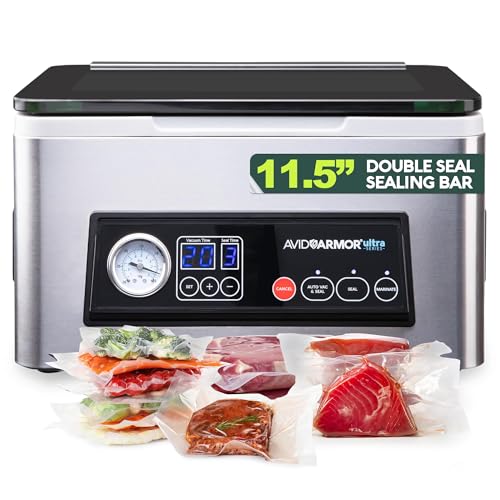
Avid Armor USV20
The chamber machine: soups, marinades and smooth cheap pouches — if it fits in an 11 x 10 pouch.
$349.00 from Amazon
FoodSaver Elite Liquid Plus
It senses bags and moisture for you — at the highest price per inch of seal bar here.
$218.56 from Amazon
Blue Alpine Medium Select
Higher cooling capacity shortens batch times, and owners praise the customer service. Up to 15 lbs per batch — the fastest route from harvest to a shelf that lasts decades. Use code TRULYPRESERVED at checkout for 3% off.
Check the priceWhat does the date on the package actually mean?
The date on the package means what the maker says it means, and US rules require almost none of it. Federal dating rules do not require product dates on shelf-stable food (infant formula is the exception); makers print dates to signal best quality, and each brand counts its stated life from its own manufacture date in its own way. That is why the same shelf can hold a “best by” five years out on a Peak pouch whose maker’s FAQ claims ten, and a Mountain House pouch carrying a 30-year guarantee with no dramatic date on the front. When a listing, a pouch, and an FAQ disagree, the order of belief is: the package in your hand, then the maker’s current FAQ, then any retailer’s page. Our serving-cost dataset and the Emergency Food Cost Index exist because the same discipline — count what is printed, not what is marketed — is the only way the money math works either.
Honest caveats
No independent laboratory test of a branded kit at 25 or 30 years exists in anything we could read this run, and we are not going to pretend otherwise. The long figures are makers’ claims, backed in Mountain House’s case by its own tasting program and a replacement guarantee, and in every case by storage conditions most garages do not meet. The extension figures for home-dried food and loose staples are more conservative because they are written for planning, not selling. Plan a real shelf on the shorter of the numbers that apply to your food and your storage spot, rotate the working layer through your kitchen, and let the long claims be what they are: a ceiling, printed by the people selling the food. For the kits themselves, our 30-day kit comparison counts what is actually inside the big buckets.

Sukerle 5-Gallon Mylar Bags
When the batch is a bucket's worth rather than a tray's worth, these 5-gallon bags line the bucket and carry the same oxygen-barrier job at bulk scale.
$42.99 from Amazon
NESCO VS-12 Deluxe Food Vacuum Sealer
This page's opened-package clock is the short one — a vacuum sealer is how an opened bag of freeze-dried food gets most of its remaining life back instead of sitting folded shut in the pantry.
$108.18 from Amazon
Metronic 8-Inch Impulse Bag Sealer
Mylar does not seal with a vacuum sealer's bar alone — an impulse sealer makes the wide, even heat seal that closes a mylar bag for real, which is the difference between stored and merely bagged.
$39.99 from AmazonFAQ
Does freeze-dried food really last 25 years?
That figure is the industry-standard maker claim for sealed commercial food — ReadyWise, Augason Farms, and Nutrient Survival all state up to 25 years, and Mountain House states 30 under a taste guarantee. Extension specialists are more cautious, particularly about pouch packaging, which is why this page attributes every number instead of picking one.
How long does freeze-dried food last after opening?
Days to weeks for best quality. Mountain House says to use an opened can’s contents within about a week; Augason Farms allows up to a year on some opened cans kept cool. Our opened-food page breaks it down by food and brand.
How long does home freeze-dried food last?
Utah State University Extension rates it safe and stable for 10 to 15 years in mylar with oxygen absorbers on a cool, dark shelf, and advises planning on 5 to 10 years. That planning figure is the one to build a rotation around.
Does the “best by” date mean the food is unsafe after it?
Makers print dates to signal best quality, and federal rules do not require dating on shelf-stable food. Past the date, the published concern is taste and texture first. Damaged packaging, off smells, or a broken seal are discard signals at any date — our guide to telling when stored food has gone bad covers the checks.
Where should I store freeze-dried food to get the longest life?
Cool, dark, and dry, at the steadiest temperature you have — the makers’ own windows run from Augason Farms’ 55–70°F to Mountain House’s “avoid prolonged exposure above 75°F.” A hot garage roughly halves the life for every 10°F it adds, per extension guidance.
Which brand states the longest shelf life?
Mountain House, at 30 years, and it is the only one framed as a guarantee: if a meal disappoints inside the window, the maker replaces it. The guarantee assumes intact packaging and storage below 75°F.
Sources & freshness: Mountain House’s shelf-life and guarantee pages and FAQs, ReadyWise’s and Nutrient Survival’s product pages, Augason Farms’ product shelf-life notes, Peak Refuel’s FAQ, Utah State University Extension’s freeze-drying guidance, USDA FSIS food-dating guidance, and our Shelf-Life Lookup (post 345) and posts 499, 555, 571 and 574, all consulted November 11, 2026. Prices last checked: November 11, 2026.
Talk it over with other readers. The Truly Preserved Community on Facebook is where readers compare notes on food storage, water, and backup power — and where your questions help decide what we research next. Join the group →
Viewers also searched for these items.

JB Black Gold Pump Oil
The second oil owners keep for the same change — either beats the waterlogged oil already in the pump.
$54.50 from Amazon

Thrive Life: Freeze-Dried Blueberries - Pantry Can Size
Freeze-dried food by the can, no machine: the same long-life ingredients the kits are built from, bought a can at a time.
$60.00 from AmazonPrices shown on this page were last checked November 26, 2026 — prices change; check before you buy.