
Truly Preserved is reader-supported. If you buy through a link on this page we may earn a commission at no extra cost to you. Nobody pays for placement or scores.
THE SHORT ANSWER
A family of four needs about 720,000 calories for 90 days — 2,000 calories per person per day, four people, ninety days, or 360 person-days. No government asks a household to store 90 days of food: the published anchors run from a 72-hour floor in the US, the EU, and the UK, through Sweden’s week and Germany’s 10 days, to the Red Cross’s 2-week home target. Ninety days is a choice a household makes for itself — and it is built in stages, on a base of ordinary staples, not bought as one giant kit.
This page extends our own reconciled datasets to the 90-day mark: the family food quantities page, which works the 3-day, 1-week, and 2-week tiers out in real food from Germany’s itemised list, and our kit-tier answer, which divides the kits on the shelf by their real calorie totals from our cost-per-serving dataset. The unit never changes — one person-day is one person fed for one day at about 2,000 calories — and a kit only counts once you have divided its calorie total by 2,000 and then by the number of people eating.
Is 90 days an official recommendation?
No — 90 days is not official household guidance from any government, and no agency has told families to store 90 days of food.
Here is what the published anchors actually are. The 72-hour supply is the floor the US, the EU, and the UK all set — the minimum a household should handle alone. Sweden’s Civil Defence Agency asks households for at least a week. Germany’s Federal Office of Civil Protection (BBK), in the crisis guide it reissued in October 2025, asks for 10 days. The American Red Cross sets the home target at 2 weeks — a 3-day supply for evacuation, a 2-week supply for staying home. Household guidance tops out there. The 90-day figure moving through the news is attached to planning for military installations, reported from unpublished documents — it was never aimed at your pantry, exactly as our kit-tier answer puts it. So treat 90 days the way this page does: a household planning choice for households whose distance from a store, fragile income, or isolating weather makes the official targets feel short. A legitimate choice — just know it is yours, not an agency’s.
The 90-day math, in calories and in real food
A family of four needs 720,000 calories for 90 days, and the durations below it scale on the same 2,000-calorie person-day, so you can see where 90 sits against the tiers governments actually publish.

Augason Farms Long Grain White Rice
Ninety days is built in stages on ordinary staples, not bought as one giant kit — rice is the base layer most of those 720,000 calories rest on.
$66.42 from Amazon
Palouse Hard Red Wheat Berries
Wheat berries store for the long term and mill into flour as needed — the other half of the staples base this page’s staged plan builds on.
$70.95 from Amazon| Duration | Person-days for 4 | Calories for 4 | Set by |
|---|---|---|---|
| 72 hours | 12 | 24,000 | US, EU and UK floor |
| 1 week | 28 | 56,000 | Sweden’s household ask |
| 2 weeks | 56 | 112,000 | Red Cross home target |
| 30 days | 120 | 240,000 | Household choice |
| 90 days | 360 | 720,000 | Household choice |
In ordinary food, that is a serious shelf. Our family quantities page derives food weight from the BBK’s per-person list — about 38 pounds of food carries a family of four for 3 days — and at the same rate, 90 days runs to roughly 1,140 pounds of food, before drinks. Scaled from the BBK’s 10-day list, one person’s 90 days looks like this:
| Food group | Per person, 90 days | Family of 4, 90 days |
|---|---|---|
| Grains, bread, pasta, rice, potatoes | 31.5 kg (69 lb) | 126 kg (278 lb) |
| Vegetables and beans/peas/lentils | 36 kg (79 lb) | 144 kg (317 lb) |
| Fruit and nuts | 22.5 kg (50 lb) | 90 kg (198 lb) |
| Milk and dairy | 23.4 kg (52 lb) | 93.6 kg (206 lb) |
| Fish, meat, eggs | 13.5 kg (30 lb) | 54 kg (119 lb) |
| Fats and oils | 3.24 kg (7 lb) | 13 kg (29 lb) |
Two things are worth noticing, and both come straight from the German list. First, this is ordinary supermarket food — canned vegetables, pasta, rice, jars of fruit — that a household eats in normal life and replaces as it goes. Second, at 90 days the rotation stops being a detail: food with months of shelf life has to move through the pantry on a schedule, or the back of the shelf quietly expires. That is the honest dividing line in the next section — rotated staples carry most of a 90-day shelf, and freeze-dried food covers the part you cannot rotate.
What do kits actually contribute to 90 days?
A kit contributes person-days, not the duration on its lid: divide its real calorie total by 2,000, and a kit sold as four weeks is 28.2 person-days — one week for a family of four.
Every total below comes from our published cost-per-serving dataset, where serving counts were checked against the makers’ own labels — the same table our kit-tier answer prints. The last column is this page’s arithmetic on those totals: how many of each kit a family of four would need to reach 720,000 calories on kits alone.
| Kit | Total calories | Days for a family of 4 | Kits to reach 90 days |
|---|---|---|---|
| ReadyWise 72 Hour Kit | 5,460 | 0.7 | 132 |
| Mountain House Essential Bucket | ~5,420 | 0.7 | 133 |
| Peak Refuel Basecamp Bucket 3.0 | 10,180 | 1.3 | 71 |
| Augason Farms Variety Pail | 21,170 | 2.6 | 35 |
| Ready Hour 4-Week Supply | 56,460 | 7.1 | 13 |
Read the last column the way a buyer should: nobody sane buys 132 of anything. Kits are building blocks and gap-fillers at this scale. The three our kit-tier answer stocks, by the job each one does:
ReadyWise 72 Hour Kit

- Weight48 oz (1361 g)
- Size (L × W × H)20.5 × 16 × 10.75 in
Augason Farms Variety Pail
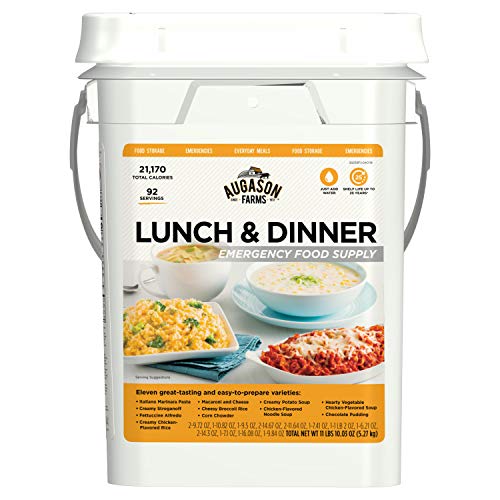
- Weight185.8 oz (5266 g)
- Size (L × W × H)11 × 14 × 11 in
Ready Hour 4-Week Supply
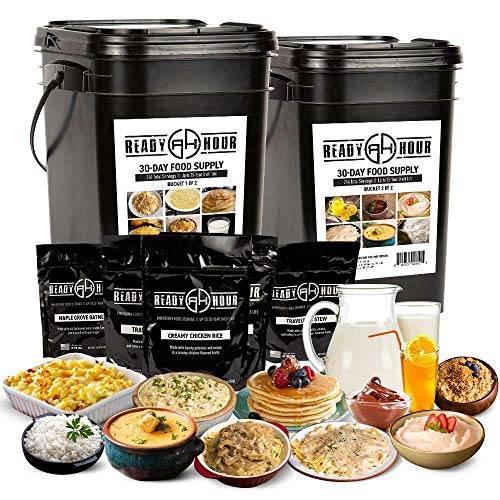
- Weight5.4 oz (152 g)
How most households actually build 90 days
Most 90-day shelves are built as a staples base with freeze-dried meals on top, because the cost gap is wide: in our dataset, bulk staples run near $1.70 to $1.90 per 1,000 calories against roughly $17 to $20 per 1,000 calories for freeze-dried meals.
Run that gap across 720,000 calories and it decides the architecture for you. An all-kit 90 days is the most expensive way to reach the number; an all-staples 90 days is the cheapest and the most dependent on rotation, cooking fuel, and water — freeze-dried and dried staples both drink from the water store, which our 90-day water answer works out at 360 gallons for the same family. The staged order matters more than the total: finish 3 days everywhere, build to the Red Cross’s 2 weeks at home, pass 30 days on purpose, and let 90 be the sum of stages you actually completed. A household with nothing stored gets more safety from completing the first tier this week than from half-funding the last one.
Viewers also searched for these items.


Clearly Filtered Pitcher
The pitcher for people who read contaminant tables: built to target fluoride, PFAS, and arsenic — the premium end of pitcher filters.
$87.99 from AmazonFrequently asked questions
How many calories does a family of four need for 90 days?
About 720,000 calories — 2,000 per person per day, four people, ninety days. In person-days that is 360. Any kit or combination of kits that totals less than 720,000 calories is less than a family 90 days, whatever its name says.
Is 90 days of food storage an official government recommendation?
No. Household guidance tops out at Germany’s 10 days and the Red Cross’s 2-week home target, above a 72-hour floor in the US, the EU, and the UK. The 90-day figure in recent reporting is attached to planning for military installations, reported from unpublished documents — it is not confirmed household guidance from any government.
Do I need freeze-dried food for a 90-day supply?
No. Freeze-dried is the no-rotation option, not the only option. Bulk staples run near $1.70 to $1.90 per 1,000 calories in our dataset, against roughly $17 to $20 for freeze-dried meals — so most long shelves are a staples base with freeze-dried meals covering the part of the shelf that cannot rotate.
How much does 90 days of food weigh for a family of four?
Roughly 1,140 pounds of food, scaled from the German BBK’s per-person list — the same list our family quantities page uses to put 3 days for four people at about 38 pounds. Drinks are on top of that: water for 90 days is a separate 360-gallon problem.
Sources & freshness: Ready.gov, “Build a Kit” (72-hour floor; 1 gallon of water per person per day twin figure); American Red Cross survival-kit guidance (3-day evacuation supply, 2-week home supply); EU Preparedness Union Strategy (72-hour self-sufficiency); Sweden’s In Case of Crisis or War (at least one week); Germany’s BBK guide, October 2025 (10 days, itemised list); UK Be Ready, October 2026 (3 days). Kit calorie totals from Truly Preserved’s published cost-per-serving dataset and kit-tier answer; food weights scaled from the BBK list as published in our family food quantities page.
More answers like this one: This answer belongs to What People Are Asking About Food Storage. The tiers underneath it are worked in How Much Food Does a Family Need for 3 Days, a Week, and 2 Weeks? and 72-Hour, 2-Week, or 30-Day Food Kits, and the same family’s water is answered in How Much Water Do I Need for 90 Days?
Talk it over with other readers. The Truly Preserved Community on Facebook is where readers compare notes on food storage, water, and backup power — and where your questions help decide what we research next. Join the group →
Prices shown on this page were last checked November 26, 2026 — prices change; check before you buy.