
Affiliate Disclosure: Truly Preserved is reader-supported. When you buy through links on this page, we may earn a commission at no extra cost to you. As an Amazon Associate, Truly Preserved earns from qualifying purchases. Learn more.
How we researched this comparison. We scored 2 products head to head for this page. The work behind the scores: manufacturer specifications and certification records where they apply, prices checked when this review was written, and patterns across verified owner feedback — a praise or complaint point only counts here when it shows up again and again, not once. The products were chosen to cover the main designs and price points a buyer in this category actually cross-shops. We are a research desk: we do not buy or hands-on test the products, and commissions never change a score. How we research and score →
Two boxes, the same 2,000 watt-hours, and the same $899 price tag on the day we checked — and yet the Bluetti Elite 200 V2 vs Jackery Explorer 2000 v2 choice for home backup comes down to one question: will this box live in one spot, or will you be carrying it there when the lights go out? This comparison is built from published specs, current prices, and aggregated owner feedback from retailer listings and owner forums. We don’t own these power stations; we did the homework so you can see where they actually differ. On paper they look like twins. In the specs that decide an outage — how fast they refill from the sun, how hard a load they can start, how long the battery lasts over years — they are not twins at all. If you are still deciding which size class you need, run the Power Station Size Calculator first. If you want the wider field, our full solar generator comparison covers both of these plus the EcoFlow DELTA 2 Max.
The Short Version
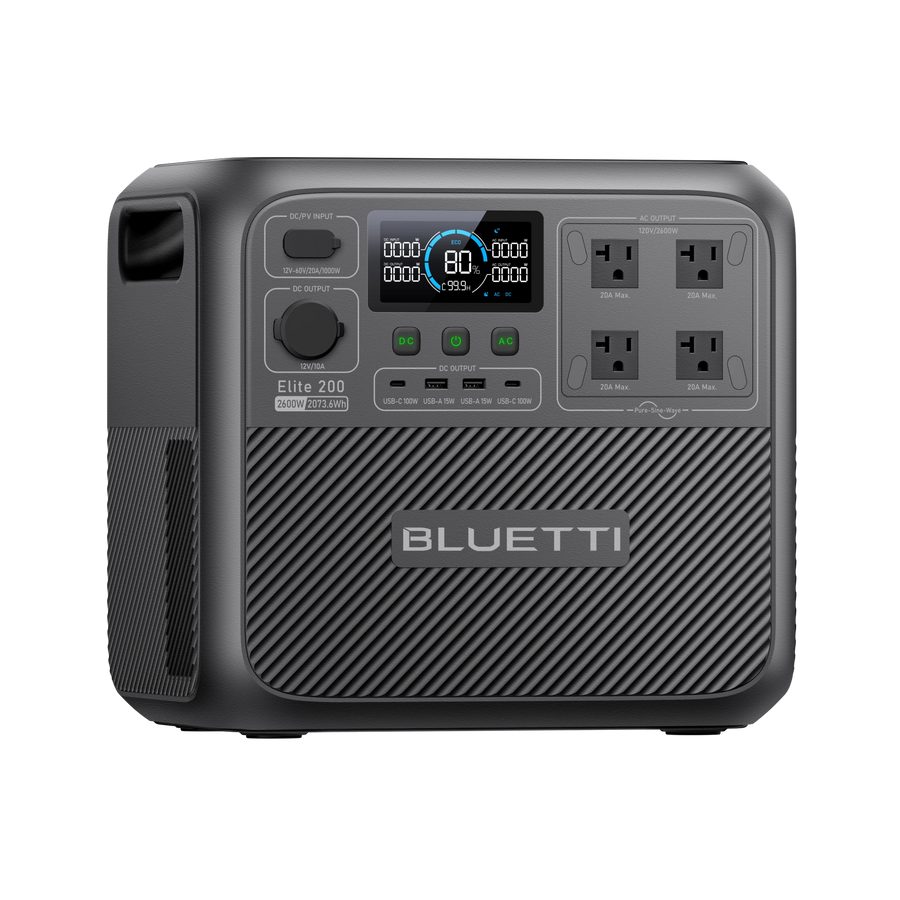
Photo: Bluetti.
Bluetti Elite 200 V2
See it at BluettiOur full breakdownWe may earn a commission at no extra cost to you.
Jackery Explorer 2000 v2
See it on AmazonWe may earn a commission at no extra cost to you.
Bluetti knocks an extra 5% off for our readers at their own store. Use code AFFEV5% at checkout.
How we chose: We compared the manufacturers’ published specs side by side, checked today’s street prices, and read owner feedback across roughly 1,800 ratings and reviews for these two models, counting the praises and complaints that kept coming up. Scores weigh how well each box works in an outage, what it costs to own, build and warranty, and what owners say after months of use. Read our full methodology.
Head-to-Head Specs
| Bluetti Elite 200 V2 | Jackery Explorer 2000 v2 | |
|---|---|---|
| Price | $899 | $899 |
| Capacity | 2,073.6Wh | 2,042Wh |
| Cost per watt-hour | ~43 cents | ~44 cents |
| Output (continuous) | 2,600W | 2,200W |
| Surge / boost | 3,900W Power Lifting (heating-type loads only; no surge rating published) | 4,400W surge |
| Battery | LiFePO4, 6,000+ cycles to 80% | LiFePO4, 4,000 cycles to 70% |
| Solar input (max) | 1,000W | 400W |
| Wall charging | 1,800W; 0–80% in about 50 minutes in fast-charge mode | Full in about 1.7 hours (Emergency Super Charge) |
| AC outlets | 4 | 3 |
| Weight | 53.4 lb | 39.5 lb |
| Switch to battery in an outage | 15 ms or less | 20 ms or less |
| Grows later? | No | No |
| Warranty | 5 years | 3 years on Amazon; 5 years only when bought direct from Jackery |
Prices and specs from manufacturer pages and retailer listings, October 2026. Prices for these boxes swing a lot with sales — always confirm before buying. Solar panels are sold separately for both.
Bluetti Elite 200 V2: The One That Stays Put and Outlasts
Our score: 8/10 — the stronger, longer-lived box of the two, built for a corner of the kitchen or garage where it will sit for years. What you give up is your back: at 53.4 pounds, you place it once and leave it there.
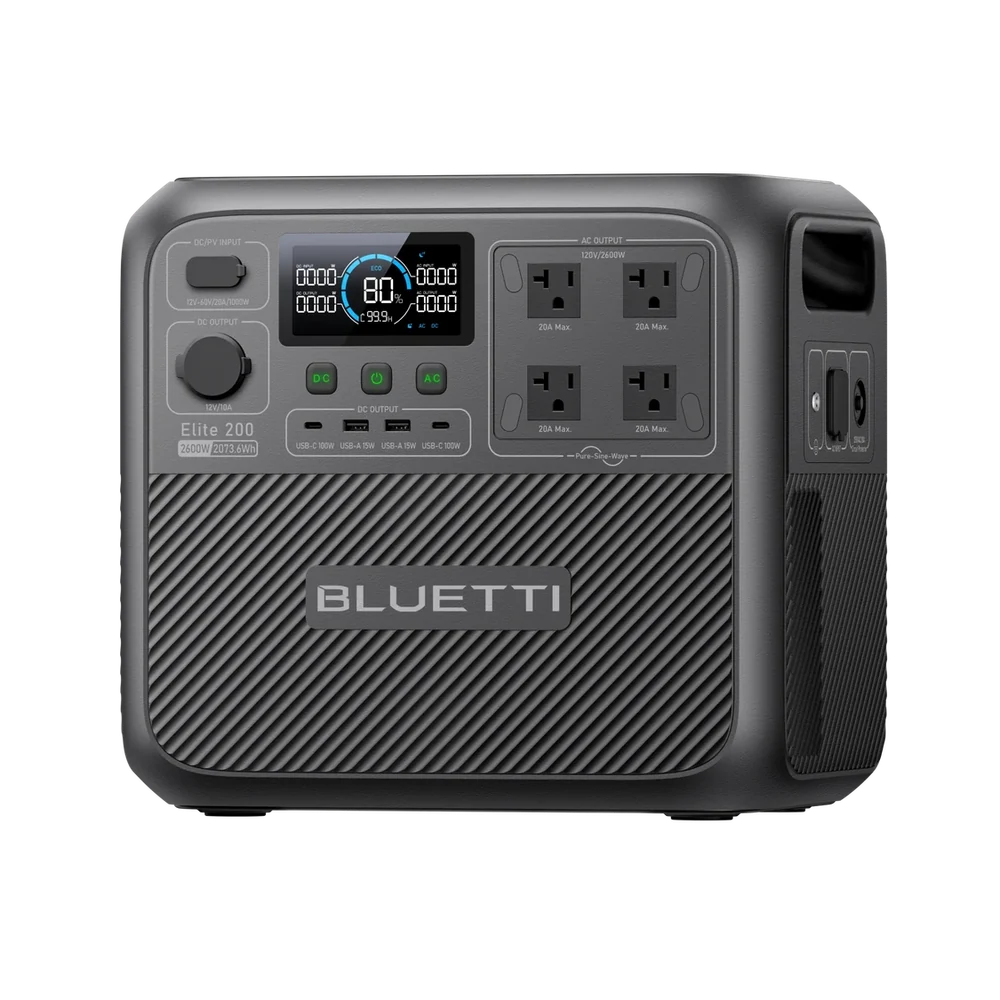
The Elite 200 V2 holds 2,073.6Wh and puts out 2,600W through four AC outlets, two 100W USB-C ports, two USB-A ports, and a car outlet. That extra 400W over the Jackery is the difference between running a microwave while the fridge cycles on, and tripping the box off at the worst moment. The battery is the real headline: 6,000 or more full charges before it fades to 80% of new, which is where Bluetti’s “17-year lifespan” line comes from — one full cycle a day, every day, for over sixteen years. It also refills like it means it: up to 1,000W of solar through one input, and about 80% in 50 minutes from a wall in fast-charge mode. One thing it does not have, whatever you may read elsewhere: there is no 30-amp RV outlet on this box.
Pros:
- Strongest output here (2,600W) — kitchen loads run together, not one at a time
- Battery rated 6,000+ cycles to 80% — the longest-lived of the pair by a wide margin
- 1,000W solar input: a same-day refill is realistic, not hopeful
- Four AC outlets, and a 5-year warranty no matter where you buy it
- Compact for its class — close to the footprint of much smaller stations
Cons:
- Heaviest at 53.4 lb — a two-hand lift, and plan on it
- No published surge rating; the 3,900W “Power Lifting” number only helps heating-type loads
- Cannot add battery later — 2,073.6Wh is all it will ever hold
- The app is basic, and some owners report it dropping its connection
Across ~940 ratings on its main Amazon listing, owners praise how much power fits in such a small box, the fast charging, and that it runs a fridge and freezer without drama. The complaints that repeat: the weight, an app that feels unfinished next to the hardware, and owners who bought expecting to add a battery later and learned there isn’t one. A smaller number of owners in Bluetti’s own forum report solar input faults that needed a firmware update or service — not the common experience, but worth knowing.
Buy it if: the box will live in one spot, you plan to refill it from solar panels, and you want the battery that lasts longest. Skip it if: you will be hauling it up stairs or out to a vehicle every time, or you need a 30-amp RV outlet.
Check the current price on Amazon →
Jackery Explorer 2000 v2: The One You Can Actually Carry
Our score: 8/10 — the easiest 2kWh box here to live with: lightest, smallest, quietest. What you give up is solar speed and battery years — and two years of warranty if you buy it on Amazon instead of from Jackery.
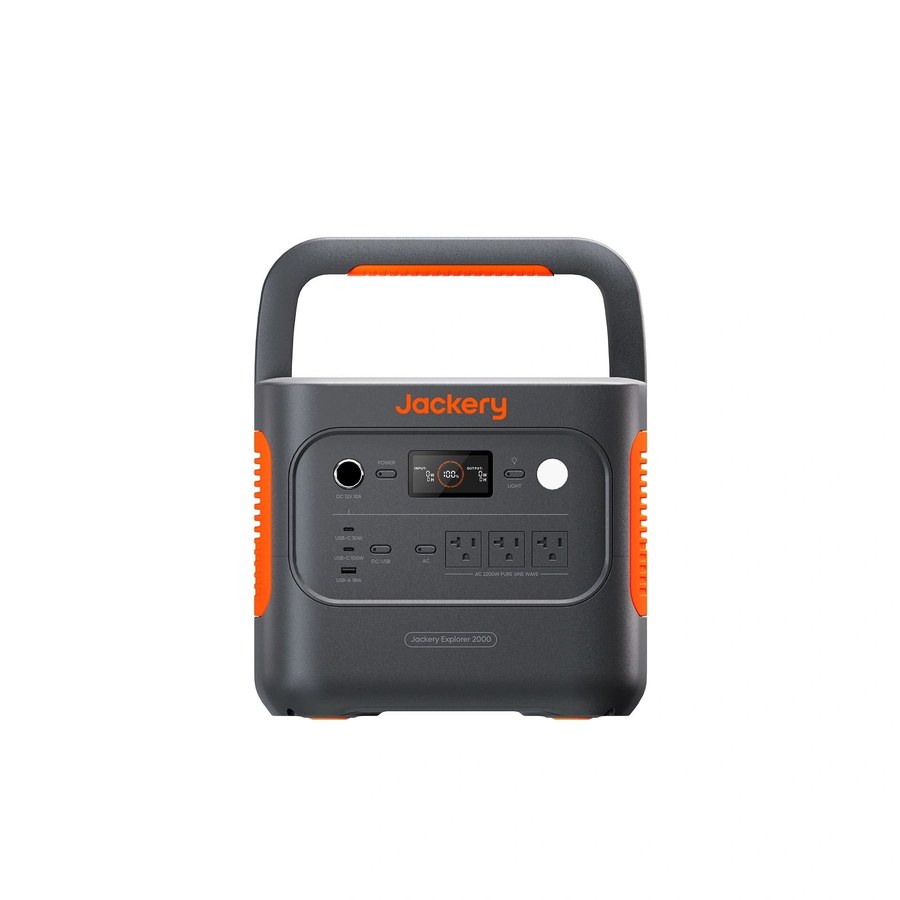
The Explorer 2000 v2 holds 2,042Wh and puts out 2,200W through three AC outlets. At 39.5 pounds it weighs about fourteen pounds less than the Bluetti — that is the difference between “grab it and go” and “get help.” Its quiet charging mode runs under 30 decibels by Jackery’s rating, it refills from a wall in about 1.7 hours, it switches to battery in 20 milliseconds or less when the grid drops, and Jackery says it still holds about 95% of its charge after a year in the closet — a real plus for a box that mostly waits. It is also the only one of the pair with a published surge rating: 4,400W, the number that matters when a fridge or freezer compressor kicks on. Its battery is rated for 4,000 cycles, but read the fine print: that rating runs to 70% of new capacity, where Bluetti’s 6,000 runs to 80%. The gap is bigger than the headline numbers suggest, in Bluetti’s favor.
Pros:
- Lightest (39.5 lb) and smallest 2kWh box in this pair
- Published 4,400W surge rating — the honest number for starting motors and compressors
- Quiet — under 30dB in quiet charging mode
- Holds its charge in storage (about 95% after a year, per Jackery)
- Fast wall refill (about 1.7 hours)
Cons:
- Solar input caps at 400W — a full sun refill takes about six good hours
- Warranty is 3 years when bought on Amazon; the extra 2 years come only with a direct purchase from Jackery
- Only 3 AC outlets, and it cannot add battery later
- Some owners report the app giving trouble at first setup
Across ~870 Amazon ratings (4.6 stars), owners love the size, the quiet, and the fast wall charging — it is the one people describe as easy to grab when the lights flicker, and one owner’s fridge-freezer test used only about 55% of the battery in the first 24 hours. The complaints that repeat: solar charging feels slow next to rivals, panels and cases are sold separately so the full setup costs more than the box price, and — detailed in the honest notes below — some owners hit a solar-charging fault that needed a software fix Jackery had to push to their unit.
Buy it if: weight, noise, stairs, or apartment living matter, and you mostly refill from a wall outlet. Skip it if: solar is your main refill plan for multi-day outages, or you want the longest battery life per dollar.
Check the current price on Amazon →
Also Consider: EcoFlow DELTA 2 Max
If the deciding question is neither weight nor solar but “what if I need more later,” stop and look at the third box. The EcoFlow DELTA 2 Max (2,048Wh, 2,400W, six AC outlets, 1,000W of solar through two inputs) is the only one in this size class that can add batteries later, up to 6,144Wh — and it is our top pick in the full three-way comparison for exactly that reason. It costs more ($1,029 when we checked today), weighs 50 pounds, and its battery rating (3,000 cycles to 80%) is the shortest of the three. But if a freezer joins the fridge next year, it is the only box here that grows with you.
Check the current price on Amazon →
Head-to-Head by What Matters
Which one keeps a refrigerator cold the longest?
Call it a tie, with the Bluetti a nose ahead. Figure about 85% of either battery is usable: roughly 1,760Wh from the Bluetti, 1,735Wh from the Jackery. A modern fridge uses about 1,000–1,500Wh a day the way it cycles on and off, so either box keeps one fridge cold for about a day to a day and a half — Bluetti’s own example, a 100W fridge for up to 16.8 hours, lands right in that range. The Bluetti’s fourth outlet and extra output headroom make the fridge-plus-freezer shuffle easier; the Jackery’s published surge rating makes starting an older compressor less of a gamble. Add both a fridge and a freezer and the time roughly halves unless you rotate which one is plugged in. And remember the other half of the plan: shelf-stable food never needs a watt at all, which is the whole point of our freeze dryer comparison.

How much solar panel power can each one take in?
The Bluetti wins this one outright, and it is not close. It takes up to 1,000W of solar — a full refill in roughly two to two and a half hours of strong sun. The Jackery caps at 400W, so the same refill takes about six good hours: a full clear day, and two days if clouds roll in. In a multi-day outage, refill speed is the whole game — the box that is full by lunch runs the fridge again that night. The honest catch: if your panel setup is 400W or less, both boxes drink at the same speed, and this whole section stops mattering. It only decides the purchase if you own, or will buy, more panel than the Jackery can take.
Which one handles hard-starting appliances better?
The Jackery wins on the number that matters. It publishes a 4,400W surge rating — the short burst a fridge compressor, freezer, or sump pump draws in the first second. Bluetti publishes no surge rating for the Elite 200 V2 at all. The 3,900W “Power Lifting” figure in its ads is a different thing: it lowers the voltage so a simple heater, kettle, or hot plate keeps working. It does nothing for a motor trying to start. For plain running loads the Bluetti’s 2,600W continuous beats the Jackery’s 2,200W — but if your worry is an old freezer that kicks hard, the Jackery is the one with its starting power in writing.
How heavy is each one to carry?
The Jackery wins, by fourteen pounds. 39.5 lb is a genuine one-person carry for most adults. 53.4 lb is a two-hand lift you plan around — fine from the garage to the kitchen, miserable up a flight of stairs at midnight. The Bluetti’s compact shape makes it less awkward than the number suggests, and if it truly never moves, the weight costs you once, on delivery day. Be honest about who will move it during an outage, in the dark, possibly on stairs. That person is the spec sheet here. For more on keeping the lights on, see our guide to backup power.
Which one is quieter at night?
The Jackery wins for sleeping near it. Its quiet charging mode is rated under 30 decibels — library quiet — and owners back that up. The Bluetti is also quiet at low loads and has a silent charging mode, but under a heavy load or a fast charge, both boxes spin their fans up and owners of both say so. If the box will spend the night in a bedroom — CPAP owners, this is you — the Jackery is the safer roommate.
What does each one cost to own over time?
No fuel, no oil, almost no upkeep for either — that part is simple. The math that separates them is price per watt-hour and price per year of battery. Today the Bluetti runs about 43 cents per watt-hour and the Jackery about 44 cents. Now divide by the battery ratings: the Bluetti’s 6,000 cycles to 80% work out to roughly 7 cents per kilowatt-hour of lifetime use, against the Jackery’s roughly 11 cents per kilowatt-hour over its 4,000 cycles to 70%. In plain words, the Bluetti’s battery delivers close to one and a half times the lifetime work per dollar — if you cycle the box often, that swamps a small price difference. If it will sit in a closet and come out twice a year, both batteries will outlast your interest, and the math that matters is just the sticker. The costs that sneak up are the same for both: solar panels (none included), cables, and — someday — a whole new box, because neither battery is replaceable.
Honest Notes Before You Buy
Neither box runs a whole house. Central air, an electric stove, a well pump and a water heater at once — that is more than either inverter and more than 2kWh. These are basics boxes: fridge, lights, router, phones, a fan, a CPAP. They do that job well. Whole-house backup is a bigger, pricier step.
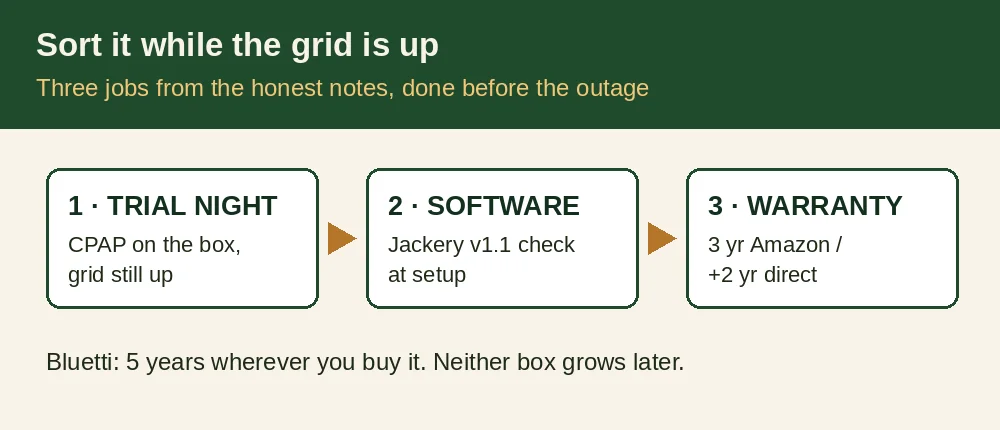
Jackery’s warranty has a catch for Amazon buyers. The “3+2 year” warranty you will see advertised is 3 years, plus 2 more only when the box is bought from Jackery’s own site. Buy on Amazon and you have 3 years. The Bluetti’s 5 years apply wherever you buy it. That difference never shows on the spec sheet, and it should be part of the price you compare.
Jackery solar-charging fault, per owners. Multiple Explorer 2000 v2 owners report solar charging pulsing on and off until Jackery pushed software version 1.1 to their unit — a fix owners say the company did not publicize well. If you buy the Jackery and charge from panels, check your software version at setup and get the update sorted while the grid is still up, not during an outage.
Neither box grows. The 2,073.6Wh or 2,042Wh you buy is the ceiling for both, forever. If there is any real chance your list gets longer — a freezer, a well pump, longer outages — that is the EcoFlow’s argument above, and it is a strong one.
CPAP and medical gear: both boxes switch to battery fast enough on paper (15–20 milliseconds) to keep a CPAP running, and owners use them that way. But Jackery’s own guidance says its stations are not recommended for medical or life-support equipment, and that caution is worth honoring in spirit for both: do a full trial night at home while the grid is still up, and never let a battery box be the only plan for equipment someone depends on to breathe.
Prices swing hard. Both boxes go on sale often and deeply — we have seen each of them hundreds of dollars apart within the same season. Every price in this post was checked today, October 17, 2026. If your pick is at full list price, waiting for the next sale is a legitimate strategy — just don’t wait into storm season.
Questions People Ask
Is the Bluetti Elite 200 V2 better than the Jackery Explorer 2000 v2?
For a box that stays in one place, yes: more output (2,600W against 2,200W), 2.5 times the solar intake, one more AC outlet, and a battery rated for far more lifetime use. For a box you will carry, no: the Jackery is fourteen pounds lighter, quieter, and has its surge power in writing. The better box is the one that matches how you will actually use it.
Which is lighter, the Elite 200 V2 or the Explorer 2000 v2?
The Jackery, at 39.5 pounds against the Bluetti’s 53.4. That is roughly the difference between a carry-on suitcase and a checked one, and it is the single best reason to choose the Jackery.
Can the Bluetti Elite 200 V2 run a 3,900W appliance?
Only a simple heating-type one — a kettle, hot plate, or space heater — and it will run slower than it does on wall power, because Power Lifting mode lowers the voltage to keep it going. It is not surge power and does nothing to help a fridge compressor or pump start. For starting power, use the plain ratings: 2,600W continuous for the Bluetti, 2,200W continuous and 4,400W surge for the Jackery.
Which charges faster from solar panels?
The Bluetti, by a lot: it accepts up to 1,000W of solar against the Jackery’s 400W cap, so a full refill takes roughly two to two and a half hours of strong sun against about six. With 400W of panels or less, though, both charge at the same speed — the Bluetti’s advantage only exists if your panels can feed it.
How long will these run a refrigerator?
About a day to a day and a half for one modern fridge on its own, from either box — figure roughly 85% of the battery is usable, and a fridge uses about 1,000–1,500Wh a day cycling on and off. Keep the door shut and it stretches further. Add a freezer, lights, and the router, and you are closer to 8–12 hours for everything together.
Which is better as a backup for a computer or CPAP?
On paper the Bluetti switches to battery a touch faster (15 milliseconds or less against 20 or less), and both are fast enough that routers and computers normally ride through. For a CPAP, either runs one all night with power to spare. Do a trial night at home first either way — and read the medical note above before making any battery the only plan.
Sources & freshness: manufacturer spec pages (Bluetti, Jackery, EcoFlow), Amazon retailer listings and owner reviews, camelcamelcamel price histories, and independent comparisons consulted October 2026. Prices last checked: October 17, 2026. Last updated: October 30, 2026.
Talk it over with other readers. The Truly Preserved Community on Facebook is where readers compare notes on food storage, water, and backup power — and where your questions help decide what we research next. Join the group →
When the outage outlasts the battery
Both of these boxes hold about a day of fridge backup. If your outages run longer and solar cannot keep up, a fuel generator is the honest second half of the plan — our portable generator picks for fridge and freezer backup compare three inverter generators built for exactly that job.
Three more worth a look
Down to these two but still cross-shopping? Three more names in and around this class that we have not reviewed or scored:
Anker SOLIX F2000
The third ecosystem: same 2,048Wh class as the two above, on wheels, from the maker most buyers already own cables from.
Goal Zero Yeti 1500X
The smaller step down: 1,516Wh from the category’s founding brand, for loads lighter than a full fridge-and-freezer brief.
Bluetti AC200L
The Bluetti that nearly made our main comparison — the Elite 200 V2 took its slot on value. Still a live option in the same family.
As an Amazon Associate, Truly Preserved earns from qualifying purchases. Mentioned products are not reviewed or scored by us.