
Truly Preserved is reader-supported. If you buy through a link on this page we may earn a commission at no extra cost to you. Nobody pays for placement or scores.
THE SHORT ANSWER
Green beans are a low-acid vegetable, so they are canned in a pressure canner — never a water bath. Pack pint jars for 20 minutes or quarts for 25 minutes, at 11 pounds of pressure on a dial-gauge canner (0–2,000 feet) or 10 pounds on a weighted-gauge canner (0–1,000 feet), with 1 inch of headspace. An average of 14 pounds of fresh beans fills a 7-quart canner load. Every figure on this page comes from the USDA’s tested procedure, credited at the bottom.
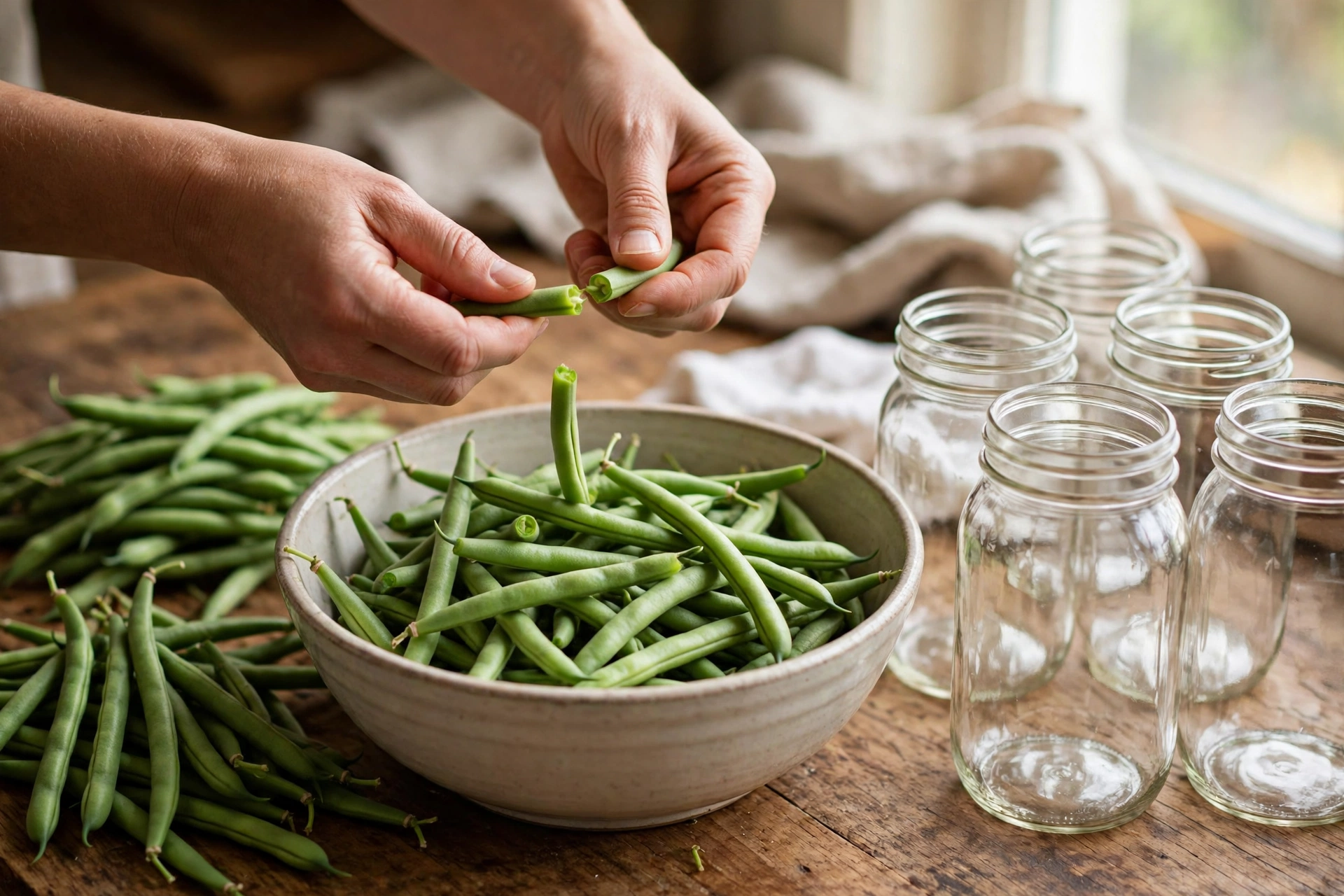
Green beans are the jar most home canners put up more of than anything else — they are a top-five canned food in the United States, and a good bean patch produces faster than a family can eat fresh. They are also the jar that teaches the one rule that matters: vegetables are low-acid, and low-acid food only becomes shelf-safe under pressure. The USDA is blunt about it — there is no safe option for processing green beans in a boiling water canner.
This guide follows the USDA’s tested procedure exactly: its quantities, its headspace, its minutes, and its pressures. If you are still choosing the canner itself, our roundup of the best pressure canner for beginners covers the sizes worth buying, and how to can food in mason jars walks the general process for both canning methods.
What You Need
Fresh beans first: the USDA calls for filled but tender, crisp pods, and says to remove and discard diseased and rusty pods. For the amounts — an average of 14 pounds of beans fills a canner load of 7 quarts, and an average of 9 pounds fills a load of 9 pints. A bushel weighs 30 pounds and yields 12 to 20 quarts, an average of 2 pounds per quart. You also need a pressure canner, pint or quart jars with new lids, and canning salt if you want it — the salt in this recipe is for flavor only.

Presto 16-Quart Pressure Canner
The beginner pressure canner that handles both pint and quart loads of beans, with dial and weighted options covered in the guide's tables.
$151.63 from Amazon
Morton Canning and Pickling Salt, 4 lb
The salt in this recipe is optional and for flavor — 1 teaspoon per quart — and this is the pure canning salt the recipe means, with nothing added to cloud the liquid.
$2.68 from Amazon
Ball Regular Mouth Canning Lids, 96 Count
Flat lids are single-use, and a bean season eats them by the dozen. The 96-count box keeps a fresh lid on every jar, every batch.
$36.99 from AmazonBefore You Start
Three things decide whether this batch is safe, and none of them is negotiable. First, the canner: green beans go in a pressure canner, full stop — a water bath, an oven, and an electric pressure cooker are all out. Second, the clock starts when the canner reaches the full pressure in the table below, not when the jars go in. Third, altitude changes pressure, not time: if you live above 2,000 feet on a dial gauge or above 1,000 feet on a weighted gauge, use the higher pressure for your altitude band in the tables.
How to Can Green Beans, Step by Step
- Prepare the beans. Wash the beans and trim the ends. Leave them whole or cut or snap them into 1-inch pieces.
- Choose your pack. For a hot pack, cover the beans with boiling water and boil 5 minutes. For a raw pack, the beans go into the jars uncooked.
- Fill the jars. Hot pack: fill jars loosely with the boiled beans, then cover with the hot cooking liquid. Raw pack: fill jars tightly with raw beans, then add boiling water. Either way, leave 1 inch of headspace.
- Add salt if you want it. 1 teaspoon of canning salt per quart jar, if desired. It flavors the beans; it does not preserve them.
- Close the jars. Wipe each rim clean, center a new lid, and screw the band down fingertip-tight.
- Process in the pressure canner for the time and pressure for your jar size, canner type, and altitude in the tables below. Let the canner cool and depressurize on its own before opening it.
- Rest and check. Lift the jars out and let them sit undisturbed until cool, then check every seal before the jars go on the shelf.
The Numbers: Time and Pressure
Processing times are the same for hot pack and raw pack. Pressure is where altitude comes in.
| Jar size | Process time | Dial gauge, 0–2,000 ft | Dial gauge, 2,001–4,000 ft | Dial gauge, 4,001–6,000 ft | Dial gauge, 6,001–8,000 ft |
|---|---|---|---|---|---|
| Pints | 20 minutes | 11 lb | 12 lb | 13 lb | 14 lb |
| Quarts | 25 minutes | 11 lb | 12 lb | 13 lb | 14 lb |
| Jar size | Process time | Weighted gauge, 0–1,000 ft | Weighted gauge, above 1,000 ft |
|---|---|---|---|
| Pints | 20 minutes | 10 lb | 15 lb |
| Quarts | 25 minutes | 10 lb | 15 lb |
Headspace is 1 inch for both packs and both jar sizes — beans and covering liquid alike.
Not every bean has to be canned. The overflow freezes well, vacuum-sealed or bagged, and these are the two tools that side of the job runs on.

Nesco VS-12 Vacuum Sealer
For the share of the harvest that gets frozen instead of canned — vacuum-sealed bags keep frozen beans and corn from drying out in the freezer.
$108.18 from Amazon
Ziploc Freezer Quart Bags
The freezer-bag half of the method — a box of quart bags handles the overflow that does not go into jars.
$26.48 from AmazonCommon Mistakes
Reaching for the water bath canner. It is the one error that matters most with beans. Boiling water cannot reach the temperature low-acid vegetables require, and the USDA offers no water-bath process for green beans at all.
Guessing at altitude. A dial-gauge canner run at 11 pounds by a cook at 5,000 feet is under-processed food. Find your altitude band in the table before the canner heats, not after.
Packing raw-pack jars loosely. The raw pack calls for jars filled tightly; a loosely filled raw pack shrinks down and leaves beans above the liquid line.
Rushing the cool-down. Forcing a pressure canner open or running cold water over it pulls liquid out of the jars and can fail seals. Let it come down on its own.
Storage and Shelf Life
Store sealed jars in a cool, dark, dry place with the bands removed, and label each jar with the date. Like other home-canned vegetables, beans hold their best quality for about a year; rotate the shelf so the oldest jars get eaten first. A jar with a failed seal goes in the refrigerator and gets eaten within a few days, or gets reprocessed with a fresh lid within 24 hours.
Viewers also searched for these items.

All American 21.5-Quart Pressure Canner
The cast-aluminum, metal-to-metal-seal canner built to be handed down, not replaced.
$449.95 from Amazon
Mrs. Wages Pickling and Canning Salt
A second pure pickling salt for the canning shelf — the same additive-free rule as the recipe's.
$19.32 from Amazon
SOLIGT Glass Fermentation Weights, 4-Pack
For the fermenting side of the harvest — glass weights that hold vegetables under brine in wide-mouth jars.
$11.99 from AmazonFrequently Asked Questions
Can I can green beans in a water bath canner?
No. The USDA states plainly that there is no safe option for processing green beans in a boiling water canner. Beans are a low-acid vegetable and require a pressure canner.
Do I have to add salt?
No. The 1 teaspoon per quart in the procedure is for flavor only, and the recipe works without it.
Hot pack or raw pack — which is better?
Both use the same processing time and pressure. The hot pack’s 5-minute boil settles the beans so jars fill more evenly; the raw pack is faster to fill. Pick the one that fits your kitchen rhythm.
How many beans do I need for a canner load?
An average of 14 pounds for 7 quarts, or 9 pounds for 9 pints. A bushel is 30 pounds and yields 12 to 20 quarts.
Procedure, times, and pressures: USDA Complete Guide to Home Canning, Guide 4, “Beans, snap and Italian — pieces, green and wax,” via the National Center for Home Food Preservation.
Prices shown on this page were last checked November 26, 2026 — prices change; check before you buy.
Talk it over with other readers
The Truly Preserved Community on Facebook is where readers compare notes on food storage, water, and backup power — and where your questions help decide what we research next.