
Truly Preserved is reader-supported. If you buy through a link on this page we may earn a commission at no extra cost to you. Nobody pays for placement or scores.
THE SHORT ANSWER
Fresh-pack dill pickles: soak 8 pounds of 3- to 5-inch pickling cucumbers 12 hours in a brine of 3/4 cup pickling salt to 2 gallons of water, then pack pint jars with 1 teaspoon of mustard seed and 1 1/2 heads of fresh dill per jar, cover with a boiling solution of vinegar, salt, sugar, and pickling spice at 1/2 inch of headspace, and process pints 10 minutes in a boiling water canner at 0–1,000 feet (quarts 15 minutes). The batch makes 7 to 9 pints. Every figure comes from the USDA’s tested recipe, credited at the bottom.
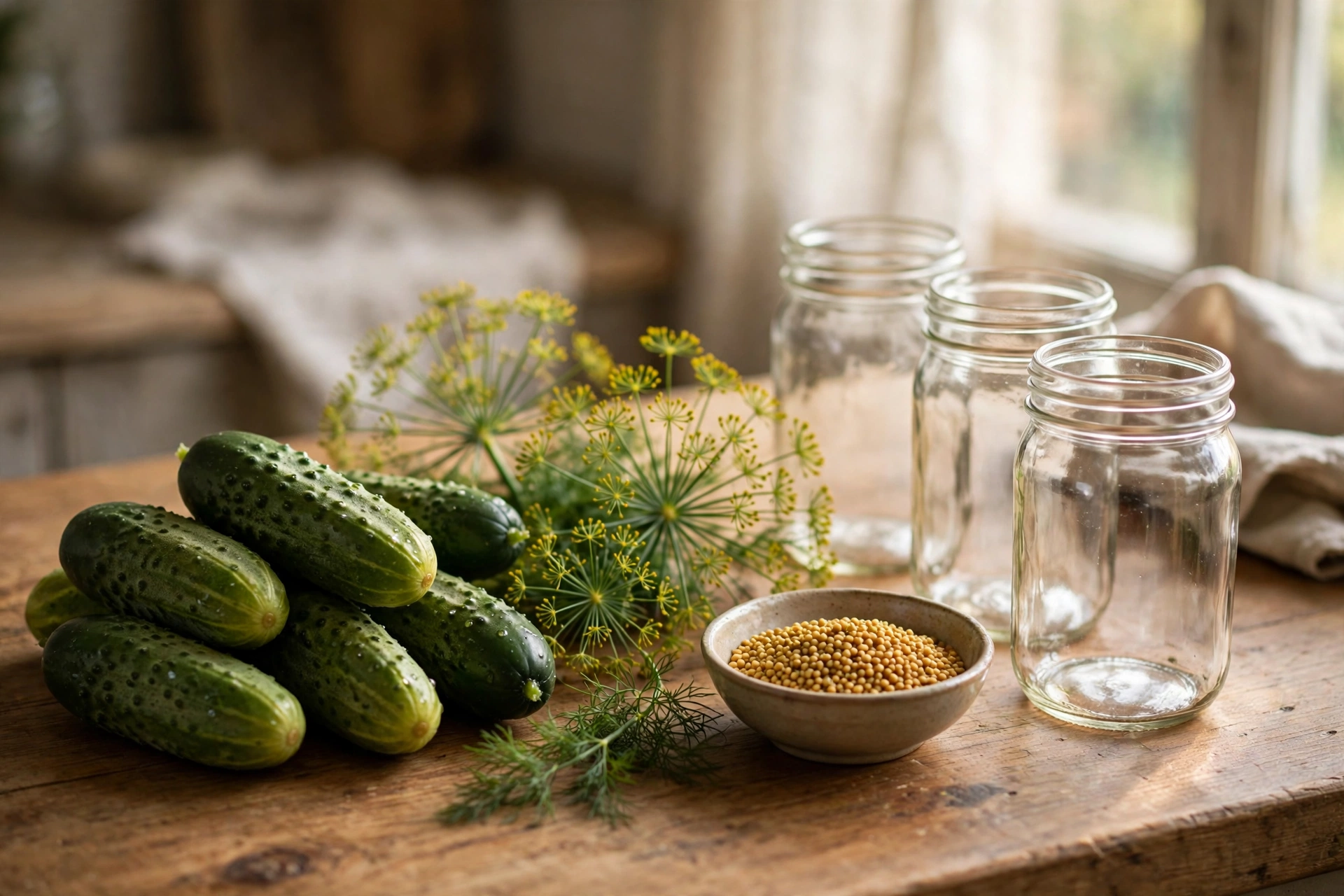
Dill is the favorite pickle in the country by more than two to one in Ball’s consumer research, and pickles sit in the top five of everything Americans can. The fresh-pack method on this page is the straightforward one: a salt brine soak overnight to firm the cucumbers, then a vinegar solution and a short trip through the water bath canner. No fermentation crock, no weeks of waiting — cucumbers in, pickles out, with the USDA’s tested numbers doing the safety work.
New to the canner itself? How to can food in mason jars covers the water bath process start to finish. Prefer the old crock method instead? Our sauerkraut guide uses the same USDA guide’s fermentation approach for cabbage.
What You Need
The USDA recipe, as written: 8 pounds of 3- to 5-inch pickling cucumbers, 2 gallons of water and 1 1/4 cups of canning or pickling salt for the recipe overall, 1 1/2 quarts of vinegar (5 percent), 1/4 cup of sugar, 2 more quarts of water, 2 tablespoons of whole mixed pickling spice, about 3 tablespoons of whole mustard seed, and about 14 heads of fresh dill — or 4 1/2 tablespoons of dill seed instead. Use pickling cucumbers, not slicing cucumbers; the recipe is built around the small, firm kind.

Granite Ware 21.5-Quart Water Bath Canner
The classic enamel canner with its jar rack — the vessel this fresh-pack recipe's 10-minute pint process assumes.
Check Availability
Ball Secure-Grip Jar Lifter
Pints go into and come out of boiling water with a lifter — the grip that keeps a jar upright and a hand dry.
Check Availability
Morton Canning and Pickling Salt, 4 lb
Pure salt with no additives to cloud the brine — the recipe calls for canning or pickling salt in both the soak and the solution.
$2.68 from AmazonBefore You Start
Two details carry this recipe. The first is the blossom end: cut a 1/16-inch slice off it and discard that slice, because the blossom end carries enzymes that soften pickles — but leave 1/4 inch of stem attached. The second is the vinegar: it must be 5 percent acidity, which is what standard store-bought pickling and distilled vinegars are labeled. Weaker vinegar is not a substitution this recipe allows.
How to Make Fresh-Pack Dill Pickles, Step by Step
- Wash and trim. Wash the cucumbers. Cut a 1/16-inch slice off the blossom end and discard it, leaving 1/4 inch of stem attached.
- Brine-soak. Dissolve 3/4 cup of the salt in 2 gallons of water, pour it over the cucumbers, and let them stand 12 hours. Drain.
- Make the pickling solution. Combine the 1 1/2 quarts of vinegar (5 percent), the remaining 1/2 cup of salt, the 1/4 cup of sugar, and 2 quarts of water. Add the 2 tablespoons of pickling spice tied in a clean white cloth, and heat the solution to boiling.
- Pack the jars. Into each pint jar put 1 teaspoon of mustard seed and 1 1/2 heads of fresh dill (or 1 1/2 teaspoons of dill seed). Fill with cucumbers.
- Cover and close. Cover the cucumbers with the boiling pickling solution, leaving 1/2 inch of headspace. Wipe the rims, center new lids, and screw bands down fingertip-tight.
- Process in a boiling water canner for the time for your jar size and altitude in the table below.
- Rest and check. Let the jars cool undisturbed, check every seal, and give the pickles time in the jar before opening the first one — the flavor develops on the shelf.
The Numbers: Processing Times
| Jar size | 0–1,000 ft | 1,001–6,000 ft | Above 6,000 ft |
|---|---|---|---|
| Pints | 10 minutes | 15 minutes | 20 minutes |
| Quarts | 15 minutes | 20 minutes | 25 minutes |
Headspace is 1/2 inch. The recipe yields 7 to 9 pints from 8 pounds of cucumbers.
Cucumbers also ferment. If part of the haul is headed for a crock instead of the canner, it runs on weights and small jars:

SOLIGT Glass Fermentation Weights, 4-Pack
The other road for cucumbers: weights that hold a ferment under its brine, in the same wide-mouth jars.
$11.99 from Amazon
Ball Half-Pint Mason Jars, 12-Pack
For the small test batch — half-pints process on the same table and let you trial a brine before committing a shelf.
Check AvailabilityCommon Mistakes
Skipping the blossom-end trim. That 1/16-inch slice is the difference between crisp pickles and soft ones — the enzymes live in the blossom end.
Using table salt. The recipe calls for canning or pickling salt. Table salt’s additives cloud the brine and can darken pickles.
Guessing the vinegar strength. The solution is built on vinegar at 5 percent acidity. Check the label; flavored or weaker vinegars change the recipe’s safety math.
Shortening the soak. The 12-hour brine is what firms the cucumbers before they ever meet heat. A two-hour soak makes a noticeably softer pickle.
Storage and Shelf Life
Store sealed jars somewhere cool and dark, bands off, each jar dated. Home-canned pickles hold their best quality for about a year. Jars that fail to seal go in the refrigerator and get eaten first.
Viewers also searched for these items.

Ball Regular Mouth Canning Lids, 96 Count
A fresh flat lid on every pint, every batch — used lids do not reseal.
$36.99 from Amazon
Mrs. Wages Pickling and Canning Salt
A second additive-free pickling salt, in a resealable pouch sized for pickle season.
$19.32 from AmazonFrequently Asked Questions
Can I use dill seed instead of fresh dill heads?
Yes — the recipe gives the swap directly: 1 1/2 teaspoons of dill seed per pint jar instead of 1 1/2 heads of fresh dill.
Why do my pickles come out soft?
The usual causes are the ones this recipe guards against: the blossom end left on, the brine soak cut short, or cucumbers that were not fresh and firm to start with.
How many cucumbers do I need?
The batch is built on 8 pounds of 3- to 5-inch pickling cucumbers and yields 7 to 9 pints.
Is there garlic in this recipe?
No. The USDA’s quick fresh-pack dill recipe as published carries no garlic — the seasoning is mustard seed, dill, and mixed pickling spice.
Recipe and processing times: USDA Complete Guide to Home Canning, Guide 6, “Quick Fresh-Pack Dill Pickles,” via the National Center for Home Food Preservation.
Prices shown on this page were last checked November 26, 2026 — prices change; check before you buy.
Talk it over with other readers
The Truly Preserved Community on Facebook is where readers compare notes on food storage, water, and backup power — and where your questions help decide what we research next.