
Truly Preserved is reader-supported. If you buy through a link on this page we may earn a commission at no extra cost to you. Nobody pays for placement or scores.
THE SHORT ANSWER
Sauerkraut is cabbage plus salt and time: work in 5-pound batches, mix 3 tablespoons of canning or pickling salt into every 5 pounds of shredded cabbage (25 pounds of cabbage total makes about 9 quarts), pack it firmly into a crock until the salt draws out enough juice to cover it, weight it down, and hold the crock at 70° to 75°F. At that temperature the kraut is fully fermented in about 3 to 4 weeks. Eat it fresh from the crock, keep it in the refrigerator for several months, or can it with the times in the table below. Every figure comes from the USDA’s tested procedure, credited at the bottom.
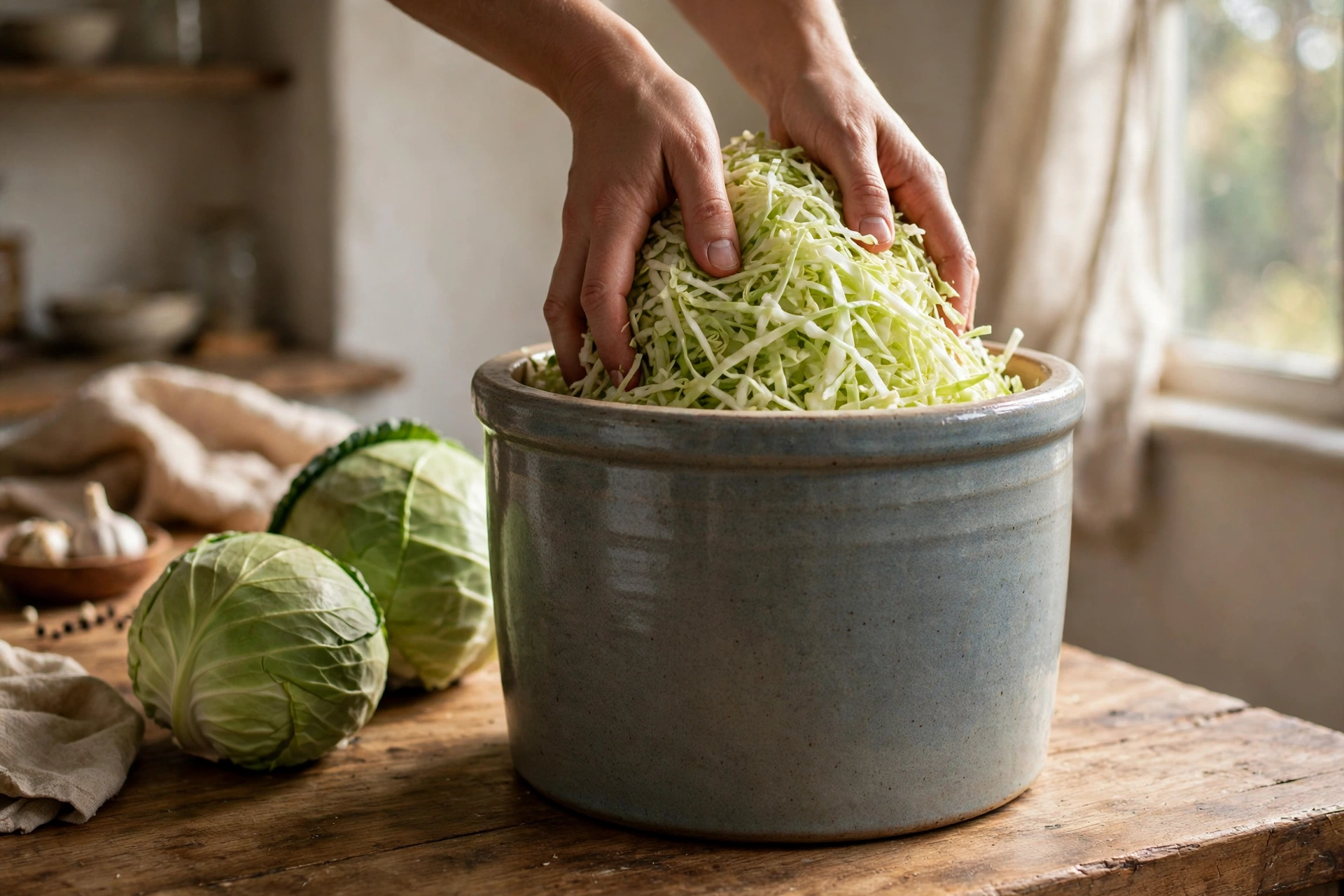
Sauerkraut is the oldest recipe in the Guides program and the simplest: two ingredients, one crock, and a room at the right temperature. It is also the flagship of fermenting — the one ferment the USDA publishes a full tested procedure for, salt ratio and all. That ratio is the whole game. Too little salt and the wrong bacteria win; too much and nothing ferments at all. This guide uses the USDA’s numbers exactly, because with ferments there is no close enough.
If pickling is more your speed, the same USDA guide covers the vinegar route — see our fresh-pack dill pickles. And if you are new to putting food up generally, how to can food in mason jars covers the canning side of the pantry.
What You Need
Firm heads of fresh cabbage — 25 pounds for the full recipe, which yields about 9 quarts — and canning or pickling salt: 3 tablespoons for every 5 pounds of cabbage. Start the kraut between 24 and 48 hours after harvest for the best result, as the USDA directs. For equipment: a crock or food-grade container deep enough that its rim sits at least 4 or 5 inches above the packed cabbage, a plate and weights (or a brine-filled bag) to hold the cabbage under its juice, and a clean bath towel to cover the container.

SOLIGT Glass Fermentation Weights, 4-Pack
Kraut ferments in wide-mouth jars with these glass weights holding every shred under the brine — the job the USDA's plate-and-weights step does in a crock.
$11.99 from Amazon
Mrs. Wages Pickling and Canning Salt
The recipe's ratio — 3 tablespoons per 5 pounds of cabbage — is written for pure canning or pickling salt like this, with nothing added.
$19.32 from Amazon
Granite Ware 21.5-Quart Water Bath Canner
For the kraut that gets canned at the end of the ferment — the water bath canner the processing table assumes.
Check AvailabilityBefore You Start
Temperature is the ingredient nobody lists. The USDA recommends holding the ferment at 70° to 75°F, where it finishes in about 3 to 4 weeks. At 60° to 65°F the same kraut may take 5 to 6 weeks. Below 60°F it may not ferment at all, and above 75°F it may become soft. Pick the room before you shred the first head — a corner that holds a steady low-seventies is worth more than any crock.
How to Make Sauerkraut, Step by Step
- Work in 5-pound batches. Discard the outer leaves of the cabbage. Rinse the heads under cold running water and drain. Cut the heads in quarters and remove the cores.
- Shred. Shred or slice the cabbage thin — the USDA describes the cut as the thickness of a quarter.
- Salt each batch. Add 3 tablespoons of canning or pickling salt to each 5 pounds of shredded cabbage and mix thoroughly with clean hands.
- Pack firmly. Pack each salted batch firmly into the crock until the salt draws juice from the cabbage. Repeat shredding, salting, and packing until all the cabbage is in the container.
- Cover with juice. The cabbage must sit under liquid. If the drawn juice does not cover it, top up with boiled and cooled brine at 1 1/2 tablespoons of salt per quart of water.
- Weight and cover. Set a plate and weights on top — or use a brine-filled bag — and cover the container with a clean bath towel.
- Ferment. Hold at 70° to 75°F for about 3 to 4 weeks. If you used jars as weights, check the kraut 2 to 3 times each week and remove any scum that forms. If you used a brine-filled bag, leave the crock undisturbed until the bubbling stops.
- Finish. Fully fermented kraut keeps tightly covered in the refrigerator for several months, or can it with the procedure below.
The Numbers: Canning Fermented Kraut
Canning is optional — plenty of kraut never leaves the crock. If you can it, headspace is 1/2 inch for both packs: hot pack (kraut and liquid brought slowly to a boil, then filled) or raw pack (kraut filled cold and covered with its juices).
| Pack | Jar size | 0–1,000 ft | 1,001–3,000 ft | 3,001–6,000 ft | Above 6,000 ft |
|---|---|---|---|---|---|
| Hot | Pints | 10 minutes | 15 minutes | 15 minutes | 20 minutes |
| Hot | Quarts | 15 minutes | 20 minutes | 20 minutes | 25 minutes |
| Raw | Pints | 20 minutes | 25 minutes | 30 minutes | 35 minutes |
| Raw | Quarts | 25 minutes | 30 minutes | 35 minutes | 40 minutes |
Once the ferment is finished, the kraut that is not canned gets portioned for cold storage — a sealer for the portions and an airtight bin for the rest:

Morton Canning and Pickling Salt, 4 lb
The wet brine is mixed at 1 to 3 tablespoons of iodine-free salt per quart of water, and this canning and pickling salt is the salt the method specifies for the job.
$2.68 from Amazon
Vittles Vault 35 lb Airtight Container
The airtight bin for finished food in daily rotation — gasket-sealed, so what is stored stays dry.
Check AvailabilityCommon Mistakes
Guessing the salt. Three tablespoons per 5 pounds of cabbage is the tested ratio. Eyeballing it is how batches go soft, slimy, or silent.
Fermenting in a cold room. Below 60°F the USDA says kraut may not ferment. A chilly basement in January is the most common reason a crock “does nothing.”
Letting the cabbage surface. Kraut that rises above its juice meets air, and air grows the wrong things. Keep it weighted and covered, and skim scum on the checking schedule.
Using table salt or old cabbage. The recipe specifies canning or pickling salt and firm, fresh heads started within 24 to 48 hours of harvest. Wilted cabbage makes wilted kraut.
Storage and Shelf Life
Fully fermented kraut keeps tightly covered in the refrigerator for several months. Canned kraut, stored cool and dark with seals intact, holds its best quality for about a year like other home-canned vegetables. Either way, date the container — kraut is forgiving, but it is not immortal.
Viewers also searched for these items.

Ball Regular Mouth Canning Lids, 96 Count
For the jars of kraut that get canned instead of refrigerated.
$36.99 from Amazon
Etekcity Digital Kitchen Scale
Kraut salt is figured by weight, as a share of the cabbage — a kitchen scale is how you hit that ratio instead of guessing by the spoonful.
$9.99 from Amazon
ThermoPro TP49 Hygrometer
A ferment runs at the temperature the room actually holds — a min/max hygrometer beside the crock replaces guessing with the number.
$8.54 from AmazonFrequently Asked Questions
How long does sauerkraut take to ferment?
At the recommended 70° to 75°F, about 3 to 4 weeks. Cooler rooms stretch it — at 60° to 65°F, plan on 5 to 6 weeks.
How much salt goes in a batch?
3 tablespoons of canning or pickling salt per 5 pounds of shredded cabbage. The full 25-pound recipe yields about 9 quarts.
What if the cabbage does not make enough juice?
Top it up with boiled and cooled brine — 1 1/2 tablespoons of salt per quart of water — until the cabbage sits under liquid.
Do I have to can sauerkraut?
No. Fully fermented kraut keeps for several months tightly covered in the refrigerator. Canning is for shelf storage, with the times in the table above.
Procedure, salt ratio, fermentation temperatures, and canning times: USDA Complete Guide to Home Canning, Guide 6, “Sauerkraut,” via the National Center for Home Food Preservation.
Prices shown on this page were last checked November 26, 2026 — prices change; check before you buy.
Talk it over with other readers
The Truly Preserved Community on Facebook is where readers compare notes on food storage, water, and backup power — and where your questions help decide what we research next.