
Truly Preserved is reader-supported. If you buy through a link on this page we may earn a commission at no extra cost to you. Nobody pays for placement or scores.
THE SHORT ANSWER
Dehydrate apples: peel, core, and slice them 1/8 to 1/4 inch thick, pretreat for 10 minutes in an ascorbic acid dip (3 3/4 teaspoons of powdered ascorbic acid in 2 cups of water — or equal parts bottled lemon juice and water), then dry at 140°F for 6 to 12 hours. They are done when a cut piece shows no moist area in the center and the slices feel pliable with no beads of moisture when pressed. Condition the dried apples in a sealed container for 7 to 10 days before long storage. Figures are from extension drying guidance built on the National Center for Home Food Preservation, credited at the bottom.
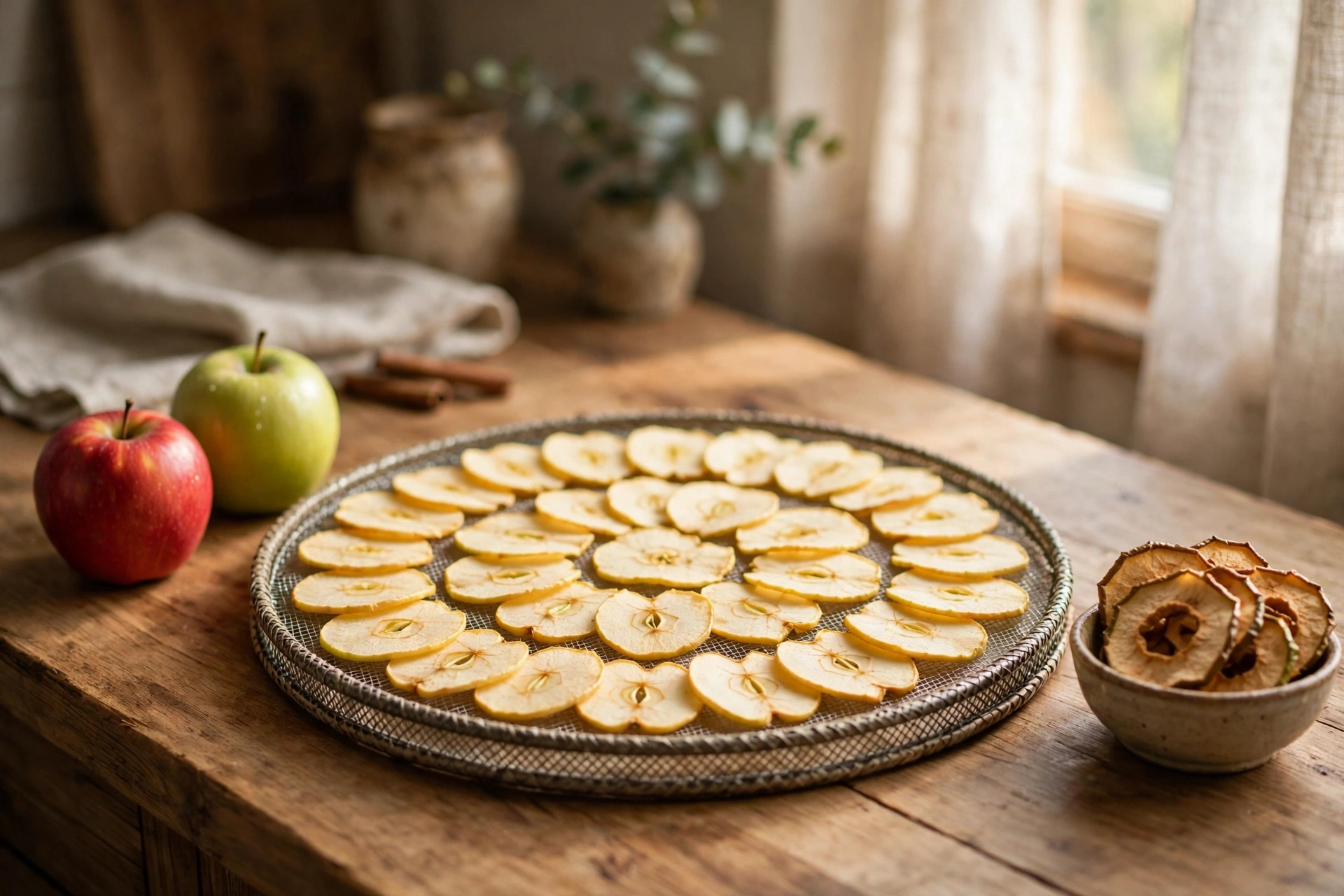
Apples are the first thing most dehydrator owners should dry: cheap in season, forgiving of beginners, and the dried rings disappear faster than any snack in the house. They are also the food that teaches the two habits every other drying project depends on — pretreat so the fruit keeps its color, and test for dryness instead of trusting the clock. The guidance below follows university extension drying publications, which draw on the National Center for Home Food Preservation.
Shopping the machine side first? Our best dehydrator for fruit roundup and the dehydrator comparison cover the models worth owning — and how to dehydrate peppers is the vegetable counterpart to this guide.
What You Need
Firm, ripe apples — the variety matters less than the condition; bruised fruit dries into bruised-tasting rings. For the pretreatment dip: powdered ascorbic acid (or vitamin C tablets) or citric acid, or a bottle of lemon juice. A peeler and corer speed the work considerably when bushels are involved. Then the dehydrator itself, and a sealed glass or plastic container for conditioning the finished apples.

Cosori Food Dehydrator, 6 Trays
Stainless trays and a thermostat that holds the extension-recommended 140°F — the temperature this whole guide is built around.
$135.99 from Amazon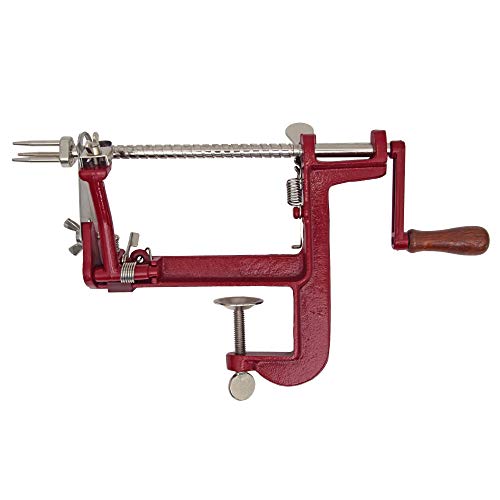
Johnny Apple Peeler
Peels, cores, and slices in one crank — the difference between a bushel processed and a bushel postponed.
$34.99 from Amazon
Nesco Snackmaster Pro Dehydrator
The round-stackable alternative with a long owner record for fruit — expandable as the harvest demands.
$64.39 from AmazonBefore You Start
Pick your pretreatment before the first apple is cut, because sliced apples brown while you decide. Extension gives three honest routes. The ascorbic acid dip: 3 3/4 teaspoons of powdered ascorbic acid — or 20 crushed 500 mg vitamin C tablets — or 1/2 teaspoon of powdered citric acid, dissolved in 2 cups of water, with the cut fruit soaked 10 minutes. The pantry route: equal parts bottled lemon juice and water, same soak. Or steam blanching: apples steam-blanch in 3 to 5 minutes. All three protect color and quality; none is optional if the rings are meant to keep.
How to Dehydrate Apples, Step by Step
- Wash, peel, and core. Wash the apples, peel them, and remove the cores.
- Slice evenly. Cut slices or rings 1/8 to 1/4 inch thick. Even thickness matters more than the exact number — a tray of mixed thicknesses finishes at mixed times.
- Pretreat. Soak the slices 10 minutes in the ascorbic acid dip (3 3/4 teaspoons powdered ascorbic acid in 2 cups water) or in equal parts lemon juice and water. Drain well.
- Load the trays. Arrange slices in a single layer with space between pieces so air can move.
- Dry at 140°F. Extension guidance dries fruit at 140°F — hot enough to force moisture out, not hot enough to cook the food. Expect 6 to 12 hours depending on thickness and moisture.
- Test for dryness. Cut a cooled piece: there should be no moist area in the center. Properly dried apples are pliable, and no beads of moisture form when a piece is pressed between your fingers.
- Condition. Pack the dried apples in a sealed plastic or glass container for 7 to 10 days, shaking it daily so moisture equalizes across pieces. If condensation appears inside, send the batch back to the dehydrator and condition again.
- Store in airtight containers in a cool, dark place.
The Numbers
| Step | The figure |
|---|---|
| Slice thickness | 1/8 to 1/4 inch |
| Ascorbic acid dip | 3 3/4 tsp powdered ascorbic acid in 2 cups water, soak 10 minutes |
| Lemon juice dip | Equal parts bottled lemon juice and water, soak 10 minutes |
| Steam blanch (alternative) | 3 to 5 minutes |
| Drying temperature | 140°F |
| Drying time | 6 to 12 hours |
| Dryness test | No moist area in the center when cut; pliable, no moisture beads when pressed |
| Conditioning | 7 to 10 days, shake daily |
Dried apples keep in whatever airtight container the pantry already runs on — freezer bags for portions, jars with sound lids for the shelf:

Ziploc Freezer Quart Bags
The freezer-bag half of the method — a box of quart bags handles the overflow that does not go into jars.
$26.48 from Amazon
Ball Regular Mouth Canning Lids, 96 Count
Finished dried apples store well in jars — and a jar only seals for storage with a sound lid on it.
$36.99 from AmazonCommon Mistakes
Skipping the pretreatment. Untreated apples dry brown and leathery-flavored. Ten minutes in a dip is the cheapest quality insurance in the whole process.
Mixed slice thickness. Thick slices stay moist in the center while thin ones turn to chips. One moldy thick slice can take a whole jar with it in storage.
Drying hotter to go faster. Extension’s 140°F is deliberate: hotter air hardens the outside of the fruit and traps moisture inside — the failure you discover weeks later, in the storage jar.
Skipping conditioning. The 7 to 10 day conditioning step is how uneven pieces share their moisture evenly. Bagging straight off the tray skips the one check that catches a damp piece.
Storage and Shelf Life
Store conditioned apples in airtight containers somewhere cool and dark, and plan to use them within a year — the storage figure extension gives for home-dried fruit. If condensation ever appears inside a storage container, the batch was not finished; re-dry it or use it soon.
Viewers also searched for these items.


FoodSaver Elite Vacuum Sealer
Conditioned apples keep longest sealed — this is the sealer for the storage step.
$218.56 from Amazon
Sukerle 5-Gallon Mylar Bags, 15-Pack with Oxygen Absorbers
Five-gallon mylar bags with absorbers store a forager-season quantity of dried mushrooms in one sealed unit.
$42.99 from AmazonFrequently Asked Questions
Do I have to peel the apples?
The standard method peels and cores. Peel left on slows drying and toughens in storage; the tested procedures this guide follows start with peeled fruit.
Why did my apple rings turn brown?
Almost always the pretreatment was skipped or cut short. The ascorbic acid or lemon juice dip exists specifically to hold the color.
How do I know they are dry enough?
Cut a piece that has cooled: no moist area in the center. The slice should feel pliable, and pressing it between your fingers should raise no beads of moisture.
What is conditioning, and can I skip it?
Conditioning is 7 to 10 days in a sealed container, shaken daily, so any remaining moisture distributes evenly. Skip it and one damp slice can mold a whole container — extension treats it as part of the process, not a garnish.
Guidance: Purdue Extension / Penn State Extension, “Let’s Preserve: Drying Fruits and Vegetables,” and Virginia Cooperative Extension, “Using Dehydration to Preserve Fruits, Vegetables, and Meats” — extension drying guidance based on the National Center for Home Food Preservation.
Prices shown on this page were last checked November 26, 2026 — prices change; check before you buy.
Talk it over with other readers
The Truly Preserved Community on Facebook is where readers compare notes on food storage, water, and backup power — and where your questions help decide what we research next.