
Truly Preserved is reader-supported. If you buy through a link on this page we may earn a commission at no extra cost to you. Nobody pays for placement or scores.
THE SHORT ANSWER
Pickled beets: cook 7 pounds of 2- to 2-1/2-inch beets until tender, about 25 to 30 minutes, drain and discard that liquid, slip the skins, slice 1/4 inch thick, then simmer 5 minutes in a solution of 4 cups of vinegar (5 percent), 2 cups of sugar, 2 cups of fresh water, and 1-1/2 teaspoons of pickling salt with cinnamon and cloves in a spice bag, pack at 1/2 inch of headspace, and process pints or quarts 30 minutes in a boiling water canner at 0–1,000 feet. The batch makes about 8 pints. Every figure on this page comes from the USDA’s tested recipe, credited at the bottom.
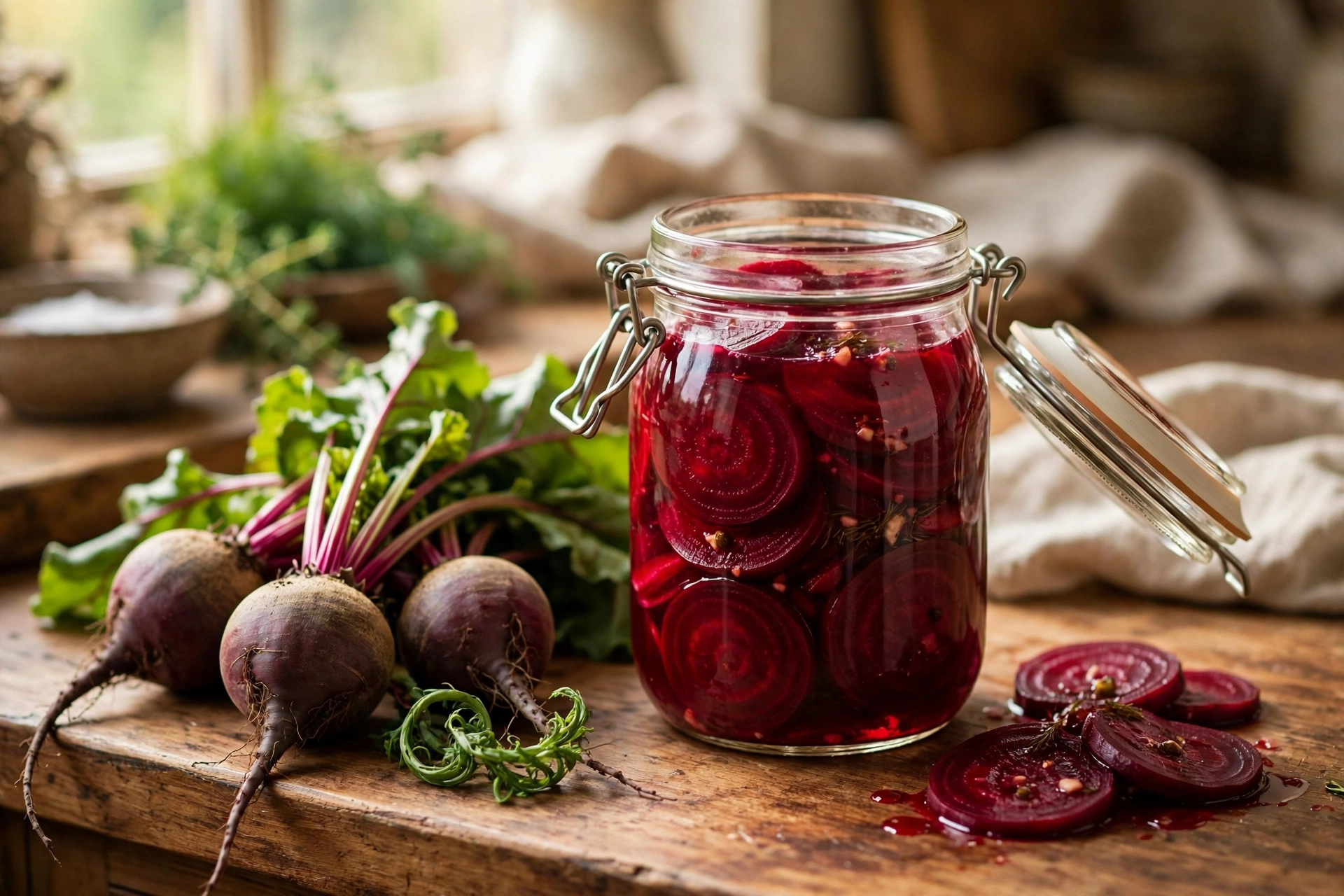
Pickled beets divide people, but the people who love them really love them — earthy, sweet, sharp, and the deepest red on the plate. They are also one of the more forgiving garden pickles: beets hold up in storage, the recipe takes the whole harvest at once at 7 pounds to a batch, and the finished jars dress up salads and holiday tables for months. Plain beets are a low-acid vegetable that belongs in a pressure canner; it is this vinegar solution that brings them into water-bath territory.
This guide is part of our preservation guides, and it follows the tested procedure exactly — its quantities, its headspace, and its minutes — rather than a family version adjusted by feel. If you are new to the canner itself, how to can food in mason jars walks the general water-bath process start to finish, and our flagship dill pickle guide covers the cucumber side of the same method.
What You Need
The USDA recipe, as written: 7 pounds of beets, 2- to 2-1/2 inches in diameter; 4 cups of vinegar (5 percent); 1-1/2 teaspoons of canning or pickling salt; 2 cups of sugar; 2 cups of water; 2 cinnamon sticks; 12 whole cloves; and 4 to 6 onions of the same 2- to 2-1/2-inch size, if desired. The yield is about 8 pints.

Granite Ware 21.5-Quart Water Bath Canner
A boiling-water canner is the processing method every tested pickle procedure on this page uses, and this 21.5-quart model holds a full batch of jars at a rolling boil.
Check Availability
Ball Half-Pint Mason Jars, 12-Pack
Half-pint jars portion pickled beets for small households — one jar is a salad's worth, opened fresh each time.
Check Availability
Ball Regular Mouth Canning Lids, 96 Count
New lids are what the procedure assumes when it says to adjust lids and process; a fresh flat on every jar is how the seal the storage section depends on actually forms.
$36.99 from AmazonBefore You Start
The step people most want to skip is the one the source prints in bold: after the beets cook, drain and discard the cooking liquid, and build the pickling solution with fresh water. Beet cooking water carried into the solution dilutes the vinegar the recipe is balanced on. Sort the beets by size before cooking so similar sizes cook together and finish tender at the same time, and leave 1 inch of stem and the roots on during cooking to prevent bleeding of color.
How to Make Pickled Beets, Step by Step
- Trim and wash. Trim off the beet tops, leaving 1 inch of stem and the roots to prevent bleeding of color. Wash thoroughly and sort for size.
- Cook the beets. Cover similar sizes together with boiling water and cook until tender, about 25 to 30 minutes. Drain and discard the liquid.
- Peel and slice. Cool the beets, trim off the roots and stems, slip off the skins, and slice into 1/4-inch slices. Peel and thinly slice the onions if you are using them.
- Make the solution. Combine the vinegar, salt, sugar, and fresh water. Put the cinnamon sticks and cloves in a cheesecloth bag, add the bag to the mixture, and bring it to a boil.
- Simmer together. Add the beets and onions and simmer 5 minutes, then remove the spice bag.
- Fill the jars. Fill jars with the beets and onions, leaving 1/2-inch headspace, then add the hot vinegar solution, allowing 1/2-inch headspace.
- Process in a boiling water canner for the time for your altitude in the table below.
- Rest and check. Let the jars cool undisturbed, check every seal, and label the jars before shelving.
The Numbers: Processing Times
| Jar size | 0–1,000 ft | 1,001–3,000 ft | 3,001–6,000 ft | Above 6,000 ft |
|---|---|---|---|---|
| Pints or quarts | 30 minutes | 35 minutes | 40 minutes | 45 minutes |
Headspace is 1/2 inch and the pack is hot. This is one of the pickle recipes whose source table splits the middle altitudes into two bands, so read across to your own elevation rather than borrowing a neighboring recipe’s table.
Beets that do not go into jars freeze and dehydrate well for winter cooking, and these are the two tools that side of the job runs on.

ThermoPro TP03H Thermometer
Refrigerator storage is the whole safety method for these eggs, and a thermometer is how you know the fridge holding them is actually cold rather than assumed cold.
$8.99 from Amazon
Ziploc Freezer Quart Bags
Quart freezer bags are the simple backup for blanched overflow vegetables and opened-jar leftovers that need to move to the freezer quickly.
$26.48 from AmazonCommon Mistakes
Keeping the cooking liquid. The source is explicit: drain and discard it. Building the solution on beet water dilutes the vinegar and throws off the tested balance.
Cooking mixed sizes together. A 2-inch beet and a much larger one do not finish together. Sort for size, as the recipe directs, or half the batch is undercooked when the other half is tender.
Leaving the spice bag in. The cinnamon and cloves simmer in a cheesecloth bag and come out after 5 minutes with the beets. Left in a jar, the spices keep intensifying past the tested flavor.
Slicing thick and uneven. The recipe slices 1/4 inch. Thick slabs heat and acidify unevenly compared with the slices the process was tested on.
Trimming the tops flush before cooking. That 1 inch of stem and the roots stay on through cooking to keep the color in the beet instead of in the pot.
Storage and Shelf Life
Store sealed jars somewhere cool and dark, with the bands removed, and label each jar with the date. Home-canned pickles hold their best quality for about a year; rotate the shelf so the oldest jars get eaten first. A jar that fails to seal goes in the refrigerator and gets eaten first. Once a jar is opened, keep it refrigerated.
Viewers also searched for these items.

Morton Canning and Pickling Salt, 4 lb
The recipe calls for canning or pickling salt by name; this is that salt, without the additives in table salt that cloud pickle brine.
$2.68 from Amazon
Etekcity Digital Kitchen Scale
The batch is built on weighed produce, and a kitchen scale is how you know you actually have the pounds of vegetables the tested ratio was written for.
$9.99 from Amazon
Mrs. Wages Pickling and Canning Salt
A second bag of pickling salt on the shelf means the next batch is not delayed or improvised with table salt when the first bag runs out.
$19.32 from AmazonFrequently Asked Questions
Can I pickle whole baby beets?
Yes — the source gives that variation: use beets 1- to 1-1/2 inches in diameter, follow the same directions, pack them whole, and do not slice. Onions may be omitted.
Why do I have to throw away the cooking water?
Because the recipe builds its solution with 2 cups of fresh water at a tested ratio to the vinegar. The cooking liquid would dilute that ratio, and the source directs you to drain and discard it.
Are the onions required?
No. The 4 to 6 onions are listed as ‘if desired.’ The beets, vinegar, salt, sugar, water, and spices are the recipe.
Why are my beets pale?
Usually the tops were trimmed flush before cooking. Leaving 1 inch of stem and the roots on during cooking is the recipe’s step for preventing bleeding of color.
Recipe and processing times: USDA Complete Guide to Home Canning, Guide 6, “Pickled Beets,” via the National Center for Home Food Preservation.
Prices shown on this page were last checked November 26, 2026 — prices change; check before you buy.
Talk it over with other readers
The Truly Preserved Community on Facebook is where readers compare notes on food storage, water, and backup power — and where your questions help decide what we research next.