
Truly Preserved is reader-supported. If you buy through a link on this page we may earn a commission at no extra cost to you. Nobody pays for placement or scores.
THE SHORT ANSWER
Purée ripe fruit, spread it about 1/8 inch thick on a lined tray, and dry it at 140°F. Two cups of fruit make one 13 x 15 inch leather. The National Center for Home Food Preservation gives about 6 to 8 hours in a dehydrator, and the test is simple: touch the center — no indentation should be evident. Every figure on this page comes from the credited source at the bottom.
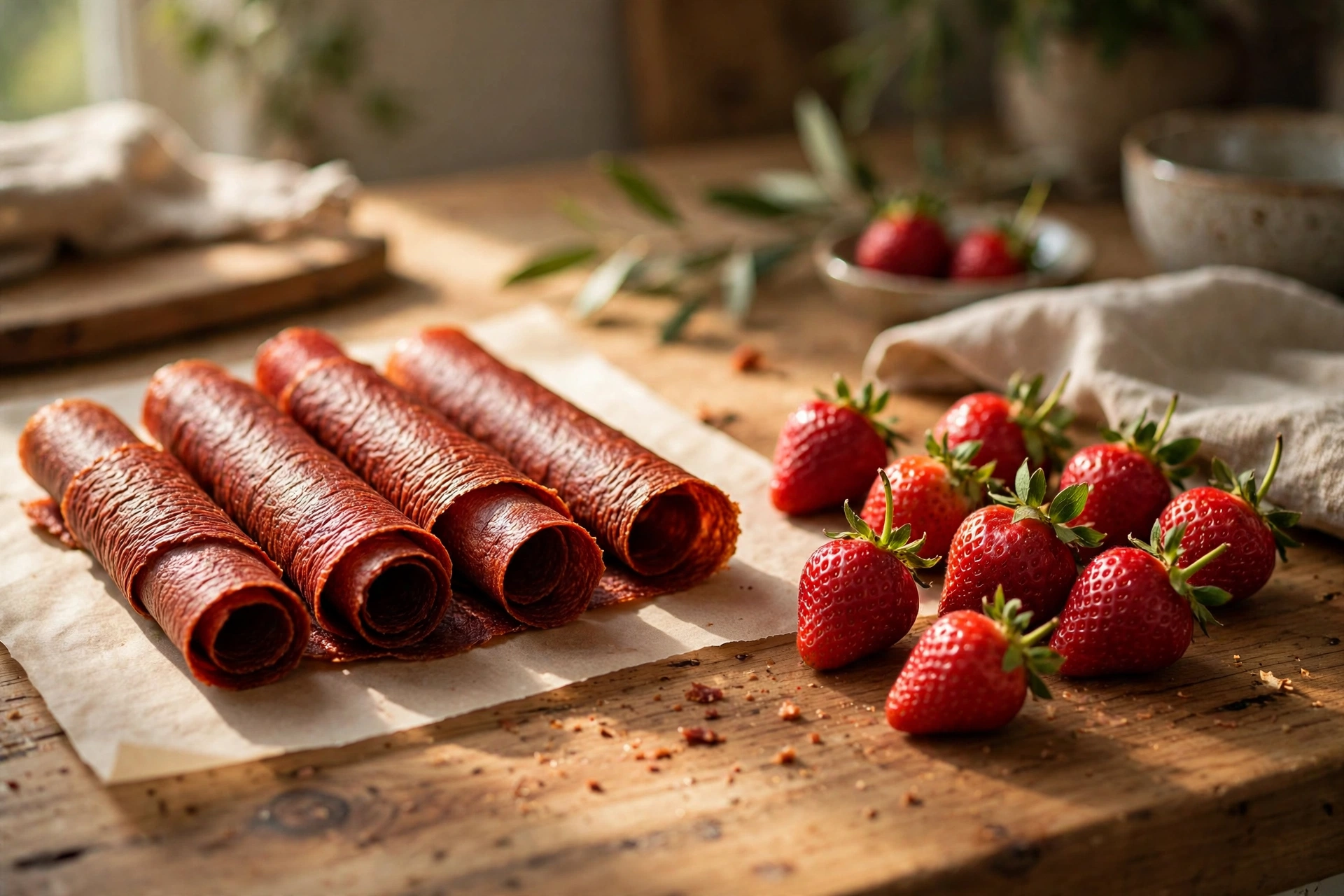
Fruit leather is the homemade version of the fruit roll: puréed fruit, spread thin, dried until it peels off the tray in a shiny, chewy sheet that rolls up for lunchboxes, hiking packs and the glove box. Making it at home means the fruit is the ingredient — ripe or slightly overripe fruit, sweetened only if you want it sweetened, and mixed flavors are fair game. The National Center for Home Food Preservation also points out that leftover fruit pulp from making jelly can be blended and made into rolls instead of thrown away.
This guide follows the National Center’s fruit leather directions exactly, and it is the dehydrator companion to can you make fruit leather without a dehydrator, which covers the oven route. This guide is part of our preservation guides; for whole fruit instead of purée, how to dehydrate apples is the place to start, and best dehydrator for beginners covers choosing the machine.
What You Need
Fresh, frozen or drained canned fruit all work. The amounts are fixed by the tray: 2 cups of fruit make a 13 x 15 inch fruit leather, and one pint of canned or frozen fruit makes one leather of the same size. For light-colored fruit, add 2 teaspoons of lemon juice or 1/8 teaspoon (375 mg) of ascorbic acid for every 2 cups of fruit to prevent darkening. Sweetening is optional: 1/4 to 1/2 cup of corn syrup, honey or sugar for each 2 cups of fruit. You also need a dehydrator with fruit-roll sheets or trays you can line with plastic wrap, and plastic wrap for rolling and storing the finished leather.
Think about the tray before the fruit. A leather is only as even as the surface it dries on, and the purée should reach the edges of the lined sheet without touching the rim of the pan, because a pour that touches the edge dries into the liner and tears on peeling. Smaller individual leathers are worth considering for a first batch: the source notes the larger leathers take longer to dry, and small rounds are easier to test, peel and portion. Applesauce deserves a mention in the shopping list too — it can be dried alone as a leather, or added to any fresh fruit purée as an extender, where it decreases tartness and makes the finished leather smoother and more pliable, which is exactly what a tart berry purée usually needs.

Cosori Food Dehydrator, 6 Stainless Trays
Fruit-roll sheets on a six-tray dehydrator turn two cups of purée into a full leather without tying up the oven for a day.
$135.99 from Amazon
ThermoPro Instant-Read Thermometer
Checking the air at the tray confirms the dehydrator is holding the 140°F this method specifies, not drifting hotter.
$8.99 from Amazon
Etekcity Digital Kitchen Scale
Weighing fruit into exact two-cup batches keeps every leather the same thickness and drying time as the last.
$9.99 from AmazonBefore You Start
Keep the leather to fruit. The National Center does not recommend milk, milk products and eggs for home drying because of the high risk of food poisoning, and home dehydrators cannot duplicate the commercial process — so yogurt, custard and egg-based purées are not leather ingredients in this method, whatever a video online suggests. Use ripe or slightly overripe fruit, wash fresh fruit in cool water, and remove peel, seeds and stem before puréeing. And line the tray properly: plastic wrap or a purpose-made sheet, smoothed out — the source says plainly not to use waxed paper or aluminum foil.
One more preparation note from the same directions: the fruit does not have to be a single kind. Mixed flavors are one of the stated advantages of making leather at home, and tart fruit blended with a sweeter one — or stretched with applesauce — often dries into a better leather than either fruit alone. What does not change in any blend is the arithmetic: the lemon juice or ascorbic acid dose, the optional sweetener range and the spread thickness are all measured per 2 cups of purée, whatever mixture of fruit made up those two cups.
How to Make Fruit Leather, Step by Step
- Prepare the fruit. Select ripe or slightly overripe fruit. Wash it in cool water, remove peel, seeds and stem, and cut it into chunks. For canned or frozen fruit, drain it and save the liquid.
- Purée it smooth. Purée until smooth — 2 cups of fruit for each 13 x 15 inch leather. If a canned or frozen purée is too thick, add reserved liquid until it reaches a pourable consistency.
- Protect the color. For every 2 cups of light-colored fruit, stir in 2 teaspoons of lemon juice or 1/8 teaspoon (375 mg) of ascorbic acid to prevent darkening.
- Sweeten only if you want to. Optional: add 1/4 to 1/2 cup of corn syrup, honey or sugar for each 2 cups of fruit. For longer storage, corn syrup or honey is best because it prevents crystals.
- Spread it thin. Pour the purée onto the lined tray and spread it evenly, about 1/8 inch thick, keeping it away from the edge of the sheet. Leather can be one large sheet or several smaller ones.
- Dry at 140°F. Dry fruit leathers at 140°F. Approximate times are 6 to 8 hours in a dehydrator, up to 18 hours in an oven, and 1 to 2 days in the sun. The leather dries from the outside edge toward the center.
- Test, peel and roll. Touch the center of the leather; no indentation should be evident. While it is still warm, peel it from the plastic, roll it, let it cool, and rewrap the roll in plastic.
The Numbers: Temperature, Time and the No-Indentation Test
The temperature never changes in this method — only the clock does, and the clock is an estimate. The touch test at the center decides.
| Food | Preparation | Drying temperature | Drying time | Done when |
|---|---|---|---|---|
| Fruit leather | Purée spread about 1/8 inch thick on a lined 13 x 15 inch tray | 140°F | 6 to 8 hours in a dehydrator; up to 18 hours in an oven; 1 to 2 days in the sun | No indentation when the center is touched |
Times are ranges and the dryness test decides. The larger leathers take longer than smaller ones, and the center is the last place to dry — an edge that feels finished proves nothing about the middle.
Not every soft fruit needs to become leather. Whole slices dry beautifully on their own — bananas and strawberries especially — and the trays and sheets below serve both jobs, purée today and slices tomorrow.

Nesco Snackmaster Pro Dehydrator
A second, smaller dehydrator is the practical way to run whole banana and strawberry slices alongside a leather batch.
$64.39 from Amazon
Excalibur 9-Tray Dehydrator
Nine trays give slice-drying room for a full fruit glut while the leather occupies its own sheets.
Check AvailabilityCommon Mistakes
Spreading the purée too thick. About 1/8 inch is the thickness in the directions. A thick pour dries at the edges while the center stays wet, and the batch drags on for hours past the estimate.
Judging by the edges. Leather dries from the outside edge toward the center. Testing the edge is testing the driest spot on the tray; the directions say to touch the center.
Adding dairy or egg to the purée. Milk, milk products and eggs are not recommended for home drying — the source ties that to a high risk of food poisoning. Leather is a fruit product; keep it one.
Lining the tray with waxed paper or foil. The directions say not to use waxed paper or aluminum foil. Use plastic wrap smoothed flat, or a sheet made for fruit leather.
Peeling it cold. Peel the leather from the plastic while it is still warm, roll it, and let it cool in the roll. A cold leather fights the liner and tears.
Storage and Shelf Life
Roll the finished leather and wrap it in plastic. The National Center gives fruit leather up to 1 month at room temperature, and for storage up to 1 year, place tightly wrapped rolls in the freezer. Store the rolls in a cool, dark, dry place. Fillings change the rule: a leather spread with a filling after drying — the source lists options such as softened cream cheese, jam or peanut butter — gets stored in the refrigerator.
In use, leather is the simplest dried food there is: unroll, tear or cut a piece, and eat it as it is. Cookie cutters turn a sheet into shapes children will actually trade for, and a leather spread with a filling after drying — jam, preserves or peanut butter among the source’s suggestions — becomes a rolled snack that lives in the refrigerator. For trips, the freezer-stored rolls thaw in a pack with no fuss and no crumbs, which is most of why fruit leather has outlasted every other lunchbox fashion.
Viewers also searched for these items.

Ziploc Freezer Quart Bags
Finished leather rolls keep well portioned in quart freezer bags for the up-to-a-year freezer storage the method allows.
$26.48 from Amazon
FoodSaver Elite Vacuum Sealer
Vacuum sealing portioned leather rolls keeps air off the surface for longer freezer storage.
$218.56 from AmazonFrequently Asked Questions
Can I make fruit leather without a dehydrator?
Yes — the same directions cover the oven, at up to 18 hours, and our companion guide to making fruit leather without a dehydrator walks through that route.
How much fruit do I need?
Two cups of fresh fruit make one 13 x 15 inch leather. For canned or frozen fruit, use 1 pint for each leather of that size.
Does fruit leather need sugar?
No. Sweetening is optional — 1/4 to 1/2 cup of corn syrup, honey or sugar per 2 cups of fruit if you want it. Leathers made without sugar are the source’s suggested choice for a diabetic adult or child, using the amount of fruit allowed for the fruit exchange.
Can I add spices?
Yes, sparingly. The source suggests starting with 1/8 teaspoon of a spice for each 2 cups of purée, and 1/8 to 1/4 teaspoon for flavorings such as vanilla or citrus peel.
Procedure, temperature, times and dryness test: National Center for Home Food Preservation, “Fruit Leathers,” via the National Center for Home Food Preservation.
Prices shown on this page were last checked November 26, 2026 — prices change; check before you buy.
Talk it over with other readers
The Truly Preserved Community on Facebook is where readers compare notes on food storage, water, and backup power — and where your questions help decide what we research next.