
Truly Preserved is reader-supported. If you buy through a link on this page we may earn a commission at no extra cost to you. Nobody pays for placement or scores.
THE SHORT ANSWER
Onions and garlic dry without any blanching. Slice onions 1/8 to 1/4 inch thick and dry them 3 to 9 hours; peel and finely chop garlic and dry it 6 to 8 hours — both at 140°F, both until brittle, per Clemson University’s HGIC drying guide, which also gives the general vegetable test: dried until brittle or crisp, at about 10 percent moisture. Grind the brittle pieces afterward for powder. Times are ranges, and the brittle test decides. Every figure on this page comes from the credited sources at the bottom.
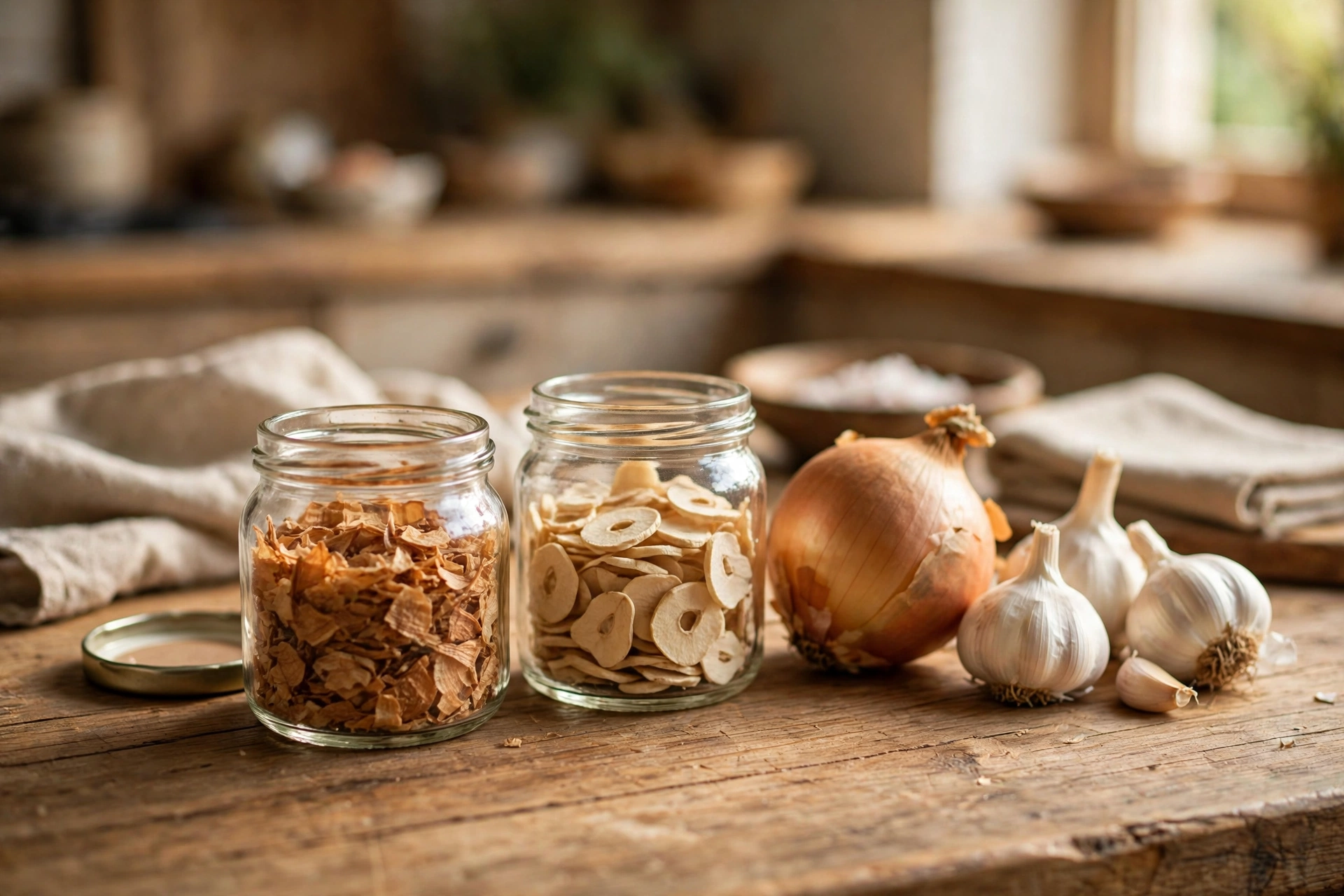
Dried onions and garlic are the seasonings a household actually runs out of — and the two easiest vegetables in the dehydrator, because neither one is blanched. A sack of onions on sale becomes jars of flakes and powder that season a year of cooking, and garlic that would sprout in the pantry drawer instead becomes garlic powder you made yourself. Clemson Extension even keeps the equivalents handy: one fresh onion equals 1 1/2 tablespoons of onion powder, or 1/4 cup of dried minced onions.
This guide follows Clemson University’s HGIC drying vegetables guide for the preparation and times, with Colorado State University Extension for the 140°F drying temperature and storage. This guide is part of our preservation guides; for the sweeter end of the dehydrator, see how to dehydrate apples. One honest warning from Clemson before you start: it is best not to dry strong-smelling foods like onions or garlic inside the home, because the odors linger — put the dehydrator on a carport, covered porch or covered patio.
What You Need
For onions: wash them, remove the outer paper shells, remove the tops and root ends, and slice 1/8 to 1/4 inch thick. For garlic: peel the bulbs and finely chop the cloves — no other pretreatment is needed, and the odor is pungent, in the source’s own understatement. Neither vegetable is blanched. Colorado State’s yield table gives the scale for onions: 12 pounds of fresh onions dry to 1 1/2 pounds, or 4 1/2 pints. You need a dehydrator that holds 140°F, a place to run it outside the living space, and a food mill, food processor or blender for the powder step.
Set up the work station where the batch will run. Slicing a sack of onions at the kitchen counter and then carrying loaded trays out to a porch dehydrator is a spill waiting to happen; peel, trim and slice near the machine, with the trays beside the board, and load each tray as it fills. Uniformity is the quality control that matters most in this batch — pieces of even thickness dry at the same rate, and a tray of mixed thick and thin onion slices finishes with half of it scorched and half of it still bendy. Garlic asks for the opposite patience: finely chopped cloves are small pieces that dry fast and can blow around in a fan-driven machine, so spread them evenly and check the garlic tray earlier and more often than the onion trays beside it.

Cosori Food Dehydrator, 6 Stainless Trays
A six-tray dehydrator on the porch runs the full onion and garlic batch at 140°F while the smell stays outside where it belongs.
$135.99 from Amazon
ThermoPro Instant-Read Thermometer
A thermometer confirms the outdoor setup is still holding 140°F, since porch air runs cooler than kitchen air.
$8.99 from Amazon
Etekcity Digital Kitchen Scale
Weighing a 12-pound onion sack against its dried yield keeps expectations honest — about 1 1/2 pounds come back.
$9.99 from AmazonBefore You Start
Location is the safety-and-sanity point here. Clemson advises against drying onions or garlic in the home — the odors may linger in drapes, clothes and furniture — and says to keep the dehydrator on a carport, covered porch or covered patio, away from rain. Also, do not dry strong-smelling food with other food, because the flavors will blend; an onion batch flavoring a tray of apples helps nobody. Keep pieces uniform in size so they dry at the same rate, and prepare only as many vegetables as can be dried at one time.
Keep the two vegetables on separate trays even though they share a run. Their clocks differ — the garlic’s 6 to 8 hours against the onion’s 3 to 9 — and their pieces differ more: chopped garlic is small and finishes fast, while a thick onion slice can lag. Separate trays mean each comes out when its own pieces pass the brittle test, and neither waits, drying past its best, for the other. Label the trays if your machine’s order gets shuffled during rotation; onion and garlic look more alike dried than fresh, right up until someone seasons the wrong dish.
How to Dehydrate Onions and Garlic, Step by Step
- Prepare the onions. Wash the onions, remove the outer paper shells, cut off the tops and root ends, and slice them 1/8 to 1/4 inch thick.
- Prepare the garlic. Peel the garlic bulbs and finely chop the cloves. No other pretreatment is needed for either vegetable, and neither is blanched.
- Set up outside the living space. Place the dehydrator on a carport, covered porch or covered patio, protected from rain, and keep this batch separate from any other food.
- Load in a single layer. Arrange the onion slices and chopped garlic in single layers on the trays, pieces not piled, so air moves freely.
- Dry at 140°F. Dry the onions for 3 to 9 hours and the garlic for 6 to 8 hours, per the Clemson table. Watch closely near the end — vegetables dry much more quickly at the end and can scorch.
- Test for brittle. Cool a few pieces. Vegetables are dried until they are brittle or crisp, at about 10 percent moisture — pieces should snap, not bend.
- Grind for powder. Once fully dry and brittle, grind the pieces into powder with a food mill, food processor or blender — Clemson lists powders as the fine form of flakes, made exactly this way — and pack the powder immediately.
The Numbers: Temperature, Time and the Brittle Test
Two vegetables, one temperature, one test — but different clocks, because chopped garlic and sliced onion hold water differently.
| Food | Preparation | Drying temperature | Drying time | Done when |
|---|---|---|---|---|
| Onions | Wash; remove outer paper shells, tops and root ends; slice 1/8 to 1/4 inch thick; no blanching | 140°F | 3 to 9 hours | Brittle or crisp (about 10 percent moisture) |
| Garlic | Peel and finely chop garlic bulbs; no other pretreatment; no blanching | 140°F | 6 to 8 hours | Brittle or crisp (about 10 percent moisture) |
Times are ranges and the dryness test decides. Clemson’s general rule for vegetables governs both rows: dried until brittle or crisp, when only about 10 percent moisture remains — and because they are so dry, vegetables do not need conditioning like fruits.
Not every onion has to be dried. The overflow freezes well for cooking, vacuum-sealed or bagged, and dried onion and garlic also sit one step from the spice shelf — these are the tools for the freezing and storage side of the same harvest.

FoodSaver Elite Vacuum Sealer
Onions chopped for the freezer keep their cooking value vacuum-sealed, ready to go straight into a hot pan.
$218.56 from Amazon
Ziploc Freezer Quart Bags
Quart freezer bags portion frozen onions and the garlic that gets frozen in paste form instead of dried.
$26.48 from AmazonCommon Mistakes
Running the batch in the kitchen anyway. Clemson says it plainly: the odors of onions and garlic linger in drapes, clothes and furniture. Move the machine to a covered outdoor spot before the first tray, not after the house smells.
Drying onions alongside other food. Strong-smelling food flavors whatever dries with it. An onion and garlic run is a solo run.
Grinding before the pieces are fully brittle. Powder made from bendy pieces is powder with moisture in it, and it clumps and molds in the jar. The brittle test comes first; the grinder comes second.
Leaving finished pieces sitting out. Clemson directs that dried foods be packaged immediately and properly — dried onions and garlic reabsorb moisture from the air quickly, and garlic powder waits for no one.
Uneven slices. Pieces that vary in thickness dry at different rates. Uniform 1/8 to 1/4 inch onion slices finish together; a mixed tray finishes in arguments.
Storage and Shelf Life
Cool the pieces completely, then pack immediately into clean, dry, insect-proof containers as tightly as possible without crushing — glass jars with tightly fitted lids are Clemson’s first choice. Store in a cool, dry, dark area. Clemson gives recommended storage times for dried foods of four months to one year, and notes vegetables keep about half as long as fruits — generally six months at 60°F or three months at 80°F — so onion and garlic powders earn their keep fastest in a cool spot. Check stored dried food frequently: glass jars make moisture visible, food that has reabsorbed moisture but is not spoiled should be used immediately or redried and repackaged, and moldy food is discarded.
On the shelf, the two forms divide the work. Flakes and minced pieces go into soups, stews and casseroles where they rehydrate in the cooking liquid; powders go anywhere a seasoning goes — rubs, sauces, eggs, roasted vegetables — measured with Clemson’s equivalents when a recipe calls for a fresh onion. Keep the powder jars small and refill them from the flake jars as needed, because powder opened daily stales faster than pieces stored sealed. And label everything with the date: a seasoning you cannot date is a seasoning you will eventually throw out on suspicion.
Viewers also searched for these items.

Sukerle 5-Gallon Mylar Bags with Absorbers
Five-gallon mylar bags with absorbers store a bulk onion harvest sealed until it is jarred for cooking.
$42.99 from Amazon
Nesco Snackmaster Pro Dehydrator
A compact dehydrator is the porch-friendly size for a household's first garlic powder batch.
$64.39 from AmazonFrequently Asked Questions
Do onions or garlic need blanching?
No. Clemson’s table lists no blanching for either — onions need no pretreatment beyond slicing, and garlic is peeled and finely chopped with no other pretreatment needed.
How do I make garlic powder from dried garlic?
Dry the finely chopped garlic 6 to 8 hours until brittle, then grind it. Clemson describes powders as finer than flakes, made with a food mill, food processor or blender, and lists onion among the most common powders.
How much dried onion equals a fresh one?
By Clemson’s equivalents table: 1 onion equals 1 1/2 tablespoons of onion powder or 1/4 cup of dried minced onions.
Why does the whole house smell?
Because the batch ran indoors. Clemson advises drying onions and garlic on a carport, covered porch or covered patio instead, and never with other food.
Preparation, times, dryness standard and powder method: Clemson University HGIC, “Drying Vegetables,” via Clemson University Home & Garden Information Center; temperature and yield: Colorado State University Extension, “Drying Vegetables.”
Prices shown on this page were last checked November 26, 2026 — prices change; check before you buy.
Talk it over with other readers
The Truly Preserved Community on Facebook is where readers compare notes on food storage, water, and backup power — and where your questions help decide what we research next.