
Truly Preserved is reader-supported. If you buy through a link on this page we may earn a commission at no extra cost to you. Nobody pays for placement or scores.
THE SHORT ANSWER
A 55-gallon drum is filled the same careful way the CDC describes for any home-filled container: wash it, sanitize it with a solution of 1 teaspoon of unscented liquid household chlorine bleach in 1 quart (4 cups) of water, wait at least 30 seconds, let it air-dry, then fill it with clean water and cover it with a tight lid. Label it “drinking water” with the storage date, keep it at 50°F –70°F away from direct sunlight and away from gasoline or pesticides, and replace the water every six months. Every figure on this page comes from the CDC guidance credited at the bottom.
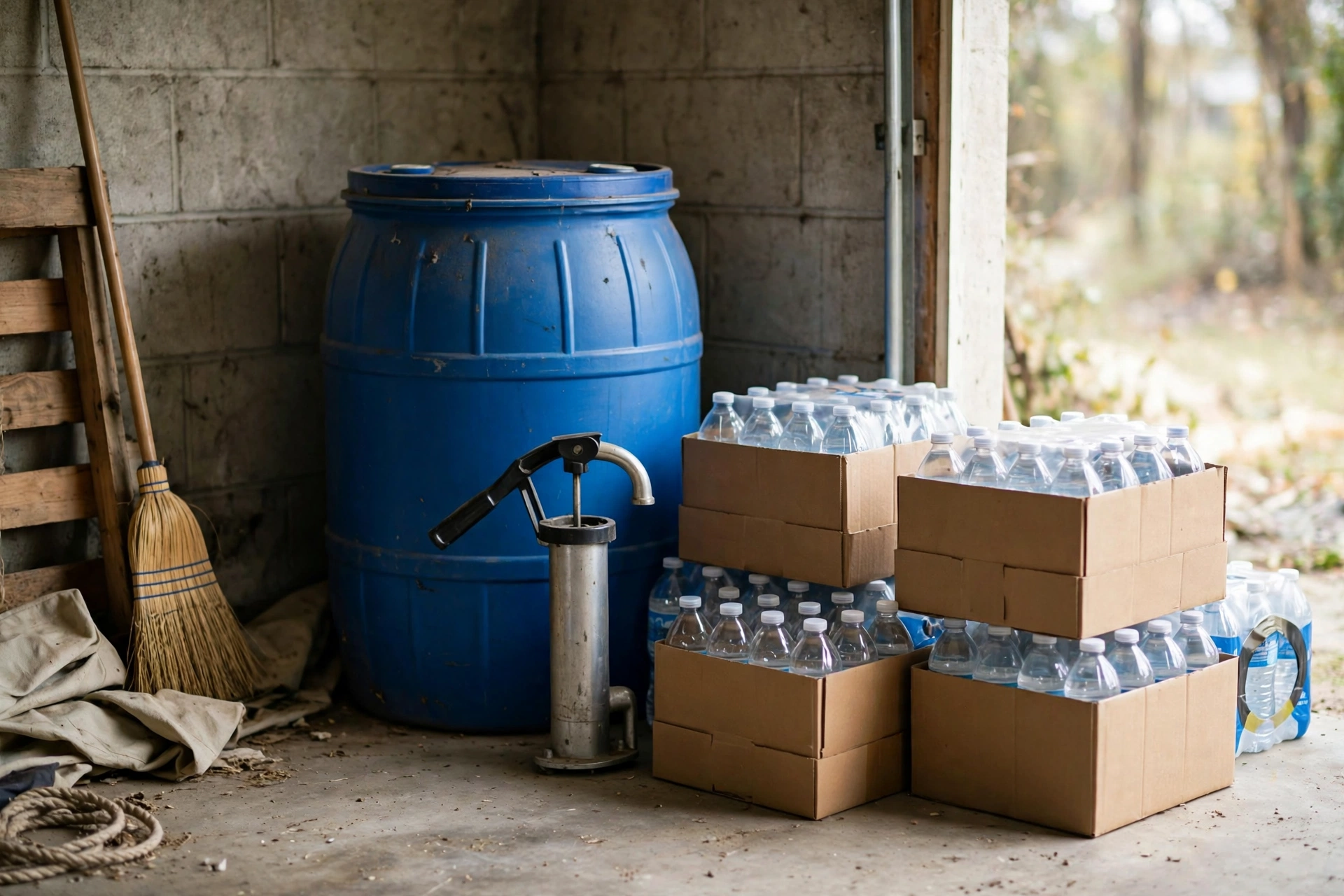
A drum is the point where emergency water stops being a few jugs in a closet and becomes a real household supply. One filled drum holds enough water to matter for days, it sits in one footprint in a garage or basement corner, and it does not need to be carried anywhere once it is full. It is also the container most likely to be filled carelessly — a drum that was never sanitized, or that once held something other than food, can undo the whole point of storing the water.
This guide follows the CDC’s container procedure exactly and applies it at drum scale: its sanitizing ratio, its waiting time, its temperature range, and its six-month replacement interval. This guide is part of our preservation guides, and it pairs with how to purify water in an emergency for the day the stored supply runs out and water has to be made safe again.
What You Need
The CDC’s baseline is at least 1 gallon of water per person, per day for 3 days, and it says to try to store a 2-week supply if possible. A 55-gallon drum is one container toward that total, not a separate rule. The container itself matters as much as the water: the CDC says it is best to use FDA-approved food-grade water storage containers, and never to use a container that previously held liquid or solid toxic chemicals, such as bleach or pesticides. You also need unscented liquid household chlorine bleach for the sanitizing solution — the CDC says the label should say it contains between 5% and 9% of sodium hypochlorite.

Augason Farms 55-Gallon Water Storage Kit
A 55-gallon water storage kit sized to this exact job, so the drum, treatment and fittings arrive as one matched system.
Check Availability
DURATECH Drum Wrench
The bung wrench that opens and seals a standard 55-gallon drum, needed at the first fill and at every six-month replacement.
$18.99 from Amazon
TeraPump Drum Pump
A drum pump draws water out in measured amounts without tipping the drum or dipping hands or cups into the stored water.
$39.99 from AmazonBefore You Start
Three limits come before the first gallon goes in. First, the drum’s history: if it held toxic chemicals, it is out, no matter how well it rinses — the CDC’s rule is do not use it. Second, the fill spot is the storage spot: a full drum is far too heavy to move safely, so choose the cool, shaded place first. Third, the water going in should be clean water from a supply you trust; this procedure stores clean water, it does not make doubtful water safe — that is a separate job, covered in our guide to purifying water in an emergency.
How to Store Water in a 55-Gallon Drum, Step by Step
- Choose a food-grade drum. Use an FDA-approved food-grade water storage container where you can. If you cannot confirm a drum is food-grade, the CDC’s fallback tests are a top that can be closed tightly and durable, unbreakable material — and a container that held toxic chemicals fails outright.
- Wash the drum. Wash the storage container with soap and rinse completely with water, inside and out, including the lid and the bung openings.
- Sanitize it. Mix the sanitizing solution — 1 teaspoon of unscented liquid household chlorine bleach in 1 quart (4 cups) of water, using bleach that contains 5%–9% sodium hypochlorite. Pour it in, cover the container tightly, and roll and shake the drum so the solution touches all inside surfaces.
- Wait, then dry. Wait at least 30 seconds, pour the sanitizing solution out, and let the empty container air-dry before use.
- Fill it where it will sit. Set the drum in its storage place first, then pour clean water into the sanitized container and cover it with a tight lid.
- Label it. Label the container as “drinking water” and include the storage date, so the six-month replacement is a date you can read, not a guess.
- Store it cool and separated. Keep the drum at 50°F –70°F, away from direct sunlight, and away from toxic substances such as gasoline or pesticides.
The Numbers: Sanitizing, Temperature, and Replacement
The CDC prints one sanitizing recipe for every container size, one temperature range, and one replacement interval. The drum changes the scale of the job, not the figures.
| Item | CDC figure |
|---|---|
| Sanitizing solution | 1 teaspoon unscented liquid household chlorine bleach in 1 quart (4 cups) of water |
| Bleach strength for sanitizing | 5%–9% sodium hypochlorite |
| Contact time before pouring out | Wait at least 30 seconds |
| Storage temperature | 50°F –70°F |
| Replacement interval, home-filled water | Replace every six months |
| Planning amount | At least 1 gallon per person, per day for 3 days; try to store a 2-week supply if possible |
The CDC does not print a separate, larger sanitizing dose for a 55-gallon drum, so this page does not invent one: the printed recipe is the solution you make, and the instruction is that it must touch all inside surfaces of the container.
A drum you cannot open or draw from cleanly is only half a system. A bung wrench and a drum pump are the two tools that turn a sealed drum into water you can actually use day to day in an emergency.

Reliance Aqua-Tainer, 7 Gallon
A 7-gallon rigid container covers the days the drum is being emptied, sanitized and refilled at rotation, so the household is never without stored water.
Check Availability
Saratoga Farms 5-Gallon Water Containers
Stackable 5-gallon containers hold the overflow planning amount when one drum does not reach the household's two-week total.
$318.79 from AmazonA drum also changes how a household uses stored water day to day. A jug supply gets carried, poured, and dipped into; a drum supply should be drawn, not dipped. The CDC’s handling rules were written for containers generally and they bite hardest at drum scale: use a clean scoop or other device each time you remove water, do not touch the water or the insides of the container with your hands, and do not scoop water out with your hands. A pump or a spigot keeps every draw on the right side of those rules, and it keeps the lid on and the cover tight between draws, which is where a drum’s protection actually lives. It also keeps the count honest. A drum that is drawn from casually, a cup here and a kettle there, is a supply nobody can size anymore — and sizing is the point of the planning figure, at least 1 gallon per person per day, that decided whether one drum was enough in the first place. Treat the drum as a reservoir with a tap, not a well with a bucket, and it will still be the clean, dated, measurable supply you filled when the day comes that you need to count on it.
Common Mistakes
Filling a drum from a drum kit that was never food-grade. A bargain used drum is the classic false economy. The CDC’s exclusion is absolute: containers that held toxic chemicals do not get rinsed into service.
Sanitizing with scented or splash-less bleach. The CDC’s recipe specifies unscented liquid household chlorine bleach at 5%–9% sodium hypochlorite. A scented or additive product is a different chemical mix and is not what the recipe was written for.
Skipping the label. An unlabeled drum has no replacement date, and the six-month rule cannot be followed from memory. The CDC’s instruction is to label the container “drinking water” and include the storage date.
Storing the drum beside the gasoline cans. The CDC says to keep containers away from toxic substances such as gasoline or pesticides, and away from direct sunlight. The garage corner next to the fuel shelf fails both tests.
Dipping a cup or hands into the drum. The CDC’s rules for taking water out are plain: use a clean scoop or device each time, and do not touch the water or the insides of the container with your hands.
Storage and Shelf Life
Store the filled drum at 50°F –70°F, out of direct sunlight, and away from gasoline, pesticides, and other toxic substances. Replace the water every six months — that is the CDC’s interval for water you filled into containers yourself. When you draw water out, use a clean device each time and keep hands out of the water and off the inside surfaces, so the last gallon is stored under the same conditions as the first.
Frequently Asked Questions
Does the water in a drum need bleach added before storage?
The CDC procedure printed here uses bleach in the sanitizing solution for the empty container, then fills the sanitized container with clean water and covers it with a tight lid. This page does not add a storage dose the CDC does not print for this procedure.
How long does drum water keep?
The CDC says to replace water you filled into containers every six months, and to observe the expiration date on store-bought water instead. The drum follows the home-filled rule: six months.
Can I use a drum that held syrup or juice?
The CDC’s test is about toxic chemicals: never use a container that previously held liquid or solid toxic chemicals. A food drum is a different case from a chemical drum, but when you cannot confirm a container is food-grade, the CDC advises contacting the manufacturer.
Where should the drum sit?
In a place that stays at 50°F –70°F, away from direct sunlight and away from toxic substances such as gasoline or pesticides — and, practically, in the exact spot it will occupy when full, because a filled drum is not a container you carry.
Procedure and storage figures: CDC, “How to Create an Emergency Water Supply”, via Centers for Disease Control and Prevention.
Prices shown on this page were last checked November 26, 2026 — prices change; check before you buy.
Talk it over with other readers
The Truly Preserved Community on Facebook is where readers compare notes on food storage, water, and backup power — and where your questions help decide what we research next.