
Affiliate Disclosure: Truly Preserved is reader-supported. When you buy through links on this page, we may earn a commission at no extra cost to you. As an Amazon Associate, Truly Preserved earns from qualifying purchases. Learn more.
How we researched this comparison. We scored 4 Harvest Right sizes head to head for this page. The work behind the scores: manufacturer specifications and certification records where they apply, prices checked when this review was written, and patterns across verified owner feedback — a praise or complaint point only counts here when it shows up again and again, not once. The products were chosen to cover the main designs and price points a buyer in this category actually cross-shops. We are a research desk: we do not buy or hands-on test the products, and commissions never change a score. How we research and score →
Every Harvest Right size runs the same freeze-drying cycle. What changes is how much food fits on the trays, what the tray space costs you, and — for the two big machines — what kind of outlet has to be waiting in the wall. This comparison is built from Harvest Right’s own published specs and store prices, checked October 26, 2026, plus aggregated owner feedback from retailer listings and owner forums. We don’t own these machines; we did the homework, and where Harvest Right’s own pages disagree with each other, we say so instead of picking the answer that reads cleaner.
The short answer for most households: the Medium, at $2,395 direct from Harvest Right, is the size owners recommend most and the one whose tray space costs a fair $3.48 per square inch. The Large earns its extra $600 only if a garden or a hunting season regularly hands you more than 15 pounds of fresh food at once. The X-Large is a small-business machine wearing a home machine’s clothes.
The Short Version
Harvest Right Medium
Harvest Right Large
Harvest Right X-Large
Harvest Right Small
How we chose: Sizes are judged on tray area and what it costs, batch and yearly capacity from Harvest Right’s own figures, the electrical requirement as the maker currently states it, and what owners report after the first season. Prices are Harvest Right’s own store prices in black, checked October 26, 2026; stainless costs more (Small $2,395, Medium $2,795, Large $3,395). Read our full methodology.
Head-to-Head Specs
| Size | Price | Tray area | Best for |
|---|---|---|---|
| Harvest Right Small Read the review ↓ |
$1,895 | 434 sq in | 1–2 people, small batches |
| Harvest Right Medium Read the review ↓ |
$2,395 | 688 sq in | Most families and gardens |
| Harvest Right Large Read the review ↓ |
$2,995 | 1,107 sq in | Big gardens, hunting season |
| Harvest Right X-Large Read the review ↓ |
$4,995 | 2,251 sq in | Homesteads, small sellers |
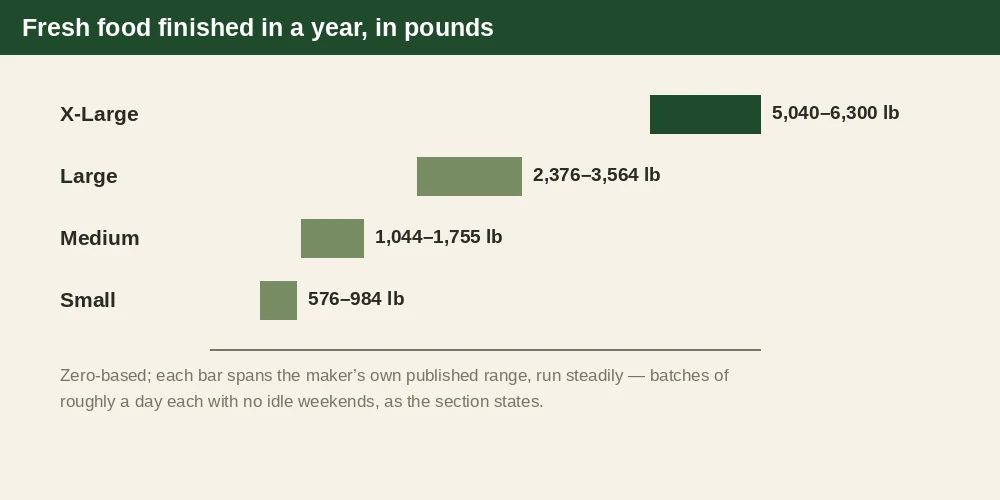
Tray area is our math from the maker’s tray sizes: Small runs 4 trays at 7.75 × 14 inches, Medium 5 trays at 7.75 × 17.75, Large 6 trays at 9 × 20.5, and X-Large 7 trays at 10.9 × 29.5. That one number explains most of the price ladder — you are mostly buying stainless tray, by the square inch. For how these machines compare with other brands, see our home freeze dryer comparison; for the wider picture, the Preserve the Harvest hub collects every drying and sealing guide we publish.
Harvest Right Small — Our Score: 7/10
The Small is the right machine for a household that freeze-dries in ones and twos — leftovers, a flat of strawberries, eggs when the hens are laying faster than anyone can eat them — and the wrong machine for a garden that ripens all at once.
Harvest Right rates it at 6 to 10 pounds of fresh food per batch and 576 to 984 pounds a year if you run it steadily. It weighs about 61 pounds, plugs into a standard 110-volt outlet (the maker’s current FAQ asks for a dedicated 15-amp circuit), and at $1,895 in black it is the cheapest way into the lineup. It is also, square inch for square inch, the most expensive: $4.37 per square inch of tray, nearly double the X-Large’s rate. Owners who praise it tend to be couples and small households. Owners who outgrow it say the same thing — the batch ends up being the limit, not the appetite — and a used Small is a common sight precisely because its first owner traded up.
Pros
- Lowest entry price in the lineup at $1,895, standard outlet, lightest machine at about 61 lb.
- Same cycle, same Premier oil pump, and same 25-year food-storage claim as its bigger siblings.
- Fits where a Large simply will not — the footprint is closer to a big microwave than a dishwasher.
Cons
- Priciest tray space of the four: $4.37 per square inch.
- 6–10 lb batches mean a real tomato harvest takes several runs, each the better part of a day.
- The most commonly outgrown size in owner reports — budget for the Medium if a garden is in your future.
Buy it if there are one or two of you and freeze drying is a weekly habit, not a harvest event. Skip it if you grow food — the Medium costs $500 more and holds about 60% more per batch.
Check the current price at Harvest Right →
Harvest Right Medium — Our Score: 9/10
The Medium is the size we’d buy, and the size long-term owners in forum after forum tell new buyers to start with: big enough for a real garden weekend, small enough to run on a normal outlet in a normal room.
The maker rates it at 10 to 15 pounds fresh per batch and 1,044 to 1,755 pounds a year. Five trays give you 688 square inches at $3.48 per square inch — a full dollar cheaper per inch than the Small, for a machine that costs only $500 more. It draws an average of 9 to 11 amps on a standard 110-volt outlet by the maker’s current FAQ, which puts its own running-cost estimate at $1.25 to $2.80 a day. The catch owners repeat most is weight: about 107 pounds before the pump, so pick its home before it arrives, because you will not be casually moving it to make room for Thanksgiving.
Pros
- The value step in the lineup: 60% more tray than the Small for $500 more.
- Standard outlet, no electrician, no special plug.
- The deepest owner community of any size — settings, fixes, and recipes are easiest to find for the Medium.
Cons
- About 107 lb — a two-person lift, and it wants a permanent home.
- A bumper garden still means back-to-back batches at 10–15 lb each.
- The included pump is an oil pump: oil changes every 20–30 batches, or a $1,495 oil-free upgrade ordered by phone.
Buy it if you are a family that cooks, gardens moderately, or buys meat in bulk. Skip it if your harvest regularly tops 15 pounds at a picking — that is the Large’s whole reason to exist.
Check the current price at Harvest Right →
Harvest Right Large — Our Score: 8/10
The Large is where the math turns in the buyer’s favor and the logistics turn against them: $2.71 per square inch and 18 to 27 pounds per batch, wrapped around an electrical requirement that Harvest Right’s own pages do not state consistently.
Six trays at 9 × 20.5 inches give 1,107 square inches, and the maker rates yearly output at 2,376 to 3,564 pounds — roughly double the Medium for $600 more. If your September looks like bushels, that is the cheapest capacity Harvest Right sells short of the X-Large. Now the honest caveat, because it decides real purchases: the maker’s current FAQ says the Large runs on a 110-volt NEMA 5-15 outlet on a dedicated 15-amp circuit, while dealer spec sheets for the same machine say NEMA 5-20 on a dedicated 20-amp circuit, and at least one Large owner reports hiring an electrician to install a dedicated 20-amp line. Those cannot all be the final word. Confirm the plug and circuit for the exact unit you are ordering with Harvest Right before you buy — and before you pay an electrician either way.
Pros
- Best capacity jump per dollar in the middle of the lineup: about double the Medium’s yearly pounds for $600 more.
- Tray space drops to $2.71 per square inch.
- One batch swallows a hunting season or a harvest weekend that would take the Medium two or three runs.
Cons
- Electrical requirement is genuinely unsettled between the maker’s FAQ and dealer spec sheets — verify before ordering.
- About 138 lb, and a bigger footprint: roughly 22.5 inches wide and 31.4 tall.
- Under-filled trays waste the advantage; a Large run at half load costs Large money for Medium output.
Buy it if you garden seriously, hunt, or split a machine with family nearby. Skip it if your batches would usually be under 15 pounds — you would be paying for empty tray.
Check the current price at Harvest Right →
Harvest Right X-Large — Our Score: 8/10
The X-Large is not really a bigger kitchen appliance; at 257 pounds, 40 to 50 pounds of fresh food per batch, and a dedicated 20-amp NEMA 5-20 circuit that every source agrees on, it is light commercial equipment, and it should be bought that way.
Seven trays at 10.9 × 29.5 inches total 2,251 square inches — more than the Small and Medium combined — at $2.22 per square inch, the cheapest tray space Harvest Right sells. The maker rates it at 5,040 to 6,300 pounds a year. For a homestead putting up a winter’s food, or a small seller freeze-drying candy and produce for market, that throughput is the whole argument, and owners in that position praise exactly that. Owners who bought it for a household report the other side: a machine that dominates the room it lands in, delivery and placement that take planning and help, and batches so large that filling the trays becomes its own chore.
Pros
- Cheapest tray space in the lineup at $2.22 per square inch, and 40–50 lb batches.
- Yearly capacity of 5,040–6,300 lb — several households’ worth, or a small business.
- Same 3-year limited warranty and Premier pump family as the rest of the Pro line.
Cons
- $4,995 in stainless only, 257 lb, and a dedicated 20-amp NEMA 5-20 circuit is required — no ambiguity on this one.
- The maker’s own running-cost estimate is about $4 a day, the highest of the four.
- Far more machine than a household batch needs; half-empty runs erase the per-inch savings.
Buy it if freeze drying is a production job — a big homestead, a shared family machine, or food you sell. Skip it if you are a household, however enthusiastic; the Large will do your work for $2,000 less.
Check the current price at Harvest Right →
How much tray space do you actually get for the money?
Tray space is the fairest way to price these four machines, because the cycle, the pump family, and the finished food are the same across the line — what the extra money buys is stainless area. The X-Large wins this measure outright at $2.22 per square inch, and the Small loses it at $4.37, nearly double.
Price per square inch of tray space
Harvest Right store price in black divided by total tray area, October 26, 2026. Lower is better.
Read that chart with one warning attached: cheap tray space you cannot fill is not cheap. A household that loads 8 pounds at a time pays the Small’s rate in practice whichever machine it owns, because the empty trays in a bigger machine still took a day to run. The per-inch ladder rewards the buyer whose food actually arrives by the bushel.
How much food does each size finish in a year?
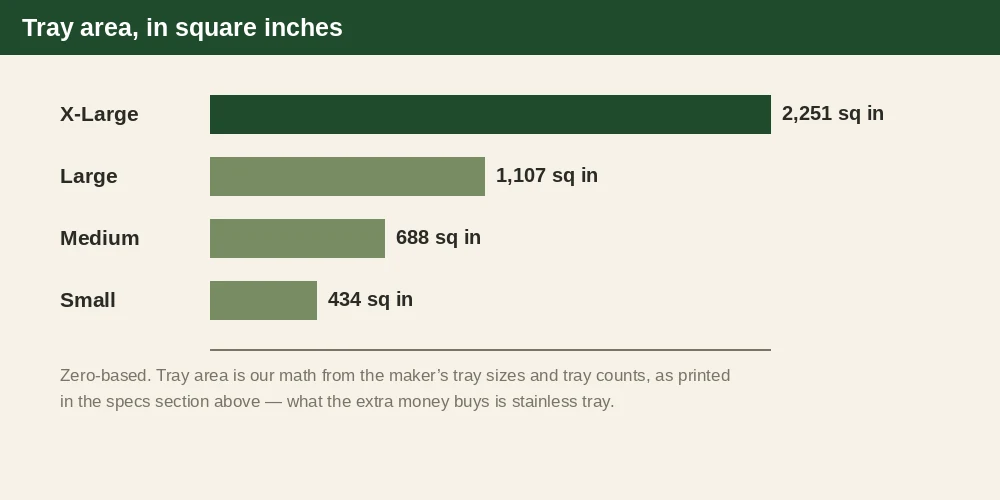
Yearly capacity is where the sizes separate hardest. By Harvest Right’s own figures, the Small finishes 576 to 984 pounds a year, the Medium 1,044 to 1,755, the Large 2,376 to 3,564, and the X-Large 5,040 to 6,300.
Those are run-it-steadily numbers, and they assume batches of roughly a day each with no idle weekends. A family putting up a garden, a deer or two, and bulk-buy meat will land near the bottom of its size’s range and still feel well served. The practical question is not the yearly ceiling; it is the single batch. Food waits for nobody in harvest season — a batch limit of 10 pounds against 40 pounds of ripe tomatoes means four days of runs on a Small or Medium, and one run on a Large. If that week is your year, size for that week. If it never happens, do not pay for it.
Will it plug into a normal outlet?
The Small and Medium plug into a standard 110-volt outlet, and Harvest Right’s current FAQ asks for a dedicated 15-amp circuit for both — a circuit with nothing else big drawing on it while a batch runs. The X-Large, every source agrees, needs a 110-volt NEMA 5-20 outlet on a dedicated 20-amp circuit.
The Large is the disputed middle, and we are not going to pretend otherwise: the maker’s current FAQ lists it as NEMA 5-15 on a dedicated 15-amp circuit, dealer spec sheets list NEMA 5-20 on a dedicated 20-amp circuit, and owners have been told both. If you are buying a Large, get the plug and circuit for your exact unit confirmed by Harvest Right in writing before it ships. An electrician’s visit runs real money either way, and finding out after delivery is the one outcome owners in this category complain about most bitterly. However you wire it, keep the machine off an extension cord — dealer guidance and warranty exclusions both point that way.
What does each size cost to run and keep?
Electricity is the small bill. Harvest Right’s own estimates put the Small and Medium at $1.25 to $2.80 a day while running, the Large at $2.00 to $3.00, and the X-Large at about $4.00. A household running two batches a week might spend the price of a pizza a month on power — noticeable, not decisive.
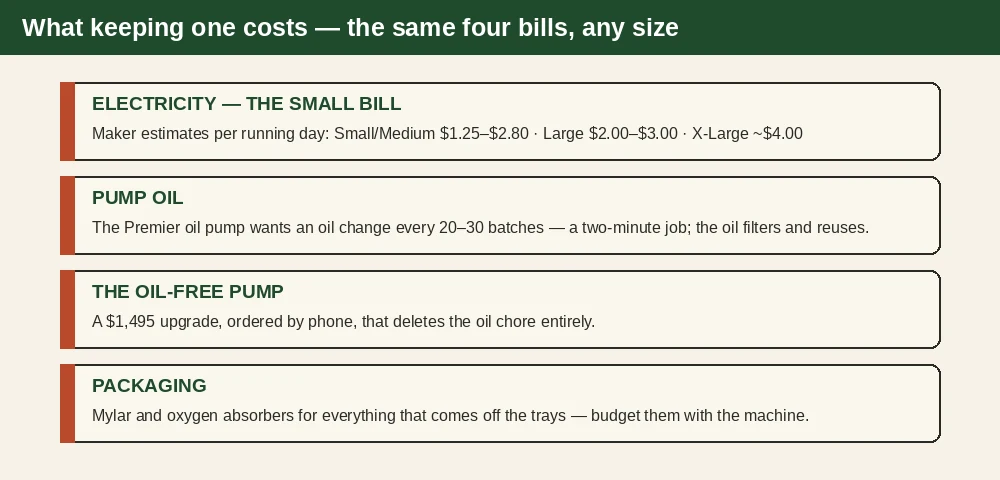
The keeping costs are the pump and the packaging. Every Pro size ships with a Premier oil pump: the oil gets filtered and reused, and the maker puts oil changes at every 20 to 30 batches, a two-minute job. The oil-free pump removes that chore for a $1,495 upgrade, ordered by phone — owners who run their machines constantly tend to call it worth it, and owners who run weekly tend to call it a lot of money to skip a two-minute task. Either way, budget the mylar and oxygen absorbers for what comes off the trays; our mylar bag buyer’s guide prices that side of the shelf. And if a freeze dryer is more machine than your food needs, a good dehydrator costs a tenth as much and still puts up a garden — drier food, shorter life, far smaller bill.
Honest caveats before you spend this much
Three things belong on the table. First, the electrical disagreement on the Large, covered above, is the maker’s own inconsistency, not a reviewer invention — verify your unit. Second, Harvest Right’s headline that freeze-dried food lasts up to 25 years is a storage claim about properly dried, properly sealed food kept cool and dark, not a promise attached to any single batch; your sealing and storage do half that work. Third, every size here is a serious appliance with a serious noise and heat output in a closed room — owners consistently advise a utility room, garage, or basement over a kitchen corner, and the 3-year limited warranty is the maker’s, counted from a sale, not from your first successful batch.
Frequently Asked Questions
Should I get the Harvest Right Small or Medium?
For most households, the Medium. It holds 10–15 lb per batch against the Small’s 6–10 lb, its tray space costs $3.48 per square inch against $4.37, and the difference is $500. Buy the Small only if one or two people, small batches, and a tight space describe you exactly.
Do I need a special outlet for the Large or X-Large?
The X-Large, yes: a NEMA 5-20 outlet on a dedicated 20-amp circuit, agreed by every source. The Large is disputed — the maker’s current FAQ says a standard NEMA 5-15 plug on a dedicated 15-amp circuit, dealer spec sheets say NEMA 5-20 and 20 amps. Confirm your exact unit with Harvest Right before it ships.
How long does one batch take?
Plan on the better part of a day and often longer — a full cycle of freezing, vacuum, and drying commonly runs 20 to 40 hours depending on the food’s water content, and wet foods sit at the long end. That cycle time, not the tray count, is why back-to-back harvest batches back up.
Is the oil-free pump worth $1,495?
It depends on how often you run the machine. The included Premier oil pump needs an oil change every 20–30 batches and the oil can be filtered and reused; heavy users value skipping that entirely, while weekly users are paying a lot to avoid a two-minute job. Size first, pump second is the order owners recommend.
What does it cost to run a Harvest Right for a day?
By the maker’s own estimates: $1.25–$2.80 a day for the Small and Medium, $2.00–$3.00 for the Large, and about $4.00 for the X-Large, at average power draws of roughly 990–1,210 watts (Small/Medium), about 1,500 watts (Large), and about 1,700 watts (X-Large).
Which size should a family of four buy?
The Medium, unless the family gardens at scale. Its 10–15 lb batches cover bulk meat buys, leftovers, and a normal garden’s weekly picking. Families freezing a whole harvest at once, or processing game, are the Large’s natural buyers.
Sources & freshness: Harvest Right’s own store and FAQ/spec pages (harvestright.com), dealer spec sheets, and aggregated owner feedback from retailer listings and owner forums, all consulted October 26, 2026. Tray areas and per-inch prices are our math from the maker’s published tray sizes and store prices. Prices last checked: October 26, 2026. Last updated: October 30, 2026.
Once you know your size, the running costs are their own question — we priced them in what freeze-drying actually costs per pound: electricity, pump oil, mylar and the machine itself, per fresh pound in and per dried pound out.
Talk it over with other readers. The Truly Preserved Community on Facebook is where readers compare notes on food storage, water, and backup power — and where your questions help decide what we research next. Join the group →