
Affiliate Disclosure: Truly Preserved is reader-supported. When you buy through links on this page, we may earn a commission at no extra cost to you. As an Amazon Associate, Truly Preserved earns from qualifying purchases. Learn more.
What does freeze-drying actually cost per pound? Run the full math on the machine most households buy — the Harvest Right Medium at $2,395 — and a steady owner lands at about $1.00 per pound of fresh food processed: roughly 38 cents of machine, 29 cents of electricity, and the rest in pump oil and mylar. Count the dried food that comes out instead of the fresh food that went in, and the same batch costs about $4.00 per dried pound, because most of the weight you paid to process was water that is now in the drain bucket. This study is built from published specs and prices, a metered owner’s electricity record, the EIA’s current average electricity price, and our own earlier datasets — the machine comparison in our home freeze dryer comparison and the commercial prices in what a serving really costs. We don’t own these machines; we did the homework, and every assumption below is printed next to its number so you can swap in your own. The rest of our freeze-drying homework lives on the Preserve the Harvest hub.
The Short Version
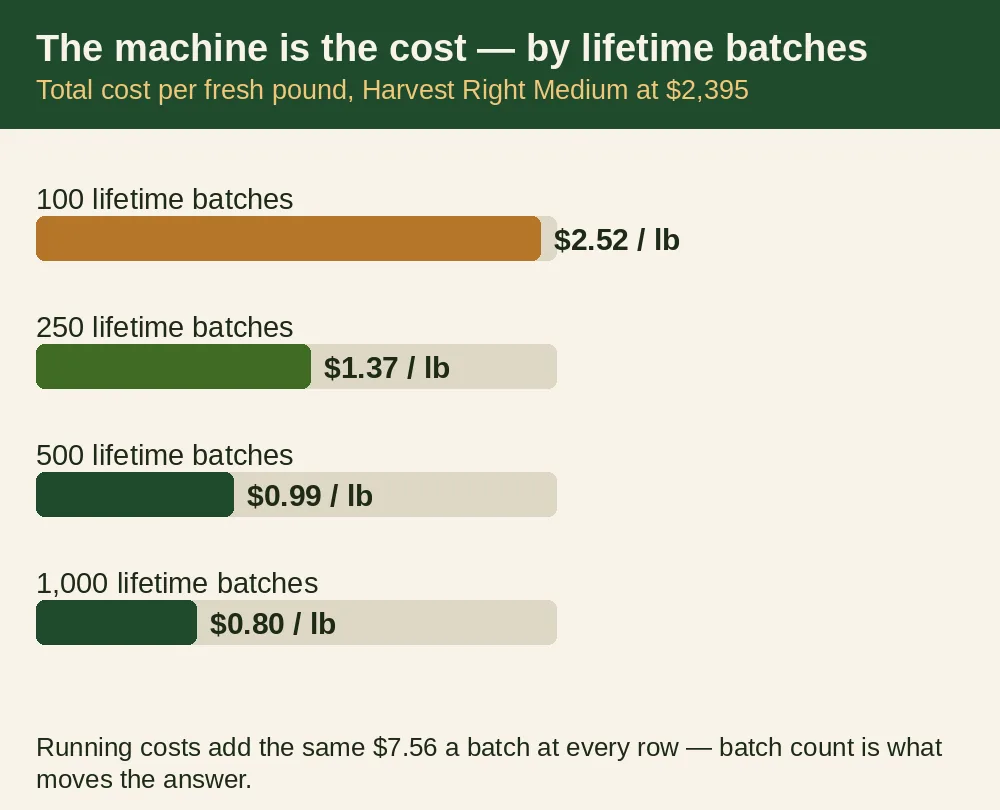
The headline: at steady use (500 lifetime batches), processing a pound of fresh food in a Harvest Right Medium costs about $1.00 before you pay for the food itself. Run the machine only 100 times in its life and the same pound costs about $2.52 — the machine is the cost, not the electricity.
The comparison: ready-made freeze-dried meals from our October 2026 dataset run $16.70 to $19.92 per 1,000 calories. A dense home batch — ground beef is the worked example below — comes out near $7.50 per 1,000 calories including the food at $5 a pound fresh.
The trap: per-pound quotes differ by 4x depending on whether they count fresh pounds in or dried pounds out. Both numbers on this page are labeled, every time.
How we chose: the model machine is the Harvest Right Medium because it is the consensus pick in our comparison research (our score: 9/10) and the size long-term owners name first. Electricity uses a metered owner’s figure of about 20 kWh per batch; the electricity price is the EIA’s August 2026 national average residential rate of 18.16 cents per kWh. Packaging uses the Wallaby 1-gallon bag price verified in our mylar guide ($21.99 for 30, absorbers included). Machine life is modeled at 100, 250, 500, and 1,000 batches because nobody knows a given machine’s real lifespan — the table shows all four instead of picking the flattering one. Read our full methodology.
What does one batch actually cost to run?
One Harvest Right Medium batch costs about $7.56 to run, before the machine itself and before the food. Electricity is the biggest piece: a long-term owner who metered several runs with a Kill A Watt meter (Backpacking Light’s year-long ownership report) landed at about 20 kWh per run, and owner reports generally put a batch between 15 and 30 kWh depending on the food’s water and the room’s temperature. At the EIA’s August 2026 average residential rate of 18.16 cents per kWh, 20 kWh is $3.63. Harvest Right’s own published figure — roughly $1.25 to $2.80 in electricity per batch — was written against cheaper power; at 2026 rates the metered math says $3.63, and both numbers are on this page so you can see why they disagree.
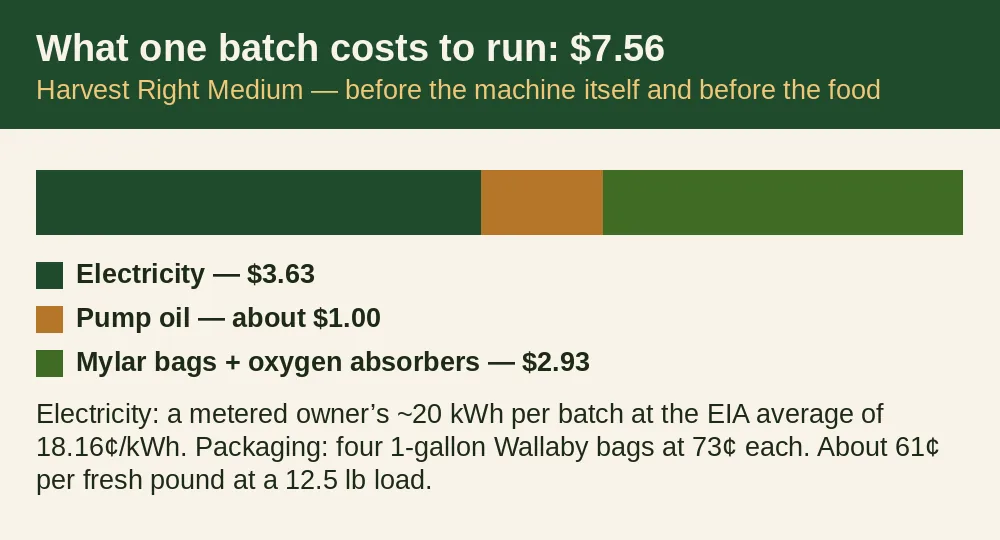
Pump oil adds about $1 a batch: the Premier pump’s oil is filtered and reused, changed every 20 to 30 batches, and owners put the amortized cost at roughly a dollar a run. Packaging adds $2.93: a Medium batch of 10 to 15 pounds of fresh food fills about four 1-gallon mylar bags, and our mylar bags guide verified Wallaby’s 1-gallon 30-pack at $21.99 — 73 cents a bag, oxygen absorber included. Electricity $3.63, oil about $1.00, packaging $2.93: $7.56 a batch, or about 61 cents per fresh pound at the Medium’s 12.5-pound midpoint load. Everything after this section is the machine.
How much does the machine itself add per pound?
The machine adds between 19 cents and $1.92 per fresh pound, and which end of that range you land on is decided entirely by how many batches it runs in its life. A Harvest Right Medium at $2,395 spread over 100 batches adds $23.95 a batch; over 500 batches, $4.79; over 1,000, $2.40. Nobody can tell you your machine’s lifetime batch count in advance — a busy garden household can pass 500 batches in five years, and a buy-it-just-in-case machine may never reach 100 — so here is the whole table instead of a single answer:
| Lifetime batches (Medium) | Machine cost per batch | Total cost per batch | Cost per fresh pound |
|---|---|---|---|
| 100 batches | $23.95 | $31.51 | $2.52 |
| 250 batches | $9.58 | $17.14 | $1.37 |
| 500 batches | $4.79 | $12.35 | $0.99 |
| 1,000 batches | $2.40 | $9.96 | $0.80 |
Totals use the $7.56 running cost from the section above and a 12.5-pound fresh load, the midpoint of the Medium’s 10-to-15-pound rated batch. Read the 100-batch row carefully if you are a light user: it is the honest version of “buying just in case,” and it is the most expensive way to own one of these machines — the same warning our comparison research heard from owners, now with the arithmetic attached.
Does a bigger machine lower the cost per pound?
Yes — a bigger machine lowers the machine cost per fresh pound, from 47 cents on the Small down to 22 cents on the X-Large at the same 500-batch life, because the price climbs slower than the batch size does. Here is every machine in our comparison research on the same footing: maker’s current price, rated batch at its midpoint, machine cost spread over 500 batches.
| Machine | Price | Fresh food per batch | Machine cost per fresh pound (500 batches) |
|---|---|---|---|
| Harvest Right Small | $1,895 | 6–10 lb | ~$0.47 |
| Harvest Right Medium | $2,395 | 10–15 lb | ~$0.38 |
| Harvest Right Large | $2,995 | 18–27 lb | ~$0.27 |
| Harvest Right X-Large | $4,995 | 40–50 lb | ~$0.22 |
| Blue Alpine Medium Select | from $2,995 | 8–15 lb | ~$0.52 |
| Stay Fresh 7-Shelf | $3,099 | Up to 18 lb | ~$0.34 |
Two honest limits on that table. The Harvest Right link above goes to the Medium, the size our comparison scored 9/10 — the Small, Large, and X-Large are covered in our freeze dryer sizes comparison, which is also where the outlet requirements live (the X-Large needs a dedicated 20-amp circuit). And the per-pound edge only exists if the big machine runs full: a Large run half-empty processes 12 pounds with a Large’s electricity and a Large’s price tag, and its cost per pound lands worse than a full Medium. Size for the harvest you actually get, not the one you imagine. The Blue Alpine (our score: 8/10) costs more per pound on the machine line and buys it back in shorter cycles and the best service reputation in our research; the Stay Fresh 7-Shelf (7/10) sits between the Medium and the Large on machine cost per pound, with a thinner track record behind it.
Fresh pounds or dried pounds — which number are you being quoted?
Freeze-drying removes water, and water is most of the weight: our freeze-dried conversion chart, built on USDA FoodData Central water content, shows 3 pounds of fresh 90/10 ground beef drying to 0.95 pounds, and watery produce going further — strawberries are about 91% water, so a 12.5-pound batch comes out near 1.1 pounds dried. That is why per-pound quotes for freeze-drying swing by 4x between sellers and forums: one person is dividing by the fresh pounds that went in, the other by the dried pounds that came out, and both are calling it “cost per pound.”
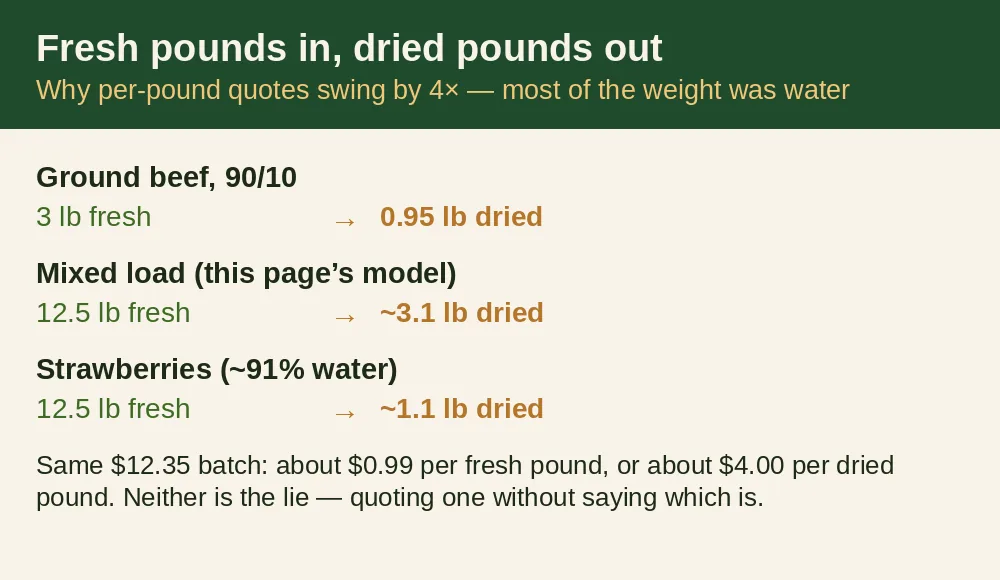
On this page’s model — $12.35 total per Medium batch at 500 lifetime batches — the same batch is $0.99 per fresh pound and, for a mixed load that dries to about a quarter of its fresh weight, about $4.00 per dried pound. Neither number is the lie; the lie is quoting either one without saying which. When a commercial product quotes its price per dried pound and a forum post quotes a home cost per fresh pound, the home figure looks four times better than the honest comparison — which is per calorie, and that is the next section.
How does home freeze-drying compare with buying it ready-made?
Home freeze-drying beats ready-made meals on cost per 1,000 calories for dense food, and the gap narrows hard for watery food. From our October 2026 dataset in what a serving really costs and Mountain House vs Peak Refuel: Peak Refuel’s Basecamp Bucket works out to $16.70 per 1,000 calories and Mountain House’s Essential Bucket to $19.92, food included. Run the same math on a home batch of 90/10 ground beef — 12.5 pounds fresh, about 9,975 calories by USDA figures, drying to about 4 pounds — and the processing adds $12.35, which is $1.24 per 1,000 calories. Add the food itself at an example $5 a pound fresh ($62.50 a batch) and the home total is about $7.50 per 1,000 calories: under half the ready-made price, with your own seasoning and no bucket of entrees you only half like. At sale prices of $3.50 a pound fresh, it drops to about $5.62.
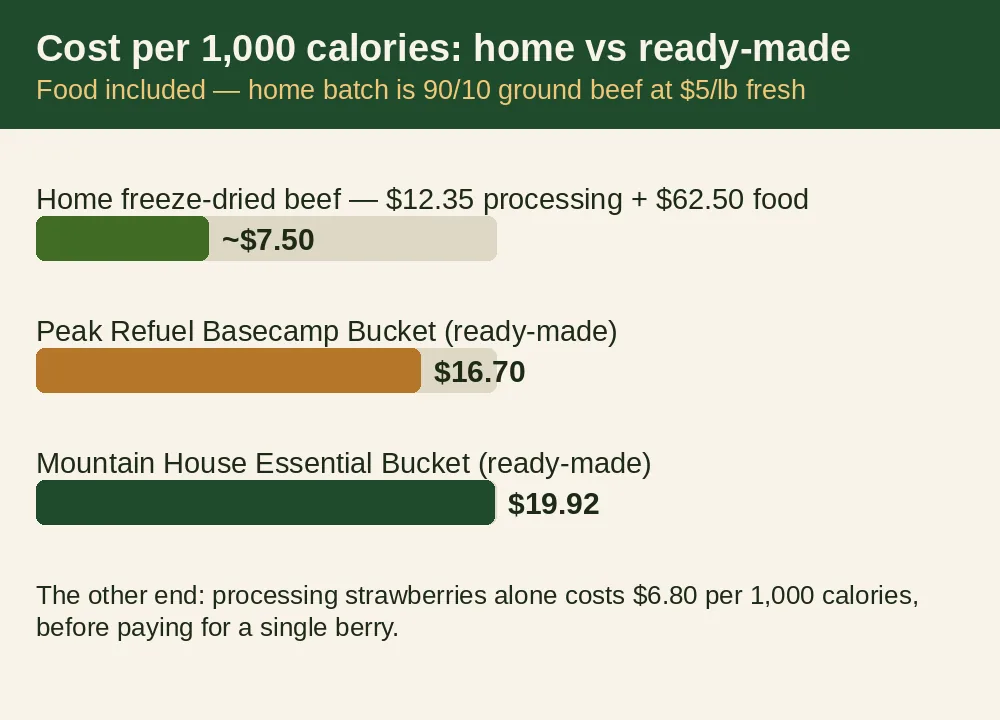
Now the other end. Strawberries at about 145 calories per fresh pound put only about 1,810 calories in the same $12.35 batch — processing alone is $6.80 per 1,000 calories before you have paid for a single berry. Freeze-drying watery produce is something you do because the garden gave it to you free, or because home-dried strawberries are simply better than the bagged kind — not because the calorie math wins. The rule the numbers support: dense food (meats, eggs, cheese, prepared meals) is where a home machine earns; watery produce is where it indulges. Our Freeze-Dryer Payback Calculator runs this same math on your own batch count and food prices.
What does your electricity rate do to the answer?
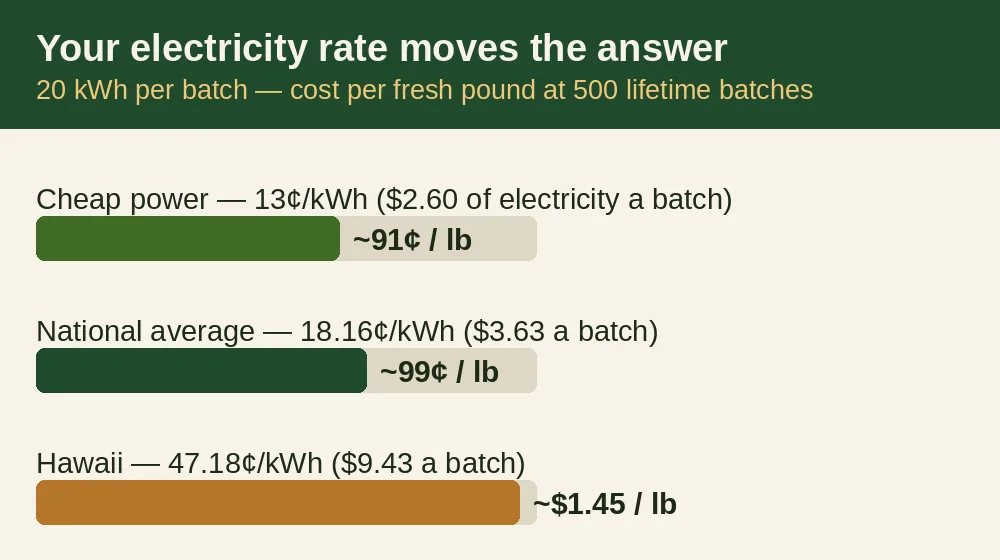
Your electricity rate moves the per-pound answer by up to about 46 cents, because a batch’s 20 kWh costs $2.60 at a cheap 13 cents per kWh and $9.43 at Hawaii’s 47.18 cents — the EIA’s August 2026 state figures run from 12.72 cents in Nevada to 47.18 in Hawaii, against the 18.16-cent national average this study uses. At the cheap end, a Medium batch’s running cost falls to about $6.53 and the 500-batch cost per fresh pound to about 91 cents. At the Hawaiian end, running cost climbs to about $13.36 a batch and the same pound costs about $1.45 to process. Electricity is still not the main lever — the batch count from the machine table above moves the answer by $1.72 a pound, roughly four times what the worst electricity rate in the country does — but if your power is dear, it is one more reason to run full loads and never half-empty trays.
Honest Caveats
Four of them, plainly. First, 500 batches is a model, not a promise: the machine table prints all four lifetimes because a freeze dryer’s real lifespan is the single biggest unknown in this math, and post-warranty repairs and paid tech support — a complaint that recurs in owner feedback — are not in any row. Second, the food itself is excluded from the processing figures on purpose and included only in the per-calorie comparison, at clearly labeled example prices; swap in your own. Third, your time is priced at zero throughout: a batch takes 24 to 36 hours of machine time but only minutes of hands-on work at each end, and reasonable people price that differently. Fourth, the oil line assumes the Premier oil pump. The oil-free pump upgrade costs $1,495 more on a Harvest Right — at about $1 of oil per batch, the upgrade needs roughly 1,495 batches to pay for itself on oil alone, which is why our comparison research keeps recommending the Premier.
Frequently Asked Questions
How much electricity does a freeze dryer use per batch?
A home freeze dryer uses roughly 15 to 30 kWh per batch depending on the food’s water content and the room temperature; a metered long-term owner’s record landed at about 20 kWh per run. At the EIA’s August 2026 national average of 18.16 cents per kWh, that is about $3.63 a batch — noticeably more than the $1.25 to $2.80 per batch figure manufacturers publish against older, cheaper power.
What does freeze-drying cost per pound?
On the Harvest Right Medium model used throughout this study, processing costs about $0.99 per pound of fresh food at 500 lifetime batches — 38 cents of machine, about 29 cents of electricity, and the rest in oil and mylar — or about $4.00 per pound of dried food out, since most of the fresh weight was water. Run the machine only 100 times in its life and the fresh-pound figure climbs to $2.52.
How many batches until a freeze dryer pays for itself?
Against ready-made meals at $16.70 to $19.92 per 1,000 calories, a dense home batch saves roughly $90 to $125 a batch after food and processing, which puts a $2,395 Medium’s break-even near 20 to 26 dense batches. Mixed real-world use — some produce, some meals, some idle months — is why owners in our comparison research put realistic payback at 2 to 4 years of regular use.
Is it cheaper to freeze dry your own food or buy freeze-dried food?
Your own, for dense food: a home ground-beef batch lands near $7.50 per 1,000 calories including the food at $5 a pound fresh, against $16.70 to $19.92 for ready-made buckets. For watery produce the saving shrinks or vanishes — processing strawberries alone costs $6.80 per 1,000 calories — so the machine earns on meats, eggs, and meals, and indulges on fruit.
Does a bigger freeze dryer lower the cost per pound?
Yes, on the machine line: at 500 lifetime batches the machine cost runs from about 47 cents per fresh pound on the Harvest Right Small to about 22 cents on the X-Large, because price climbs slower than batch size. The edge only counts if the big machine runs full — a half-empty Large costs more per pound than a full Medium.
What costs do people forget when they price freeze-drying?
Pump oil (about $1 a batch amortized), mylar bags and oxygen absorbers ($2.93 a batch on the prices in our mylar guide), their own electricity rate rather than the national average, and the machine’s lifetime batch count — the forgotten figure that moves the answer more than all the others combined.
Sources: Harvest Right published specs and store prices (checked October 26–30, 2026, in our sizes comparison and on the maker’s store); Blue Alpine and Stay Fresh prices from our home freeze dryer comparison (October 2026); Backpacking Light’s metered long-term ownership report (about 20 kWh per batch); EIA Electric Power Monthly, August 2026 (national average residential rate 18.16 cents/kWh; state range 12.72–47.18 cents); USDA FoodData Central water and calorie figures via our freeze-dried conversion chart; Truly Preserved datasets from our home freeze dryer comparison, emergency food cost per serving, and Mountain House vs Peak Refuel (October 2026). Last updated: October 30, 2026
Talk it over with other readers. The Truly Preserved Community on Facebook is where readers compare notes on food storage, water, and backup power — and where your questions help decide what we research next. Join the group →