
Affiliate Disclosure: Truly Preserved is reader-supported. When you buy through links on this page, we may earn a commission at no extra cost to you. As an Amazon Associate, Truly Preserved earns from qualifying purchases. Learn more.
How we researched this comparison. We scored 2 products head to head for this page. The work behind the scores: manufacturer specifications and certification records where they apply, prices checked when this review was written, and patterns across verified owner feedback — a praise or complaint point only counts here when it shows up again and again, not once. The products were chosen to cover the main designs and price points a buyer in this category actually cross-shops. We are a research desk: we do not buy or hands-on test the products, and commissions never change a score. How we research and score →
Mountain House vs Peak Refuel is the freeze-dried argument that matters if you are stocking a pantry, because the two buckets look almost identical on the shelf — 12 pouches each, a serving count in the low twenties — and are not identical at all once you count calories. This comparison is built from published specs, current prices checked October 26, 2026, and aggregated owner feedback. We don’t own these buckets; we did the homework, including the arithmetic Mountain House does not publish for its own bucket.
Here is the number the whole comparison turns on: Peak’s bucket carries 10,180 calories. Mountain House publishes no calorie total for the Essential Bucket, so we built one from the maker’s own pouch labels — about 5,420 calories. Peak holds nearly twice the food. Everything below follows from that.

The Short Version
Mountain House Essential Bucket
See it on AmazonWe may earn a commission at no extra cost to you.
Peak Refuel Basecamp Bucket 3.0
See it on AmazonWe may earn a commission at no extra cost to you.
How we chose: Buckets are judged on real calories and protein (published where the maker publishes them, derived from the maker’s own pouch labels where it does not), cost per 1,000 calories at this run’s verified prices, shelf life as each maker states it, and what owners report. Prices were checked October 26, 2026 on Keepa and camelcamelcamel; where the two trackers disagreed, we used the tracker with a dated price from today — details in the cost section. Read our full methodology.
Head-to-Head Specs
| Product | Price | Calories | Best for |
|---|---|---|---|
| Mountain House Essential Bucket Read the review ↓ |
$107.99 | ≈5,420* | Store it and forget it |
| Peak Refuel Basecamp Bucket 3.0 Read the review ↓ |
$169.99 | 10,180 | Most food, most protein |
*Mountain House publishes no calorie total for this bucket. Ours is derived pouch by pouch from the maker’s current labels: 4 Beef Stew at 420 calories, 2 Breakfast Skillet at 520, 2 Scrambled Eggs with Bacon at 350, and 4 Rice & Chicken at 500 — 5,420 in total, and the same method gives about 238g of protein the maker also does not total. Peak publishes its figures: 10,180 calories and 480g of protein across 12 pouches and 24 servings, against Mountain House’s 12 pouches and 22 servings. Both buckets were checked on Amazon on October 26, 2026: each had a live New / Buy Box offer ($107.99 and $169.99) with Amazon’s own direct offer out of stock on both. This comparison sits in our Preserve the Pantry hub, and the per-calorie method comes straight from our Emergency Food Cost Index.
Mountain House Essential Bucket — Our Score: 8/10
For food you intend to store and not touch, the Essential Bucket is still the safer buy: a 30-Year Taste Guarantee no rival matches, a gluten-free assortment, and an owner record — 4.7 stars across about 1,233 Amazon ratings on this listing — deep enough to trust.
The bucket holds four meals: Beef Stew, Breakfast Skillet, Scrambled Eggs with Bacon, and Rice & Chicken. Prep is hot water in the pouch, ready in under 10 minutes, 17 cups of water for the whole bucket. Owners praise the same things decade after decade: the meals taste like the meals, prep never surprises, and a pouch from deep storage comes back fine. The complaints are just as consistent, and our derived math backs the biggest one — portions run small. At about 246 calories per serving, a Mountain House serving is a side dish wearing a dinner’s name; plan on two servings per adult per meal, which is exactly why the per-serving price below flatters this bucket. Sodium is the second standing complaint, and the labels agree: about 3,050mg per 1,000 calories on our derived bucket total, roughly two and a half times the rate in Peak’s comparable dishes.
Pros
- 30-Year Taste Guarantee — the longest storage promise in the category, from a maker selling since 1969.
- Bucket is marketed gluten-free, the only one of these two that is.
- Deepest owner record here: 4.7 stars across ~1,233 ratings, against Peak’s ~192.
- Cheaper to buy outright: $107.99, and $4.91 per serving.
Cons
- No published bucket calorie or protein total — you have to trust our pouch-by-pouch math, not the maker’s.
- About 246 calories per serving; one serving is not a meal for most adults.
- Highest cost per calorie of the two: $19.92 per 1,000 calories.
- Sodium runs high, about 3,050mg per 1,000 calories derived from the maker’s labels.
Buy it if this food is insurance: bought once, stored cool and dark, and expected to sit for 10 to 30 years. Skip it if you rotate and eat your storage — you are paying for shelf life you will never use, and getting half the food.
Our score: 8/10
Check the current price on Amazon →
Peak Refuel Basecamp Bucket 3.0 — Our Score: 7/10
Peak Refuel built its bucket the opposite way: fewer promises about decades, far more food in the pouches — 10,180 calories, 480g of protein, and servings that actually fill a person at about 424 calories each.
Six meals, two pouches each: Biscuits & Sausage Gravy, Strawberry Granola, Beef Pasta Marinara, Chicken Alfredo Pasta, Homestyle Chicken & Rice, and Beef Stroganoff. The per-pouch numbers are in another class from Mountain House — the Stroganoff alone carries 810 calories and 41g of protein against roughly 500 calories and 14g in Mountain House’s Rice & Chicken. Owners who eat both brands rate Peak’s taste and meat content higher, and praise that the meals need less water — about 9.5 ounces per pouch on the brand’s own average, against roughly two cups for a typical Mountain House pouch. The complaints cluster on price per pouch, a few meals eating richer than a tired stomach wants, and a thin track record: 4.5 stars across about 192 ratings on this listing is a good start, not a proven decade. One more honest wrinkle: Peak’s own FAQ currently promises a 10-year unopened shelf life, while some Peak listings and older pouches still carry a 5-year best-by — if the bucket that arrives says 5, believe the bucket.
Pros
- 10,180 published calories and 480g protein — nearly twice Mountain House’s food per bucket.
- Cheapest calories of the two: $16.70 per 1,000 calories.
- Servings that are meals: about 424 calories and 40g protein per pouch on average.
- Less prep water per calorie, and owners consistently rate the meat and taste first in class.
Cons
- Shelf claim is 10 years by the maker’s current FAQ — a third of Mountain House’s — with older 5-year best-by dates still in circulation.
- No certified gluten-free meals, by the maker’s own FAQ.
- $169.99 is the most money on this page, and the owner record is shallow: ~192 ratings.
- Per-serving price looks worse than it is ($7.08) only because the servings are twice the size — still, the sticker shocks.
Buy it if you will actually eat this food — on rotation, on trips, or in a short emergency measured in weeks — and want protein that works like food. Skip it if the bucket is a 20-year insurance policy; that is not the promise Peak is making.
Our score: 7/10
Check the current price on Amazon →
Which bucket actually holds more food?
Peak Refuel’s Basecamp 3.0 holds more food, and it is not close: 10,180 published calories against about 5,420 derived calories in the Mountain House Essential Bucket — 1.88 times as much energy in buckets that take up the same shelf space.
The serving counts hide this completely. Twenty-two servings against 24 sounds like a tie until you divide: a Peak serving averages about 424 calories, a Mountain House serving about 246. Counted in days of eating at 2,000 calories, Peak’s bucket is about 5.1 days of food for one person and Mountain House’s is about 2.7. Neither bucket is the two weeks of family food the bucket shape suggests — for a family of four, even Peak is a day and a bit — which is why we keep pricing this category per calorie in our cost-per-serving investigation instead of per bucket.
What does each brand cost per 1,000 calories?
Peak Refuel costs less per calorie: $16.70 per 1,000 calories at $169.99, against Mountain House’s $19.92 per 1,000 at $107.99 — about 19% more per calorie for the bucket with the longer guarantee.
The rest of the money math flips depending on the unit, so here is all of it. Per 2,000-calorie day: Peak $33.40, Mountain House $39.85. Per serving: Mountain House $4.91, Peak $7.08 — Mountain House wins that line only because its servings are little more than half the size. Per pouch: Mountain House $9.00, Peak $14.17. A note on where these prices came from, because this category’s trackers fight: on October 26, Keepa showed dated, same-day New prices for both listings ($107.99 and $169.99, Amazon’s own offer out of stock on both), while camelcamelcamel showed no dated price rows at all for either bucket in the last 90 days — so we printed Keepa’s figures and ignored camel’s undated ones. If you want the cheapest calories in this whole category, neither bucket is it: the bulk staples priced per 1,000 calories in our pantry research run a tenth of these prices, in exchange for doing your own cooking.
Total calories in each bucket
Mountain House publishes no bucket total; its figure is summed from the maker’s own pouch labels. The section’s cost per 1,000 calories is a price, so it is not charted.
Which meals carry more protein — and what about the sodium?
Peak Refuel carries more protein by every measure: 480 published grams per bucket against about 238 derived grams for Mountain House, about 47g of protein per 1,000 calories against about 44g — and per pouch it is a rout, roughly 40g against 20g.
Sodium needs the same per-calorie treatment or it misleads. Peak’s pouches are bigger, so their raw sodium numbers look similar while carrying far more food. Like for like — Beef Stroganoff against Beef Stroganoff, a dish both brands sell as a standard pouch — Mountain House’s label reads 1,540mg of sodium in a 560-calorie pouch (about 2,750mg per 1,000 calories) against Peak’s 940mg in an 810-calorie pouch (about 1,160mg per 1,000). Mountain House does not publish a bucket sodium total and Peak does not either, so we are not inventing one; on the dishes that can be compared directly, Peak runs at well under half Mountain House’s sodium rate.
How long will each bucket keep in storage?
Mountain House keeps longest by a wide margin: its 30-Year Taste Guarantee covers the Essential Bucket’s unopened pouches, and the brand has the decades of stored-product history to make that promise mean something.
Peak’s own current FAQ promises 10 years unopened, with taste guaranteed inside that window — and adds a wrinkle worth knowing before you buy: some Peak listings and older pouches still show a 5-year best-by, because the maker raised the claim as its testing caught up. Ten years is a reasonable rotation horizon for food you actually cycle through. It is not a buy-it-for-2055 horizon. Storage conditions govern both brands the same way: cool, dark, and dry beats every number on either box.
How much water does each bucket take to make?
Peak Refuel takes less water — about 14¼ cups for the whole bucket by the brand’s own per-pouch average, against a published 17 cups for the Mountain House bucket — and the gap widens per calorie, because Peak’s food is denser.
Worked per 1,000 calories, Mountain House needs about 3.1 cups of water and Peak about 1.4 cups. In a real outage, stored water is the thing that runs out first, and a food supply that drinks half as much of it leaves more for drinking. It is a quiet advantage, and for a household storing water by the jug it may matter more than the protein gap. Both brands want hot water — boiling for Peak’s 10-minute prep, hot preferred for Mountain House, with room-temperature water doubling Mountain House’s wait by the maker’s own guidance.
Honest caveats
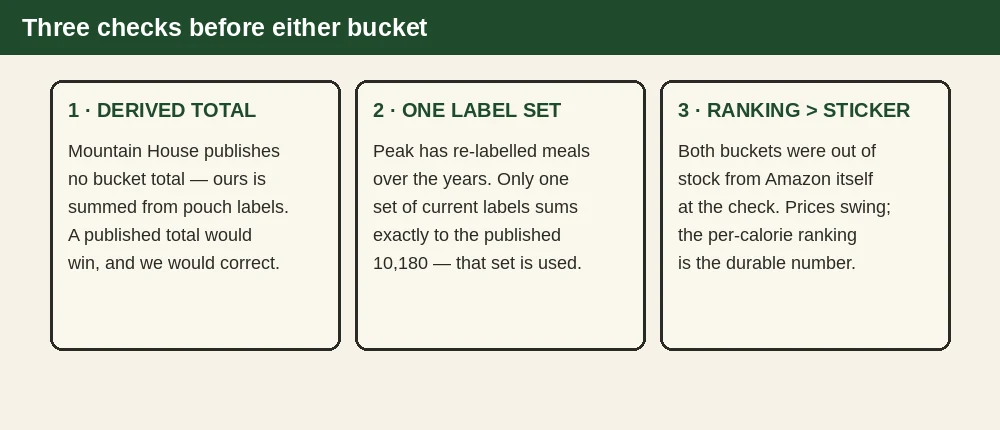
Three, plainly. First, our Mountain House calorie total is derived, not published — built from the maker’s current pouch labels for the four meals in this bucket, and other Mountain House buckets with different meals will total differently. If Mountain House ever publishes an Essential Bucket total that disagrees with 5,420, the published number wins and we will correct this page. Second, Peak has re-labelled meals over the years — its Chicken Alfredo and Beef Pasta Marinara appear at different calorie counts in different listings — though only one set of current labels sums exactly to the published 10,180 bucket total, and that is the set used here. Third, both brands’ buckets were out of stock from Amazon itself on the day we checked, with third-party New offers carrying both listings; bucket prices in this category swing hard around sales and storm news, so the per-calorie ranking matters more than either sticker.
Frequently Asked Questions
Is Mountain House or Peak Refuel better?
For long-term storage, Mountain House: a 30-year taste guarantee against Peak’s 10 years, and a far deeper owner record. For food you will eat, Peak Refuel: nearly twice the calories per bucket, more protein, less sodium per calorie, and a lower cost per 1,000 calories ($16.70 vs $19.92 on October 26, 2026).
How many calories are in a Mountain House Essential Bucket?
Mountain House does not publish a bucket total. Adding the maker’s own pouch labels — Beef Stew 420, Breakfast Skillet 520, Scrambled Eggs with Bacon 350, Rice & Chicken 500 calories per pouch, in the bucket’s 4-2-2-4 mix — gives about 5,420 calories, or about 2.7 days at 2,000 calories a day.
How long does Peak Refuel last in storage?
Peak’s current FAQ states a 10-year unopened shelf life with taste guaranteed in that window. Some listings and older pouches still show a 5-year best-by date from before the claim was raised, so check the date printed on the bucket you receive.
Which freeze-dried brand has the most protein?
Of these two, Peak Refuel, clearly: 480g per bucket and about 40g per pouch on average, against Mountain House’s derived 238g per bucket and about 20g per pouch. Peak built its meals around meat content, and the labels show it.
Why is Peak Refuel more expensive if its calories are cheaper?
Because there is more food in it. At $169.99 against $107.99 you are buying 10,180 calories against about 5,420. Per serving Peak also looks pricier ($7.08 vs $4.91) until you notice a Peak serving averages 424 calories and a Mountain House serving 246.
How much water do I need stored for a bucket?
Mountain House states 17 cups for the Essential Bucket. Peak publishes no bucket total; at its brand average of about 9.5 ounces per pouch, the Basecamp 3.0 needs roughly 14¼ cups — about 1.4 cups per 1,000 calories, against Mountain House’s 3.1.
Sources & freshness: Mountain House and Peak Refuel maker pages and FAQs, REI’s Basecamp 3.0 listing, Keepa and camelcamelcamel price records, and aggregated owner feedback, all consulted October 26, 2026. Prices last checked: October 26, 2026. Last updated: October 30, 2026.
Talk it over with other readers. The Truly Preserved Community on Facebook is where readers compare notes on food storage, water, and backup power — and where your questions help decide what we research next. Join the group →