
Affiliate Disclosure: Truly Preserved is reader-supported. When you buy through links on this page, we may earn a commission at no extra cost to you. As an Amazon Associate, Truly Preserved earns from qualifying purchases. Read our full affiliate disclosure.
Last updated: October 31, 2026
THE SHORT ANSWER
Yes, liquid coffee creamer freeze dries into a powder, and owners report it stirs back into hot coffee acceptably — which is exactly the use in this question. The limits are real, though: the oils in sweetened non-dairy creamer can go rancid in storage, so plan on weeks to a few months rather than years, expect the sweetness to taste concentrated, and know that plain powdered creamer off the shelf already solves the waste problem with no machine time at all.
Alicia King Terry asked in The Freeze Drying Community’s Open Questions: “Has anyone done coffee creamer?? My husband likes the sweet and creamy International Delight one, but he’s only home on the weekends so we always waste so much of the creamer. Wondered if anyone has experience freeze drying it and then using.” (International Delight is her words — it is the bottle in her fridge.) The waste problem is real: an opened bottle of liquid creamer has a short fridge life, and a weekends-only coffee drinker rarely finishes one. Here is the honest answer, chemistry first.
What is actually in the tray
A sweetened liquid creamer like the one in this question is mostly water, sugar, and vegetable oils, with emulsifiers to keep the oil suspended. Freeze drying removes the water — which is most of the bottle by weight — and leaves the sugar and oils behind as a dry solid. Nothing about that is a problem for the machine. It is a problem for the calendar, and the next sections explain why.
| Part | What freeze drying does |
|---|---|
| Water (most of the bottle) | Removed — this is the weight you lose |
| Sugar | Stays, and tastes more concentrated |
| Vegetable oils | Stay — and can oxidize over time |
| Emulsifiers / flavors | Stay, which is why it re-dissolves at all |
How it behaves on the tray
Owner reports on liquid creamer runs share a few consistent details, and we are labeling them as exactly that — owner reports, not maker guidance, because no creamer maker publishes freeze-drying instructions:
- It spreads and can foam. A sugary liquid poured thin on a tray may puff or bubble under vacuum. Owners who report clean runs pour thin layers, use tray liners or parchment, and pre-freeze the trays solid before the cycle starts.
- It dries to a sheet, then a powder. The dried layer crumbles or blends into a powder. That powder is the product — spoon it into coffee the way you would a powdered creamer.
- It clumps in storage more than most freeze-dried foods. Sugar is hygroscopic — it pulls moisture from the air — so owners report the powder caking if the jar is opened often in a humid kitchen. Small containers, opened rarely, behave better than one big jar.
Using it afterward — the coffee test
The reconstitution principle is the same one that governs all freeze-dried food: the water that came out is roughly the water that goes back in. For creamer, nobody measures it that precisely in practice, because the coffee itself is the water. Owner-report ranges cluster around 1 to 2 tablespoons of powder per mug of hot coffee, adjusted to taste, stirred well — it dissolves in hot coffee far more readily than in cold drinks, where owners report it floats and clumps.
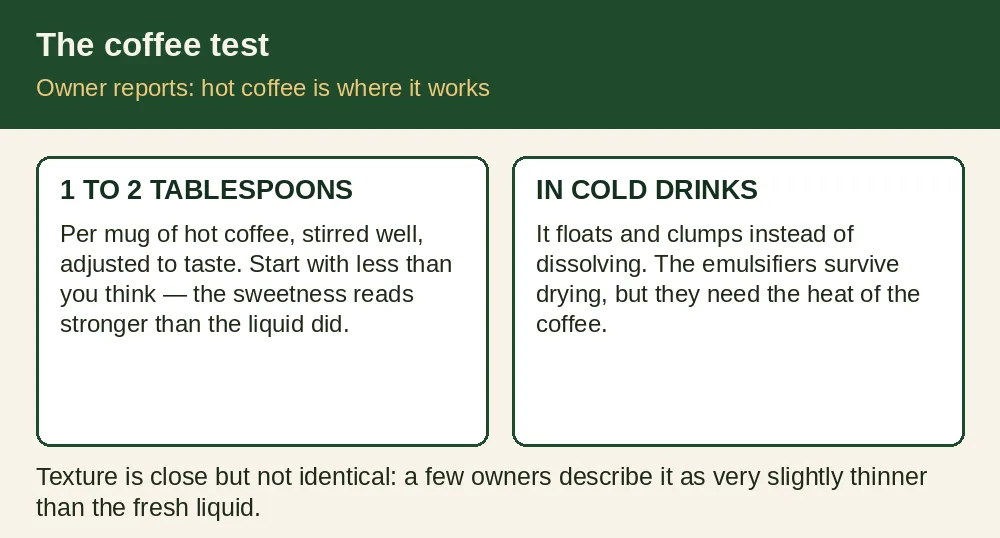
Two taste notes show up repeatedly. First, the sweetness reads stronger than the liquid did, because you are portioning by spoon rather than by pour and the sugar never left. Start with less than you think. Second, the texture in coffee is close but not identical — the emulsifiers survive drying, so it whitens and blends, but a few owners describe it as very slightly thinner than the fresh liquid. For a weekends-only drinker, that trade — close coffee, no wasted bottles — is the whole point.
The honest storage horizon
This is where creamer parts company with most freeze-dried food. The oils that make it creamy are exposed to oxygen once the water is gone, and oils oxidize — that is the rancid, old-crayon smell owners describe in freeze-dried foods that were stored too long. Sugar does not protect the oil. So:
- Plan on weeks to a few months, not the years you would expect from freeze-dried fruit or meat.
- Store small batches in mylar with an oxygen absorber, cool and dark, per our mylar storage guidance — and date every bag.
- Dry only what the household will use in that window. For this question, that is the good news: the batch size that matches a weekends-only drinker is small anyway.
Creamer is also a case where the candidacy rules in What Foods Can’t You Freeze Dry? apply in spirit: high-fat liquids are the edge of what freeze drying is good at, and the honest answer is “it works, briefly” rather than “it works, forever.”
The comparison the question actually needs
| Option | Waste | Shelf life |
|---|---|---|
| Liquid bottle, fridge | Most of the bottle, in this house | Days to ~2 weeks after opening |
| Freeze-dried liquid | None — use by the spoonful | Weeks to a few months, sealed |
| Commercial powdered creamer | None | Months on the shelf, as sold |
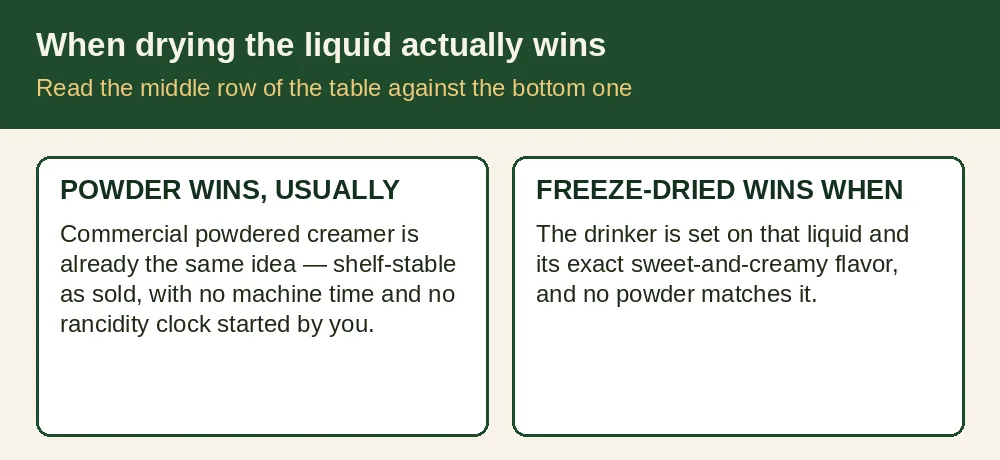
Read that middle row against the bottom one before running a batch. Powdered creamer is already the same idea — the water was never added — and it is shelf-stable as sold, with no machine time and no rancidity clock started by you. Freeze drying the liquid wins in one specific case: the drinker is set on that liquid’s exact flavor, the sweet-and-creamy profile included, and no powder matches it. That is a legitimate reason. It is just worth naming, so the machine time goes in with eyes open.
Food safety before the tray
Freeze drying does not sterilize food — microbes present before drying go dormant and wake back up when water returns, which is the core rule in our page on freeze drying raw meat and eggs safely. Creamer is a gentler case than raw meat, but the same handling applies: dry creamer that has been kept refrigerated and is well inside its date, not a bottle that sat warm on a counter; use clean trays; and once the powder is rehydrated in coffee, treat it like fresh creamer, not like a shelf-stable food.
Questions people also ask
Can you freeze dry half-and-half or real cream?
Real dairy creams can be freeze dried, but their higher fat content makes the storage problem worse — owners report rancid flavors sooner than with non-dairy creamer. Treat dried cream as a short-horizon ingredient, weeks rather than months, and store it cold if you can.
How much freeze-dried creamer goes in a cup of coffee?
Owner reports cluster around 1 to 2 tablespoons of powder per mug of hot coffee, starting low because the sweetness concentrates in drying. Stir it into the hot coffee directly; it does not dissolve well in cold drinks.
Why did my freeze-dried creamer go rancid?
The vegetable oils in sweetened creamer oxidize once the water is removed, especially in warm or partly filled containers. Smaller batches, mylar with an oxygen absorber, and a weeks-to-months use window are the fix — rancid powder should be discarded, not stirred in anyway.
Is freeze-dried creamer the same as powdered creamer?
Close in the cup, different on the shelf. Commercial powdered creamer is manufactured dry and stays stable for months; freeze-dried liquid creamer starts its oxidation clock the day you dry it, so its honest horizon is shorter.
Related questions
- What foods can’t you freeze dry?
- How do you use freeze-dried cheese after drying?
- How do I freeze dry yogurt — and why did my yogurt bites fail?
- Can I freeze dry raw meat and eggs safely?
This question sits in What People Are Asking About Freeze-Dried Food — the full list of freeze-dried questions from real forums, each with a short answer.
Talk it over with other readers
The Truly Preserved Community on Facebook is where readers compare notes on food storage, water, and backup power — and where your questions help decide what we research next.