
Affiliate Disclosure: Truly Preserved is reader-supported. When you buy through links on this page, we may earn a commission at no extra cost to you. As an Amazon Associate, Truly Preserved earns from qualifying purchases. Read our full affiliate disclosure.
Freeze-Dried Food — How-To
How Much Water Do I Add to Rehydrate Freeze-Dried Food?
This question stops almost every first batch. One home freeze dryer owner weighed her food at 150 grams going in and 40 grams coming out, then guessed 90 grams of water to rehydrate it — and asked the group whether that was right, or whether you just hydrate until it looks right. It is a fair guess and it is 20 grams short. The math is simpler than the guessing: what the machine took out is what you put back.
THE SHORT ANSWER
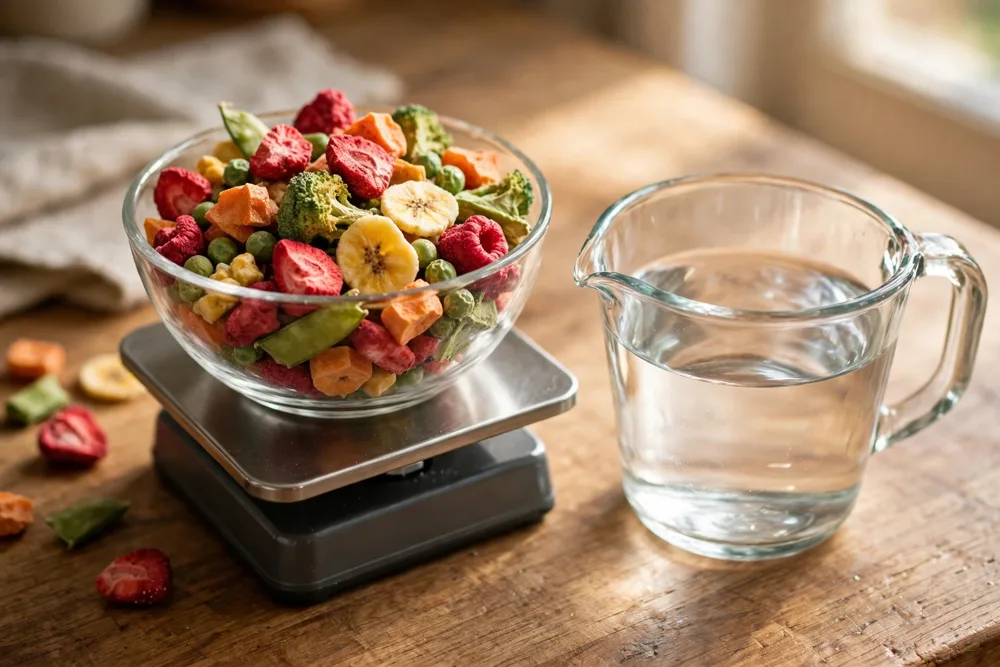
Add back the water that came out, by weight. Food that weighed 150 grams before drying and 40 grams after it lost 110 grams of water, so it takes 110 grams of water to bring it back — not the 90 grams people often guess. If you did not weigh the food first, add hot water a little at a time, let it rest, and stop when it is plump and tender with no free water pooling in the bowl.
The rule: water out equals water back
Weigh the food before it goes into the freeze dryer, and weigh it again when the cycle finishes. The difference is the water the machine removed. University of Minnesota Extension gives exactly this advice for home freeze drying — weigh before and after, and let the difference tell you how much water to return. Water makes the scale easy: 1 gram of water is 1 millilitre, so the number on the scale is the number to pour.
| Step | Weight |
|---|---|
| Food before drying | 150 g |
| Food after drying | 40 g |
| Water the machine removed | 110 g |
| Water to add back | 110 g |
That 110 grams is 110 ml — just under half a cup. Write it on the bag when you pack the food: “add 110 g water.” Future you, standing in a kitchen months from now, will not remember the tray weights, and the bag is the one place the number cannot get lost. Weigh per tray or per bag, not per recipe — two trays of the same chili dry to different weights if one was filled deeper.
Leftovers: chili, lasagna, and other mixed meals
A mixed meal follows the same math as a single food. You do not need a separate number for the beans, the meat, and the sauce in a chili — weigh the tray of chili before, weigh it after, and the difference is the water for that tray. A tray that went in at 800 grams and came out at 180 grams took 620 grams of water to dry, and it takes about 620 grams of liquid to come back.
Two practical notes on meals. First, liquid counts in whatever form it arrives: broth, tomato sauce, and gravy are mostly water, and they all count toward the total. Second, a solid slab of lasagna rehydrates unevenly — the edges drink and the middle sulks. Meals rehydrate better dried and stored in portion-size pieces than in one thick block, and a slab that is already dried is worth cutting or breaking into pieces before the water goes on.
If you did not weigh it first
Plenty of bags in plenty of pantries carry no weights at all. There is no exact number for those, and anyone who gives you one is guessing with confidence. Work up to the answer instead:
- Commercial pouch? Follow the water amount printed on the pouch first. The maker weighed that meal so you do not have to.
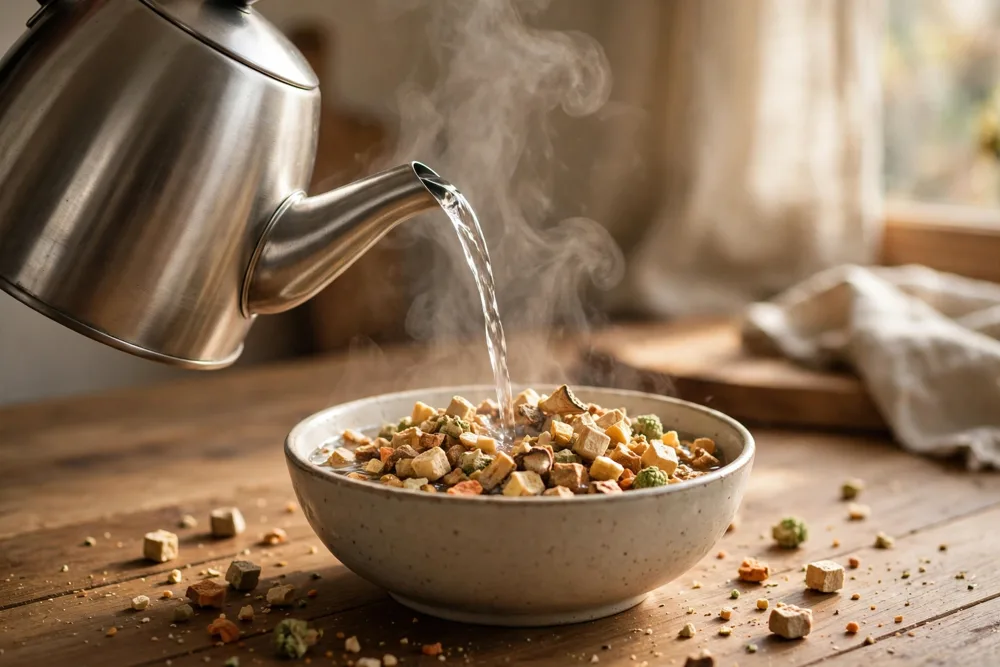
- Home batch, no record: put the dried food in a bowl and add hot water about equal to the food’s dried weight — 40 grams of dried food, roughly 40 grams of water. Stir, cover, and give it five minutes.
- Then add in small pours, about half the dried weight at a time, waiting a few minutes between pours, until the food is plump and tender all the way through.
- Write the running total on the bag. The first bag from a batch is the experiment. Every bag after it gets the measured number.
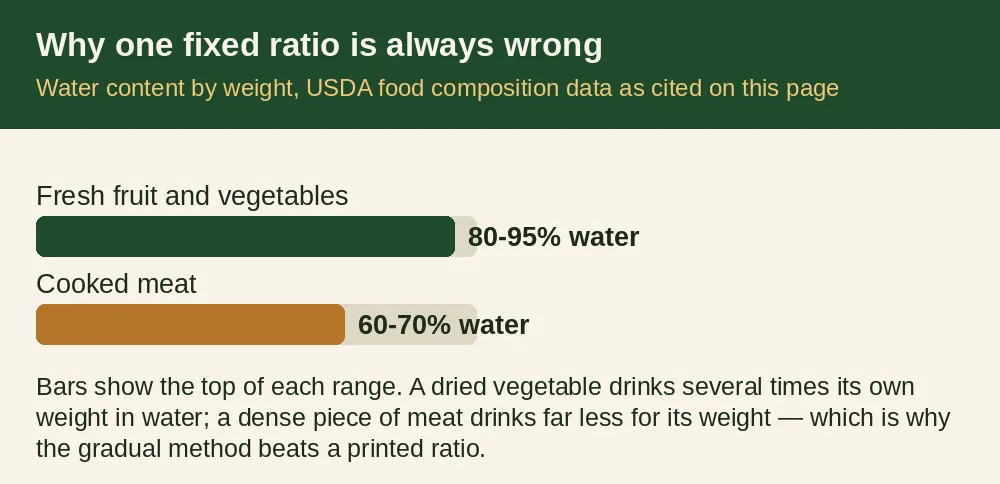
Expect the final total to surprise you. Most fresh fruit and vegetables are 80–95% water by weight in USDA food composition data, and cooked meat sits closer to 60–70% — so a dried vegetable drinks several times its own weight in water, while a dense piece of meat drinks far less relative to its weight. That gap is exactly why one fixed ratio printed on a chart will always be wrong for something in your pantry, and why the gradual method beats it.
Two pages do the looking-up for you: our freeze-dried conversion chart shows fresh, dried, and rehydrated amounts side by side by ingredient, and the conversion calculator runs the same math on your own weights.
Hot water or cold?
Hot water is faster and it is the better choice for pasta, rice, and anything with meat in it. Mountain House’s own directions are the commercial benchmark: add boiling water, stir, seal, and the meal is ready in 15 minutes or less. Cold water reaches the same place on a slower clock — the maker says cold takes about twice as long — and our full cold-water timings by meal type, including the no-stove case, are in Can you rehydrate freeze-dried meals with cold water, or no stove at all?
One safety line either way: once water goes back in, the food is fresh food again. Eat it within a few hours, do not reseal a soaked meal for tomorrow, and remember that food dried from raw meat or eggs still has to be cooked after rehydrating — soaking is not cooking.
When to stop adding water
- Size: the food has swelled back to about the size it was before drying.
- Bite: a piece cut or bitten open shows no dry, hard core in the middle. Dense meat is the usual holdout — if the centre is still dry, it needs time more than it needs water.
- Surface: after a covered rest of five to ten minutes, there is no free water pooling in the bowl. Pooling means you have poured past what the food can hold.
- Sauce: in a meal, the liquid coats the food instead of running off it like soup — unless soup is what you made.

Poured a little too much? Drain the excess, or stir the meal and let it stand — grains and pasta keep drinking for a while. Poured too little is the easier mistake: add a splash of hot water, cover, and wait again. The common failure is not the amount, it is impatience — food that gets ten undisturbed minutes in the right amount of water beats food that gets drowned and eaten at minute four.
Questions people also ask
Can you add too much water to freeze-dried food?
Yes. Freeze-dried food can only take back the water it lost; anything past that stays in the bowl as free liquid and thins the flavour. Drain it off, let grains sit and absorb, or cook a soupy meal down for a minute or two.
Should I measure the water by cups or by weight?
By weight, when you can. A scale reads grams of water directly, and grams are millilitres — 110 grams is 110 ml. In cups that same amount is just under half a cup, and “just under” is where the guessing creeps back in.
Does broth or sauce count toward the water?
Yes — broth, sauce, and gravy are mostly water, and the food does not care what the water arrived in. Count them toward your total, and go lighter on added salt, because a salty broth plus a seasoned meal stacks up fast.
How long should freeze-dried food sit in the water?
Most home batches are ready in about 10–15 minutes in hot water, close to the 15-minutes-or-less the commercial makers print. Give dense meat and thick pasta pieces longer, covered, and check the centre of the biggest piece before you call it done.
Related questions
- Can you rehydrate freeze-dried meals with cold water, or no stove at all?
- How long does opened freeze-dried food last?
- What foods can’t you freeze dry?
This question sits in What People Are Asking About Freeze-Dried Food — the full list of freeze-dried questions from real forums, each with a short answer.
Talk it over with other readers
The Truly Preserved Community on Facebook is where readers compare notes on food storage, water, and backup power — and where your questions help decide what we research next.