
Affiliate Disclosure: Truly Preserved is reader-supported. When you buy through links on this page, we may earn a commission at no extra cost to you. As an Amazon Associate, Truly Preserved earns from qualifying purchases. Learn more.
THE SHORT ANSWER
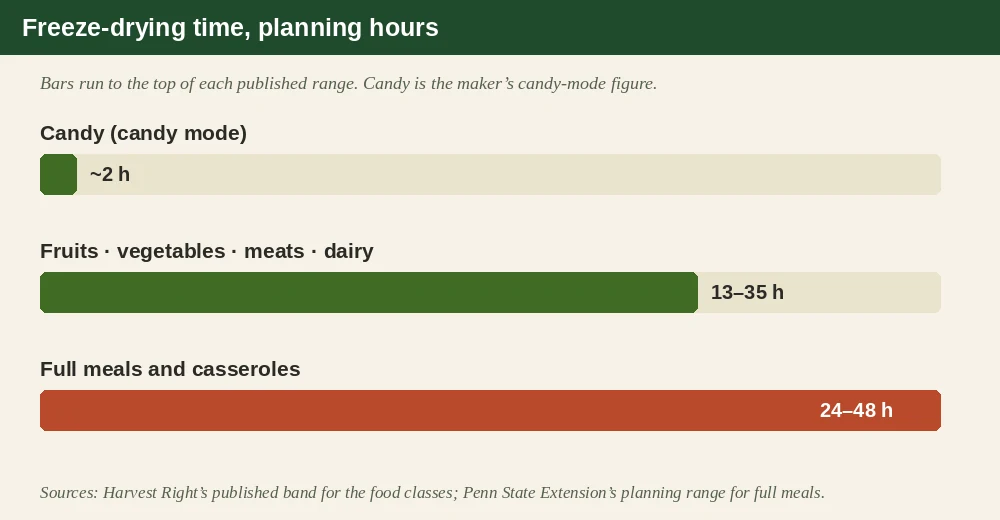
Most full batches of food run 24–36 hours or more, start to finish. Harvest Right publishes 13–35 hours for most foods — fruits, vegetables, meats, meals, and dairy — and about 2 hours for candy in candy mode, while Penn State Extension tells home users to plan on 24–48 hours. Both are right about different loads. What actually ends a batch is not the clock: the machine senses dryness and beeps when the food is done, and the biggest, wettest piece on the tray is the one that decides.
The ask shows up in every freeze-drying group, usually worded the same way: is there a chart that shows how long different foods take? There is no honest single-number chart, because the same food can finish in 16 hours as a half load of thin slices and run past 36 as a full load of thick ones. What a chart can do — and what this one does — is give you the planning range for each class of food, name the source each range comes from, and show you the handful of things that move your batch toward the fast end or the slow end.
How long does each food take to freeze dry? The chart
| Food | Plan on | What moves it most |
|---|---|---|
| Candy (candy mode) | About 2 hours | Maker figure; small loads |
| Fruits | 13–35 hours | Water content; slice thickness |
| Vegetables | 13–35 hours | Piece size; blanching prep |
| Meats | 13–35 hours | Thickness; fat slows it |
| Dairy and eggs | 13–35 hours | Layer thickness on the tray |
| Full meals and casseroles | 24–48 hours | Thickest, wettest loads |
Read the chart the way it was built. The 13–35 hour band is Harvest Right’s own published figure for fruits, vegetables, meats, meals, and dairy, and the candy figure — about two hours — is the maker’s as well. Inside that band, the maker names the fast and slow ends for you: meat, peas, and corn dry quickly, while pineapple and watermelon take longer. The 24–48 hour row for full meals is the planning range Penn State Extension’s Let’s Preserve: Freeze-Drying gives home users, and it is the honest row for a tray of lasagna or stew — a full, deep, wet load lives at the top of anyone’s chart. The two figures run on different bases: Harvest Right’s 13–35 hour band counts meals among its listed foods at ordinary loads, while Penn State’s 24–48 is the planning range it states for drying times in general — and the full, wet meal load is the one that reaches it. Utah State Extension’s freeze-drying teaching materials land in the same territory, putting a typical cycle at roughly 20–40 hours. If a food class is not in the table, it is because no published source we trust puts a range on it — we would rather leave a gap than print a guess.
Pair this chart with its sibling: the freeze-dried conversion chart shows how much fresh food becomes how much freeze-dried food, by ingredient. Times live on this page; amounts live on that one.
Why the ranges are this wide
Load size. A full machine sublimates far more ice than a half load, and the cycle stretches to match. The same recipe on four full trays is a different job than on two.
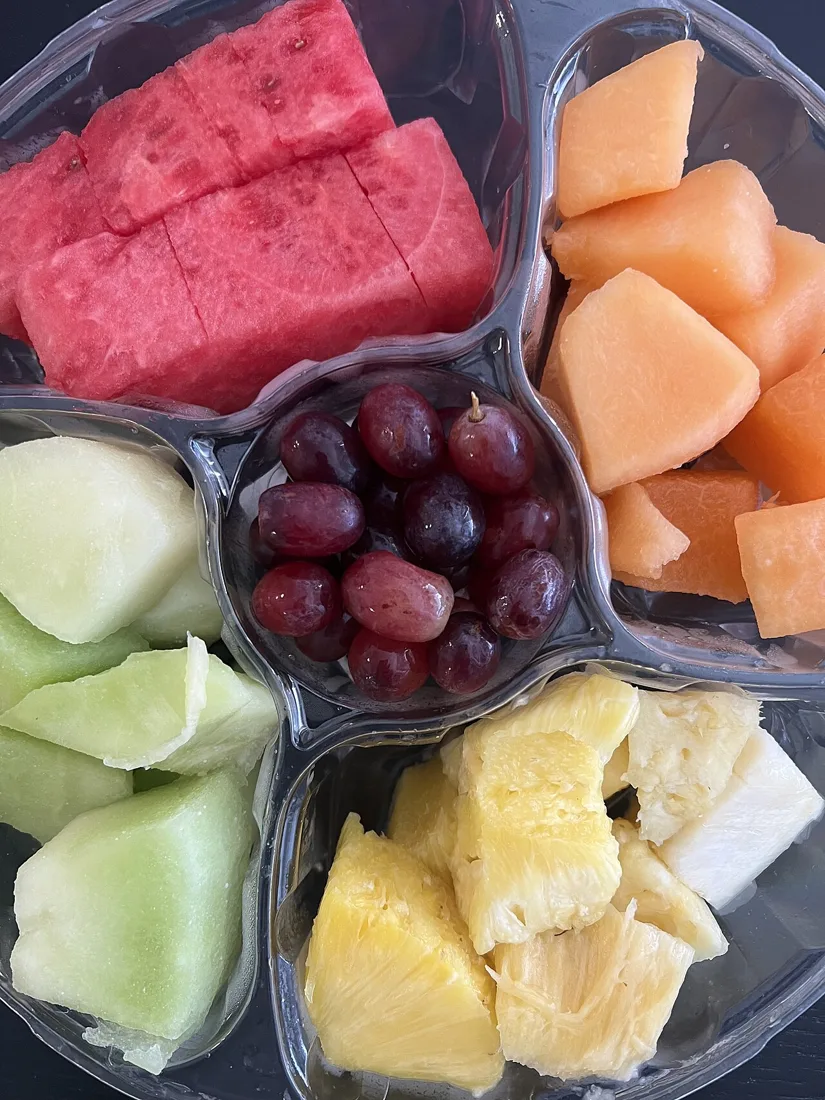
Piece thickness. Harvest Right names thickness directly as a cycle-time factor. Ice leaves a thick piece from the outside in, so doubling thickness much more than doubles the wait. Even, thin, uniform pieces are the single biggest lever you control.
Water content. Watermelon and pineapple are the maker’s own examples of slow foods; peas and corn are its fast ones. The difference is mostly how much water has to leave.
Pre-freezing. Loading food already frozen shortens the machine’s freezing stage — Harvest Right notes the machine takes pre-frozen food down further, to as low as −40°F — and pre-freezing high-moisture food is a standard step in extension guidance. It moves hours, not minutes, and it does nothing for the drying stage itself.
What shares the batch. Penn State Extension advises processing foods with similar drying times together. One tray of watermelon among three of peas means the whole batch waits on the watermelon.
The clock doesn’t end the batch — dryness does
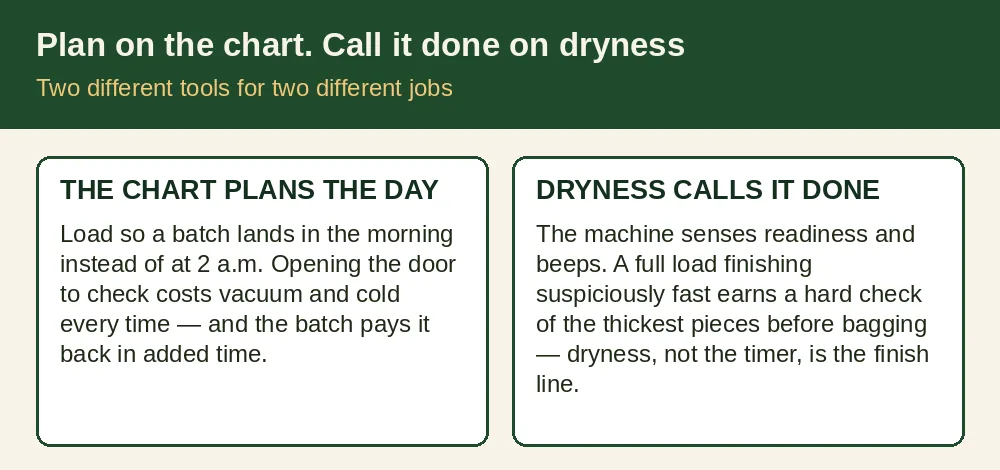
Harvest Right’s own FAQ makes the point plainly: the machine senses when the food is ready and alerts you with a beep, so you do not have to guess when to stop the cycle. Use the chart to plan your day — when to load so a batch lands in the morning instead of at 2 a.m. — and use the machine’s check, plus your own, to call it done. Before anything gets bagged, test the largest piece from the middle of the fullest tray: it should feel dry and light all the way through, snap or crumble rather than bend, and show no cool, dense center when you break it open. A soft center means more dry time, however the clock reads. Packaging a batch that is still damp in the middle is how good food goes off in the bag — the failure we take apart in How Do I Tell If Stored Food Has Gone Bad?
Follow-Up Questions
How long does one batch take on the machine I’m shopping for?
Batch time follows the food more than the machine, but size decides how much food is in each run. Our Harvest Right sizes compared page works through batch times and tray space size by size, and the home freeze dryer comparison puts the brands side by side.
Why did my batch take over 40 hours?
Almost always the load, not the machine: full trays, thick pieces, a high-water food, or one slow tray holding up the rest. Check the thickest piece’s center first. If it is dry and the cycle still ran long, the batch was simply a big job of sublimation — extension’s 48-hour top end exists because loads like that are normal.
Can I shorten a batch by opening the door to check?
Checking costs you vacuum and cold every time, and the batch pays it back in added time. Plan on the chart, trust the machine’s dryness sensing, and check at the end — breaking open the biggest piece tells you more than three mid-cycle peeks.
Frequently Asked Questions
Does candy really finish in about two hours?
In candy mode, yes — that is Harvest Right’s published figure, and candy is the exception that proves the chart’s rule: it holds very little water compared to a tray of fruit or a casserole. Food-mode batches are the 13–35 hour band, not the two-hour one.
Is it a problem if a batch finishes much faster than the chart?
A small, thin, pre-frozen load finishing early is normal. A full load finishing suspiciously fast is worth a hard check of the thickest pieces before bagging — dryness, not the timer, is the finish line either way.
Last updated: October 29, 2026. Batch-time ranges from Harvest Right’s published FAQ (harvestright.com), Penn State Extension’s “Let’s Preserve: Freeze-Drying,” and Utah State University Extension freeze-drying teaching materials — all checked October 29, 2026.
This question came from our harvest of what readers ask in the forums. See the rest of the list: What People Are Asking About Freeze-Dried Food.
Talk it over with other readers
The Truly Preserved Community on Facebook is where readers compare notes on food storage, water, and backup power — and where your questions help decide what we research next.