
Affiliate Disclosure: Truly Preserved is reader-supported. When you buy through links on this page, we may earn a commission at no extra cost to you. As an Amazon Associate, Truly Preserved earns from qualifying purchases. Learn more.
How we researched this comparison. We scored 3 products head to head for this page. The work behind the scores: manufacturer specifications and certification records where they apply, prices checked when this review was written, and patterns across verified owner feedback — a praise or complaint point only counts here when it shows up again and again, not once. The products were chosen to cover the main designs and price points a buyer in this category actually cross-shops. We are a research desk: we do not buy or hands-on test the products, and commissions never change a score. How we research and score →
Every 200W panel promises 200 watts and delivers about 160 on a good afternoon — the honest differences are what you pay per real watt and whether the plug fits your station without a $20 adapter hunt. This comparison of the best 200W solar panels for power stations is built from the manufacturers’ published specs, prices verified on October 27–28, 2026, and the owner feedback we could verify on the current listings. We don’t own these panels; we did the homework on the three brand-name folding panels our power-station readers keep pairing with their boxes.
The Short Version
Bluetti PV200
See it at BluettiWe may earn a commission at no extra cost to you.
EcoFlow NextGen 220W Bifacial
See it on AmazonWe may earn a commission at no extra cost to you.
Jackery SolarSaga 200
See it on AmazonWe may earn a commission at no extra cost to you.
How we chose: We compared the manufacturers’ published electrical specs side by side, verified every price below against Keepa and camelcamelcamel records and the makers’ own stores on October 27–28, 2026, and read the owner feedback on the current listings (about 1,500 verified ratings across the Jackery and Bluetti listings; the EcoFlow’s current listing record is still thin, so tester measurements carry more weight there). Scores weigh real watts per dollar, connector fit, weight, and warranty. Read our full methodology.
Head-to-Head Specs
| Bluetti PV200 | EcoFlow NextGen 220W | Jackery SolarSaga 200 | |
|---|---|---|---|
| Rated power | 200W | 220W front | 200W |
| Price | $349 | $399 | $379 |
| Price per rated watt | $1.75 | $1.81 | $1.90 |
| Connector | MC4 | XT60 cable incl. | DC8020 cable |
| Best for | Any station, best value | EcoFlow stations | Jackery stations |
| Our score | 9/10 | 8/10 | 8/10 |
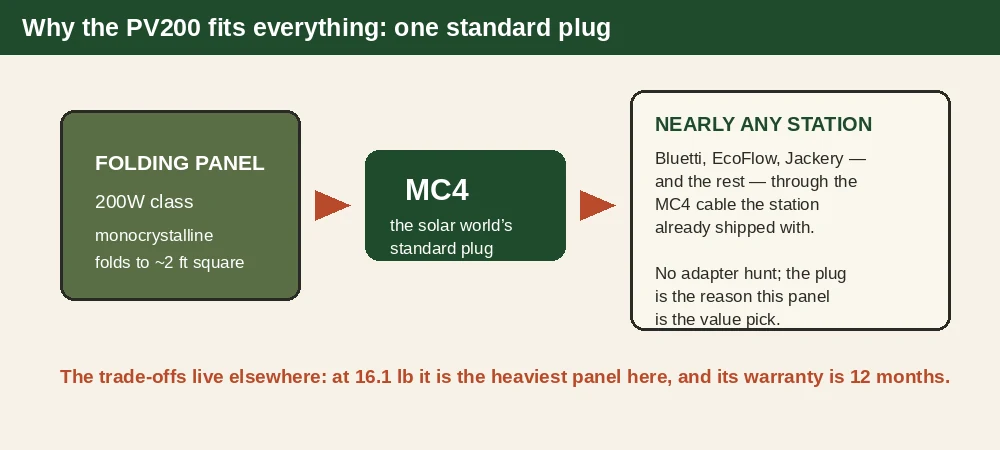
Read the connector row before the watt row. The Bluetti speaks plain MC4, the solar world’s standard plug, so it pairs with nearly any station through the cable that station already shipped with. The EcoFlow ships with its solar-to-XT60 cable in the box. The Jackery’s cable ends in Jackery’s own DC8020 plug — perfect for a Jackery station, an adapter purchase for everything else.
Bluetti PV200 — the value pick that fits everything
The Bluetti PV200 is the panel we would buy first, because it is the cheapest honest watt here and the least likely to strand you on connectors. Our score: 9/10. Amazon’s Buy Box sits at $349 — the price both trackers agree on — and Bluetti’s own store asks the same $349 for its current 200W panel (now listed there as the SP200L, pre-order shipping from October 29). Call it $1.75 per rated watt, against $1.81 for the EcoFlow and $1.90 for the Jackery. The panel is 200W of monocrystalline cells at up to 23.4% efficiency, Voc 26.1V, Vmp 20.5V, Imp 9.7A, with standard MC4 connectors, an ETFE coating, and an IP65 junction box. It folds to roughly a two-foot square and weighs 16.1 pounds — the heaviest here, and the owners notice.
Keepa’s record shows 4.4 stars across about 1,218 ratings, the deepest owner base of the three. The praise that repeats: it just works with whatever station people already own, Bluetti or not, and Outdoor Life’s side-by-side test measured 178W from it in full sun — about 89% of rating, the honest end of this class. The complaints repeat too: the weight, kickstands owners call fiddly in wind, and a warranty that is only 12 months on Bluetti’s US spec table while Jackery below covers you for years. If a panel lives in your garage between outages, the weight matters less than the price; if it lives in your car, read the next two sections first.
Pros: lowest price per watt; universal MC4; deepest owner record here; strong measured output. Cons: heaviest at 16.1 lb; 12-month warranty; IP65 junction box, not a panel you leave out in storms.
Buy it if your station is not a Jackery, or your budget is the deciding factor. Skip it if you will carry the panel any distance, or the short warranty bothers you.
Check the current price at Bluetti →
EcoFlow NextGen 220W Bifacial — the most watts in the lightest frame
The EcoFlow NextGen 220W Bifacial is the output leader: 220W from the front face, with a bifacial rear face rated at 175W for whatever light bounces up from pale ground. Our score: 8/10. EcoFlow claims 25% efficiency from N-type TOPCon cells, with Voc 21.4V and an IP68 rating — the toughest weather spec here. The panel itself weighs 5.1 kg (about 11 lb) on EcoFlow’s spec sheet, the lightest carry of the three, folding to about 24 x 24 inches. EcoFlow’s own US store sells it at $399 — the price we verified on October 28, 2026 — which works out to $1.81 per rated watt.
Independent testers back the output claim better than most: OutdoorGearLab measured an average of 193W from this panel, the highest raw number in their folding-panel test. Owner feedback on the current listing is still thin compared with the older 220W model’s record (4.5 stars across about 704 ratings on that discontinued listing), so we are leaning on tester measurements and the spec sheet more than on a deep owner base for the NextGen itself, and we say so plainly. The other honest catch is the warranty: 12 months in the US. And one shopping trap worth naming: the older EcoFlow 220W Bifacial (heavier, 155W rear, different listing) is still sold alongside this NextGen model at similar prices. The NextGen is the one with the 25% efficiency claim and the lighter frame.
Pros: highest rated and measured output; lightest panel here; IP68; XT60 cable included for EcoFlow stations. Cons: thin owner record on the current listing so far; 12-month US warranty; older same-name model invites mix-ups.
Buy it if you own an EcoFlow station and want the fastest single-panel recharge it can take. Skip it if a long owner track record matters more to you than the last 20 watts.
Check the current price on Amazon →
Jackery SolarSaga 200 — the home-team panel
The Jackery SolarSaga 200 is the panel Jackery owners should buy and everyone else should price-check twice. Our score: 8/10. The current version is bifacial, rated 200W at a claimed 24.3% efficiency, Voc 24.8V, Vmp 20V, Imp 10A, IP68, and 13.67 pounds — a genuinely easy carry. It also carries USB-A and USB-C ports on the panel itself, handy for topping a phone while the station charges. The price is the rub: $379 from marketplace sellers on Amazon this week — both trackers agree, and Jackery’s own store matches it at $379 (list $429) — which is $1.90 per rated watt, the most per watt here, though the gap over the Bluetti’s $1.75 is narrower than it used to be.
What the premium buys is fit and coverage. The attached cable ends in Jackery’s DC8020 plug, so an Explorer station takes it with no adapter and no thought, and the warranty runs 3 years plus 2 more — five years of coverage against the other two panels’ one. Keepa’s record shows 4.5 stars across about 282 ratings; owners praise the setup speed and the magnetic handles, and complain about exactly what you would predict: the price, and needing an adapter the moment the panel meets a non-Jackery station. In Outdoor Life’s test it measured 184W in sun, between the Bluetti and the older EcoFlow — output is not what the extra money is for.
Pros: plug-and-play with Jackery stations; 3+2 year warranty; light at 13.67 lb; USB ports on the panel; IP68. Cons: priciest watts here by a wide margin; DC8020 plug needs adapters elsewhere; Amazon-direct stock was out at checking.
Buy it if you own a Jackery Explorer and value the five-year warranty. Skip it if your station is any other brand — the Bluetti gives you the same class of watts for $30 less.
Check the current price on Amazon →
How many real watts do you actually get?
About 160 to 195 watts in strong sun, depending on the panel — never the full rating for long. The ratings are lab numbers (1,000 W/m², 25°C cells, perfect angle). In Outdoor Life’s side-by-side test the Bluetti PV200 measured 178W and the Jackery SolarSaga 200 measured 184W in full sun; OutdoorGearLab averaged 193W from the EcoFlow NextGen 220W. Plan your recharge math at roughly 75–85% of the nameplate and you will not be disappointed; plan at 100% and every panel here will feel broken by 3 p.m.
Will this panel plug into your power station?
The Bluetti PV200 plugs into the widest range of stations, because MC4 is the standard connector and most stations ship with an MC4 input cable. The EcoFlow NextGen 220W includes its solar-to-XT60 cable, which is what EcoFlow stations take; other brands need their own MC4 cable, which most already have. The Jackery SolarSaga 200 is the odd one out: its cable is hardwired to Jackery’s DC8020 plug, so a non-Jackery station needs a DC8020 adapter before the panel earns anything. Check your station’s solar voltage window too — all three panels sit between 21V and 26V open-circuit, safely inside the input range of the 1kWh-class stations in our apartment backup comparison, and two panels in series stay inside most larger stations’ limits as well.
How long will one panel take to refill your station?
One 200W-class panel refills a 1,000Wh station in roughly a day of good sun, not a morning. Work it honestly: at a realistic 160W average input, a 1,024Wh station needs about six and a half hours of strong sun to fill from empty — which is most of a clear day, and two days in winter or haze. That math is why these panels pair the way they do in our station reviews: one panel keeps a fridge-first load treading water (a typical fridge eats roughly 1,000–1,200Wh a day; see how long a power station runs a refrigerator), and two panels actually get ahead of it. Our Solar Recharge Time Calculator runs the same math for your station and your sun hours.
What does a watt cost, and what does it buy over time?
Price per rated watt is the comparison that survives the marketing: Bluetti PV200 at $1.75, EcoFlow NextGen 220W at $1.81, Jackery SolarSaga 200 at $1.90. Panels have no running cost beyond a replacement cable someday, so the ownership question is really coverage: if the Jackery’s five-year warranty saves one dead panel in year three, its $30 premium over the Bluetti was the cheap option; if all three live a decade in a garage, the Bluetti’s saving was free money. Our solar generator comparison shows how each brand’s stations pair with these panels when you are buying the whole setup at once.
Honest caveats
Three, plainly. First, bifacial gains are real but modest at ground level: the rear face only earns when light bounces up from pale surfaces, so on grass expect the front rating and treat anything extra as a gift. Second, the EcoFlow’s owner record on the current NextGen listing is thin, and look-alike listings are a real trap: the older, heavier 220W Bifacial (a different panel, discontinued at EcoFlow’s own store) still sells on Amazon under a similar name, so check the listing title actually says NextGen before you pay NextGen money. Third, none of these panels should live outdoors permanently: IP65 and IP68 ratings cover splashes and storms, not seasons of UV and weather, and every maker here designs them to fold away.
FAQ
Can I mix panel brands with a different brand of power station?
Yes, as long as the connector matches or adapts and the panel’s open-circuit voltage sits inside the station’s solar input window. MC4 panels like the Bluetti PV200 are the easiest to mix. Brand-matched panels like the SolarSaga 200 and the EcoFlow NextGen are simpler with their own stations, not magically better — the station’s charge controller cannot tell whose logo is on the glass.
Is a 220W panel worth it over a 200W panel?
Only at the right price per watt. The EcoFlow NextGen’s extra 20 rated watts showed up in tester measurements (193W average, the best here), and at $1.81 per watt it is fairly priced. A 220W panel at a big premium over a 200W panel is not — the difference is about half an hour of recharge time on a 1kWh station.
How many solar panels does it take to keep a fridge running day after day?
For a typical fridge using about 1,000–1,200Wh a day, one 200W panel roughly breaks even in good summer sun and falls behind in winter; two panels (400W) keep ahead of the fridge in most of the country most of the year, station size permitting. Your station’s maximum solar input is the ceiling — check it before buying the second panel.
Can I connect two of these panels together?
Yes. Two in parallel double the current at the same voltage; two in series double the voltage. Series is usually the better fit for these low-voltage panels, provided the combined open-circuit voltage — about 42–52V for two of these — stays under your station’s solar input maximum. Never series-connect panels past that limit.
Do folding panels work on cloudy days?
They work at a fraction of rating — roughly a quarter to a fifth of nameplate under heavy overcast in tester measurements. A cloudy day stretches a one-day recharge into three or four. Panels are a fair-weather fuel; size your station battery for the gray stretch, not the panel for the sunny day.
Sources: manufacturer spec pages (Bluetti, EcoFlow, Jackery), Keepa and camelcamelcamel price and rating records and the makers’ own stores checked October 27–28, 2026, Outdoor Life and OutdoorGearLab published panel tests, and aggregated owner reviews. Prices last checked: October 28, 2026. Last updated: October 30, 2026.
Talk it over with other readers. The Truly Preserved Community on Facebook is where readers compare notes on food storage, water, and backup power — and where your questions help decide what we research next. Join the group →