
Affiliate Disclosure: Truly Preserved is reader-supported. When you buy through links on this page, we may earn a commission at no extra cost to you. As an Amazon Associate, Truly Preserved earns from qualifying purchases. Learn more.
How much water does a family of four need for two weeks? The short answer is 56 gallons — and the honest answer is that 56 is where the math starts, not where it ends. A family of four normally uses more than 300 gallons a day at home, according to the EPA. The emergency figure is 4 gallons a day for the whole household. That gap is why people read the official number, assume they misread it, and go looking for a chart that explains what the gallon actually covers. This page is that chart, with the extras put in numbers instead of warnings. It is built from the published guidance of Ready.gov, the CDC, the EPA, FEMA and the American Red Cross, checked against each other on October 22, 2026. We don’t sell water and we don’t store yours; we did the homework so the number you plan around is the number your household will actually use. If you want the number for your own household size, our Food & Water Planner runs the same math, and the Preserve the Water hub covers the containers and filters that go with it.
The Short Version
Store 56 gallons for a family of four for two weeks. That is 4 people × 14 days × 1 gallon per person per day — the baseline Ready.gov, the CDC, FEMA and the Red Cross all publish. It covers drinking, basic cooking and basic hygiene. It does not cover showers, laundry or flushing. Add water on top of the 56 if your summers are hot, if anyone is pregnant, nursing or sick, if your food plan leans on freeze-dried meals, or if you have pets — the sections below turn each of those into a number. A realistic total for a hot-climate family of four eating freeze-dried dinners with a 50-pound dog in the house lands near 100 gallons.
How we got these numbers: We read the current Ready.gov, CDC, EPA, FEMA and Red Cross guidance side by side, used their shared 1-gallon baseline, and computed every household total on this page from it — including the pet math (about 1 ounce per pound of body weight per day) and the freeze-dried rehydration math (about ¾ to 1 cup per serving). Where a figure is a planning estimate rather than official guidance, the text says so. Read our full methodology.
The Math: Gallons by Household and Days
| Household | Per day | 3 days | 1 week | 2 weeks | 30 days | Best for |
|---|---|---|---|---|---|---|
| 1 person | 1 gal | 3 gal | 7 gal | 14 gal | 30 gal | — |
| 2 people | 2 gal | 6 gal | 14 gal | 28 gal | 60 gal | — |
| 3 people | 3 gal | 9 gal | 21 gal | 42 gal | 90 gal | — |
| 4 people | 4 gal | 12 gal | 28 gal | 56 gal | 120 gal | This page’s household |
| 5 people | 5 gal | 15 gal | 35 gal | 70 gal | 150 gal | — |
| 6 people | 6 gal | 18 gal | 42 gal | 84 gal | 180 gal | — |
Baseline: 1 gallon per person per day (Ready.gov; CDC). The Red Cross splits the same supply two ways: a 3-day supply for evacuation and a 2-week supply for home. Build in that order — 12 gallons first, then 28, then 56.
The 2-week column from that table, drawn out:
What Does the One Gallon Actually Cover — and What Does It Leave Out?
The one gallon per person per day covers drinking, cooking and brushing teeth, in the CDC’s words, plus basic sanitation like handwashing and a basin wash. The older FEMA and Red Cross wording splits it plainly: about two quarts to drink and two quarts for food preparation and sanitation. A normally active person needs about three quarters of a gallon of fluid a day from water and other drinks combined, Ready.gov notes — the rest of the gallon is the cooking and washing share.
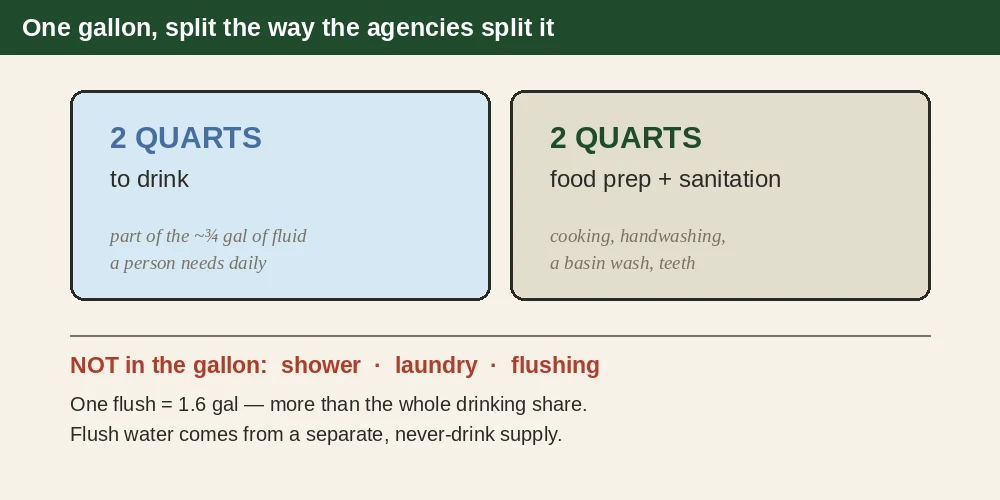
What it leaves out matters more. The gallon does not cover a shower, a load of laundry, or flushing. A standard toilet uses 1.6 gallons per flush — one flush spends more than a person’s whole daily drinking share. A family of four flushing as usual would burn through 25 gallons a day or more on toilets alone. Keep a separate supply of water you would never drink — a filled bathtub, a rain barrel, pool water — for flushing, and let the stored 56 gallons stay drinking water. Our Household Emergency Checklist walks the rest of the house on the same split.
How Long Will a 55-Gallon Drum Last a Family of Four?
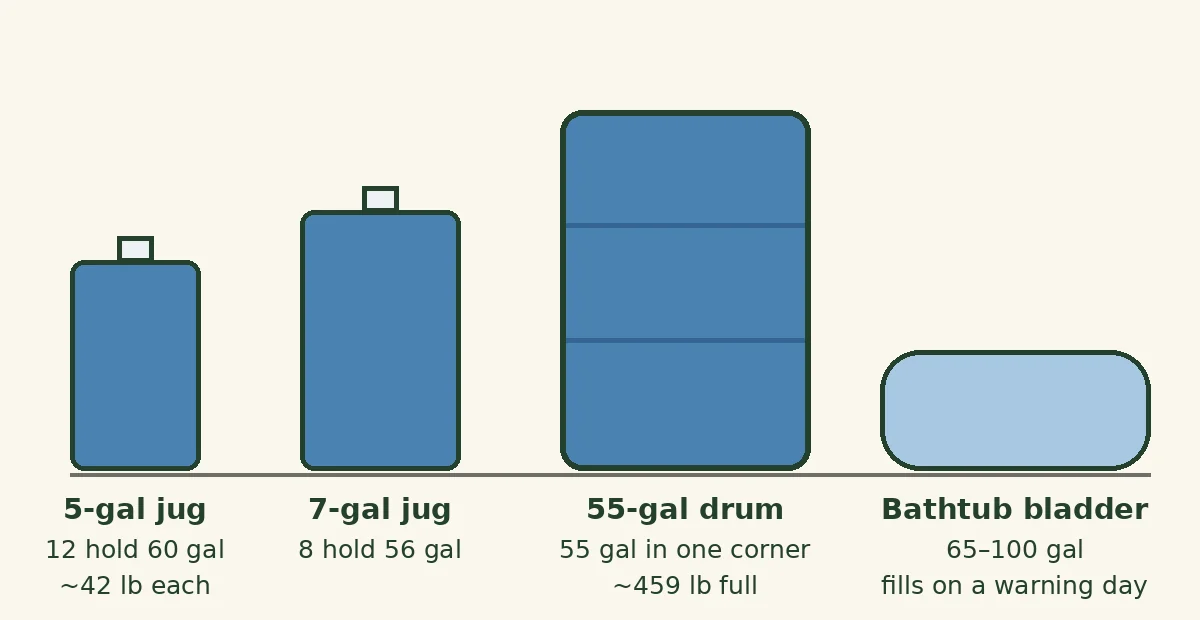
A 55-gallon drum lasts a family of four 13.75 days at the baseline — it is 1 gallon short of two weeks. That is the most useful awkward fact in water storage: the container everyone buys first does not quite hold the supply everyone is told to store. One drum plus a single 5-gallon jug gets you to 60 gallons and a small cushion. Two drums hold 110 gallons, which is 27.5 days at the baseline and just under the 112-gallon comfortable target below.
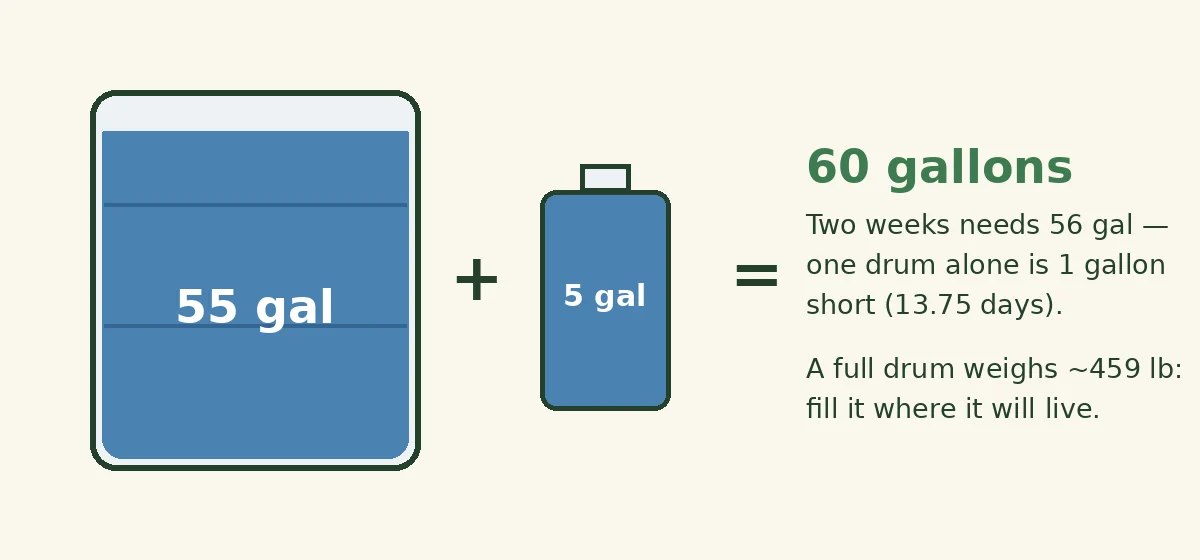
The drum has a second catch: at 8.34 pounds per gallon, 55 gallons of water weighs about 459 pounds before the drum itself. You fill it where it will live, on a ground floor or slab, and you get water out of it with a pump — it is never moving again. If that trade sounds wrong for your house, the same 56 gallons fits in twelve 5-gallon jugs at about 42 pounds each. We compare the drum, the stackable jugs and the bathtub bladder head to head in our water storage containers comparison, linked from the Preserve the Water hub.
How Much Extra Water Do You Need in Hot Weather?
In very hot temperatures, water needs can double — that is Ready.gov’s wording, not a prepper rule of thumb. Doubling the baseline takes a family of four from 56 gallons to 112 gallons for two weeks. You do not have to plan for the full double in April. You do have to plan for it if a summer outage with no air conditioning is a real scenario where you live, because a hurricane-season outage is exactly when the heat, the cleanup work and the water outage arrive together.
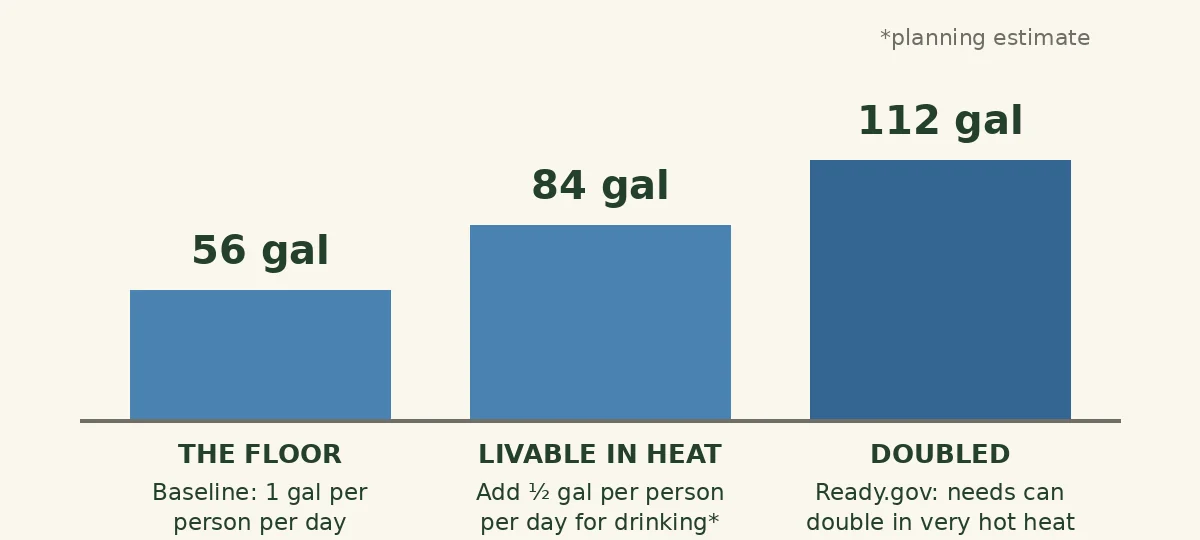
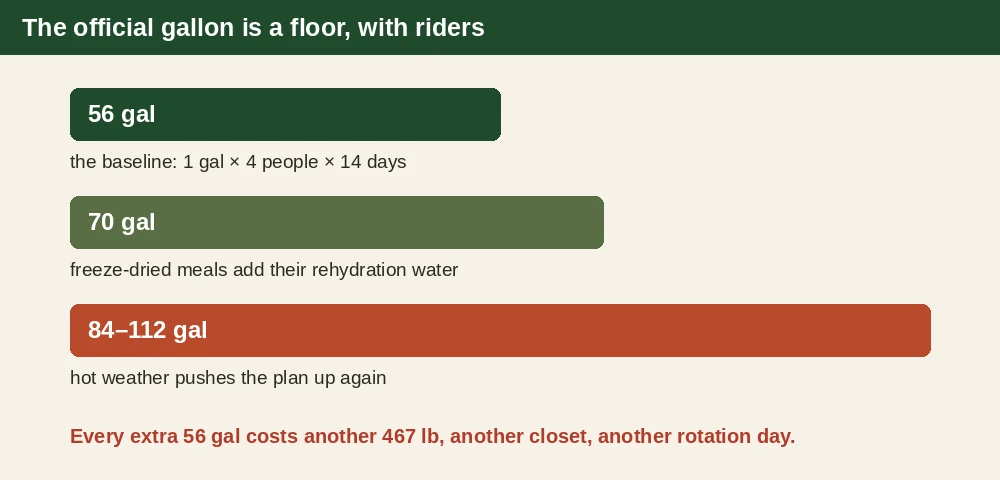
A middle step most charts skip: add half a gallon per person per day for drinking alone in serious heat and you land at 84 gallons for the family. That is a defensible planning estimate — it is not official guidance, and the post labels it that way on purpose. Pick your row with your eyes open: 56 is the floor, 84 is livable in heat, 112 is the doubled official warning taken at face value.
How Much Water Do Freeze-Dried Meals Use?
Freeze-dried meals use about ¾ to 1 cup of water per serving, and a household eating them three times a day spends roughly an extra gallon a day on rehydration alone. This is the extra our own readers are most likely to miss, because the bucket in the pantry says how many servings it holds and never says where the water comes from. It comes from the same 56 gallons.
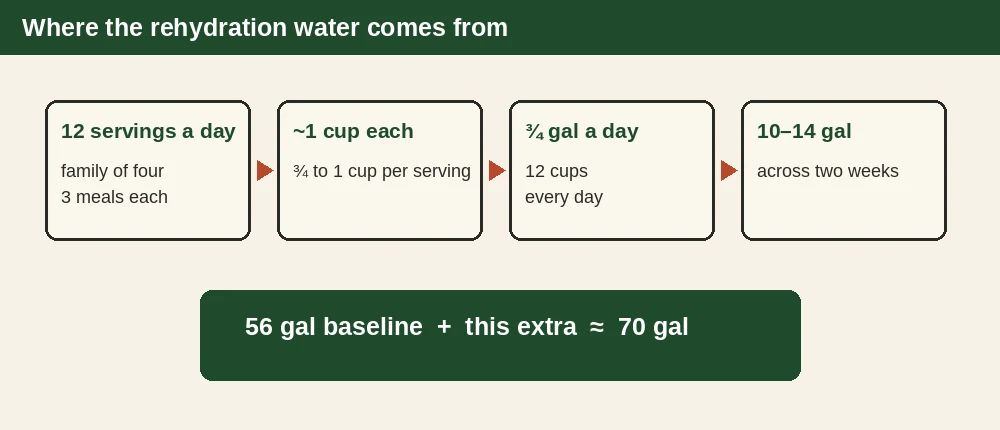
Run it for a family of four: three servings each is 12 servings a day, at about 1 cup each that is 12 cups — ¾ of a gallon — every day, or about 10 to 14 extra gallons across two weeks. Add that to the baseline and the freeze-dried-heavy household needs about 70 gallons, not 56. Eating the food dry does not dodge the bill; it rehydrates in your stomach instead of the bowl and the water comes out of you either way. Our freeze-dried kit reviews on the Starter Kit Reviews page count servings the same honest way.
How Much Water Does a Dog or Cat Need for Two Weeks?
A 50-pound dog needs about 5.5 gallons for two weeks; a 10-pound cat needs about 1 gallon. Pet water is not inside the 1-gallon-per-person figure — the CDC lists pets as a reason to store more, and Ready.gov gives no number, which is why most charts just say “ask your vet” and stop. The working rule vets use is about 1 ounce of water per pound of body weight per day for dogs. A 20-pound dog drinks about 20 ounces a day, or 2.2 gallons in two weeks. An 80-pound dog drinks about 80 ounces a day, or 8.8 gallons. Cats run about 4 ounces per 5 pounds a day, so a 10-pound cat needs roughly 8 ounces a day — under a gallon for the whole two weeks.
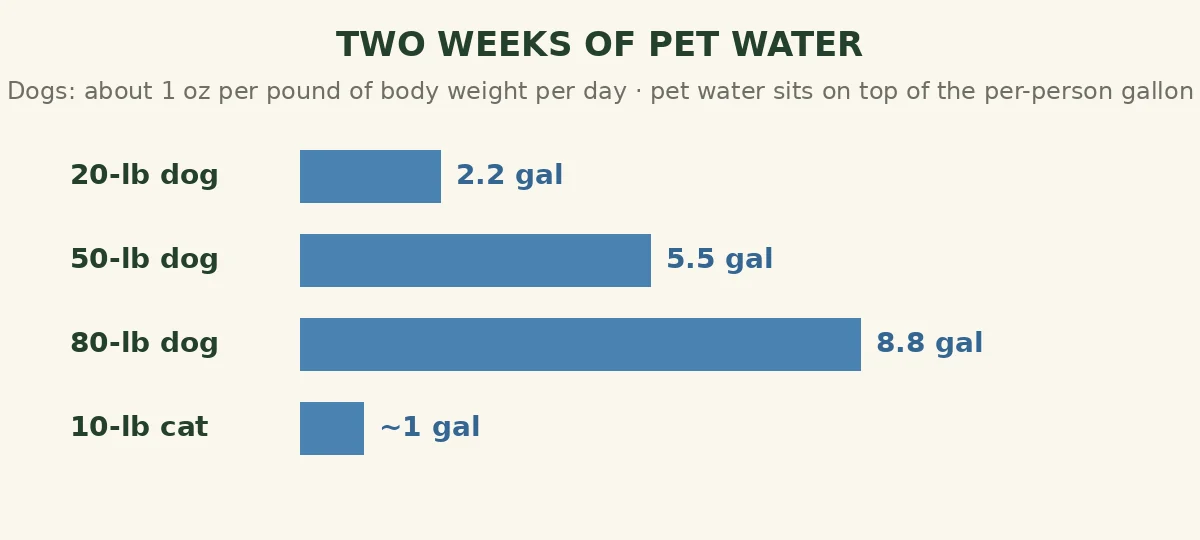
You may see other charts add a flat gallon per day per pet. That shortcut overstates a cat’s need by more than ten times and only roughly fits a very large dog in heat. Weigh your own animal, do the ounce math, and then measure what it actually drinks in a normal week — a bowl you fill every morning tells you more than any table, including this one.
How Heavy Is Two Weeks of Water, and Where Can You Put It?
Two weeks of water for a family of four weighs about 467 pounds. Water weighs 8.34 pounds a gallon no matter what you store it in: 56 gallons is 467 pounds, 84 gallons is about 700 pounds, and 112 gallons is about 934 pounds, before the containers. That weight decides where the water can live. A full drum belongs on a slab or ground floor. Jugs spread across closets and under beds spread the load with them — one reason smaller containers suit apartments and upper floors, where no one should stack half a ton in one corner without knowing what the floor can carry. We are not going to bless a floor from here; we will state the weight plainly and let you check yours.
Wherever it sits, the CDC’s storage conditions are the same: cool, between 50°F and 70°F, out of direct sunlight, and away from gasoline, pesticides and cleaning chemicals — plastic can take up vapors from what sits next to it. A closet that meets those conditions beats a hot garage full of mower fuel, even if the garage has more room.
How much the stored water weighs
Water alone, at 8.34 lb a gallon, before the containers.
What Does 56 Gallons Look Like in Jugs, Drums and Cases?
56 gallons looks like twelve 5-gallon jugs, eight 7-gallon jugs, eighteen cases of bottled water, or one drum plus one jug. In stackable 5-gallon containers, twelve jugs hold 60 gallons and split the supply into 42-pound pieces one person can carry to a sink on rotation day. In a 55-gallon drum kit, the same supply is one corner, one pump, and the lowest cost per gallon of any rigid container — with the 1-gallon shortfall above. A bathtub bladder is a different tool: it stores nothing on a normal day and holds 65 to 100 gallons the day a storm is forecast, which makes it a good flushing and washing layer on top of stored drinking water, not a replacement for it.
Two more sources are already in your house. A water heater holds 30 to 50 gallons you can drain in an emergency, and the water in toilet tanks — tanks, never bowls, and only if no chemical cleaner lives in them — can be disinfected and used. Count both as backup, not toward the stored 56: the day you need them is the day you find out whether they were usable.
How Often Do You Have to Replace Stored Water?
Replace water you filled yourself every 6 months. That is the CDC and Ready.gov interval, and the easy way to keep it is to tie rotation to the clock changes in spring and fall: dump the old water on the garden, wash and sanitize the containers, refill, and write the new date on the label. Sanitizing, per the CDC, is 1 teaspoon of unscented household bleach (5% to 9% sodium hypochlorite) mixed in 1 quart of water, shaken to coat every inside surface, left at least 30 seconds, poured out, and air-dried before filling.
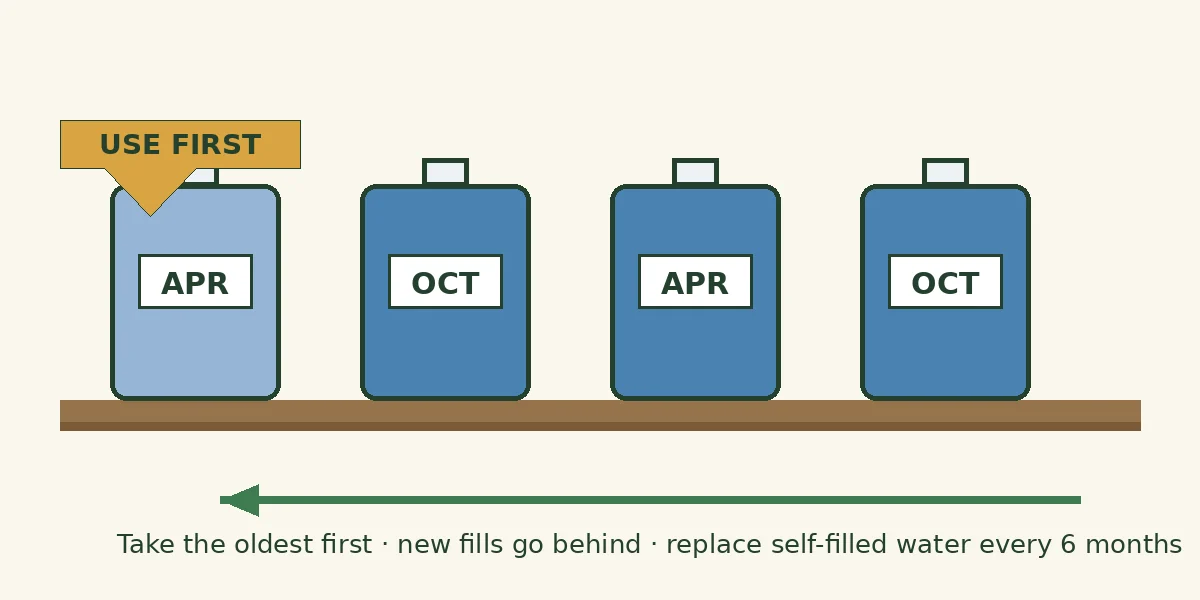
Store-bought bottled water plays by a different clock: follow the date on the bottle. The FDA does not require an expiration date on bottled water and treats properly stored sealed water as having no set shelf-life limit — the printed date is the maker’s best-by for taste and packaging, usually one to two years. Water preserver products claim treated water keeps up to 5 years; that is a manufacturer claim, not CDC guidance, and this page keeps the 6-month rotation as the recommendation and the claim labeled as a claim. However long you store it, filter stored tap water at drinking time if taste is the only complaint, and discard any container that smells of chemicals or turns cloudy or green.
How Do You Make Water Safe If the Stored Supply Runs Out?
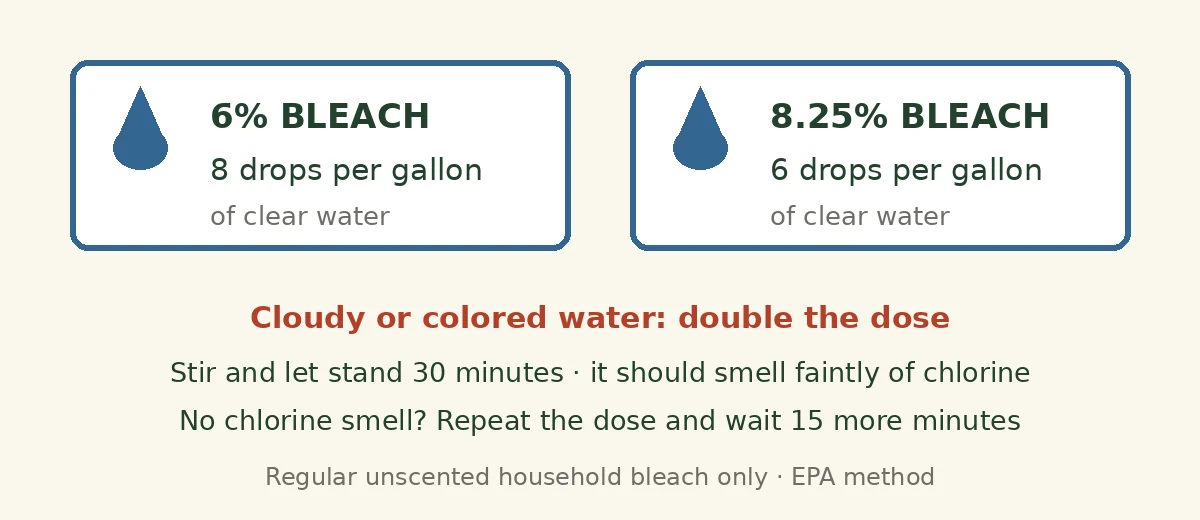
Boiling is the surest way to make water safe: a rolling boil for 1 minute, or 3 minutes above 6,500 feet, after filtering cloudy water through a clean cloth or coffee filter. If you cannot boil, the EPA’s bleach method uses regular unscented household bleach — check the percentage on the label, because the dose changes with it. For clear water, add 8 drops of 6% bleach per gallon, or 6 drops of 8.25% bleach per gallon; double the dose if the water is cloudy or colored; stir and let it stand 30 minutes. It should smell faintly of chlorine. If it does not, repeat the dose and wait 15 more minutes.
Know what neither method does. Boiling and bleach handle germs. They do not remove fuel, pesticides, heavy metals or salt, and bleach is weak against Cryptosporidium — boiling is the reliable answer for surface water. A good filter earns its place here as the everyday layer: our water filter comparison covers what each home system actually removes, with the lab reports, for the day stored water is not the water you are drinking. And one rule from Ready.gov that cuts against instinct: never ration drinking water unless authorities order it. Drink what you need today, reduce activity, stay cool, and find more for tomorrow. Dehydration harms faster than an empty jug does.
Honest Caveats
The “FEMA’s number is too low” argument is half right. Plenty of experienced preparers plan on 2 gallons per person per day and call the official gallon a survival figure. They are right that it is not comfortable — no showers, no laundry, basin washing. The official sources never claimed otherwise: the gallon is a floor with “store more if” riders attached, and this page’s scenario math (70 with freeze-dried food, 84 to 112 in heat) is how you act on those riders instead of just reading them.
Over-storing has a cost too. Every extra 56 gallons is another 467 pounds, another closet, and another rotation day. Water stored in a hot garage and skipped at rotation becomes dead inventory you trust and should not. If two weeks will not fit where you live, store what fits — the guidance itself says to store as much as you can — and put the difference into a filter, a bathtub bladder for warning days, and knowing where your water heater drain is.
Medical needs cut both ways. Fever, vomiting and wound care raise a person’s water need. Some equipment, like a CPAP humidifier, needs a specific kind of water in small amounts. And some conditions — kidney disease and heart failure among them — come with clinician-set fluid limits, where drinking more is the harm. No table on this page can set that number for your household. If someone in your house has a medical condition, their care team sets the figure and the type; plan the storage around their answer.
Frequently Asked Questions
Is one gallon per person per day really enough?
It is enough for the job it was written for: drinking and basic hygiene for a short disruption, per Ready.gov and the CDC. It is a floor, not a comfort level. Heat can double the need, and illness, pregnancy, nursing and hard physical work all push it up — which is why the same sources that publish the gallon also tell you to store more when those apply.
How much water should a family of four store?
At the baseline, 12 gallons for three days, 28 gallons for a week and 56 gallons for two weeks. Add for your own extras on top of that: about 14 gallons if the food plan is freeze-dried-heavy, about 5.5 gallons for a 50-pound dog, and up to double in serious heat. Many real households land between 70 and 112 gallons for two weeks.
Does the gallon include water for flushing the toilet?
No. The planning gallon covers drinking, cooking and basic hygiene. A single standard flush uses about 1.6 gallons, so normal flushing would spend the whole emergency supply in days. Keep a separate non-drinking supply — a filled bathtub, rain barrel or pool water — for flushing.
How much water does a pet need in an emergency?
About 1 ounce per pound of body weight per day for a dog: roughly 2.2 gallons over two weeks for a 20-pound dog and 5.5 gallons for a 50-pound dog. A 10-pound cat needs about 8 ounces a day, under 1 gallon for two weeks. Pet water is on top of the per-person gallon, not inside it.
Should I store water for three days or two weeks?
Both, in that order. The Red Cross frames it as a 3-day supply for evacuation and a 2-week supply for home. Start with the 12 gallons a family of four needs for three days, carry some of it in the car kit, then build the at-home supply toward 56 gallons in stages as space and budget allow.
Is it safe to drink less to make water last longer?
No. Ready.gov’s guidance is explicit: never ration drinking water unless authorities order you to. Drink the amount you need today and look for more tomorrow. You lower the body’s need by reducing activity and staying cool — not by shorting the glass in front of you.
Sources: Ready.gov (Build a Kit; Water), CDC “How to Create and Store an Emergency Water Supply” and “Making Water Safe in an Emergency,” EPA Emergency Disinfection of Drinking Water and WaterSense statistics, FEMA/Red Cross “Food and Water in an Emergency,” Ready Store freeze-dried serving data, WebMD/PetSafe pet hydration guidance. Prices last checked: October 22, 2026. Last updated: October 22, 2026.
Talk it over with other readers. The Truly Preserved Community on Facebook is where readers compare notes on food storage, water, and backup power — and where your questions help decide what we research next. Join the group →