
Truly Preserved is reader-supported. If you buy through a link on this page we may earn a commission at no extra cost to you. Nobody pays for placement or scores.
THE SHORT ANSWER
Standard tomato sauce is tomatoes pressed as for juice, then simmered down — the volume reduced by about one-third for thin sauce or by one-half for thick sauce. Every jar gets acid before filling (1 tablespoon bottled lemon juice or ¼ teaspoon citric acid per pint; 2 tablespoons or ½ teaspoon per quart), the headspace is ¼ inch, and pints process 35 minutes and quarts 40 minutes in a boiling-water canner at 0–1,000 feet, with pressure-canner options in the tables below. Every figure on this page comes from the USDA’s tested procedure, credited at the bottom.
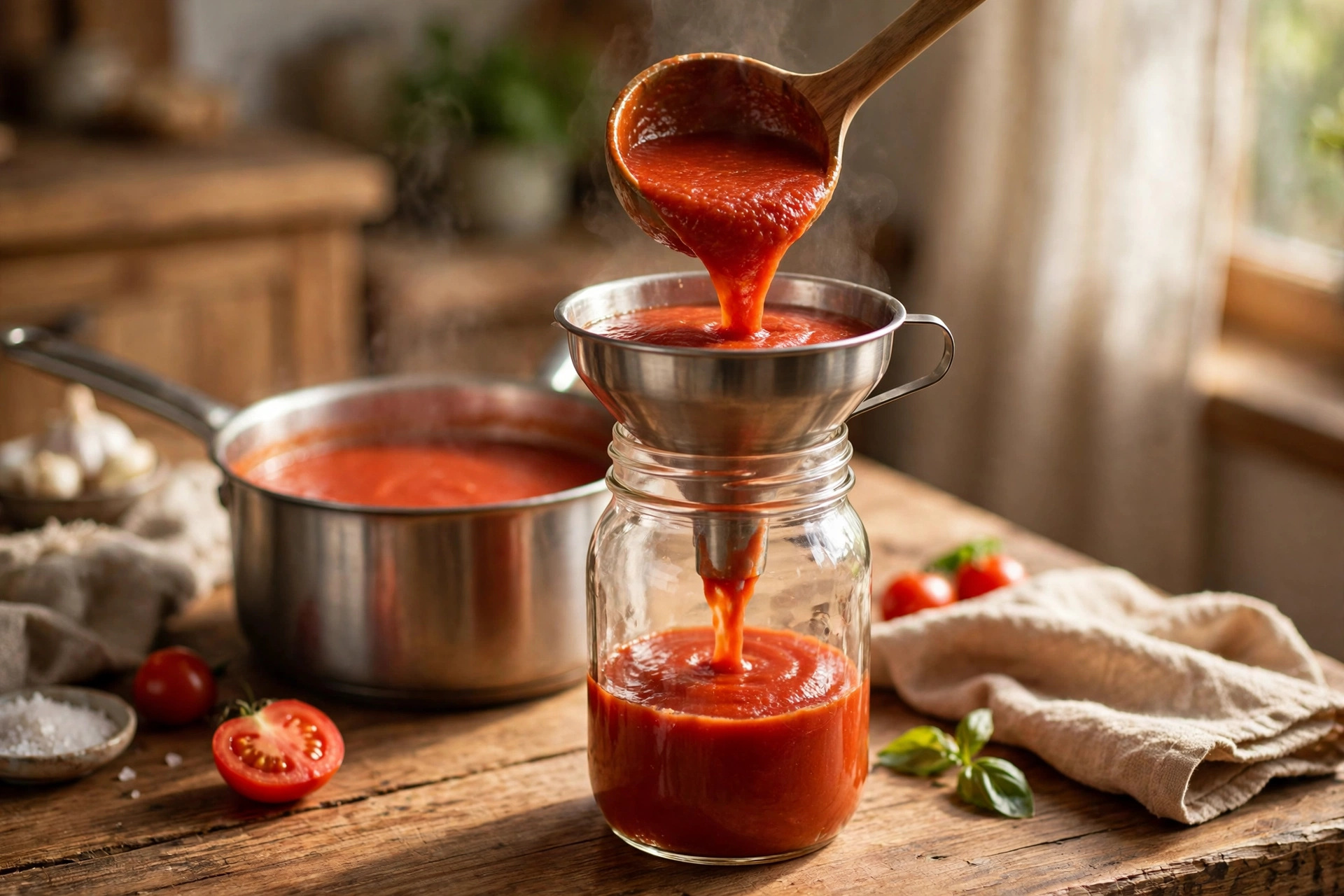
Plain tomato sauce is the most useful jar in the tomato run: no seasoning commitments, no chunks to argue about, just a smooth base that becomes pasta sauce, pizza sauce, soup, or stew in the winter. It is also the tomato product where the cooking happens before the canning — the reduction is what makes it sauce.
This guide follows the USDA’s tested “Standard Tomato Sauce” procedure exactly, in both its thin and thick versions and with both canners the source gives. If you are putting up the tomatoes themselves instead, how to can tomatoes covers the whole, halved, and crushed procedures. This guide is part of our preservation guides; if you are still choosing equipment, water bath or pressure canner — which should a beginner buy explains why sauce can go either way.
What You Need
The amounts depend on the sauce you want. For thin sauce, an average of 35 pounds of tomatoes is needed per canner load of 7 quarts and 21 pounds per load of 9 pints; a bushel weighs 53 pounds and yields 10 to 12 quarts of sauce, an average of 5 pounds per quart. For thick sauce, an average of 46 pounds is needed per 7 quarts and 28 pounds per 9 pints; a bushel yields 7 to 9 quarts, an average of 6½ pounds per quart. You also need bottled lemon juice or citric acid for every jar, a large-diameter saucepan for the reduction, jars with new lids, and canning salt if you want it — 1 teaspoon per quart, for flavor only.

Granite Ware 21.5-Quart Water Bath Canner
A 21.5-quart water bath canner is the classic route for acidified tomato sauce and holds a full 7-quart load while the sauce simmers down beside it.
Check Availability
Ball Half-Pint Mason Jars, 12-Pack
Half-pint jars portion sauce for small households and single meals — one jar, one dinner, nothing left open in the fridge.
Check Availability
Ball Regular Mouth Canning Lids, 96 Count
Flat lids are single-use and sauce day is a long run of jars. The 96-count box keeps a fresh lid on every jar without a mid-season reorder.
$36.99 from AmazonBefore You Start
Two things are settled before the first jar is filled. First, the acid: the USDA requires bottled lemon juice or citric acid in every jar of tomato sauce, for pressure canning as well as boiling-water canning — 1 tablespoon of bottled lemon juice or ¼ teaspoon of citric acid per pint, 2 tablespoons or ½ teaspoon per quart. Second, the thickness: thin sauce is reduced by about one-third of its volume and thick sauce by about one-half, and the amount of tomatoes you need changes with that choice, so decide before you start pressing tomatoes, not after.
How to Can Tomato Sauce, Step by Step
- Press the tomatoes. Prepare and press the tomatoes as for making tomato juice — washed, trimmed, heated, and run through a sieve or food mill so skins and seeds stay behind.
- Reduce the sauce. Simmer in a large-diameter saucepan until the sauce reaches the consistency you want: boil until the volume is reduced by about one-third for thin sauce, or by about one-half for thick sauce.
- Acidify the jars. Add the acid to each jar before filling: 1 tablespoon bottled lemon juice or ¼ teaspoon citric acid per pint; 2 tablespoons or ½ teaspoon per quart. Add 1 teaspoon of salt per quart, if desired.
- Fill the jars. Fill jars with the hot sauce, leaving ¼-inch headspace.
- Close the jars. Wipe each rim clean, center a new lid, and screw the band down fingertip-tight.
- Process. Use the time for your jar size, canner, and altitude in the tables below — boiling-water, dial-gauge, and weighted-gauge options are all tested for this sauce.
- Rest and check. Lift the jars out, let them cool undisturbed, and check every seal before the jars go on the shelf.
The Numbers: Times, Pressures, and Amounts
Boiling-water canner:
| Style of pack | Jar size | 0–1,000 ft | 1,001–3,000 ft | 3,001–6,000 ft | Above 6,000 ft |
|---|---|---|---|---|---|
| Hot | Pints | 35 min | 40 | 45 | 50 |
| Hot | Quarts | 40 | 45 | 50 | 55 |
Pressure canner, dial gauge — pints or quarts, one complete row:
| Jar size | Process time | Dial gauge, 0–2,000 ft | Dial gauge, 2,001–4,000 ft | Dial gauge, 4,001–6,000 ft | Dial gauge, 6,001–8,000 ft |
|---|---|---|---|---|---|
| Pints or quarts | 20 min | 6 lb | 7 lb | 8 lb | 9 lb |
| Pints or quarts | 15 min | 11 lb | 12 lb | 13 lb | 14 lb |
Pressure canner, weighted gauge — pints or quarts:
| Jar size | Process time | Weighted gauge, 0–1,000 ft | Weighted gauge, above 1,000 ft |
|---|---|---|---|
| Pints or quarts | 20 min | 5 lb | 10 lb |
| Pints or quarts | 15 min | 10 lb | 15 lb |
| Pints or quarts | 10 min | 15 lb | Not Recommended |
Headspace is ¼ inch for every jar of sauce, whichever canner you use.
Sauce also freezes beautifully, and plenty of cooks freeze the overflow flat instead of running a second canner load. These are the two tools that side of the job runs on.

Nesco VS-12 Vacuum Sealer
For sauce that gets frozen instead of canned — vacuum-sealed portions keep frozen tomato sauce from drying out over a long winter in the freezer.
$108.18 from Amazon
Ziploc Freezer Quart Bags
Quart freezer bags are how frozen sauce stores flat and stacks — one bag is roughly one meal's worth of sauce base.
$26.48 from AmazonCommon Mistakes
Skipping the acid because the sauce tastes tart already. Taste is not the measure. The USDA requires the measured acid in every jar of tomato sauce, pressure-canned jars included, because tomato acidity varies too much to judge by tongue.
Stopping the reduction early. A sauce that has not reduced by about one-third (thin) or one-half (thick) is tomato juice in a sauce jar — thinner than planned, and not the product the procedure describes.
Using tomato-sauce headspace from another recipe. Sauce takes ¼-inch headspace, not the ½ inch used for whole or crushed tomatoes. The number belongs to this procedure.
Seasoning the pot like a finished pasta sauce. This is standard — plain — tomato sauce. The tested procedure covers tomatoes, acid, and optional salt; a sauce built with added vegetables or oil is a different product with no tested process on this page.
Guessing at altitude. Boiling-water times step up at 1,001, 3,001, and above 6,000 feet. Find your band before the canner heats.
Storage and Shelf Life
Store sealed jars in a cool, dark, dry place with the bands removed, labeled with the date and whether the batch is thin or thick. Home-canned tomato sauce holds its best quality for about a year; rotate the shelf so the oldest jars get used first. A jar with a failed seal goes in the refrigerator and gets used within a few days, or gets reprocessed with a fresh lid within 24 hours.
Viewers also searched for these items.

Presto 16-Quart Pressure Canner
A 16-quart pressure canner covers the pressure options in this page's tables — 20 minutes at the lower pressures or 15 at the higher — for pints or quarts.
$151.63 from Amazon
Morton Canning and Pickling Salt, 4 lb
The salt here is optional and for flavor — 1 teaspoon per quart — and this is the pure canning salt the procedure means, with nothing added.
$2.68 from Amazon
Etekcity Digital Kitchen Scale
Sauce planning is by weight — 35 pounds for thin, 46 for thick, per 7 quarts — and a kitchen scale makes the bushel math exact.
$9.99 from AmazonFrequently Asked Questions
Thin or thick sauce — what actually changes?
The reduction and the tomatoes required. Thin sauce boils down by about one-third of its volume and needs an average of 5 pounds of tomatoes per quart; thick sauce reduces by about one-half and needs about 6½ pounds per quart. Processing times are the same.
Does tomato sauce have to be pressure canned?
No. The USDA gives boiling-water times (35 minutes for pints, 40 for quarts at 0–1,000 feet) and pressure options. Either way, the acid in each jar is required.
Why is the headspace only ¼ inch?
Because that is the tested figure for this procedure. Whole and crushed tomatoes use ½ inch; sauce uses ¼ inch. Each product keeps its own number.
Can I add onions, peppers, or herbs to the sauce before canning?
Not under this procedure. Standard tomato sauce is tomatoes, acid, and optional salt. A seasoned salsa is a different tested recipe — see how to can salsa for the one this site publishes.
Procedure, times, and amounts: USDA Complete Guide to Home Canning, Guide 3, “Standard Tomato Sauce,” including the USDA tomato acidification directions, via the National Center for Home Food Preservation.
Prices shown on this page were last checked November 26, 2026 — prices change; check before you buy.
Talk it over with other readers
The Truly Preserved Community on Facebook is where readers compare notes on food storage, water, and backup power — and where your questions help decide what we research next.