
Truly Preserved is reader-supported. If you buy through a link on this page we may earn a commission at no extra cost to you. Nobody pays for placement or scores.
THE SHORT ANSWER
Tomatoes are canned two tested ways on this page. Whole or halved, packed in water: add bottled lemon juice or citric acid to every jar (1 tablespoon lemon juice or ¼ teaspoon citric acid per pint; 2 tablespoons or ½ teaspoon per quart), leave ½-inch headspace, and process pints 40 minutes and quarts 45 minutes in a boiling-water canner at 0–1,000 feet. Crushed tomatoes are hot-packed with the same acid and headspace, at 35 minutes for pints and 45 minutes for quarts. Pressure-canner options for both are in the tables below. Every figure on this page comes from the USDA’s tested procedures, credited at the bottom.
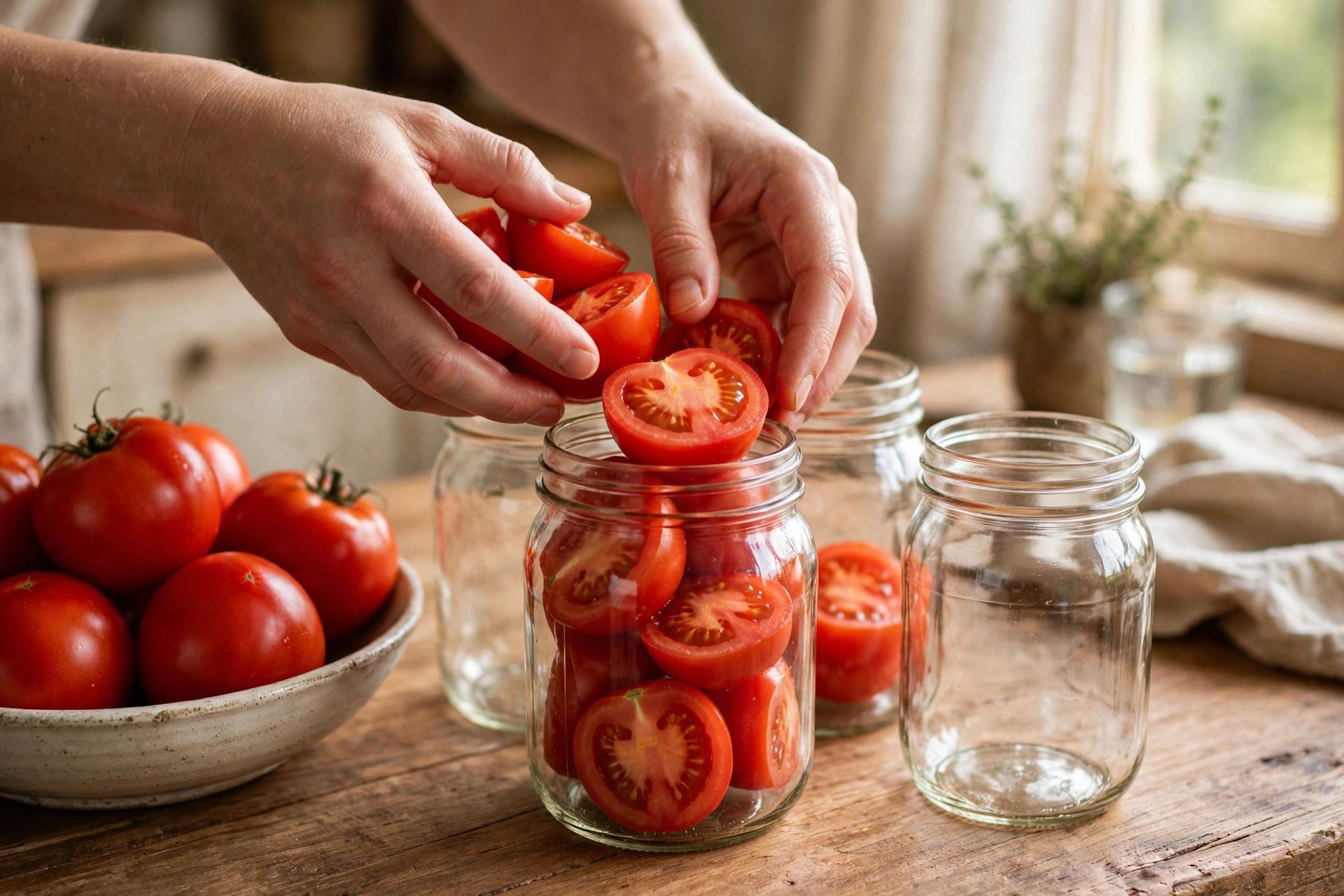
A ripe tomato glut is the best problem a garden makes, and canning is how it becomes January’s sauce, soup, and stew base. Tomatoes sit close enough to the acid line that the USDA acidifies every jar and then gives you a choice of canners — which is exactly why the details on this page matter more than the technique, which is simple.
This guide follows the USDA’s tested procedures exactly, for both whole or halved tomatoes packed in water and crushed tomatoes with no added liquid. If you are still deciding on equipment, water bath or pressure canner — which should a beginner buy lays out the choice, and how to can food in mason jars covers the general process. This guide is part of our preservation guides, and the same acid-first discipline runs our how to can tomato sauce page.
What You Need
For whole or halved tomatoes packed in water, an average of 21 pounds fills a canner load of 7 quarts and an average of 13 pounds fills a load of 9 pints; a bushel weighs 53 pounds and yields 15 to 21 quarts, an average of 3 pounds per quart. For crushed tomatoes, an average of 22 pounds fills 7 quarts and an average of 14 pounds fills 9 pints; a bushel yields 17 to 20 quarts, an average of 2¾ pounds per quart. You also need bottled lemon juice or citric acid for every jar — this is not optional — plus a boiling-water or pressure canner, jars with new lids, and canning salt if you want it: 1 teaspoon per quart, for flavor only.

Granite Ware 21.5-Quart Water Bath Canner
A 21.5-quart water bath canner is the standard route for acidified tomatoes, sized for a full 7-quart load of whole, halved, or crushed tomatoes.
Check Availability
Ball Half-Pint Mason Jars, 12-Pack
Half-pint jars earn their place on tomato day too — small batches for weeknight sauces, and the size to reach for when the last picking won't fill pints.
Check Availability
Ball Regular Mouth Canning Lids, 96 Count
Flat lids are single-use, and tomato season is the biggest canning run of the year. The 96-count box keeps a fresh lid on every jar.
$36.99 from AmazonBefore You Start
Acidification is the whole safety story here. The USDA directs you to add acid to every jar of whole, crushed, or juiced tomatoes, for both boiling-water and pressure processing: per pint, 1 tablespoon of bottled lemon juice or ¼ teaspoon of citric acid; per quart, 2 tablespoons or ½ teaspoon. Vinegar at 5 percent acidity is the third listed option — 2 tablespoons per pint or 4 tablespoons per quart — though the USDA notes it may cause undesirable flavor changes. Sugar may be added to balance the acidic taste, but the acid itself is never left out. Use bottled lemon juice, not fresh: the bottled product is the standardized acid the directions are written around.
How to Can Tomatoes, Step by Step
- Wash and peel. Wash the tomatoes. Dip them in boiling water for 30 to 60 seconds or until the skins split, then dip in cold water. Slip off the skins and remove the cores.
- Add the acid first. Put the acid for your jar size into each hot jar before filling: 1 tablespoon bottled lemon juice or ¼ teaspoon citric acid per pint; 2 tablespoons or ½ teaspoon per quart. Add 1 teaspoon of salt per quart, if desired.
- Whole or halved — raw pack. Leave the tomatoes whole or halve them. Fill hot jars with the prepared raw tomatoes, leaving ½-inch headspace, then cover with boiling water, again leaving ½-inch headspace.
- Whole or halved — hot pack. Put the prepared tomatoes in a large saucepan, add enough water to completely cover them, and boil gently for 5 minutes. Fill hot jars with the hot tomatoes and add the cooking liquid to cover, leaving ½-inch headspace.
- Or make crushed tomatoes. Quarter the peeled tomatoes. Heat one-sixth of the quarters quickly in a large pot, crushing them as they are added so they release juice. Once boiling, gradually add the remaining quarters, stirring constantly — these do not need to be crushed. When all are in, boil gently 5 minutes, then fill jars immediately with the hot tomatoes, leaving ½-inch headspace.
- Close the jars. Wipe each rim clean, center a new lid, and screw the band down fingertip-tight.
- Process. Use the time for your procedure, jar size, canner, and altitude in the tables below. Let the jars cool undisturbed and check every seal before the jars go on the shelf.
The Numbers: Times, Pressures, and Amounts
Whole or halved tomatoes packed in water, boiling-water canner:
| Style of pack | Jar size | 0–1,000 ft | 1,001–3,000 ft | 3,001–6,000 ft | Above 6,000 ft |
|---|---|---|---|---|---|
| Hot and raw | Pints | 40 min | 45 | 50 | 55 |
| Hot and raw | Quarts | 45 | 50 | 55 | 60 |
Crushed tomatoes (no added liquid), boiling-water canner:
| Style of pack | Jar size | 0–1,000 ft | 1,001–3,000 ft | 3,001–6,000 ft | Above 6,000 ft |
|---|---|---|---|---|---|
| Hot | Pints | 35 min | 40 | 45 | 50 |
| Hot | Quarts | 45 | 50 | 55 | 60 |
Pressure canner options — whole or halved, packed in water. Dial gauge (the source gives two time-and-pressure combinations; use one complete row):
| Jar size | Process time | Dial gauge, 0–2,000 ft | Dial gauge, 2,001–4,000 ft | Dial gauge, 4,001–6,000 ft | Dial gauge, 6,001–8,000 ft |
|---|---|---|---|---|---|
| Pints or quarts | 15 min | 6 lb | 7 lb | 8 lb | 9 lb |
| Pints or quarts | 10 min | 11 lb | 12 lb | 13 lb | 14 lb |
Weighted gauge, whole or halved:
| Jar size | Process time | Weighted gauge, 0–1,000 ft | Weighted gauge, above 1,000 ft |
|---|---|---|---|
| Pints or quarts | 15 min | 5 lb | 10 lb |
| Pints or quarts | 10 min | 10 lb | 15 lb |
Pressure canner options — crushed tomatoes. Dial gauge:
| Jar size | Process time | Dial gauge, 0–2,000 ft | Dial gauge, 2,001–4,000 ft | Dial gauge, 4,001–6,000 ft | Dial gauge, 6,001–8,000 ft |
|---|---|---|---|---|---|
| Pints or quarts | 20 min | 6 lb | 7 lb | 8 lb | 9 lb |
| Pints or quarts | 15 min | 11 lb | 12 lb | 13 lb | 14 lb |
Weighted gauge, crushed:
| Jar size | Process time | Weighted gauge, 0–1,000 ft | Weighted gauge, above 1,000 ft |
|---|---|---|---|
| Pints or quarts | 20 min | 5 lb | 10 lb |
| Pints or quarts | 15 min | 10 lb | 15 lb |
| Pints or quarts | 10 min | 15 lb | Not Recommended |
Headspace is ½ inch for both procedures, both packs, and both jar sizes.
Plenty of a tomato glut is better frozen than canned — whole peeled tomatoes and sauce freeze without any acid math at all. These are the two tools that side of the job runs on.

FoodSaver Elite Vacuum Sealer
For the share of the harvest that gets frozen instead of canned — vacuum-sealed bags keep frozen tomatoes and sauce from drying out in the freezer.
$218.56 from Amazon
Ziploc Freezer Quart Bags
Quart freezer bags are the low-effort half of the freezing method — peeled tomatoes and sauce go in flat and stack in the freezer.
$26.48 from AmazonCommon Mistakes
Skipping the acid. Modern tomato varieties vary in acidity, and the USDA’s answer is not to guess: every jar gets its measured lemon juice or citric acid, whichever canner you use.
Using fresh lemon juice instead of bottled. The acidification directions are written for bottled lemon juice, whose acidity is standardized. Fresh lemons vary, and varying acid is the thing this step exists to prevent.
Mixing up the two procedures’ times. Crushed tomatoes and water-packed whole tomatoes have different boiling-water times — 35 minutes for crushed pints against 40 for water-packed pints at low altitude. Match the table to the jar you actually filled.
Guessing at altitude. Above 1,000 feet, boiling-water times step up band by band. Find your band in the table before the canner heats, not after.
Canning tomatoes from dead or frost-killed vines. The USDA’s general tomato guidance is to select disease-free, preferably vine-ripened, firm tomatoes — damaged and overripe fruit does not belong in the jar.
Storage and Shelf Life
Store sealed jars in a cool, dark, dry place with the bands removed, and label each jar with the date and which procedure it was. Home-canned tomatoes hold their best quality for about a year; rotate the shelf so the oldest jars get used first. A jar with a failed seal goes in the refrigerator and gets used within a few days, or gets reprocessed with a fresh lid within 24 hours.
Viewers also searched for these items.

Presto 16-Quart Pressure Canner
A 16-quart pressure canner covers the pressure options in this page's tables and doubles as the low-acid canner for vegetables like green beans.
$151.63 from Amazon
Morton Canning and Pickling Salt, 4 lb
The salt in these procedures is optional and for flavor — 1 teaspoon per quart — and this is the pure canning salt meant, with nothing added to cloud the liquid.
$2.68 from Amazon
Etekcity Digital Kitchen Scale
Both procedures are planned by weight — 21 pounds for a 7-quart load of whole tomatoes — and a kitchen scale makes the load math exact.
$9.99 from AmazonFrequently Asked Questions
Do I really have to add lemon juice to tomatoes?
Yes. The USDA acidification directions require acid in every jar of whole, crushed, or juiced tomatoes, for boiling-water and pressure processing alike: 1 tablespoon of bottled lemon juice or ¼ teaspoon of citric acid per pint, doubled for quarts.
Water bath or pressure canner — which is right for tomatoes?
Both are tested options for acidified tomatoes, with different times. Our how to can food in mason jars guide walks through both methods, and the tables on this page give each canner’s figures.
Can I can tomatoes without adding any liquid?
The crushed-tomato procedure on this page is exactly that — no added liquid, just the tomatoes’ own juice. Whole or halved tomatoes packed in water are the other procedure covered here.
How is this different from canning tomato sauce?
Sauce is cooked down before it is jarred — reduced by about one-third for thin sauce or one-half for thick — and uses ¼-inch headspace instead of ½ inch. See how to can tomato sauce for its own tested figures.
Procedure, times, and amounts: USDA Complete Guide to Home Canning, Guide 3, “Whole or Halved Tomatoes (packed in water)” and “Crushed Tomatoes (with no added liquid),” including the USDA tomato acidification directions, via the National Center for Home Food Preservation.
Prices shown on this page were last checked November 26, 2026 — prices change; check before you buy.
Talk it over with other readers
The Truly Preserved Community on Facebook is where readers compare notes on food storage, water, and backup power — and where your questions help decide what we research next.