
Truly Preserved is reader-supported. If you buy through a link on this page we may earn a commission at no extra cost to you. Nobody pays for placement or scores.
THE SHORT ANSWER
Pickled peppers, marinated style: take 4 pounds of firm peppers — bell, Hungarian, banana, or jalapeño — slash 2 to 4 slits in each, blister and peel, flatten, then cover with a boiling marinade of 2 cups of white vinegar (5 percent), 1 cup of bottled lemon juice, and 1 cup of olive or salad oil with oregano and onion, at 1/2 inch of headspace, and process half-pints or pints 15 minutes in a boiling water canner at 0–1,000 feet. The batch makes about 9 half-pints. This is the tested pepper recipe that contains oil, and its acid — bottled lemon juice and vinegar together — is exactly why it works. Every figure on this page comes from the USDA’s tested recipe, credited at the bottom.
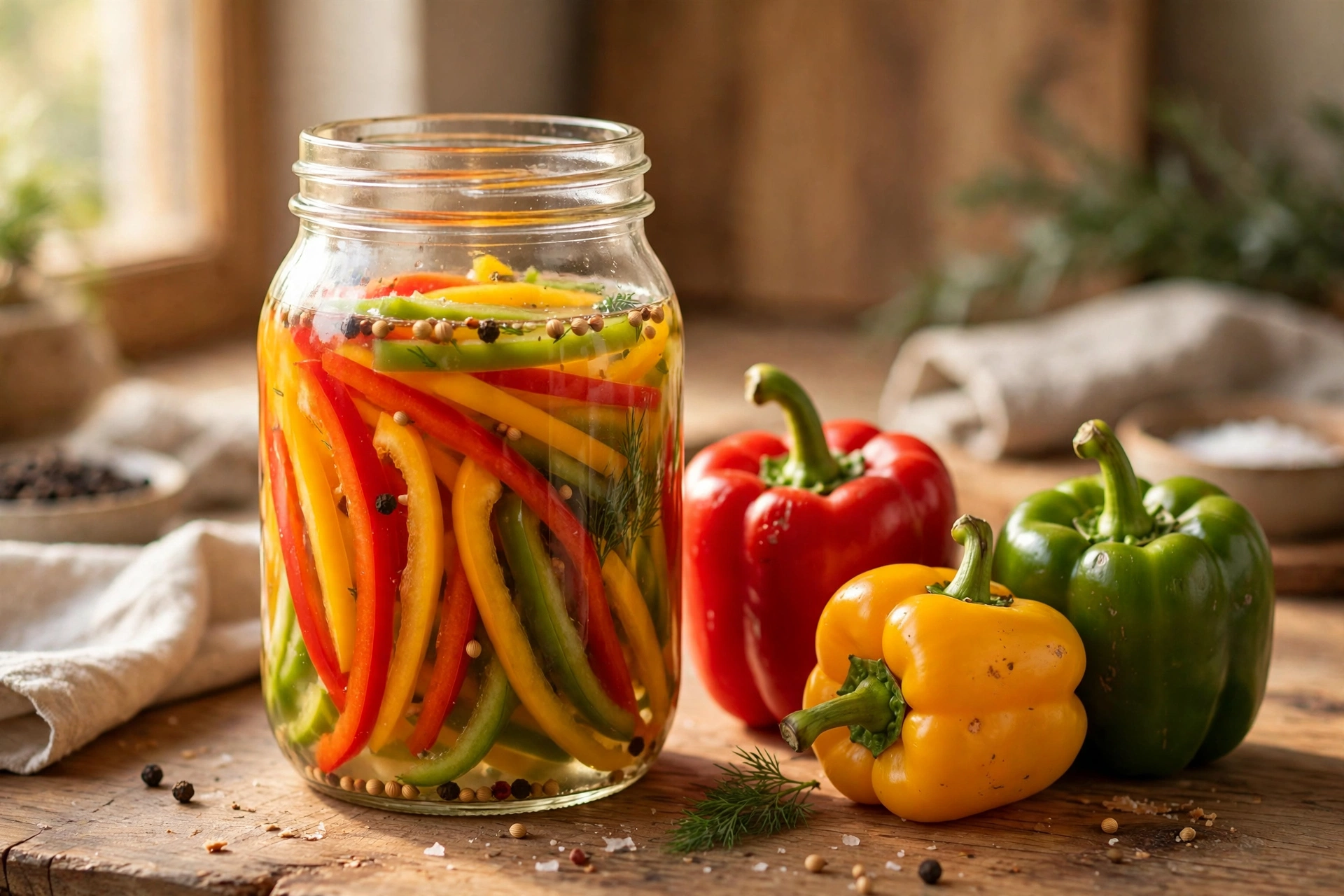
Marinated peppers are the deli-style jar: soft, glossy peppers in an herbed oil-and-vinegar marinade, ready for sandwiches, antipasto plates, and pizza. They are also the recipe readers most often try to improvise — peppers in oil feels like something a store sells, so it feels like something a kitchen can freestyle. It cannot. Oil over a low-acid vegetable is a serious safety problem unless the acid is there in tested proportions, and this USDA recipe is the tested version: a measured cup of oil against bottled lemon juice and vinegar.
This guide is part of our preservation guides, and it follows the tested procedure exactly — its quantities, its headspace, and its minutes — rather than a family version adjusted by feel. If you are new to the canner itself, how to can food in mason jars walks the general water-bath process start to finish, and our flagship dill pickle guide covers the cucumber side of the same method. For the oil-free pepper pickle, see pickled jalapeños, which uses the hot peppers procedure from the same guide.
What You Need
The USDA recipe, as written: 4 pounds of firm peppers (bell, Hungarian, banana, or jalapeño); 1 cup of bottled lemon juice; 2 cups of white vinegar (5 percent); 1 tablespoon of oregano leaves; 1 cup of olive or salad oil; 1/2 cup of chopped onions; 2 cloves of garlic, quartered (optional); and 2 tablespoons of prepared horseradish (optional). Salt goes in per jar, below. The yield is about 9 half-pints.

Granite Ware 21.5-Quart Water Bath Canner
A boiling-water canner is the processing method every tested pickle procedure on this page uses, and this 21.5-quart model holds a full batch of jars at a rolling boil.
Check Availability
Ball Half-Pint Mason Jars, 12-Pack
The marinated pepper recipe yields about 9 half-pints and is processed in half-pints or pints, so this half-pint case matches the stated yield jar for jar.
Check Availability
Ball Regular Mouth Canning Lids, 96 Count
New lids are what the procedure assumes when it says to adjust lids and process; a fresh flat on every jar is how the seal the storage section depends on actually forms.
$36.99 from AmazonBefore You Start
Two words in the ingredient list are load-bearing: bottled lemon juice. Bottled juice has a standardized acidity that fresh lemons do not, and this recipe’s safety rests on it alongside the 5 percent vinegar — do not swap in fresh-squeezed. The oil amount is equally fixed at 1 cup; more oil is not a richer version of this recipe, it is a different and untested one. If you use hot peppers, the source cautions to wear plastic or rubber gloves and not touch your face, or wash hands thoroughly with soap and water first.
How to Make Pickled Peppers, Step by Step
- Choose your heat. Select your peppers. For jalapeños, the source gives three styles: hot uses 4 pounds of jalapeño peppers; medium uses 2 pounds of jalapeños and 2 pounds of sweet and mild peppers; mild uses 1 pound of jalapeños and 3 pounds of sweet and mild peppers.
- Wash, slash, and peel. Peppers may be left whole; large peppers may be quartered. Wash, slash 2 to 4 slits in each pepper, and blanch in boiling water or blister to peel tough-skinned hot peppers — a hot oven (400 degrees F) or broiler for 6 to 8 minutes until skins blister, or a burner covered with heavy wire mesh. Peel and flatten whole peppers.
- Heat the marinade. Mix all the remaining ingredients in a saucepan and heat to boiling.
- Season each jar. Place 1/4 garlic clove (optional) and 1/4 teaspoon of salt in each half-pint jar, or 1/2 teaspoon of salt per pint.
- Fill the jars. Fill jars with peppers, then add the hot, well-mixed oil and pickling solution over the peppers, leaving 1/2-inch headspace. Stir as you fill — the oil and acid separate, and each jar needs the mixture as mixed.
- Close the jars. Wipe the rims thoroughly — oil on a rim works against a seal — center new lids, and screw bands down fingertip-tight.
- Process in a boiling water canner for the time for your altitude in the table below.
- Rest and check. Let the jars cool undisturbed, check every seal, and label the jars before shelving.
The Numbers: Processing Times
| Jar size | 0–1,000 ft | 1,001–3,000 ft | 3,001–6,000 ft | Above 6,000 ft |
|---|---|---|---|---|
| Half-pints or pints | 15 minutes | 20 minutes | 20 minutes | 25 minutes |
Headspace is 1/2 inch. Note the middle bands: 1,001–3,000 feet and 3,001–6,000 feet both process 20 minutes in this recipe’s table, which is why the table is printed in full rather than assumed.
Peppers beyond the marinade batch dehydrate into flakes and strips for winter cooking, and these are the two tools that side of the job runs on.

ThermoPro TP03H Thermometer
Refrigerator storage is the whole safety method for these eggs, and a thermometer is how you know the fridge holding them is actually cold rather than assumed cold.
$8.99 from Amazon
Ziploc Freezer Quart Bags
Quart freezer bags are the simple backup for blanched overflow vegetables and opened-jar leftovers that need to move to the freezer quickly.
$26.48 from AmazonCommon Mistakes
Adding extra oil. The 1 cup of oil against 2 cups of vinegar and 1 cup of bottled lemon juice is the tested balance. A heavier pour of oil is the single most dangerous improvisation on this page.
Using fresh lemon juice. The recipe says bottled, because its acidity is standardized. Fresh lemons vary, and this recipe is not built on a variable acid.
Pouring unstirred marinade. Oil and acid separate in the pan. The recipe says hot, well-mixed solution — a jar filled from an unstirred pan can get mostly oil or mostly acid.
Skipping the rim wipe. This marinade contains oil, and oil on the rim is a seal failure waiting to happen. Wipe thoroughly before the lid goes on.
Quartering nothing and slashing nothing. Whole peppers need their 2 to 4 slits so the marinade reaches inside; skipping them leaves the center of the pepper out of the procedure.
Storage and Shelf Life
Store sealed jars somewhere cool and dark, with the bands removed, and label each jar with the date. Home-canned pickles hold their best quality for about a year; rotate the shelf so the oldest jars get eaten first. A jar that fails to seal goes in the refrigerator and gets eaten first. Once a jar is opened, keep it refrigerated.
Viewers also searched for these items.

Morton Canning and Pickling Salt, 4 lb
The recipe calls for canning or pickling salt by name; this is that salt, without the additives in table salt that cloud pickle brine.
$2.68 from Amazon
Etekcity Digital Kitchen Scale
The batch is built on weighed produce, and a kitchen scale is how you know you actually have the pounds of vegetables the tested ratio was written for.
$9.99 from Amazon
Mrs. Wages Pickling and Canning Salt
A second bag of pickling salt on the shelf means the next batch is not delayed or improvised with table salt when the first bag runs out.
$19.32 from AmazonFrequently Asked Questions
Why does this recipe have oil when other canning recipes avoid it?
Because it was tested with it: 1 cup of oil balanced by 2 cups of 5 percent vinegar and 1 cup of bottled lemon juice, with its own processing table. That tested balance is the whole point — do not carry the oil idea into other recipes.
Can I use fresh lemon juice instead of bottled?
No. The recipe specifies bottled lemon juice, whose acidity is standardized. That consistency is part of the tested formula.
How do I make the batch milder?
Use the source’s own blends: medium is 2 pounds of jalapeños with 2 pounds of sweet and mild peppers; mild is 1 pound of jalapeños with 3 pounds of sweet and mild peppers, out of the 4 pounds total.
What jar sizes are tested?
Half-pints or pints, at the same time in the table. The yield is stated as about 9 half-pints.
Recipe and processing times: USDA Complete Guide to Home Canning, Guide 6, “Marinated Peppers,” as reprinted by Clemson Extension from the USDA guide, via the National Center for Home Food Preservation.
Prices shown on this page were last checked November 26, 2026 — prices change; check before you buy.
Talk it over with other readers
The Truly Preserved Community on Facebook is where readers compare notes on food storage, water, and backup power — and where your questions help decide what we research next.