
Truly Preserved is reader-supported. If you buy through a link on this page we may earn a commission at no extra cost to you. Nobody pays for placement or scores.
THE SHORT ANSWER
Salt pork, North Dakota State University Extension’s dry cure: for 100 pounds of meat, mix 6 pounds of salt, 3 pounds of sugar, and 3 ounces of sodium nitrate or 1 ounce of sodium nitrite. Rub the mix over the entire surface in three applications — one-third on the first day, one-third on the seventh day, and one-third on the fourteenth day — then hold the meat uncovered on a flat surface at 38°F for two days per pound. The extension service adds the floor under the whole method: curing action stops when the temperature inside the meat gets below 34°F. Every figure comes from that publication, credited at the bottom.
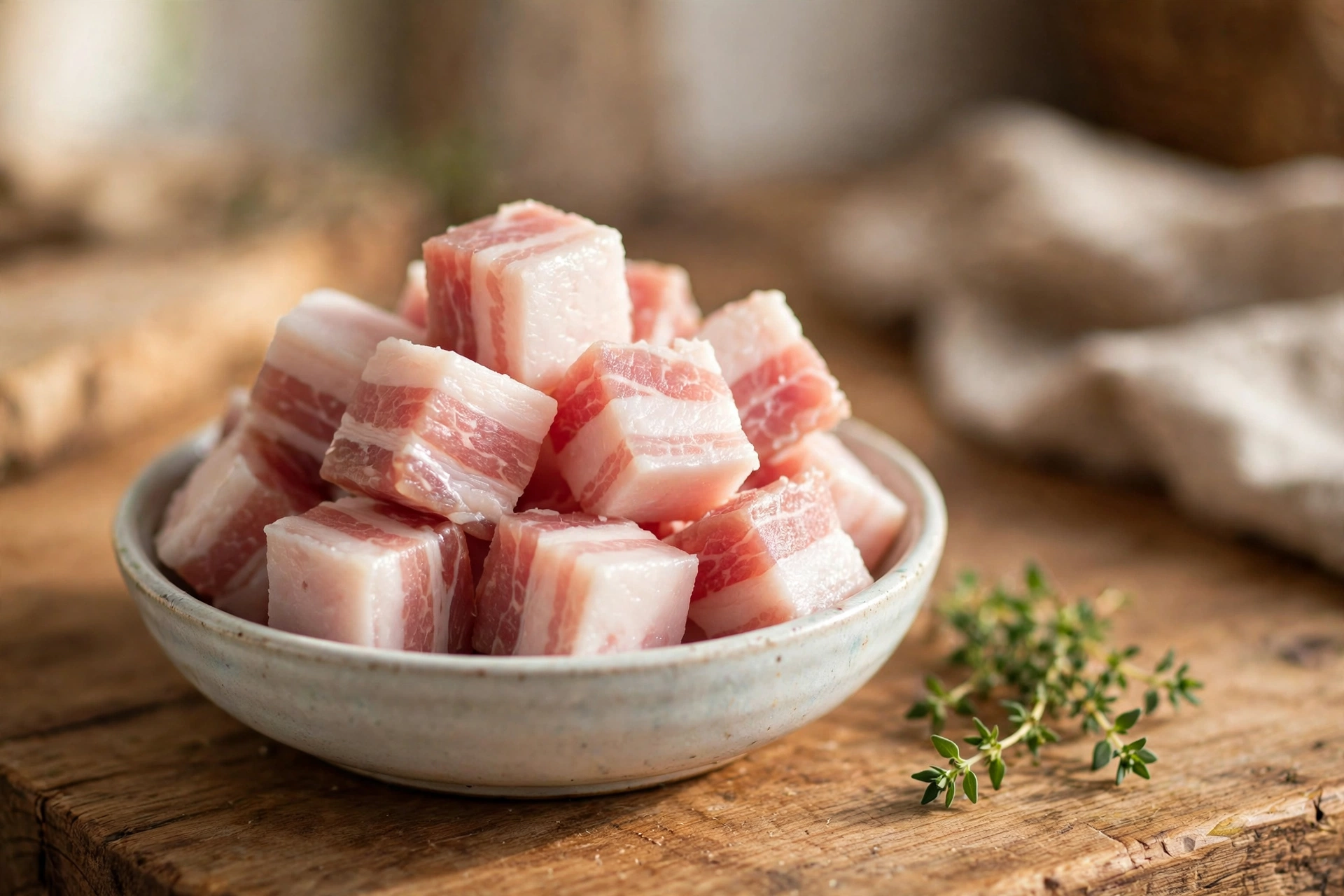
Salt pork is the oldest cure in this section: fresh pork — classically the fatty side and belly pieces — packed under a salt cure until the salt has done the preserving. It was the cooking fat and seasoning base of generations of kitchens, diced into beans, greens, and chowders, and it survives because nothing else seasons a pot of beans quite like it. The method below is the traditional dry cure as a university extension service still publishes it, in its game-and-pork preserving bulletin.
Note the shape of the recipe before you start: it is written per 100 pounds of meat, the farm scale the tradition comes from, and its curing ingredient is printed two ways — sodium nitrate or sodium nitrite, in different amounts, because they are different chemicals. Never swap one for the other at the same measure. For a small batch, a prepackaged cure used exactly to its package directions is the practical route, and how to use curing salt safely explains the products. This guide is part of our preservation guides, beside the wet-cured ham from the same tradition.
What You Need
Fresh pork side or belly pieces, weighed. The dry cure, per 100 pounds of meat: 6 pounds of salt, 3 pounds of sugar, and 3 ounces of sodium nitrate or 1 ounce of sodium nitrite. A flat surface or shelf in a cold space that holds 38°F, room for the meat to sit uncovered, and the patience the schedule below requires — this cure is measured in weeks.

Morton Canning and Pickling Salt, 4 lb
Salt is the cure's foundation — 6 pounds per 100 pounds of meat in the extension recipe — and this is the plain, additive-free salt for it.
$2.68 from Amazon
Etekcity Digital Kitchen Scale
The cure is written per 100 pounds of meat and its time per pound, so the pieces are weighed before the first rubbing.
$9.99 from Amazon
Mrs. Wages Pickling and Canning Salt
A second additive-free pickling salt in a resealable pouch, for the next cure on the shelf.
$19.32 from AmazonBefore You Start
Temperature governs everything here. The meat cures at 38°F, and the publication warns that curing action stops when the temperature inside the meat gets below 34°F — a cure in a too-cold space is a cure that is not happening, whatever the calendar says. Rub the cure well over all the meat, especially around any bones and joints, where the publication directs extra attention. And keep the meat uncovered on a flat surface, as the method specifies, so moisture can leave rather than pool.
How to Make Salt Pork, Step by Step
- Mix the dry cure. For 100 pounds of meat: 6 pounds of salt, 3 pounds of sugar, and 3 ounces of sodium nitrate or 1 ounce of sodium nitrite. Mix thoroughly.
- First rubbing. Rub one-third of the mix over the entire surface of the meat, working it around bones and joints.
- Set it at 38°F. Place the meat on a flat surface, uncovered, at 38°F.
- Second rubbing, day seven. Apply the second third of the mix on the seventh day.
- Third rubbing, day fourteen. Apply the final third on the fourteenth day.
- Hold for the full cure. Keep the meat at 38°F for two days per pound of meat — approximately four to six weeks for a leg-sized piece, by the publication’s own example.
- Use or store cold. The finished salt pork is a cooking ingredient: refrigerate or freeze it in recipe-size pieces, and cook it as part of the dish it seasons.
The Numbers: Cure per 100 Pounds, and the Calendar
| Item | Amount or figure |
|---|---|
| Salt, per 100 lb of meat | 6 pounds |
| Sugar, per 100 lb of meat | 3 pounds |
| Sodium nitrate, per 100 lb of meat | 3 ounces |
| Or sodium nitrite, per 100 lb of meat | 1 ounce |
| Application schedule | ⅓ of the mix on day 1, ⅓ on day 7, ⅓ on day 14 |
| Curing temperature | 38°F |
| Curing time | Two days per pound of meat (approximately four to six weeks) |
| Curing stops below | 34°F inside the meat |
Salt pork is portioned small and used a few ounces at a time — the freezer packs that suit it best are sealed tight and flat. Two tools for that portioning:

Nesco VS-12 Vacuum Sealer
Salt pork freezes in recipe-size sealed packs — a few ounces per bag, ready to dice into beans and greens.
$108.18 from Amazon
Ziploc Freezer Quart Bags
Quart freezer bags for the small portions this ingredient is actually used in, frozen flat and stacked.
$26.48 from AmazonCommon Mistakes
Swapping nitrate for nitrite measure-for-measure. The recipe prints 3 ounces of sodium nitrate or 1 ounce of sodium nitrite per 100 pounds. They are alternatives at different amounts, not equivalents.
Curing too cold. Below 34°F inside the meat, curing action stops. A cure in an unheated winter space that dips under that line is stalled, not finished.
Dumping the whole cure on day one. The method is three rubbings across fourteen days. The schedule is the recipe.
Covering the meat. The publication specifies a flat surface, uncovered. Trapped moisture works against the dry cure.
Scaling the cure by eye for a small piece. The figures are per 100 pounds. For a single belly, use a prepackaged cure to its package directions instead of doing mental arithmetic on a curing chemical.
Storage and Shelf Life
Keep finished salt pork refrigerated or frozen in recipe-size pieces. Mississippi State University Extension’s rule for products that are not completely dry cured and aged is the safe household default: package them in airtight materials and freeze them, and products cured for a shorter time should be refrigerated during curing and frozen immediately after processing. Salt pork earns its keep from the freezer, a few ounces at a time.
Viewers also searched for these items.

ePackageSupply 5-Gallon Buckets, 3-Pack
Food-grade buckets for cure-day mixing and for holding salt and sugar in sealed, stackable storage.
$73.99 from Amazon
ThermoPro TP49 Hygrometer
A hygrometer for the cold curing space, so the room the meat cures in is a measured place, not a guessed one.
$8.54 from Amazon
Hoosier Hill Farm Prague Powder No. 1
Prague Powder #1 for the modern Cure #1 recipes in this section — a different, measured product, used only where a recipe names it.
$18.99 from AmazonFrequently Asked Questions
What cut is salt pork made from?
Traditionally the fatty side and belly pieces of the pig — the same side meat this extension dry cure was published for, rubbed and held at 38°F until the cure has worked through.
How long does salt pork cure?
Two days per pound of meat at 38°F — the publication’s example runs approximately four to six weeks for a leg-sized piece — with the cure applied in thirds on days 1, 7, and 14.
Can I use just salt, with no nitrate or nitrite?
The published recipe includes one or the other, in the amounts printed. Plain-salt versions exist in older tradition, but they are not this tested recipe, and this page does not rewrite it.
How is salt pork eaten?
As a seasoning ingredient, cooked into the dish — diced and rendered into beans, greens, soups, and chowders — rather than as a standalone meat.
Method and figures: North Dakota State University Extension, “Wild Side of the Menu No. 3: Preservation of Game Meats and Fish,” FN155 (reviewed August 2022). Storage rule: Mississippi State University Extension, “Curing Pork Products at Home,” via via the North Dakota State University Extension (FN155, PDF).
Prices shown on this page were last checked November 26, 2026 — prices change; check before you buy.
Talk it over with other readers
The Truly Preserved Community on Facebook is where readers compare notes on food storage, water, and backup power — and where your questions help decide what we research next.