
Truly Preserved is reader-supported. If you buy through a link on this page we may earn a commission at no extra cost to you. Nobody pays for placement or scores.
THE SHORT ANSWER
Small spaces change the containers, not the rules. The CDC’s amount still applies — at least 1 gallon per person, per day for 3 days, and a 2-week supply if possible — and so do its conditions: food-grade containers with tight covers, labeled “drinking water” with the storage date, kept at 50°F –70°F away from direct sunlight and toxic substances, and replaced every six months. What an apartment changes is the geometry: several small, narrow-necked containers spread across a closet floor, under a bed, and behind a door add up to the same gallons a drum holds in one corner. Every figure on this page comes from the federal guidance credited at the bottom.
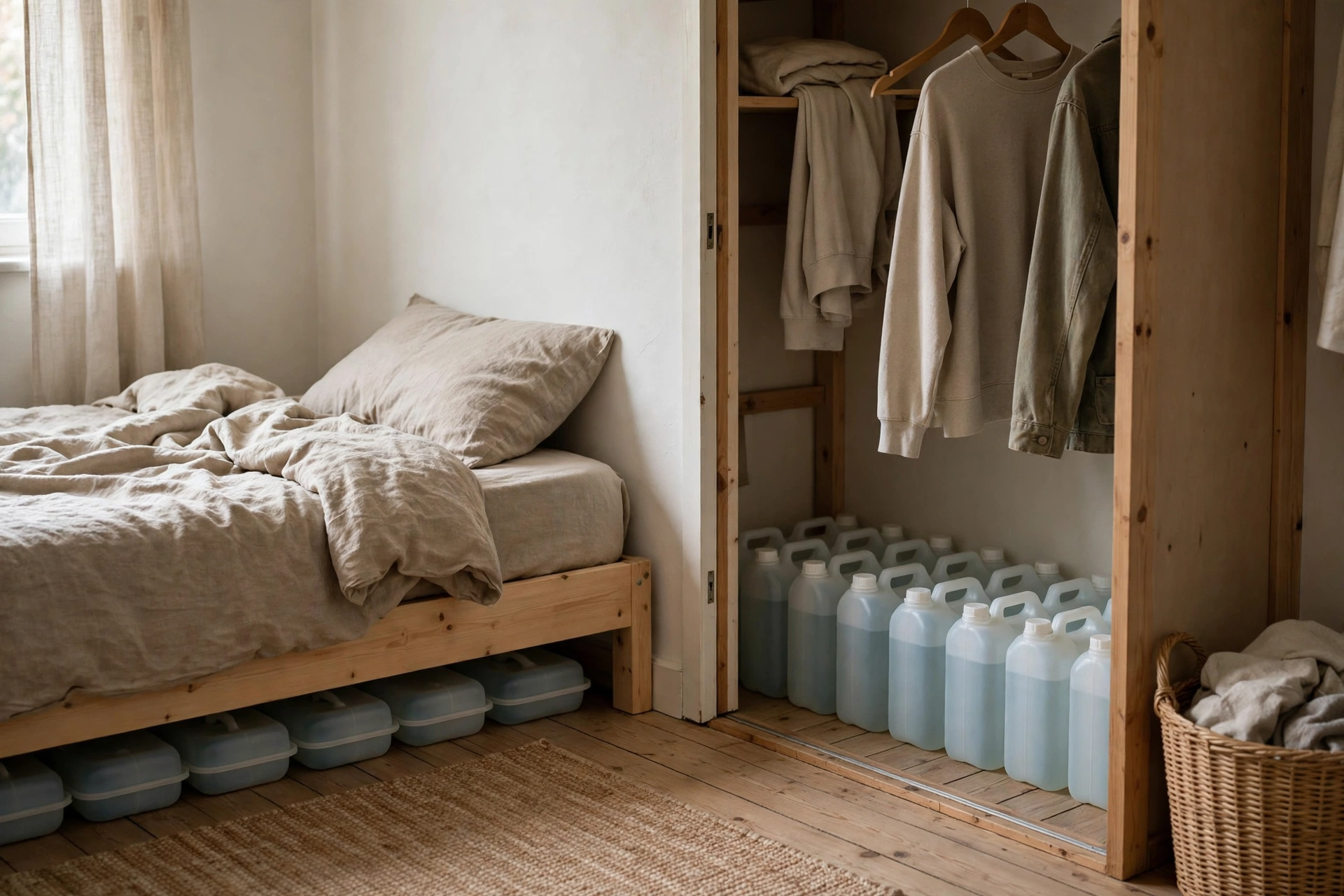
Ask an apartment dweller about emergency water and the answer is usually a shrug at the floor plan: there is no garage, no basement, no corner for a drum. But the federal amount was never written for houses with garages. Three days for one person is 3 gallons — a row of containers that fits under most beds — and even the two-week ambition is a set of small vessels in dead spaces, not one large one in a room you do not have.
This guide applies the CDC’s container and storage rules to small footprints, container by container. This guide is part of our preservation guides; run your household total first with how much water to store, then come back here to place it.
What You Need
The CDC’s container guidance reads like it was written for apartments. Best is an FDA-approved food-grade water storage container; failing that, choose a container with a top that can be closed tightly, made of durable, unbreakable materials (not glass), with a narrow neck or opening if possible so you can pour from it. Never use a container that held toxic chemicals such as bleach or pesticides. Small, narrow-necked, unbreakable containers are exactly what fits under beds and in closet corners — the guidance and the floor plan agree.

Reliance Aqua-Tainer, 7 Gallon
A 7-gallon rigid container with a spigot fits a closet floor and covers one person for a week at the CDC rate.
Check Availability
Saratoga Farms 5-Gallon Water Containers
Stackable 5-gallon containers turn a vertical closet corner into two weeks of water for one person.
$318.79 from Amazon
ePackageSupply 5-Gallon Buckets, 3-Pack
Sealed 5-gallon buckets slide under beds and behind doors, distributing the supply across dead spaces.
$73.99 from AmazonBefore You Start
Two apartment temptations to refuse at the start. Glass is out: the CDC’s fallback test says unbreakable, not glass, and a small space puts containers where they get knocked. And the balcony is out as a storage place: the conditions are 50°F –70°F and away from direct sunlight, and an exposed balcony promises neither. Inside the living space — closets, under-bed, a kitchen cabinet’s back row — is where the temperature rule can actually be kept.
How to Store Water in Small Spaces, Step by Step
- Run your total first. At least 1 gallon per person, per day for 3 days is the floor; a 2-week supply is the CDC’s stated ambition. One person: 3 gallons to start, 14 at the full aim. Two people: 6, then 28.
- Choose small containers that pass the CDC tests. Food-grade where you can; otherwise tight-closing tops, durable unbreakable material, and a narrow neck if possible. Several small containers beat one large one here because they fit the spaces that exist.
- Wash and sanitize every container. Wash with soap and rinse completely. Sanitize with 1 teaspoon of unscented liquid household chlorine bleach in 1 quart (4 cups) of water: cover tightly, shake so it touches all inside surfaces, wait at least 30 seconds, pour it out, and air-dry.
- Fill, seal, and label each one. Pour clean water into the sanitized container, cover with a tight lid, and label it “drinking water” with the storage date. In a spread-out supply, the label on every container is what keeps rotation possible.
- Place them inside the temperature rule. Distribute the containers through cool interior spaces — closet floors, under the bed, cabinet backs — anywhere that holds 50°F –70°F, out of direct sunlight, and away from toxic substances such as gasoline or pesticides. Cleaning chemicals under the sink count: do not store drinking water against them.
- Rotate on the same six months. Replace the water in home-filled containers every six months, container by container, oldest date first. A distributed supply rotates in small batches, which is the one way an apartment system is easier than a drum.
The Numbers: Totals Against Container Sizes
The CDC total, in the container sizes an apartment actually holds. Container capacities are the products’ own; the totals are the CDC’s.
| Household and span | CDC total | In 7-gallon containers | In 5-gallon containers |
|---|---|---|---|
| 1 person, 3 days | 3 gallons | 1 (part-filled) | 1 (part-filled) |
| 1 person, 2 weeks | 14 gallons | 2 | 3 |
| 2 people, 3 days | 6 gallons | 1 | 2 |
| 2 people, 2 weeks | 28 gallons | 4 | 6 |
| Storage rule | CDC figure |
|---|---|
| Temperature | 50°F –70°F |
| Replacement, home-filled | Every six months |
| Sanitizing solution | 1 teaspoon bleach in 1 quart (4 cups) water; wait at least 30 seconds |
The table’s quiet lesson: the 3-day floor for a small household is one or two containers. The two-week column is where distribution matters — four to six vessels, none of them large, each in a different dead space.
A small-space supply pairs naturally with a bathtub bladder for surge and a compact filter for treatment — the methods in our guide to how to purify water in an emergency — capacity you store flat and capability you store in a drawer.

waterBOB Bathtub Water Bladder, 100 Gallon
A bathtub bladder stores flat in a drawer and becomes 100 gallons of surge capacity only when a warning arrives.
Check Availability
Sawyer Squeeze Water Filtration System
A squeeze filter takes almost no shelf space and covers treatment when the stored total runs out.
Check AvailabilityThe mental shift that makes apartment storage work is to stop looking for a water closet and start counting dead spaces. Every small home has them: the flat acreage under a bed, the back strip of a kitchen cabinet where the seldom-used pans live, the floor of the linen closet, the square behind a door that never fully opens. The CDC’s total for one person — 3 gallons at the floor, 14 at the ambition — spreads across those spaces as a container here and two containers there, none of them large enough to need a room of their own. Distribution has a second virtue beyond fit: no single leak, knock, or failed lid can take the whole supply, and rotation can proceed a container or two at a time on an ordinary evening instead of as a weekend project. What distribution demands in return is discipline about the label. In one closet, memory might serve; across six hiding places, only the written date on each container keeps the six-month rule real. Write it large, face it outward, and the apartment system runs itself on the same federal rules as any basement drum.
Common Mistakes
Storing water on the balcony or by a sunny window. Direct sunlight and heat are both against the CDC conditions. A container that bakes all summer has not been stored at 50°F –70°F, whatever its date says.
Using glass bottles because they fit the shelf. The CDC’s container test says durable and unbreakable, not glass. In a small home, containers live where they get bumped; glass fails the test and then fails physically.
Keeping jugs under the sink with the cleaners. The CDC says to keep containers away from toxic substances such as gasoline or pesticides. The under-sink chemical cabinet is the apartment version of the garage fuel shelf.
One big container wedged in a hallway. Beyond blocking the hall, a single large container concentrates the whole supply in one failure. The CDC’s rules are per-container; several labeled containers rotate and survive better.
Skipping labels because “it’s all the same batch.” Six months from now it will not be one batch, because rotation replaces containers a few at a time. The date on each container is the system.
Storage and Shelf Life
Between rotations, small containers ask for the CDC’s handling care in miniature: when you take water out, use a clean scoop or device each time, and do not touch the water or the insides of the container with your hands. Store-bought bottled water is the other apartment-friendly form — the CDC calls unopened, commercially bottled water the safest and most reliable emergency source — and it follows its printed expiration date rather than the six-month rule.
Frequently Asked Questions
How much water does one person in an apartment really need to find room for?
The CDC floor is 3 gallons for 3 days, and the stated ambition is 14 gallons for 2 weeks, at 1 gallon per person per day. Three gallons is one modest container; fourteen is a distributed set.
Can I store water under the bed?
The CDC’s rules are about conditions, not rooms: 50°F –70°F, away from direct sunlight, away from toxic substances, in a labeled food-grade container with a tight cover. An under-bed space inside the home can meet those conditions where a balcony cannot.
Are reused soda bottles acceptable?
The CDC’s tests for a non-food-grade container are a tight-closing top, durable unbreakable material, and a narrow neck if possible — and never a container that held toxic chemicals. Judge any reused bottle against those printed tests and the manufacturer’s guidance.
How do I rotate six containers in different rooms?
By the labels: every container carries its storage date, and every six months the home-filled ones are replaced, oldest first. Our rotation guide walks the sequence.
Storage figures and container rules: CDC, “How to Create an Emergency Water Supply,” with Ready.gov, “Water”, via Centers for Disease Control and Prevention.
Prices shown on this page were last checked November 26, 2026 — prices change; check before you buy.
Talk it over with other readers
The Truly Preserved Community on Facebook is where readers compare notes on food storage, water, and backup power — and where your questions help decide what we research next.