
Truly Preserved is reader-supported. If you buy through a link on this page we may earn a commission at no extra cost to you. Nobody pays for placement or scores.
THE SHORT ANSWER
Vacuum sealing is a packaging step, not a preservation method: Utah State University Extension is explicit that vacuum packaging can increase the shelf life of some foods, but food that required refrigeration or freezing before vacuum sealing must still be kept refrigerated or frozen — and removing oxygen increases the ability of botulism bacteria to grow, which is why sealed meat goes straight into a freezer at 0°F and stays there. The federal Cold Food Storage Chart then sets the quality clock: steaks 6 to 12 months in the freezer, roasts 4 to 12 months, chops 4 to 6 months, ground meat 3 to 4 months, whole poultry 1 year, and poultry pieces 9 months. Freezing at 0°F keeps food safe indefinitely; those months are for quality. Every figure on this page comes from the credited sources at the bottom.
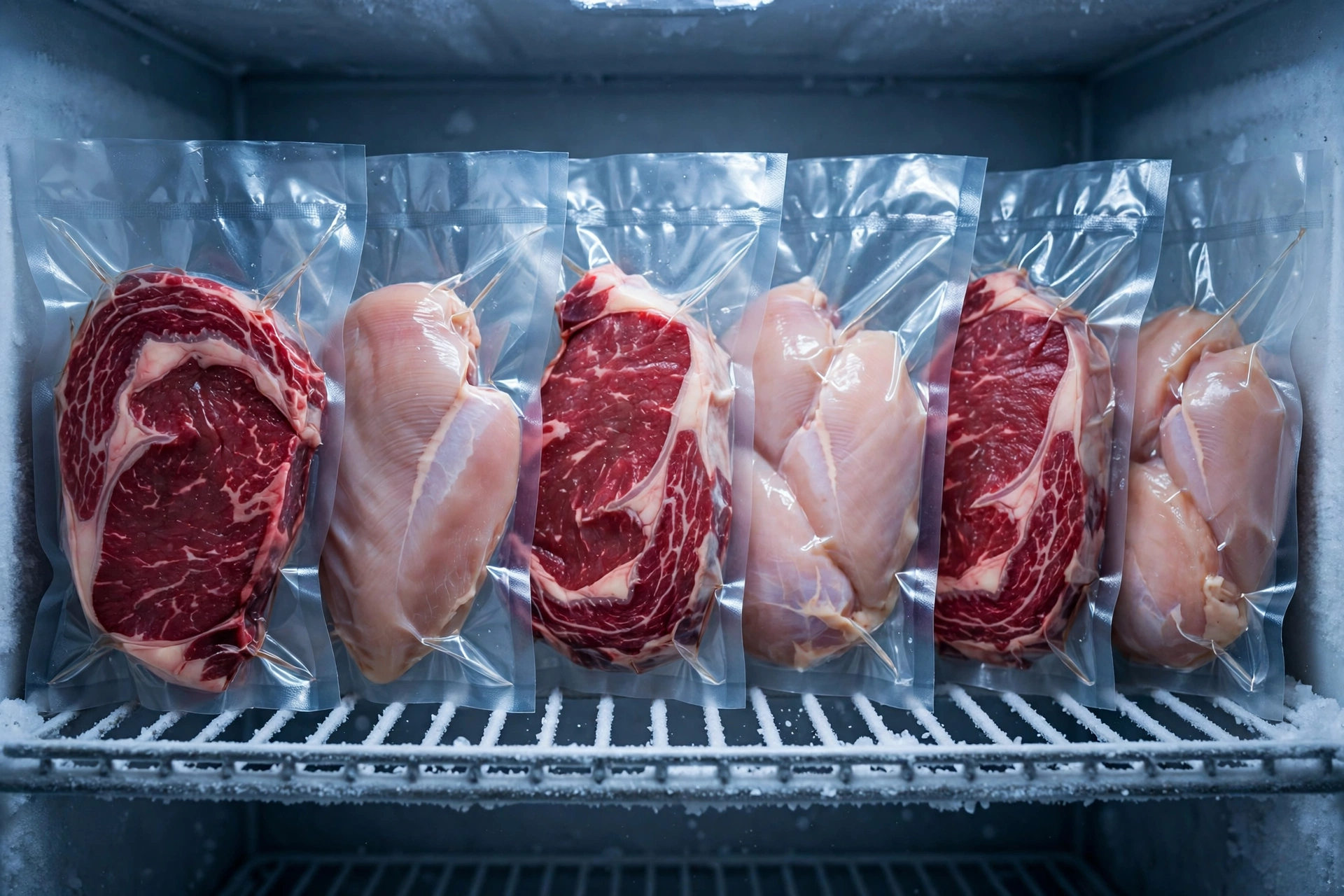
Vacuum sealing is the one method in this category that works on wet food, and it works by a different logic than the dry shelf. There is no drying and no absorber: the machine pulls the air out of a pouch, seals it, and the freezer does the preserving. What the vacuum buys is quality — no air against the meat means far less freezer burn and slower flavor loss, so a sealed steak has a real chance of reaching the top of its chart range instead of the bottom. What it does not buy is safety at room temperature, and the extension warning on that point is the most important sentence in this guide.
This guide follows Utah State’s vacuum-packaging guidance and the federal cold storage chart exactly. It is the freezer half of this category; the dry half starts with our flagship, how to store flour long-term. This guide is part of our preservation guides covering both halves of the stored pantry.
What You Need
Fresh meat or poultry, a vacuum sealer, and pouches or rolls rated for the freezer. The federal chart adds one packaging rule of its own: if you freeze meat and poultry in its original store package for longer than 2 months, overwrap the package with airtight heavy-duty foil, plastic wrap, or freezer paper, or place the package inside a plastic bag — which is another way of saying store wrap alone is not freezer packaging. A marker for dates is the last tool: every chart time on this page runs from the day the meat goes into the freezer, and an undated pouch has no clock at all.

FoodSaver Elite Vacuum Sealer
A countertop vacuum sealer is the machine the whole method runs on, drawing the air out and fusing the seam in one cycle for steaks, chops, and portions.
$218.56 from Amazon
Nesco VS-12 Vacuum Sealer
A second well-regarded sealer with strong suction covers households sealing ground meat in flat pouches week after week without overheating.
$108.18 from Amazon
Ziploc Freezer Quart Bags
Heavy freezer bags answer the chart's overwrap rule for anything frozen in its store package past 2 months, and hold odd cuts a pouch roll cannot.
$26.48 from AmazonBefore You Start
Utah State’s vacuum-packaging warning, in its own terms: vacuum packaging is NOT a food preservation method by itself. If the food required refrigeration or freezing before vacuum sealing, it must still be kept refrigerated or frozen. In fact, vacuum packaging will increase the ability of the botulism bacteria to grow by removing oxygen. Two working rules follow. First, seal and freeze promptly — the refrigerator times on the chart below (3 to 5 days for steaks, chops, and roasts; 1 to 2 days for ground meat and poultry) are the outer limit for meat waiting to be sealed, not a target. Second, thaw sealed meat in the refrigerator and open the pouch when you thaw it, so the low-oxygen environment ends when the cold does.
How to Vacuum Seal Meat for the Freezer, Step by Step
- Start cold and fresh. Seal meat well inside its refrigerator window — 3 to 5 days for steaks, chops, and roasts, 1 to 2 days for ground meat and fresh poultry.
- Portion before you seal. Pack the amount one meal uses. A pouch is opened once; portions sized to a meal mean nothing thawed goes back.
- Keep the seal area dry. Meat juices pulled into the seam weaken it. Leave headroom at the top of the pouch and blot the inside edge where the seal will form.
- Vacuum and seal. Run the machine’s full cycle so the pouch draws down tight against the meat, and check the seam is fused across its full width with no channels.
- Flatten ground meat pouches. A flat pouch freezes faster, stacks tighter, and thaws quicker than a lump — the practical step that makes ground meat, with its short 3 to 4 month clock, easy to rotate.
- Label with the date and the cut. The chart times run from freezing day, and a steak at month ten is a different decision than a steak at month two.
- Freeze at 0°F and keep it there. The chart’s freezer column assumes 0°F or below, held constantly. That is the condition the quality months are printed for.
The Numbers: Freezer Storage Times
From the federal Cold Food Storage Chart (FoodSafety.gov / FDA), refrigerator at 40°F or below, freezer at 0°F or below. Because freezing keeps food safe indefinitely, these times are for quality only.
| Food | Refrigerator (40°F or below) | Freezer (0°F or below) |
|---|---|---|
| Steaks (beef, veal, lamb, pork) | 3 to 5 days | 6 to 12 months |
| Chops (beef, veal, lamb, pork) | 3 to 5 days | 4 to 6 months |
| Roasts (beef, veal, lamb, pork) | 3 to 5 days | 4 to 12 months |
| Hamburger and other ground meats | 1 to 2 days | 3 to 4 months |
| Sausage, raw | 1 to 2 days | 1 to 2 months |
| Bacon | 7 days | 1 month |
| Fresh poultry, whole chicken or turkey | 1 to 2 days | 1 year |
| Fresh poultry, pieces | 1 to 2 days | 9 months |
| Cooked meat and meat dishes | 3 to 4 days | 2 to 3 months |
And the chart’s packaging rule, printed with it: meat frozen in its original package for longer than 2 months gets overwrapped airtight, or bagged — store wrap alone is not enough.
Whole birds and bulk buys ask more of a machine than a countertop sealer gives. These are the heavier tools the other half of the freezer runs on.

VacMaster VP215 Chamber Vacuum Sealer
A chamber vacuum sealer is the step up for bulk meat days — whole birds and quartered animals — sealing pouches a countertop machine struggles with.
Check Availability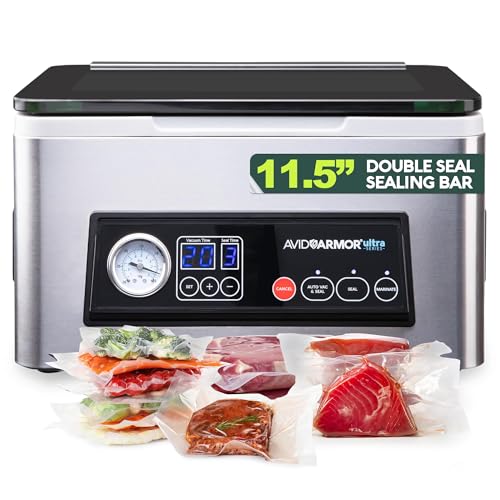
Avid Armor USV20 Chamber Vacuum Sealer
A second chamber sealer option covers the heavy end of the job, for households breaking down a whole animal or a quarter beef at once.
$349.00 from AmazonCommon Mistakes
Treating the vacuum seal as preservation. It is the mistake Utah State writes its warning about. Sealed meat left at room temperature, or kept in the refrigerator past its chart days because it “looks sealed,” is in more danger, not less — removing oxygen increases the ability of botulism bacteria to grow.
Freezing in the store tray. The chart’s own instruction: original packaging frozen longer than 2 months needs an airtight overwrap. Thin store wrap lets air in, and air against frozen meat is freezer burn on a schedule.
Sealing a wet seam. Juice in the seal channel leaves a leak too small to see and big enough to refill the pouch with air over weeks in the freezer. A dry seal area is the difference between the top and bottom of the chart range.
Skipping the date. Every time on the chart is counted from freezing. An undated pouch forces a guess at exactly the moment the chart was meant to replace one.
Thawing sealed meat on the counter. The low-oxygen pouch and a warm counter are the combination the extension warning describes. Thaw in the refrigerator, and open the pouch as it thaws.
Storage and Shelf Life
Hold the freezer at 0°F or below, constantly — the chart’s premise is that food stored constantly at 0°F is safe indefinitely, and the months in the table are quality limits, not safety deadlines. Rotate by the dates you wrote: ground meat and sausage, with the shortest clocks, live at the front; roasts and whole poultry, with the longest, can sit at the back. When a pouch comes out, judge it by the refrigerator column after thawing — cooked meat dishes keep 3 to 4 days refrigerated, and leftovers freeze again at 2 to 3 months on the chart. A pouch that has lost its vacuum has lost its quality protection, not its safety, provided it stayed frozen; cook it first and do not re-seal it for another long stay.
Viewers also searched for these items.

ThermoPro Instant-Read Thermometer
An instant-read thermometer checks that thawed, cooked meat reaches a safe temperature, closing the loop the storage chart starts.
$8.99 from Amazon
Etekcity Digital Kitchen Scale
Portioning by weight before sealing makes every pouch a known meal size, which is what makes date rotation by the chart practical.
$9.99 from Amazon
Hoosier Hill Farm Prague Powder No. 1
Curing salt is the adjacent freezer craft: the measured cure for bacon and sausage you make before it is portioned, sealed, and frozen.
$18.99 from AmazonFrequently Asked Questions
Does vacuum sealing make meat last longer than the chart?
The chart prints one range per food, and good packaging is how meat reaches the top of its range — the federal guidance’s own overwrap rule shows packaging is part of the figure. This page prints the chart as published rather than inventing a separate vacuum-sealed chart, because no source used here publishes one.
Is frozen meat safe after the months on the chart?
Yes, on the chart’s own terms: because freezing at 0°F keeps food safe indefinitely, the recommended storage times are for quality only. Past the range, expect dryness and flavor loss, not a safety deadline.
Can I vacuum seal meat and keep it in the refrigerator?
Only within the refrigerator times on the chart — 3 to 5 days for steaks, chops, and roasts, 1 to 2 days for ground meat and poultry. Utah State’s rule controls: food that required refrigeration before sealing still requires it after, and the seal extends no refrigerator clock.
What about fish?
The sources used here center on meat and poultry. The same federal chart family rates fish separately, and no fish figure is printed on this page rather than borrowed from a chart this guide did not work from.
Vacuum-packaging guidance: Utah State University Extension, “Packaging Foods”; storage times: FDA / FoodSafety.gov, “Cold Food Storage Chart,” via FoodSafety.gov.
Prices shown on this page were last checked November 26, 2026 — prices change; check before you buy.
Talk it over with other readers
The Truly Preserved Community on Facebook is where readers compare notes on food storage, water, and backup power — and where your questions help decide what we research next.